The year 1968 was the most important in the ten years of American involvement in Vietnam. It is also among the most important in the two hundred years of American history. These two facts are connected. Major events in Vietnam were to have a lasting effect on American history and major events in the United States were to have a similar effect on the struggle in Southeast Asia. By the end of the year America was as ruined emotionally as Vietnam was physically. One of the major American political figures of the century was out of office and another had made a comeback. Two other important Americans were dead from violence and, though very few knew it yet, hundreds of Vietnamese villagers had been deliberately slaughtered by American soldiers.
In order to clearly see what went on in 1968 we should go back a few months.
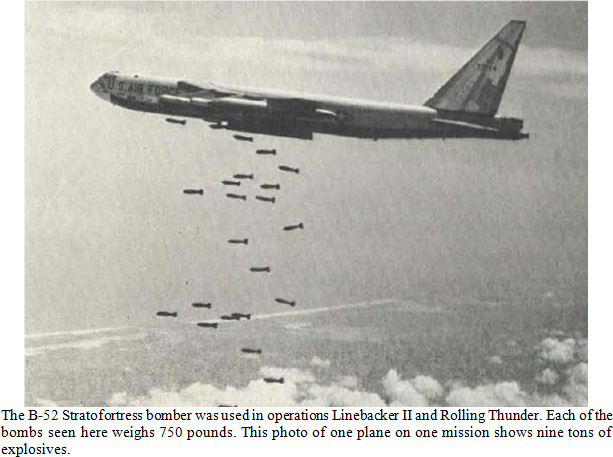
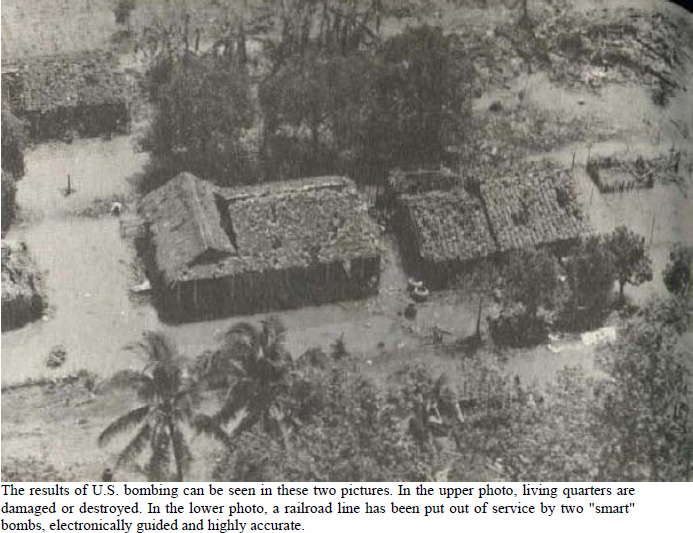
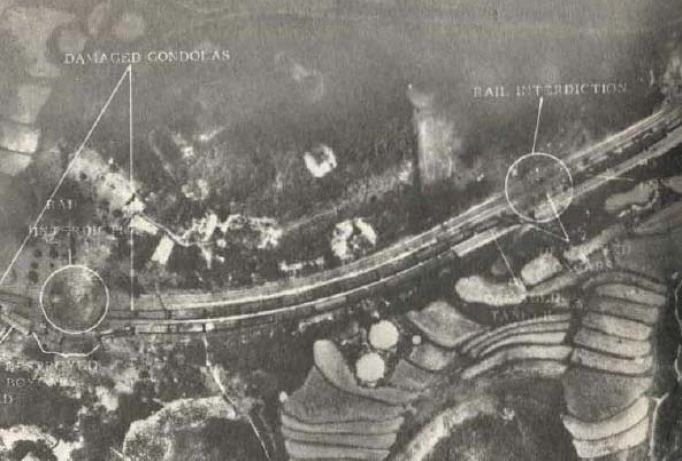
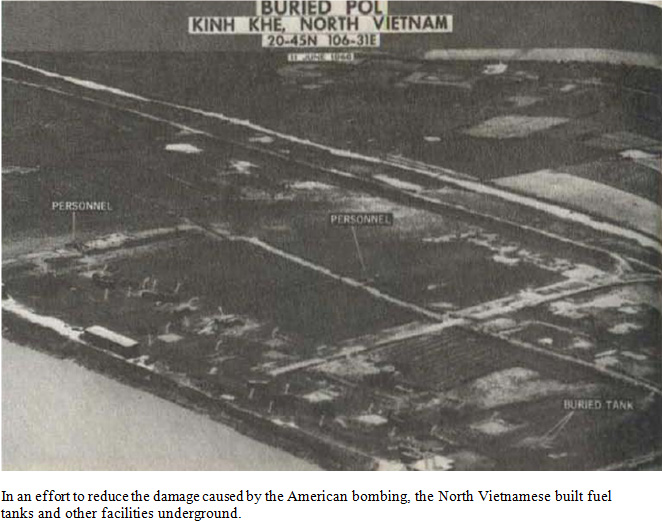
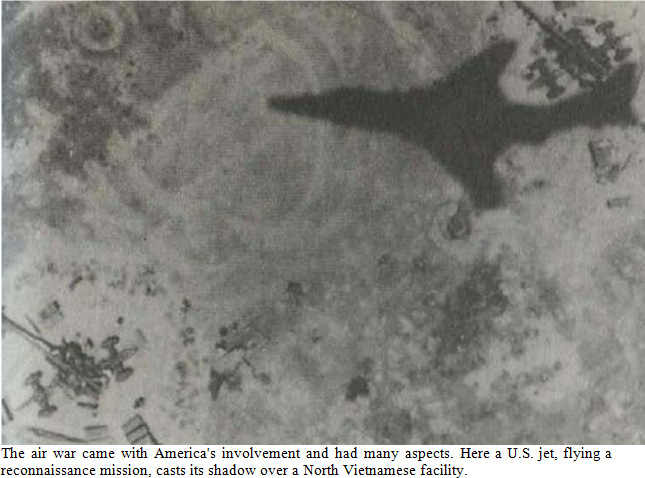
By the middle of 1967, it was clear to some, at least, that the bombings were not having much effect. You recall that the original guess had been that the North Vietnamese would seek peace within six months. More than two years of bombing had taken place, but no change in the North Vietnamese position was seen. So the long-range goal of the bombing-peace negotiations-had not been reached. Neither had the short-term goal-reduction of supplies to the antigovernment forces in the south.
Many of these supplies came down from the north along what was known as the Ho Chi Minh Trail. This was a network of roads along the Laotian side of the Vietnam-Laos border. The bombing targeted the main roadway, which was some three thousand miles long, but with its side paths and detours, the trail itself was actually over eight thousand miles of roads. To keep their forces in the south supplied, the Vietnamese only needed to move sixty tons of material every day along this network. Twenty small trucks would do the job.
It is easy to see that the chances of spotting and bombing twenty camouflaged trucks among thousands of miles of roadway would not be an easy one. The trucks moved at night and hid in the jungle during the day. Troops coming from the north were also safe from the bombers because they moved in small groups and could easily hide themselves from high-flying airplanes. One could hope to damage the trail so that nothing could move on it, but every night thousands of Vietnamese went out to repair the day’s damage.
There was one old-fashioned way to deal with the problem and one very new one. The old-fashioned way was to send troops to take and hold the Trail, but it was located in Laos, a neutral country, and President Johnson refused to send troops into that country. The more modern approach was soon given the name of “McNamara’s Fence.”
This was a system of microphones, disguised as plants and other natural objects, which were dropped along the trail from planes. These would pick up the sounds of troops or trucks and signal the bombers as to where and when they should attack. But in order to keep the microphones in place, they needed to be surrounded by mines, which would stop their removal. Mine crews came under attack from North Vietnamese troops and the system never really worked.
After the failure of the bombing and the fence, Secretary McNamara apparently became increasingly worried about the war. He sent the president memoranda suggesting that the bombing was a failure and was taking too many innocent lives. Johnson offered to stop the bombing in exchange for peace negotiations. The North Vietnamese refused. In November of 1967, Secretary McNamara resigned.
The American public knew little of what was going on. They knew that there were many American troops in South Vietnam and that bombers were dropping hundreds of tons of explosives every day. They heard of fighting here and there, and they were given the idea that the war was ending. They strongly supported the war in public opinion polls, and while there were demonstrations against the war, there were many rallies in favour of it as well.
The nation as a whole supported the war effort and scorned the protestors. But this support was based on faith, on a trust in the national leadership, and on a belief that the war was not only for a good purpose but that the goal could be reached. The next few months would seriously strain that faith if not break it entirely. When those months were over, more Americans would support the war than would oppose it, but their support was very slight.
It began on January 21, 1968, at a place called Khe Sanh just a few miles south of the line dividing North and South Vietnam and even closer to the Laotian border. A small plateau and a few surrounding hills were held by over five thousand American marines and South Vietnamese troops. It was not a very important place, but it was a place where the North Vietnamese might be drawn into a serious battle. In that way it was much like Dien Bien Phu, but in other ways it was just the opposite. Dien Bien Phu was a valley, and the French lost there because they did not hold the high ground surrounding their troops. At Khe Sanh the Americans and South Vietnamese held the high ground.
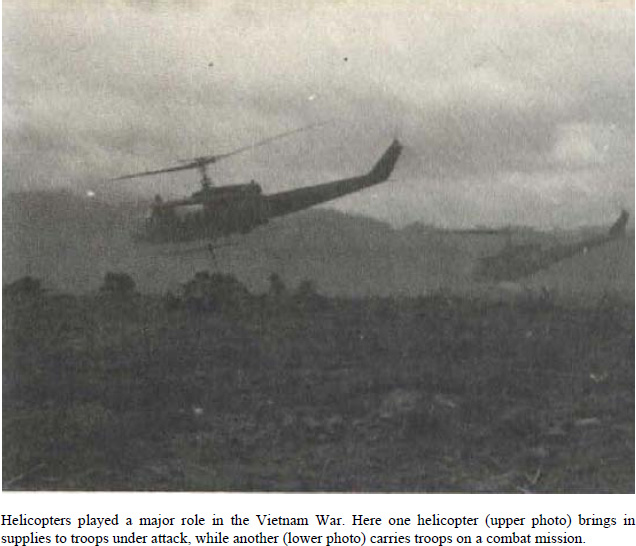
At Dien Bien Phu the French were shocked at the size of the force opposing them. At Khe Sanh the microphones prepared for “McNamara Fence” gave the warning that a large number of North Vietnamese were moving into the area. At Dien Bien Phu, the loss of the airfields had doomed the defenders. At Khe Sanh the airfield was better protected, and even if lost, the troops could still be supplied by helicopter. At Dien Bien Phu the French had little help from the outside. At Khe Sanh the North Vietnamese faced five thousand bombs a day in an area the size of a small town. Imagine ten square miles near where you live, then think about what it would be like if five thousand bombs fell on that area every day.
There was another difference between the two situations-the most important difference of all-television. Khe Sanh was attacked for seventy-seven days and during that time reporters and television crews were brought in and out. Every night the American news programs showed the fighting and showed the fighters. These familiar American faces were set against a strange and foreign background. They were fighting an enemy that the American people believed to be near defeat, and they were in trouble.
Comparisons with the French at Dien Bien Phu were sure to be made. The comparison is almost silly because of the enormous advantages the Americans had over the French, but they were made anyway. The nightly drama began to make many Americans nervous about the war effort. Many were concerned that not enough forces were being committed. Many others began to wonder if further commitment was worthwhile. Then, just ten days after the drama at Khe Sanh had begun, the same news programs showed a far more sudden and far more disturbing event.
Tet is the New Year celebration in Vietnam. It is both a holiday and a holy day. Every year cease-fires had been declared around the time of Tet. This year was no exception. Despite reports of troop movements in South Vietnam, half of the South Vietnamese Army went home for vacation and the general appearance was one of rest.
That rest was broken on January 31, when eighty thousand NLF and North Vietnamese troops began a simultaneous attack on nearly every community of any size in South Vietnam. That night the television news showed marines defending the United States Embassy in Saigon.
How could such a thing have happened in a war that Americans thought was being won?
The “how” was simple and showed the basic weakness of the American military position in Vietnam. Tens of thousands of NLF and North Vietnamese troops put on normal clothes and gathered in communities throughout the South. There they grouped, armed, and changed into uniforms. Then, at a certain time, they attacked their targets. Up until the point that they showed themselves in uniform and armed, there was nothing to stop them.
Their attacks were not successful. In fact, the Tet offensive can be described as a major military defeat. Though two thousand five hundred American troops died during the attacks, many times that number of North Vietnamese forces were killed and no important goal was taken.
While Tet was a great military defeat for the North Vietnamese, it was also a major political victory. At about the same time as the Tet offensive was ending, so was the siege of Khe Sunh. There, too, the Americans and South Vietnamese were victorious, but, after the siege was lifted, the position at Kile Sanh was no longer Important.
Tet and Khe Sanh left Americans with major questions. Could this enemy be defeated? If so, for what purpose? Why fight for a place for eleven weeks when the place had no real importance? How there could be an end to a war where the soldier could disappear into any village at night? These questions were being asked in the middle of a presidential election campaign.
Lyndon Johnson was running again, but despite his enormous victory in 1964, he had strong opposition from inside his own party. Senator Engene McCarthy of Minnesota challenged Johnson on the war issue. McCarthy was an unusual man. A poet and former monk, he gave an impression of complete peace. This made him an odd choice to lead a movement that was as passionate as any in recent years. But McCarthy was effective in getting support from college students, and they formed an important campaign force with ability and with time to spare. On March 12, the first primary election was held, as always, in the state of New Hampshire. McCarthy lost, but only by a small margin, this in New Hampshire, a state as conservative as any in the nation.
The nation was shaken but not as badly as it soon would be. The New York Times soon carried two stories that must have been leaked by someone in the government. The stories said that General Westmoreland had requested two hundred thousand more troops and that Johnson had ordered thirty thousand more Americans to Vietnam. A few days later, Robert F. Kennedy entered the race for the Democratic nomination.
Eugene McCarthy was one thing, but Robert Kennedy was something very different. McCarthy could count on very little support from Democratic party officials. Kennedy, by now a Senator from New York, could count on wide support from such people. He was also popular among working people. At the 1964 Democratic convention, which nominated Lyndon Johnson, Kennedy was supposed to introduce a film on his late brother. Johnson, fearing that people would turn to Kennedy, set the speech for after the nomination. When Kennedy spoke, Johnson’s fears were justified. The clapping lasted for twenty minutes; the feeling probably lasted much longer.
Kennedy’s entry meant that Lyndon Johnson would have to campaign very hard to gain his own party’s nomination while running the nation and fighting a war. On March 31, Johnson spoke to the nation on television. He announced a freeze in the number of troops in Vietnam, a cutback in the bombing and, in a brief and shocking announcement, he told the country that he would no longer be a candidate for renomination.
Four days later the nation received” another shock. Dr. Martin Luther King, civil rights leader and winner of the Nobel Peace prize, was killed by an assassin’s bullet. The nation’s cities broke out in rioting. Dr. King was a symbol of peaceful struggle, and it is terrible to know that he died by violent means and that his death set off a great wave of violence and property destruction.
Just as the Tet offensive ended the idea that the war in Vietnam was ending, so did Dr. King’s death and the idea that the long civil rights struggle at home was nearing its end. The violence of war on the television screens and rioting in the cities of America created great divisions in the nation.
Young and old, black and white, cities and countryside seemed to be split in ways that would not heal. Even the antiwar movement was split. There were those who believed in the normal political processes and those who believed in violence. There were those who saw the movement as a way to end a war that seemed to be against basic American values. Others saw the movement as a way to gain a complete change in American society.
The movement was split, too, by the Kennedy candidacy. Some decided to stay with McCarthy because he had been the first to take a stand. Others switched to Kennedy because they believed he was more able or because they believed he could be elected. Lyndon Johnson’s vice-president, the very respected Hubert Humphrey, also entered the campaign, and the race looked like a close one.
The last major primary was in California on June 6. Kennedy won and seemed to be heading into the August convention as the favourite when, after speaking to his campaign workers, he, like his brother and Dr. King, was killed by a bullet fired from a gun by a fanatic.
The nation mourned its second Kennedy in five years, and the race for the Democratic nomination was a wreck. Whatever strength McCarthy had had, had been lost to Kennedy. Hubert Humphrey had closer ties to the Democratic leaders, and he had the support of Lyndon Johnson, but the antiwar groups were coming to Chicago to make their presence felt.
The Republicans had no such problems. They were to nominate Richard Ni.xon with ease. For the fourth time in sixteen years, Nixon would be on the Republican ticket. Like any Republican candidate, he had almost no chance against a united Democratic Party. The number of Democratic voters in the United States is greater than the Republican, and more independents voted Democratic than Republican in most presidential elections. But Richard Nixon was not to face a united Democratic party. He was to face one that was broken apart, for the convention in Chicago had turned into what a federal commission later called a police riot.
Many antiwar protesters had come to Chicago just to protest against the war. Others had come looking for a fight. Democrats ran Chicago and their leader was Mayor Richard Daley. Daley ran the city as though it were a kingdom. He would not allow a group of long-haired college students to disrupt the Democratic convention in his city.
There were more police and National Guard troops than demonstrators. When the protesters marched toward the convention hall, a bloody battle broke out, which the demonstrators were certain to lose. Hundreds were injured and millions more watched the struggle on television and heard it condemned on the convention floor.
Hubert Humphrey was nominated to lead the Democratic Party in the fall election, but there was almost no Democratic Party to lead. In the three months remaining, Humphrey used his enormous energy to attempt to reunite the party and, in the end, he almost did so.
But it was too late. Richard Nixon had been elected by a whisker-thin margin.
The election of Richard Nixon began a new era in the story of America in Vietnam. The Johnson Administration had seemed close to deciding that Vietnam was not the place to fight the war that was being fought. As early as March of 1968, the last Johnson Secretary of Defense, Clark Clifford, had suggested that American troops be withdrawn. The new administration was to adopt a policy of Vietnamization-turning the war over to the Vietnamese. But before that new policy could begin, an event that had taken place in March of 1968 came to light. It happened in the small village that was called, on American maps, My Lai (4).
On March 16, 1968, soliders of the First Battalion of Twentieth Infantry entered the hamlet of My Lai, rounded up the old men, women and children and killed them. The soldiers were not being fired on nor was there any apparent danger from the people of the hamlet.
There was reason to believe that My Lai was a headquarters for NLF forces, and the Americans had been having great deal of trouble lately from that area. But nothing in the rules of war permitted what happened on that day. A report was filed with the Army by Lt. Colonel Frank A. Barker. He claimed that 128 enemy troops were killed and that, among other things, three enemy rifles had been taken. He did not explain how one counts over a hundred dead soldiers and only three rifles, nor did he mention the hundreds of civilian dead. In fact, no one mentioned that fact official1y, though over one hundred American troops were in the hamlet.
In fact, it was not until one year after the event that Ronald Ridenhour wrote letters to the army and to his congressmen demanding an investigation. Ridenhour had not been at My Lai, but he knew several people who had been, and these friends told the story to him separately. Under pressure from Ridenhour’s congressman, Morris Udall of Arizona, the army began a quiet and slow investigation. Months passed, and many of the people involved were due to be released from the army. After that release, they would be safe from criminal charges for the event. But the story did not remain quiet, Seymour Hersh, a reporter for The New York Times, was told about the story by a source in the army and in November of 1969, he ran a full account of the events in that newspaper. Several officers and enlisted men were charged.
The news of the massacre was one more shock to the nation, but in some ways this shock was quite different. By the time that Hersh broke the story, protest against the war had reached new levels. A quarter of a million Americans had marched on Washington that same month. Doubts about the war and the government had become very strong. The official response to My Lai did little to end these doubts. In the end, only Lieutenant William Calley was convicted of serious charges. His jury consisted of officers, most of whom had served in Vietnam. They found his conduct criminal, but at each level of authority above them, including the president, the sentence given to Calley was reduced. In the end he served his brief time in an apartment at a military base.
Calley, a convicted murderer, became a hero to some people. They saw his acts, and those of his colleagues, as a part of war and Calley as a victim of a system that did not understand what he had been through. Others saw him as a scapegoat, a lamb sent to slaughter while the higher officers, who had either ordered the massacre or had failed to report it, escaped conviction. There is more basis for time view than the view of Calley as a hero, for there is nothing to indicate that Calley was other than a willing participant in the murders.
Calley and My Lai presented a strange dilemma. Here was a war in which the enemy looked and dressed just like the rest of the people. Here was a war in which a child might well be carrying a hand grenade. Here was a war in which the deaths of a hundred civilians caused a major scandal and in which it was barely noticed that tens of thousands of civilians (Secretary McNamara estimated one hundred eighty-two thousand) were killed by bombs dropped by invisible planes flying miles above their invisible targets. Right and wrong were not black and white in this war; they were similar shades of gray.
The American people, whether they felt that Calley had been done an injustice or not, were not in support of the slaughter of civilians as a normal part of war. A war in which more than a hundred Americans could have known of such an event and said nothing was not the kind of war that the American public was likely to support for long.
The war was doing something wrong to America. It was dividing its people and killing its young and these young were engaged in killing of their own. My Lai did not end the war in Vietnam. But it was one of the events of 1968 that led to an end to support for the war. To fight a war in a democracy you must have the consent of the people. Americans were withdrawing their consent as much because they disagreed with what the war was doing to America as because they disagreed with the war itself.