Indochina is more than Vietnam. It is the other nations of Southeast Asia as well. Much was going on in those lands that was similar to what was happening in Vietnam. The Indochina War is a term that properly includes all of the conflicts in that peninsula during this time. But in this chapter, as elsewhere in this book, we will use the term Indochina to mean French-ruled Vietnam and the Indochina War will refer to the struggle that took place between the French and the Vietnamese between the end of World War II and the surrender of French forces in 1954.
Another term used frequently before will have to change in this chapter because it was no longer (as of the 1940s) an appropriate term. That term is “nationalists.” The word from now on will be “revolutionaries.” The change is for two reasons. First, nationalism was no longer just a political idea, to be talked and written about; it was a revolution, an armed attack against the ruling class.
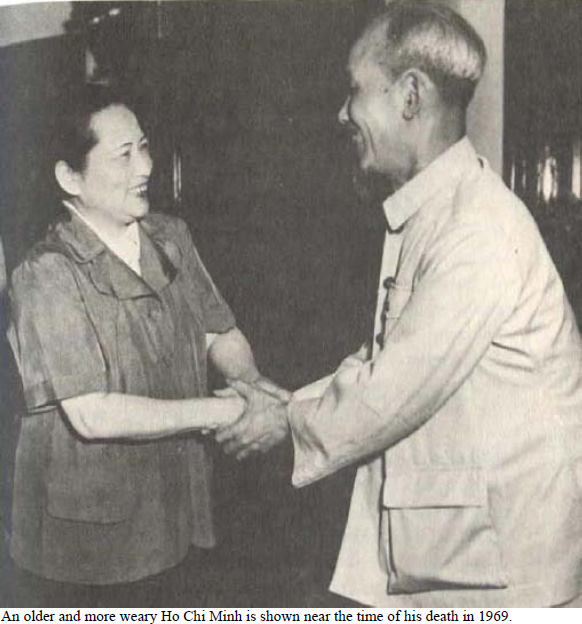
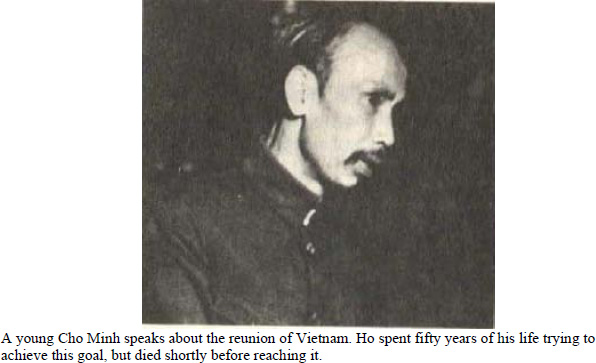
Second, this revolution was led by Ho Chi Minh and his supporters. Ho was a communist. Whether he was a nationalist first and a communist second or just the opposite is a matter of much debate. Indeed, it is one of the unanswered questions mentioned in the introduction. But he was a communist, and the movement that he led, the goal that he hoped to reach, was not just a free and independent Vietnam, but a Vietnam in which the society and economy would be in line with the principles of Marx and Lenin. His would be a “revolutionary” Vietnam.
How many of his followers .wanted something different or did not care if Vietnam was communist or not, so long as it was free, is the subject of another debate that we need not get into. It does not really matter much. The mistakes that were made by Western powers in Vietnam would stil1 be mistakes whether the Viet Minh were more communist or more nationalist. The only difference is that if the Viet Minh were more nationalist than communist, then the Western mistakes were bigger ones.
Bur let us accept what the major powers all accepted. The United States and France accepted Ho as a communist revolutionary. The Chinese and the Russians did also. If they were all wrong, then Ho was a more complicated man than he appeared, and he appeared to be very complicated indeed. With all this in mind, let us return to Southeast Asia.
World War II was a terrible period for the people of Vietnam. In addition to the difficulties imposed by being caught in the middle of a war and being occupied by two nations, it was also a period of great floods that damaged the rice crop. It is estimated that between one and two million Vietnamese died of starvation between 1940 and 1945.
Life was no less difficult to the north in China. The leader of that nation was Chiang Kaishek and he too had two enemies-the Japanese, who had invaded in 1939, and the Communist Chinese under the leadership of Mao Zedong. All three parries struggled to control that great elephant of a nation and struggled against each other. Chiang hardly knew which enemy to fight first. Shortly after Ho Chi Minh’s arrival in China, Chiang had him jailed as a communist.
In 1943, though, Chiang’s American advisors persuaded him to release Ho on the theory that he could be of help against the Japanese in Indochina. Their feeling was that Japan was the immediate enemy and that anyone who would cause trouble for Japan was their friend, for the moment at least. To aid this new ally they also convinced Chiang to supply Ho with $100,000 a month. Ho used these funds to build up the Viet Minh as a military force.
The Americans also used Ho as a source of information about Japanese activities. In light of what was to happen a few years later, this may seem strange. But in 1943, Russia was America’s ally against Nazi Germany, and the fear of communism, which was to be a central fact in American foreign policy in the late 1940s and early 1950s, had not yet become a major factor.
In addition, there was the attitude of Franklin Delano Roosevelt. President Roosevelt felt that European colonialism was a major cause of World War II. He had determined that at the end of the war he would push for independence for the French colonies, particularly Vietnam. But Roosevelt was nothing if not a practical man. As the United States and its allies gained control in both Europe and the Pacific, he began to meet with other allied leaders about the postwar situation.
In those meetings Vietnam was small potatoes. The Russians were moving toward Germany and were taking control of the Eastern European nations. German defeat was certain, but postwar control of Germany was an open question that divided the allies. The fate of a far-off Asian land was not something that a seriously ill Roosevelt was going to fight with his allies about. He needed their support on other matters, and he was not going to waste that support on less important things.
As 1945 came and the war was coming to a close, the Americans had no real policy about Vietnam. Officially the allies supported continuing French rule in Indochina. Unofficially, the American government was taking steps to make a French return to power difficult, and it was clear that the American agents in Vietnam would be just as happy if Ho Chi Minh ended up leading an independent Vietnam at war’s end.
In this they had a strange ally-Japan. A major factor in Japan’s going to war was its desire to establish an Asia ruled by Asians. While they had hoped that those Asians would be Japanese, they also preferred any Asians to continuing European control.
Events came to a head in the spring of 1945. The Japanese had begun to sense defeat, though, since they did not know of the atomic bomb, they must have felt that they had more time than they did. Their German allies were in their last effort and France was free of German control. Japan decided to end the phony French control over Vietnam.
On March 9, the Japanese disarmed and imprisoned the French forces in Vietnam and declared it to be a free nation under the rule of Emperor Baa Dai and under the protection of Japan. The Viet Minh refused to accept the new regime and Ho Chi Minh formed the National Liberation Army.
The United States was not going to send troops to Vietnam to move out the Japanese. America was too busy with its plans to invade Japan for that. But America was very interested in having local forces tie down the Japanese troops in Indochina. The more Japanese troops tied down in Indochina, the fewer would be available in Japan.
In April, Major Archimedes Patti of the Office of Strategic Services (later to become the Central Intelligence Agency) went to northern Vietnam from China and met with Ho Chi Minh. Major Patti was impressed with Ho and began supplying arms to him. Soon a small group of Americans were training Ho’s people and going on joint missions with them against the Japanese.
By August of 1945, the National Liberation Army had established control over the northern parts of Vietnam. When the Japanese surrendered in that month, a group of non-communist nationalists, the United National Front, took control in the south.
What neither of the Vietnamese groups realized was that the Allies had already met and decided the fate of Vietnam. At the Potsdam Conference in July, it had been agreed by America, Britain and Russia that British troops would take over the Japanese territories in Southeast Asia and that, when order was restored, the French colonies would be returned to the French.
Of course, the British troops did not arrive immediately after the Japanese surrender. So, in late August there were three competing leaders of a “free” Vietnam. Ho Chi Minh in the north, the Emperor Bao Dai in the central region, and the United National Front in the south. Bao Dai knew he could not hold power by himself since he was not liked by the people. He chose Ho as the stronger of his two rivals and declared him to be the head of the Democratic Republic of Vietnam.
For the first time in his life Ho Chi Minh entered the city of Hanoi. He established his capital there and announced that while Vietnam was now a free nation, it would retain strong ties with France. But that was not enough for the French. British troops landed in Saigon on September 12, and French troops followed ten days later. Ho’s rule over a free and united Vietnam lasted less than a month.
The French moved quickly to remove Ho’s authority in the south, but they left him alone in the north for a while. Just as in the original French takeover, they brought the south under their control first and dealt with the problems of the Japanese prisoners still in Vietnam.
Ho had his own problems in the north though, for there were two hundred thousand Chinese troops in his region. Faced with the fact that the French would eventually turn north and the fact that the Chinese were already there, Ho made the best deal that he could. He agreed to have fifteen thousand French troops move into the north on the condition that the Chinese would leave. While Ho may have feared the French, he remembered that the Chinese were the oldest and most dangerous enemy of Vietnam.
There began a period of uneasy peace. Though neither side was completely aware of it, the future of Vietnam and the Jives of millions of people were at stake in the discussions that took place during this time.
The discussions seemed to go well. The French accepted the idea of a free Vietnam with close political and business ties to France. They agreed to withdraw their troops by 1952. The Viet Minh, in turn, agreed to stop all military activities against the French. This agreement took place in March of 1946. By June it had been broken, for in that month Frenchmen living in Vietnam had decided that they wanted no part of the deal. They must have realized that an independent Vietnam would mean an end to their large estates and their complete control over business. They wanted a French-owned South Vietnam.
This group of French businessmen declared an independent Republic of Cochinchina. The discussions started again. This time, though, the results were different. The north of Vietnam would be allowed some independence but not complete freedom, and there would be no unified Vietnam.
This agreement was doomed from the start. Signed in September, it was gone before Christmas. How and why the shooting started is not clear. But minor battles soon turned into serious conflicts. The leak in the truce became a flood on December 19, 1946, when the French bombarded the city of Haiphong, killing six thousand Vietnamese.
Ho knew that his new and poorly equipped army could not defeat French troops who had been fighting in Europe for years. So he decided to avoid a major battle until he had the power to win one. He pulled back his troops from Hanoi into the country and waited-for eight years.
The military parts of the Viet Minh were under the control of a former history professor named Vo Nguyen Giap. He and Ho planned a strategy that would annoy the French, keep the idea of rebellion in the minds of the Vietnamese people and would depend on the great strength of the Viet Minh: their knowledge of Vietnam and its people. Over the next three years they put their idea to work. The Viet Minh were armed, trained and sent off into the country.
They existed everywhere in the north, but were no-where to be seen. There were no uniforms, medals or badges. They were just there, attacking the French when and where they least expected it and moving swiftly back into their villages. There was no way to fight them because there was no way to find them. So long as they were better liked in their villages than were the French, they were safe, for no one would tell the French who they were.
For more than four years this “guerrilla” warfare was kept up. The French were not only annoyed, they were spending a lot of money on what was, after all, supposed to be a money-making colony. They longed for the opportunity to fight the Vier Minh out in the open-the type of battle they knew about and believed that they could win. But General Giap held his forces back. He was not going to fight the French on their terms until the moment that he was sure that he could win. That moment would come soon.
Two things took place in early 1950 that made Giap more sure of himself. First, the Chinese Communists had won their own revolution the year before and had recognized Ho Chi Minh’s government as the true government of Vietnam. That meant that just to the north was a powerful and now friendly neighbor who could supply military as well as political aid.
Second, the Korean War had broken out. Korea, a former Japanese colony, had been broken into two parts at the end of World War II. In the spring of 1950, the communist-controlled north invaded the south. The United Nations sided with the south, and large numbers of American and other United Nations troops were involved in the fighting. The Chinese supported the North Koreans with troops as well as arms. The war ended in pretty much a tie. The original borders were kept. In large part the tie was due to American unwillingness to attack China. To Ho and General Giap, the events in Korea must have been very interesting. One conclusion that they could have drawn was that the people of Europe and the United States were not happy about a war that seemed to drag on forever with no clear winner in a land that was far from home and had not even appeared in their school history books.
But another idea that they could have had and probably did not was that the Korean War deeply upset the American people. The communist takeover in China had set off a tide of strong anticommunism in the United States. The lack of victory in Korea was upsetting for a country that had just beaten Germany, Japan and Italy in World War II.
Because of these two facts, elected officials in the United States could not ever seem to give in to communists. But the Viet Minh must not have seen this or, if they did, they went ahead despite it. In 1950, Giap went on the offensive. His first efforts at open battles were not always successful. The French were growing stronger since the United States had started to pour large amounts of money into the French military effort. Starting with $10 million in 1950, American military aid to rose to $1billion by 1954.
Giap started slowly, attacking a small French camp near the Chinese border-Dong Khe. Two hundred French Legionnaires were defeated there in September of 1950. The next month he attacked French forces near Cao Bang. Of the ten thousand French troops, six thousand were killed, wounded or captured.
But by the new year, Giap was not doing so well. Throughout 1951, Giap was defeated several times by French troops, No victory was lasting, though, since the French had to keep to the roads. Their modern military equipment gave them a great advantage in an open battle, but once they had defeated the Viet Minh, their opponents went off into the forests and mountains where French tanks and artillery could not follow them.
At this point the French should have begun to realize that they were caught in what had been properly described as a “quicksand war”--one in which they stepped on what seemed to be solid ground, only to find that they were sinking quickly into the mud.
The French finally reached this conclusion and tried to convince the United States of it. But as we shall see, the United States did not agree with the French view.
Indeed, by 1953, when the French had suffered seventy-four thousand casualties and had two hundred and fifty thousand troops in Vietnam, the French military had decided that the war was hopeless. But France was a proud nation and its military leaders remembered very clearly the swift defeat of the French army by the Germans early in World War II. They wanted to show that France was stronger than it had seemed in that war.
They believed that if they could only force the Viet Minh out into the open, they could win a military victory that would allow France to begin the process of seeking an honorable peace. They were willing to quit but they wanted to quit when they were ahead.
There were those who thought that nothing would make the French effort in Indochina honorable. One of them was a young American senator who visited Vietnam in late 1951. On his return he said, “In Indochina we have allied ourselves to the desperate effort of the French regime to hang on to the remnants of an empire.”
The speaker was John F. Kennedy.
But the French were set in their ways, and by late 1953, that course had led them on the road to a small and not very important Vietnamese village called Dien Bien Phu.