
[1861]
Secession was no new thought at the South. It lurked darkly behind the
Kentucky and Virginia resolutions of 1798-99. It was brought out into
broad daylight by South Carolina in the nullification troubles of 1832.
"Texas or disunion!" was the cry at the South in 1843-44. In 1850 South
Carolina declared herself ready to secede in the event of legislation
hostile to slavery. Two years later the same State solemnly affirmed
that it had a right to secede, but that, out of deference to the wishes
of the other slave States, it forbore to exercise such right.
It must be admitted that in early years the North had helped to make the
thought of secession familiar. In 1803, in view of the great increase of
southern territory by the Louisiana Purchase, and again in 1813, when
New England opposition to the war with England culminated in the
Hartford Convention, there had been talk of a separate northern
confederacy. But from that time on the thought of disunion died out at
the North, while the South dallied with it more and more boldly. During
the presidential campaign of 1856, threats were made that if Fremont,
the republican candidate, should be elected, the South would leave the
Union. In October of that year a secret convention of southern governors
was held at Raleigh, N. C., supposed to have been for the purpose of
considering such a contingency. Governor Wise, of Virginia, who called
the convention, afterward proclaimed that had Fremont been chosen he
would have marched to Washington at the head of 20,000 troops, seized
the Capitol, and prevented the inauguration. This threatening attitude
in 1856 may have been chiefly an electioneering device; but during the
next four years the gulf between North and South widened rapidly, and
the southern leaders turned more and more resolutely toward secession as
the remedy for their alleged wrongs.
No sooner had the presidential campaign of 1860 begun than deep
mutterings foretold the coming storm. "Elect Lincoln, and the South will
secede!" cried the campaign orators of the South, while the halls of
Congress rang with threats similar in tenor. As the campaign went on and
republican success became probable, the southern leaders began to nerve
up their hosts for the conflict. In October the governor and congressmen
of South Carolina, with other prominent politicians, met and unanimously
resolved that if Lincoln should win, the Palmetto State ought to
renounce the Union. Similar meetings were held in Georgia, Alabama,
Mississippi, and Florida. Governor Gist sent a confidential circular to
the governors of all the cotton States declaring that South Carolina
would secede with any other State, or would make the plunge alone if
others would promise to follow. The governors of Florida, Alabama, and
Mississippi replied that their States would certainly do this. Georgia
proposed to wait for some overt act by the National Government. North
Carolina and Louisiana, it was learned, would probably not go out at
all.
But the enthusiasts in South Carolina had got all the encouragement they
wanted, and bided their time. Their time was at hand. The presidential
election fell on November 6th. Next day the tidings flashed over the
land that Abraham Lincoln had been elected President by the vote of a
solid North against a solid South. The wires had scarcely ceased to
thrill with this message of death to slavery-extension, when South
Carolina sounded a trumpet-call to the South. Her Legislature ordered a
secession state convention to meet in December, issued a call for 10,000
volunteers, and voted money for the purchase of arms. Federal
office-holders resigned. Judge Magrath, of the United States District
Court, laid aside his robes, declaring, "So far as I am concerned, the
temple of Justice raised under the Constitution of the United States is
now closed." Militia organized throughout the State. The streets of
Charleston echoed nightly with the tramp of drilling minute-men.
Secession orators harangued enthusiastic crowds. Hardly a coat but bore
a secession cockade. November 17th, the Palmetto flag was unfurled in
Charleston. It was a gala day. Cannon roared, bands played the
Marseillaise, and processions paraded the streets bearing such mottoes
as "Let's Bury the Union's Dead Carcass!" "Death to All Abolitionists!"
The whole South was beside itself with excitement. One State after
another assembled its convention to decide the question of secession.
Even the Georgia Legislature, within a week after the election of
Lincoln, voted $1,000,000 to arm the State.
The South Carolina convention met at Charleston, and on December 20th
unanimously adopted an ordinance declaring:
"The union now subsisting between South Carolina and other States, under
the name of the United States of America, is hereby dissolved."
This action was hailed with wildest enthusiasm. Huge placards–"The
Union is Dissolved!"–were posted throughout the city, while the clang
of bells and the boom of cannon notified the country round. The
sidewalks were thronged with ladies wearing secession bonnets made of
cotton with palmetto decorations. A party of gentlemen visited the tomb
of Calhoun, and there registered their vows to defend the southern cause
with their fortunes and lives. In the evening the convention marched to
the hall in procession, and formally signed the revolutionary ordinance.
The chairman then solemnly proclaimed South Carolina an "independent
commonwealth." The little State, whose white population was less than
300,000, began to play at being a nation. The governor was authorized to
appoint a cabinet and receive foreign ambassadors, and the papers put
information from other parts of the country under the head of "foreign
news."
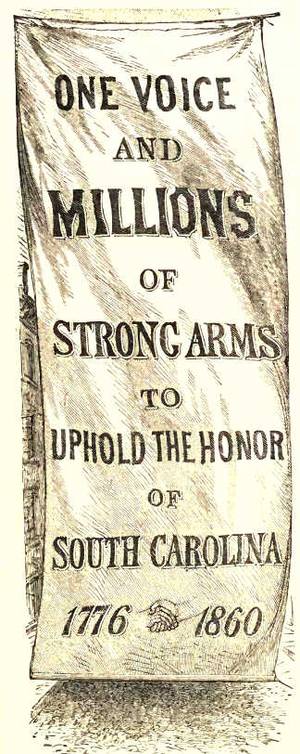
Street Banner in Charleston.
"One voice and millions of strong arms to uphold the honor of South
Carolina 1776-1860"
The secession of South Carolina was greeted with joy in most of the
other slave States. Montgomery and Mobile, Ala., each fired one hundred
guns. At Richmond, Va., a palmetto banner was unfurled, while bells,
bonfires, and processions celebrated the event all over the South. The
other cotton States, spurred on by the bold deed of South Carolina,
rapidly followed her lead. Mississippi seceded January 9th, Florida the
10th, Alabama the 11th, Georgia the 19th, Louisiana the 26th, Texas
February 1st.
It is probable that only in South Carolina, Mississippi, and Florida
were the majority of whites in favor of secession. The South was after
all full of Union sentiment. The ordinance of secession proceeded in
each State from a convention, and the election of delegates to this
witnessed the earnest work. The noble efforts of those Union men in
their fierce struggle have never yet been appreciated. But they fought
against great odds, and were inevitably overborne. The opposition was
organized, ably led, and white-hot with zeal. The political power and
the wealth of the South lay in the hands of the secessionists. The
clergy threw their weight on that side, preaching that slavery, God's
ordinance, was in danger. Union proclivities were crushed out by force.
Vigilance committees were everywhere on the alert. In the rougher States
of the Southwest abolitionists were tarred and feathered. Some were
shot. In all the States Union men were warned to keep quiet or leave the
South. One of the most powerful agents of intimidation was the Knights
of the Golden Circle, a vast secret society which extended throughout
the southern States.
Yet, in spite of all, the vote was close even in several of the cotton
States. The Georgia people wanted new safeguards for slavery, but did
not at first desire secession. Alexander H. Stephens, who headed the
anti-secession movement, declared that Georgia was won over to take the
fatal step at last only by the cry, "Better terms can be made out of the
Union than in it." Even then the first vote for secession stood only 165
to 130. In Louisiana the popular vote for convention delegates was
20,000 for secession and 17,000 against.
The border States held aloof. Kentucky and Tennessee refused to call
conventions. So, for long, did North Carolina. The convention of
Virginia and of Missouri each had a majority of Union delegates. When
the Confederate Government was organized in February, only seven of the
fifteen slave States had seceded. Their white population was about
2,600,000, or less than half that of the entire slave region. But
Arkansas and North Carolina were soon swept along by the current, and
seceded in May. Virginia and Tennessee were finally carried (the former
in May, the latter in June) by the aid of troops, who swarmed in from
the seceded States, and turned the elections into a farce. Unionists in
the Virginia Convention were given the choice to vote secession, leave,
or be hanged. Missouri, Kentucky, Delaware, and Maryland resisted all
attempts to drag them into the Confederacy, though the first two, after
the United States began to apply force, appeared neutral rather than
loyal.
The seizure of United States property went hand in hand with secession.
Most of the government works were feebly garrisoned, and made no
resistance. By January 15th the secessionists had possession of arsenals
at Augusta, Ga., Mount Vernon, Ala., Fayetteville, N. C, Chattahoochee,
Fla., and Baton Rouge, La., of forts in Alabama and Georgia, of a
navy-yard at Pensacola, Fla., and of Forts Jackson and St. Philip,
commanding the mouth of the Mississippi. At one arsenal they found
150,000 pounds of powder, at another 22,000 muskets and rifles, besides
ammunition and cannon, at another 50,000 small arms and 20 heavy guns.
The whole South had been well supplied with military stores by the
enterprising foresight of J. B. Floyd, of Virginia, Buchanan's Secretary
of War, who had sent thither 115,000 muskets from the Springfield
arsenal alone.
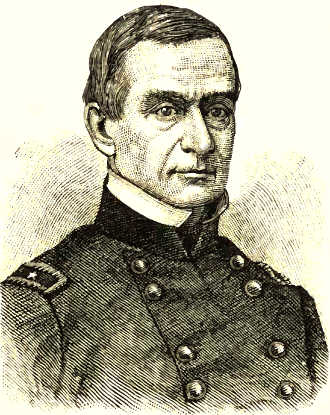
Major Robert Anderson.
Fort Moultrie, in Charleston harbor, was held by Major Robert Anderson,
of Kentucky, with a garrison of some seventy men. On December 27th the
whole country was thrilled, and the South enraged, by the news that on
the previous night Anderson had secretly transferred his whole force to
Fort Sumter, a new and stronger work in the centre of the harbor,
leaving spiked cannon and burning gun-carriages behind him at Moultrie.
The South Carolina militia at once occupied the deserted fortress with
the other harbor fortifications, and began to put them into a state of
defence. At Pensacola, Fla., Lieutenant Slemmer, by a movement similar
to Anderson's, held Fort Pickens.
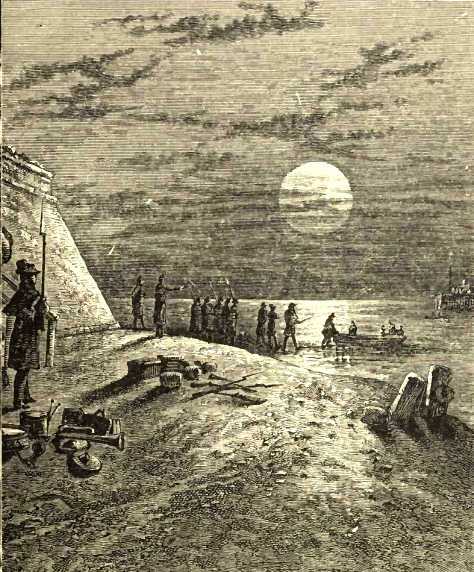
Major Anderson removing his Forces from Fort Moultrie to Fort Sumter,
December 26, 1861.
The seizure of government property went on through January and February.
In Louisiana all the commissary stores were confiscated, and the revenue
cutter McClelland surrendered. The mint at New Orleans, containing over
half a million in gold and silver, was seized. More than half of the
regular army were stationed in Texas, under General Twiggs. In February,
at the demand of a secessionist committee of public safety, he
surrendered his entire force, together with eighteen military posts. The
troops were sent to a Gulf port and there detained.
This wholesale seizure of government property, worth some $20,000,000,
has brought down upon the South much scathing rebuke. The conduct of
Floyd, stabbing his country under the cloak of a cabinet office, cannot
be too strongly condemned; but with the seceding States the case was
different. Having (so they thought) established themselves as
independent republics, they could not allow the military works within
their borders to remain in the hands of a foreign power. As to the
Government's property right, they recognized it, and proposed to pay
damages. The provisional constitution of the Confederacy, adopted in
February, provided for negotiations to settle the claim of the United
States.
The southern leaders were not more anxious to get the slave States out
of the Union than to get them into a grand Southern Confederacy. Early
in January a caucus of secession congressmen was held at Washington, and
arrangements made for a constitutional convention.
February 4, 1861, delegates from the States which had left the Union met
at Montgomery, Ala., and formed themselves into a provisional Congress.
A temporary government, styled "The Confederate States of America," was
soon organized. Jefferson Davis, of Mississippi, was chosen President by
the Congress, and Alexander H. Stephens, of Georgia, Vice-President.
Davis was born in Kentucky in 1808. He graduated at West Point, fought
as colonel in the Mexican war, served three terms as congressman from
Mississippi, the last two in the Senate, and was Secretary of War under
Pierce. After Calhoun's death, in 1850, he became the most prominent of
the ultra southern leaders. The new President was brought from Jackson,
Miss., to Montgomery by a special train, his progress a continual
ovation. Cheering crowds gathered at every station to see and hear him.
February 18th Davis was inaugurated. In his address, which was calm and
moderate in tone, he declared that reunion was now "neither practicable
nor desirable;" he hoped for peace, but said that if the North refused
this, the South must appeal to arms, secure in the blessing of God on a
just cause.
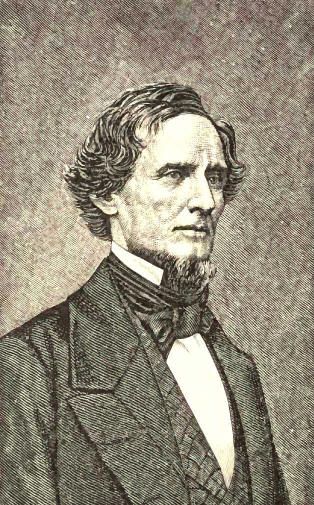
Jefferson Davis.
The Confederate President was intrusted with very large powers,
including supreme control of military affairs. He was authorized to
muster into the service of the central government the regiments which
had been forming in the various States. A call was issued for 100,000
volunteers, and provision made for organizing a regular army. President
Davis appointed a cabinet, with state, treasury, war, navy, and
post-office departments. Robert Toombs, of Georgia, a rabid
secessionist, became Secretary of State.
March 11th the Confederate Congress adopted a permanent constitution. It
reproduced that of the United States, with some important changes. State
sovereignty was recognized in the preamble, which read, "We, the people
of the Confederate States, each State acting in its sovereign and
independent character," etc. Slavery was called by name, and elaborate
safeguards fixed for it in the States and Territories. Slave-trade from
beyond the sea, or with states not in the Confederacy, was, however,
prohibited. Protective tariffs were absolutely forbidden. The president
and vice-president were to serve six years, and the former could not be
re-elected. Some valuable features were inserted. Members of the cabinet
might discuss matters pertaining to their departments in either house of
congress. The president could veto one part of an appropriation bill
without killing the whole, and was required to lay before the senate his
reasons for the removal of any officers from the civil service.
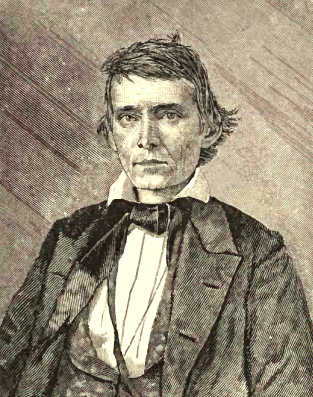
Alexander H. Stephens.
By the last of April all the seceded States had ratified this
constitution. The other slave States were taken in as fast as they
withdrew from the Union. The Southern Confederacy, now fairly launched,
set sail over strange seas upon its short but eventful voyage. At the
start the hopes of those it bore rose high. Few believed that the North
would dare draw sword. Even if it should, the southern heart, proud and
brave, felt sure of victory. King Cotton would win Europe to their side.
Peace would come soon. Visions of a glorious future dazzled the
imaginative mind of the South. A vast slave empire, founded on the
"great physical, philosophical, and moral truth" that slavery is the
"natural condition," of the inferior black race, would spread encircling
arms around the Great Gulf, swallowing up the feeble states of Mexico,
and rise to a wealth and glory unparalleled in the history of nations.