
[1861]
It were a mistake to refer the great Rebellion, for ultimate source, to
ambiguity in the Constitution or to the wickedness of politicians or of
the people. It was simply the last resort in an "irrepressible conflict"
of principle–in the struggle for and against the genius of the world's
advance. Economic, social, and moral evolution, resulting in two
radically different civilizations, had enforced upon each section
unfaithfulness to the spirit and even to the letter of its
constitutional covenant. The South was not to blame that slavery was at
first profitable; and if it deemed it so too long and even thought of it
as a good morally, these convictions, however big with ill consequences
to the nation, were but errors of view, not strange considering the then
status of slavery in the world.
The South's pride, holding it to the course once chosen, was also no
indictable offence. Nor could the North on its part be taxed with crime
for its "higher law fanaticism," which was simply the spirit of the age;
or for seeing early what all believe now, that slavery was a blight upon
the land. Much as was "nominated in the bond" of the Constitution,
neither law nor equity forbade free States to increase the more rapidly
in numbers, wealth, and other elements of prosperity; and northern
congressmen must have been other than human, if, seeing this increase
and being in the majority, they had gone on punctiliously heeding formal
obligation against manifest national weal. And when, in 1854, the great
sacred compact of 1820 was set aside by the authority of the South
itself, the North felt free even from formal fetters. All talk of
extra-legal negotiations and understandings touching slavery was now at
an end. The northern majority was at last united to legislate upon
slavery as it would, subject only to the Constitution. The South too
late saw this, and fearing that the peculiar institution, shut up to its
old home, would die, sought separation, with such chance of expansion as
this might yield.
The South had come to love slavery too well, the Constitution too
little. Upon conserving slavery all parties there, however dissident as
to modes, however hostile in other matters, were unconditionally bent.
The chief argument even of those opposing disunion was that it
endangered slavery. Our new government, said Alexander H. Stephens, soon
to be vice-president of the Southern Confederacy, is founded, its
cornerstone rests, upon the great physical, philosophical, and moral
truth, to which Jefferson and the men of his day were blind, that the
negro, by nature or the curse of Canaan, is not equal to the white man;
that slavery, subordination to the superior race, is, by ordination of
Providence, whose wisdom it is not for us to inquire into or question,
his natural and normal condition. As the apostle of such a principle the
South could not but abjure the old establishment, whose genius and
working were inevitably in the contrary direction. Many confessed it to
be the essential nature of our Government, and not unfair treatment
under it, against which they rebelled.
Slavery had also bred hatred of the Union indirectly, by fostering
anti-democratic habits of thought, feeling, and action. "The form of
liberty existed, the press seemed to be free, the deliberations of
legislative bodies were tumultuous, and every man boasted of his
independence. But the spirit of true liberty, tolerance of the minority
and respect for individual opinion, had departed, and those deceitful
appearances concealed the despotism of an inexorable master, slavery,
before whom the most powerful of slave-holders was himself but a slave,
as abject as the meanest." Over wide sections, untitled manorial lords,
"more intelligent than educated, brave but irascible, proud but
overbearing," controlled all voting and office-holding. Congressional
districts were their pocket-boroughs, and they ignored the common man
save to use him. The system grew, instead of statesmen, sectionalists,
whom love for the "peculiar institution" rendered callous to national
interests.
The vigorous secession movements in the South at once after Lincoln's
election, raised a question of the first magnitude, which few people at
the North had reflected upon since 1833, viz., whether or not
non-revolutionary secession was possible. Almost unanimously the North
denied such possibility, the South affirmed it. This was at bottom
manifestly nothing but the old question of state sovereignty over again.
The South held the Union to be a state compact, which the northern
parties thereto had broken. To prove the compact theory no new proof was
now adduced. Rather did the southern people take the assertion of it as
an axiom, with a simplicity which spoke volumes for the influence of
Calhoun and for the indoctrination which the South had received in 1832.
Not alone Calhoun but nearly every other southerner of great influence,
at least from the day of the Missouri Compromise, had been inculcating
the supreme authority of the State as compared with the Union. The
southern States were all large, and, as travelling in or between them
was difficult and little common, they retained far more than those at
the North each its original separateness and peculiarities. Southern
population was more fixed than northern; southern state traditions were
held in far the deeper reverence. In a word, the colonial condition of
things to a great extent persisted in the South down to the very days of
the war. There was every reason why Alabama or North Carolina should,
more than Connecticut, feel like a separate nation.
This intense state consciousness might gradually have subsided but for
the deep prejudices and passions begotten of slavery and of the
opposition it encountered from the North. Their resolution, against
emancipation led Southerners to cherish a view which made it seem
possible for them as a last resort to sever their alliance with the
North. It was this conjunction of influences, linking the slave-holder's
jealousy and pride to a false but natural conception of state
sovereignty, which created in southern men that love of State, intense
and sincere as real patriotism, causing them to look upon northern men,
with their different theory, as foes and foreigners.
A very imposing historical argument could of course have been built up
for the Calhoun theory of the Union. The Union emerged from the
preceding Confederacy without a shock. Most who voted for it were
unaware how radical a change it embodied. The Constitution, one may even
admit, could not have been adopted had it then been understood to
preclude the possibility of secession. Doubtless, too, the gradual
change of view concerning it all over the North, sprung from the
multiplication of social and economic ties between sections and States,
rather than from study of constitutional law. We believe that the
untruth of the central-sovereignty theory in no wise follows from these
admissions, and that its correctness might be made apparent from a
plenitude of considerations.
Champions of the northern side deemed it the less necessary to expatiate
upon this question, since, admitting the South's basal contention, the
right in question depended upon sufficiency of grievance. As, in the
South's view, the case was one of sovereigns one party of whom, without
referee, was about to break a compact without the other's consent, the
adequacy of the grievance should, to excuse the step, have been
absolutely beyond question. On the contrary it was subject to the
gravest question.
The South's only significant indictment against the North was the one
concerning the personal liberty laws. Moderates like Stephens, indeed,
stoutly condemned this plea for secession as insufficient; but,
believing in the State as sovereign, they had perforce to yield, and
they became as enthusiastic as any when once this "paramount authority"
had spoken. "Fire-eaters," at first a small minority, saw this advantage
and worked it to the utmost. On its complaint touching the personal
liberty legislation the South's case utterly broke down, theorizing the
Union into a rope of sand, not "more perfect" but far less so than the
old, which itself was to be "perpetual." According to the Calhoun
contention States were the parties to a pact, and it was a good way from
clear that any northern State as such, even by personal liberty
legislation, had broken the alleged pact. The liberty laws were innocent
at least in form, and at worst had never been endorsed in any state
convention. Buchanan himself testified that the fugitive slave law had
been faithfully executed, and its operation is well known never to have
been resisted by any public authority.
It was suspicious that no State ventured upon secession alone. It was
equally remarkable that the Gulf States were the readiest to go, and
made most of the personal liberty laws as their pretext, accounting this
cry, as was ingenuously confessed, a necessary means for holding the
border States solidly to the southern cause. Weak enough, indeed, was
the complaint of "consolidationist" aggression, of which certainly no
party to the so-called pact was or could have been guilty. But the deeps
of folly were sounded when northern "persecution" of the South was
mentioned, or Lincoln's election as threat of such. This was simply the
election as President, in a perfectly constitutional way, of a citizen,
honest and unambitious, who was pledged against touching slavery in
States. Having become President, he was unable to procure minister, law,
treaty, or even adequate guard for his own person save by the consent of
the party hitherto in power. Lincoln had failed of a popular majority by
a million. Both Houses of Congress were against him at the time of his
election, and, but for the absence of southern members, they would, it
is likely, have continued so through his entire term. It was the South's
bad logic on these points which gave the war Democrats their excellent
plea for drawing sword on the northern side.
But even supposing secession technically justifiable, how strange that
it should have been judged rational, prudent, or in the long run best
for the South itself. Could aught but frenzy have so drowned in
Americans the memories of our great past; or launched them upon a course
that must have ended by Mexicanizing this nation, wresting from it the
lead in freedom's march, and crushing out, in the breast of struggling
patriotism the world over, all hope of government by and for the people!
The South ought at least to have spared itself. Either its alleged
horror at the advance of central-sovereignty sentiment at the North was
sheer pretence, or it should have been certain that this section would
not hesitate, as Buchanan so illogically did, to coerce "rebellious"
state-bodies. If the North believed the totality of the nation to be the
"paramount authority," Lincoln would surely imitate Jackson instead of
Buchanan, and in doing so he would not seek military support in vain.
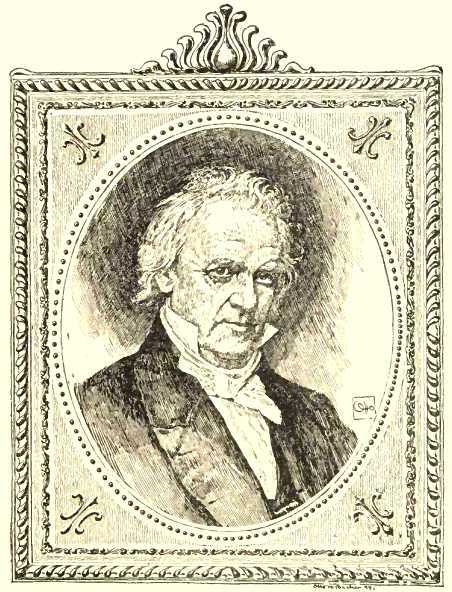
James Buchanan. From a photograph by Brady.
Quite as sure, too, must the final result have appeared from the census
of 1850, had people been calm enough to read this. By that census the
free States had a population fifty per cent. above the population of the
slave states, slaves included, and the disparity was rapidly increasing.
Their wealth was even more preponderant, being, slaves apart, nearly one
hundred per cent. the larger. Their merchant tonnage was five times the
greater–even young inland Ohio out-doing old South Carolina in this,
and the one district of New York City the whole South. The North had
three or four times the South's miles of railway, all the sinews of war
without importation, and mechanics unnumbered and of every sort. And
while champions of the Union would fight with all the prestige of law,
national history and the status quo on their side, Europe's aid to the
South, or even that of the border slave States, was more than
problematical, as was a successful career for the Confederacy in case
its independence should chance to be won. Events proved that the very
defence of slavery had best prospect in the Union, and it seems as if
this might have been foreseen by all, as it actually was by some.