
[1850]
The repeal of the Missouri Compromise was politically a remarkable
epoch. It not only consolidated old anti-slavery men, but cooled, to say
the least, many "silvergray," or conservative Whigs, as well as many
"hards" and "hunkers" among the Democrats. But the slavocrats were blind
to the risk they were running, and grew bolder than ever. There were now
propositions for renewing the foreign slave-trade. Worse black laws were
enacted. There was increased ferocity toward all who did not pronounce
slavery a blessing, prouder domineering in politics, especially in
Congress, and perpetual threat of secession in case the slave power
should fail to have its way.
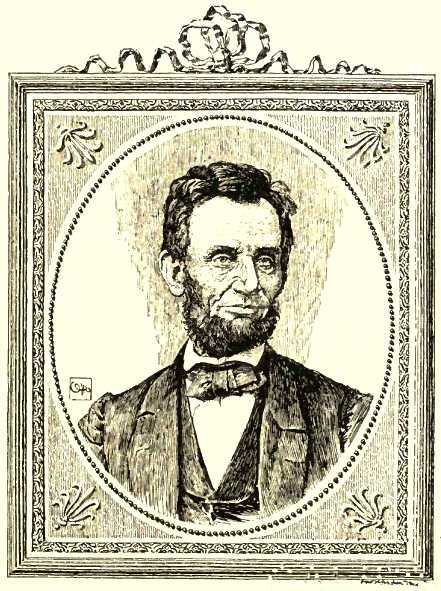
Abraham Lincoln. After a rare photograph in the possession of Noah
Brooks. (Only five copies of this photograph were printed.)
There were also plans for foreign conquest in slavery's behalf, which
received countenance from public and even from national authorities. The
idea seemed to be that the victory and territorial enlargement
consequent upon the Mexican War might be repeated in Central America and
Cuba. The efforts of Lopez in 1850 and 1851 to conquer Cuba with aid
from the United States had indeed been brought to an end through this
adventurer's execution in the latter year by the Cuban authorities.
Pierce put forth a proclamation in 1854, warning American citizens
against like attempts in future. Defying this, the next year William
Walker headed a filibustering expedition to the Pacific coast of
Nicaragua, conquering the capital of that state and setting up a
government which proceeded to re-establish slavery and invite
immigration from the United States. Driven out by a coalition of other
Central American states against him, Walker at once organized a new
raid, and landed at Punta Arenas, Nicaragua, November 25, 1857; but he
was seized by Commodore Paulding of our navy and brought to New York. He
made a similar effort the next year, and another in 1860, when he
captured Truxillo in Honduras, only to be soon overwhelmed, tried and
shot.
[1852]
If the Government at Washington was not openly implicated in any of
these movements, no more, surely, did it heartily deprecate them.
Fillmore's administration had in 1852 declined to enter into an alliance
with Great Britain and France disclaiming intention to secure Cuba. In
1854, inspired by Pierce, our ministers at London, Paris, and Madrid,
met at Ostend and put forth the "Ostend Manifesto." The tenor of this
was that Spain would be better off without Cuba and we with it, and
further, that, if Spain refused to sell, the United States ought as a
means of self-preservation to take that island by force, lest it should
become a second San Domingo. This proposition, like everything else
relating to the great Repeal, was under umbrage in 1856; but in 1858 the
southern Democrats in Congress brought in a bill to purchase Cuba for
$30,000,000, and the democratic platform of 1860 spoke for the
acquisition thereof at the earliest practicable moment, by all
"honorable and just means."
[1854]
Thus an institution, barbarous, anti-democratic, sectional, an
unmitigated curse even to its section, not so much as named in the
Constitution, beginning with apology from all, by the zeal and
unscrupulousness of advocates, the consolidation of political power at
the South, and apathy, sycophancy, divided counsels, and commercial
greed in the North, gradually amassed might, till, at the middle of Mr.
Buchanan's term, every branch of the national Government was its tool,
the Supreme Court included, enabling it authoritatively to mis-read the
Constitution, declare the Union a pro-slavery compact, and act
accordingly. But justice would not be mocked, and, though advancing upon
halting foot, dealt the death-blow like lightning at last.
We have seen the feeble efforts of the old Liberty Party to make head
against slavery, Birney and Earle being its candidates in 1840, Birney
and Morris in 1844. In 1848 these "conscience Free-soilers" were
re-enforced by what have been called the "political Free-soilers" of the
State of New York, led by ex-President Van Buren. This astute organizer,
aware that his defeat in the democratic convention of 1844 had resulted
from southern and pro-slavery influences, led a bolt in the New York
Democracy. His partisans in this were known as the "Barn-burners," while
the administration Democrats were called the "Hunkers." In the
democratic convention of 1848 at Baltimore appeared representatives of
both factions, and both sets were admitted, each with half the state
vote. This satisfied neither side. The Barn-burners called a convention
at Utica in June, and put Van Buren in nomination for the presidency.
The Liberty Party men had the preceding year nominated Hale for this
office, but now, seeing their opportunity, they called a new convention
at Buffalo for August 9, 1848, to which all Free-soilers were invited;
and this convention made Van Buren and Charles Francis Adams its
candidates for President and Vice-President. The platform declared
against any further extension of slavery. The party was henceforth known
as the "Free-soilers," the name coming from its insistence that the
territory conquered from Mexico should forever remain free. Its platform
denounced slavery as a sin against God and a crime against man, and
repudiated the compromise of 1850. It also laid special emphasis upon
the wickedness of the new fugitive slave law, of which it demanded the
repeal. By 1852 the regular Democracy in New York had won back a large
proportion of the Barn-burners or free-soil revolters, so that the
free-soil prospect in this year was not encouraging. Only 146,149
free-soil votes were polled in all the northern states.
[1856]
What quickened this drooping movement into new and triumphant life was
the revocation of the Missouri Compromise. This rallied to the free-soil
standard nearly all the northern Whigs, many old Barn-burners who since
1848 had returned to the democratic fold, and vast numbers of other
anti-Lecompton Democrats. Most of the Know-nothings throughout the North
also joined it, while of course it had in all its anti-slavery measures
the hearty co-operation, directly political or other, of the
Abolitionists. The first national convention of this new party,
fortunately styling itself "Republican," was in 1856. Whig doctrine
early appeared in the party by the demand for protection, internal
improvements, and a national banking system; in fact, Republicanism may
be said to have received nearly entire the whig mantle, as the Whigs did
that of Federalism.
But the living soul and integrating idea of the party was new, the rigid
confinement of slavery and the slave power to their narrowest
constitutional limits. It denounced the repeal of the Missouri
Compromise. In the election of this year, 1856, eleven States chose
Republican electors, viz.: all New England, also New York, Ohio,
Michigan, Iowa, and Wisconsin. Evidently the Democracy had at last found
a foe at which it were best not to sneer. The Dred Scott decision
immensely aided the growth of this new political power, as it was now
quite generally believed in the North that the whole policy of the South
was a greedy, selfish grasping for the extension of slavery.
[1858]
Out of this conviction, apparently, grew the John Brown raid into
Virginia in 1858. John Brown was an enthusiast, whom sufferings from the
Border Ruffians in Kansas, where one of his sons had been atrociously
murdered and another driven to insanity by cruel treatment as a
prisoner, had frenzied in his opposition to slavery. He had dedicated
himself to its extirpation. The intrepid old man formed the purpose of
invading Virginia, and of placing himself with a few white allies at the
head of a slave insurrection that should sweep the State. Friends in
the North had contributed money for the purchase of arms, and on October
16th, Brown, with fourteen white men and four negroes, seized the United
States Armory at Harper's Ferry. He stopped the railway trains, freed
some slaves, and assumed to rule the town. United States troops were at
once despatched to the scene, when the misguided hero, with his devoted
band, fortified themselves in the engine house, surrendering only after
thirteen of them, including two of Brown's sons, were killed or mortally
wounded. Brown and the other survivors were soon tried, convicted, and
hung. This insane attempt was deprecated by nearly all of all parties;
but the fate of Brown, with his resolute bravery, begot him large
sympathy, and the false assumption of the South that he really
represented northern feeling made his deed helpful to the anti-slavery
movement, of which the Republican Party was now the centre.
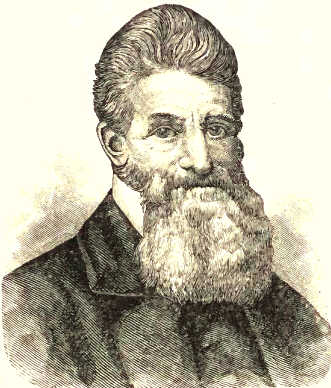
John Brown.
[1860]
Notwithstanding all this the Democracy might still have elected a
president in 1860 had it been united. But it was now desperately at feud
with itself, the cause of this, beautifully enough, lying back in that
very device of Repeal which was intended to make Kansas a slave State
and so to perpetuate the democratic sway. Judge Douglas, and most of the
northern Democrats with him, had insisted so long and earnestly upon the
doctrine of squatter sovereignty that they could not now possibly recede
from it even had they desired to do so. The great majority of them did
not so desire, but sincerely believed in that doctrine as part and
parcel of the true democratic faith. But it was now obvious that the
working out of the Douglas theory was absolutely sure to make free all
the western States henceforth to be formed. This would, of course,
remove the Senate from the domination of slavery. Hence the South was
irrevocably opposed to it, and insisted with all its might upon the
Calhoun-Taney contention that the national Government must protect
slavery in all the Territories to which it pleased to go. In a passage
at arms with Douglas as they were stumping Illinois for the senatorship
in 1858, Lincoln keenly forced upon him the question whether under the
Dred Scott decision any Territory could possibly be kept free from
slavery. "If," said he, "Douglas answers yes, he can never be President;
if no, Illinois will not again elect him senator." Douglas replied in
the affirmative, and, as his antagonist prophesied, became in the South
a doomed man.
The schism was fully apparent when, on April 23d, the democratic
convention of 1860 began its session in Charleston. A majority of the
delegates were for Douglas, voting down the Calhoun-Taney view, though
willing that the party should bind itself to obey the Dred Scott
decision. When the Douglas platform was adopted the delegations from
Alabama, Mississippi, Florida, and Texas, with parts of those from
Louisiana, North and South Carolina, Arkansas, and Delaware, seceded.
Douglas had a majority vote as presidential candidate, but not
two-thirds. The convention adjourned to meet at Baltimore June 18th, and
when it met there Douglas was nominated by the requisite two-thirds
vote. The seceders met at Richmond, June 11th, where, imitating some new
seceders at Baltimore they nominated Breckenridge and Lane. The
so-called Constitutional Union Party also had in the field its ticket,
Bell and Everett, which secured votes from a few persistent Whigs and
Know-nothings still foolish enough to suppose that further clash between
the powers of slavery and freedom could somehow be averted.
The Republicans nominated Abraham Lincoln, of Illinois, and Hannibal
Hamlin, of Maine. Lincoln was already a marked man in his party,
especially in the West, his brilliant joint debate with Judge Douglas
during some months in 1858 having brought out his matchless good sense
and good nature, his rare knowledge of our history and law, and his high
quality as thinker and speaker. Born in Kentucky in 1809, removing to
Indiana in 1816, to Illinois in 1830, reared in extreme poverty and
wholly self-educated, this man had risen by his wits, his sturdy
perseverance and industry, his extraordinary ability, and his proverbial
honesty, to be the acknowledged peer of the "Little Giant" himself. He
began political life a Whig and ably represented that party in the
national Congress from 1847 to 1849, making his voice heard against the
high-handed procedure of the Administration in the Mexican War. But as
with Seward, Greeley, Fessenden, Thaddeus Stevens, Sherman, Dayton,
Corwin, and Collamer, subsequent events had intensified his anti-slavery
feeling, convincing him, as he avowed, that the Union could not
"permanently continue half slave and half free." He was thus drawn to
unite his fortunes with the Republicans. His nomination was received
coolly in the East, where Seward had been preferred; but as men studied
Lincoln's record they were convinced of the wisdom which had made him
the party's leader. He swept New England, New York, New Jersey,
Pennsylvania, Ohio, Indiana, Illinois, Michigan, Iowa, Wisconsin,
California, Minnesota, and Oregon, having 180 electoral votes to
Breckenridge's 72, Bell's 39, and Douglas's 12.
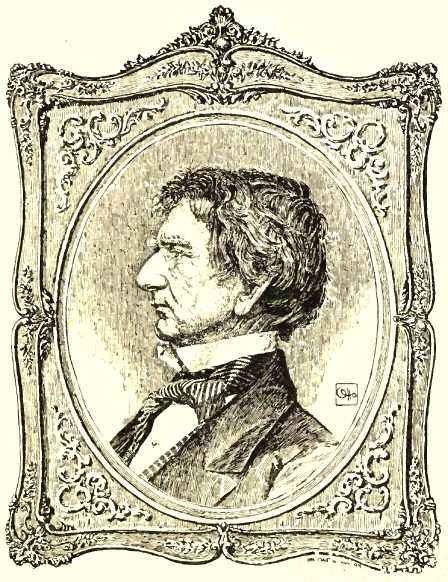
William H. Seward.
From a photograph by Brady.