
[1841]
The Democratic Party was predominantly southern, the Whig northern. Both
sought to be of national breadth, but the democratic with much the
better success. Democracy would not give up its northern vote nor the
Whigs their southern; but a better party fealty, due to a longer and
prouder party history, rendered the Democrats far the more independent
and bold in the treatment of their out-lying wing. The consequence was
that while its rank and file at the North never loved slavery, they
tolerated it and became its apologists in a way to make the party as a
whole not only in appearance but in effect the pliant organ of the
slavocracy. This status became more pronounced with the progress of the
controversy and of the South's self-assertion. It was real under
Jackson, rigid under Van Buren, manifest and almost avowed under Polk,
Pierce, and Buchanan.
Whig temper toward slavery was throughout the North much better, but
whig party action was little better. Fear of losing southern supporters
permanently forbade all frank enlistment by the Whig Party for freedom.
The mighty leaders, Adams, Webster, even Clay, were well inclined, and
the party, as such, was at the South persistently accused of alliance
with the Abolitionists. This was untrue. Abolitionists, Liberal Party
men, and Free-soilers oftener voted with Democrats than with Whigs. Clay
complained once that Abolitionists denounced him as a slave-holder,
slave-holders as an Abolitionist, while both voted for Van Buren.
Compromise was the bane of this party as of the other; and each of the
resplendent chieftains named at one time or another seemed so reverent
to Belial that the record is painful reading.
When in 1841 the ship Creole sailed from Richmond with one hundred and
thirty-five slaves on board bound for the southern market, and one
Madison Washington, a recovered runaway on board, headed a dash upon
captain and crew, got possession of the vessel and took her into New
Providence, Clay was as loud as Calhoun or any southern senator in
demanding of the English Government the return of these slaves to
bondage or, at least, that of "the mutineers," as they were called.
Webster, Secretary of State at the time, instructed Edward Everett, our
English minister, to insist upon this, his arguments being sound and his
tone emphatic enough to please Mr. Calhoun. This was the time when
Giddings, of Ohio, brought into the House his resolutions to the effect
that slavery was a state institution only, and that hence any slave
carried on to the open ocean or to any other locality where only
national law prevailed, was free. He was censured in the House by a
large majority and resigned, but his Ohio constituency immediately
re-elected him.
[1836-1844]
Up to this time Giddings and Adams were the only pronounced anti-slavery
men in that body. Adams had acquiesced in the Missouri Compromise, but
all his subsequent career, especially his course in the House of
Representatives after 1830, is not only creditable to him so far as the
slavery question is concerned, but registers him as one of the most
influential opponents of slavery in our history. Refusing to be classed
with the Abolitionists, he was, in effect, the most efficient
Abolitionist of them all.
Previous to 1835, though petitions against slavery reached Congress in
great numbers and nettled many members, they had been received and
referred in the usual manner. But in February, 1836, the House created a
special committee to consider these petitions. It reported a resolution,
which passed under the previous question, that thereafter all papers of
the kind should be tabled without printing or reference. Adams declared
to the House: "I hold the resolution to be a direct violation of the
Constitution of the United States, the rules of this House, and the
rights of my constituents." In this rencounter Adams advanced the view
on which the Emancipation Proclamation by and by proceeded, that
slavery, even in States, was not beyond reach of the national arm, but
would be at the mercy of Congress the instant slave-masters should
rebel. This, the first of the gag laws, was, however, enacted. The
second, or Patton gag, was passed on December 21, 1837, and the third,
or Atherton gag, a year later. The principle of these, practically
cutting off all petitions to Congress respecting slavery, was taken up
in the twenty-first rule of the House in 1840.
Mr. Adams was from the first the resolute and uncompromising foe of the
gag policy. Wagon-loads of petitions came to him to offer, among them
one for his own expulsion from the House and one to dissolve the Union,
and he presented all.
February 6, 1837, he inquired of Mr. Speaker whether or not it would be
appropriate to offer a petition in his hand from slaves, whereupon the
pro-slavery members flew at him like vampires. After much uproar, in
which Adams gave as good as was sent him, he sarcastically reminded his
already infuriated assailants that the petition was in favor of slavery,
not against, and that he had emphatically not offered it, but only made
an innocent inquiry of the Speaker about doing so, the proper answer to
which was so far from obvious that the Speaker himself had signified his
intention to take the sense of the House upon it. Regularly, year after
year, Adams moved the abolition of the gag rule, was beaten as
regularly, long as a matter of course, sometimes after heated debate in
which he was always victor. But little by little the majority vote
against him lessened. In 1842 the gag passed by but four votes, in 1843
it had a majority of three only, in 1844 his motion to strike it out was
carried by a vote of one hundred and eight to eighty. Adams wrote that
day in his diary: "Blessed, forever blessed be the name of God."
[1850]
But a plenitude of Whigs, not all southern, voted for each of these
gags. The worst one of all was moved by a Whig. The XXVIIth Congress,
strongly whig, voted to retain the gag, which it was left for the
XXVIIIth, strongly democratic, finally to repeal. At the South, slavery
more and more overbore party feeling. Said Dixon, a Kentucky Whig, in
1854, "Upon the question of slavery I know no Whiggery, no Democracy–I
am a pro-slavery man." It should be added, however, that as the
conflict progressed, pro-slavery Whigs became few save in the South, and
that these nearly all soon turned Democrats.
Most humiliating was the vassalage to the slave power displayed by
northern congressmen of both parties, though forming a majority in the
House during all the great days of the slavery battle. The gag history
is one example. Resolutions against unquestionably unconstitutional laws
imprisoning northern seamen at southern ports simply because they were
colored, were tabled in the House by a large majority. Slavery in the
District of Columbia, where Congress had the right of "exclusive
legislation in all cases whatsoever," so that the entire nation was
responsible, defied every effort to abolish it till 1862, after the
Civil War began. Nor was the trade there in aught alleviated till 1850,
when some modification of it was possible as an element of the
compromise described in the preceding chapter. An enlargement of
Missouri, adding to the northwest corner of that State, as slave
territory, a vast tract which the Missouri Compromise had forever
devoted to freedom, being in truth a preliminary repeal of that pact,
was carried without opposition.
The brutal and murderous lawlessness practised against Abolitionists was
praised by northern congressmen often as slavery came up in debate. Even
Senator Silas Wright, of New York, subsequently famous as a foe of
slavery, in remarks upon the reference of anti-slavery petitions,
boasted of the atrocities at Utica in 1835 and of others similar, as
proof that "resistance to these dangerous and wicked agitators in the
North had reached a point beyond law and above law." A bill, in 1836,
for closing the mails to abolitionist literature, another defiance of
the Constitution, Amendment I., secured engrossment in the Senate by the
casting vote of Vice-President Van Buren; Wright, Tallmadge, and
Buchanan also favoring; but failed to pass, nineteen to twenty-five,
because Benton, Clay, and Crittenden had the patriotism to vote nay.
Discussion hereon laid bare the vital contradiction in our governmental
system. Calhoun showed that the Constitution permits each State for
itself to define, in order to inhibit, incendiary literature.
Characteristically, he would have forced mail agents to obey state laws
upon this matter. Yet for Congress to have so directed would plainly
have been abridging freedom of the press.
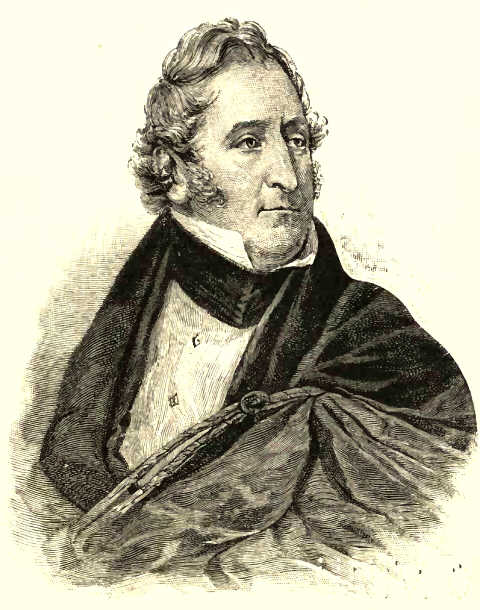
Thomas H. Benton.
Had the Whig Party, while in power from 1849 to 1853, been brave enough
boldly to assume a rational anti-slavery attitude, though it might have
been defeated, as it was in 1852, it would have had a future. The chance
passed unimproved. The temporizing attitude of the party's then leaders
and the known pro-slavery feeling of most of its southern
members–twelve Whigs voting in the House for the repeal of the Missouri
Compromise–proved deadly to the organization, its faithful old
battalions going over in the South to the Democrats, in the North to the
Republicans.
Many Whigs took the latter course by a circuitous route. Ever since the
alien and sedition laws, cry had been raised at intervals against the
too easy attainment of citizenship by the unnumbered immigrants
thronging to our shores, and agitation raised, more or less successful,
to thrust forward "Nativism" or Americanism, with opposition to the
Roman Catholic Church, as an issue in our politics. To such movements
Whigs, as legatees of Federalism, were always more friendly than
Democrats, which was partly a cause and partly a consequence of the
affinity that naturalized citizens all along showed for the Democratic
Party.
Americanism had its greatest run after 1850, when the Whigs saw their
organization going to pieces, and, mistakenly in part, attributed
democratic success to the immigrant vote. A secret fraternity arose,
called the "Know-nothings," from "I don't know," the ever-repeated reply
of its members to inquiry about its nature and doings. "America for
Americans" was their cry, and they proposed to "put none but Americans
on guard." At first pursuing their aims through silent manipulation of
the old parties, by 1854 the Know-nothings swung out as a third party.
From this date they lustily competed with the Republicans for the hosts
of whig and democratic stragglers jostled from their old ranks by the
omnibus bill legislation, the Kansas-Nebraska act, and the "Crime
against Kansas" committed by Pierce and his slavocratic Senate. In 1855
this party assumed national proportions, and worried seasoned
politicians not a little; but having crystallized around no living
issue, like that which nerved Republicanism, it fell like a
rocket-stick, its sparks going over to make redder still republican
fires. Henry Wilson became a Republican from the status of a
Know-nothing; so did Banks, Colfax, and a score of others subsequently
eminent among their new associates. Some had of old been Democrats,
though most had been Whigs.
Notwithstanding many appearances to the contrary, the Democracy had
begun to lose its hold upon the North from the moment of Polk's
nomination in 1844. In that act it showed preference, on the score of
availability, for a small man as presidential candidate. Harrison's
election and Van Buren's defeat in 1840 doubtless had something to do
with this. The same disposition was revealed in 1852, when Pierce was
made candidate. What harmed the party still more was swerving from
strict construction in declaring for the annexation of Texas, which in
this case did not imply enlargement of view in reading the Constitution,
but simply subserviency to the slave power. In this way Van Buren was
alienated and the vote of New York lost in 1848, insuring defeat that
year.
[1856-1860]
This particular breach was pretty well healed, but the evil survived.
Then came the compromise repeal, wherein the Democracy stood by the
South in casting to the winds, the moment it promised to be of service
to the North, a solemn bargain which had yielded the South Florida,
Arkansas, and Missouri as slave States. Northern Democrats, especially
in the rural parts, unwilling longer to serve slavery, drew off from the
party in increasing numbers. Northern States one by one passed to the
opposition. The whole of New England had gone over in 1856, also New
York, Ohio, Michigan, Wisconsin, and Iowa–Buchanan having six votes
outside those of Pennsylvania, where he won, as many believed, by unfair
means. In 1860, New Jersey, Pennsylvania, California, Illinois, Indiana,
Minnesota, and Oregon crossed to the same side.