
[1850-1854]
The measures of 1850 proved anything but the "finality" upon slavery
discussion which both parties, the Whigs as loudly as the Democrats,
promised and insisted that they should be. Elated by its victory in
1850, and also by that of 1852, when the anti-slavery sentiment of
northern Whigs drove so many of their old southern allies to vote for
Pierce, giving him his triumphant election, the slavocracy in 1854
proceeded in its work of suicide to undo the sacred Missouri Compromise
of 1820. Douglas, the ablest northern Democrat, led in this, succeeding,
as official pacificator between North and South, somewhat to the office
of Clay, who had died June 29, 1852. The aim of most who were with him
was to make Kansas-Nebraska slave soil, but we may believe that Douglas
himself cherished the hope and conviction that freedom was its destiny.
This rich country west and northwest of Missouri, consecrated to freedom
by the Missouri Compromise, had been slowly filling with civilized men.
It did not promise to be a profitable field for slavery, nor would
economic considerations ever have originated a slavery question
concerning it. But politically its character as slave or free was of the
utmost consequence to the South, where the resolution gradually arose
either to secure it for the peculiar institution or else prevent its
organization even as a Territory. A motion for such organization had
been unsuccessfully made about 1843, and it was repeated, equally
without effect, each session for ten years. None of these motions had
contained any hint that slavery could possibly find place in the
proposed Territory. The bill of December 15, 1853, like its
predecessors, had as first drawn no reference whatever to slavery, but
when it returned from the committee on Territories, of which Douglas was
chairman, the report, not explicitly, indeed, made the assumption,
unheard of before, that Kansas-Nebraska stood in the same relation to
slavery in which Utah and New Mexico had stood in 1850; and that the
compromise of that year, in leaving the question of slavery to the
States to be formed from these Territories, had already set aside the
agreement of 1820. These assumptions were totally false. The act of 1850
gave Utah and New Mexico no power as Territories over the debatable
institution, and contained not the slightest suggestion of any rule in
the matter for territories in general.
But the hint was taken, and on January 16th notice given of intention to
move an out-and-out abrogation of the Missouri Compromise. Such
abrogation was at once incorporated in the Kansas-Nebraska bill reported
by Douglas, January 23, 1854. This separated Kansas from Nebraska, and
the subsequent struggle raged in reference to Kansas alone. The bill
erroneously declared it established by the acts of 1850 that "all
questions as to slavery in the Territories," no less than in the States
which should grow out of them, were to be left to the residents, subject
to appeal to the United States courts. It passed both houses by good
majorities and was signed by President Pierce May 30th. Its animus
appeared from the loss in the Senate of an amendment, moved by S. P.
Chase, of Ohio, allowing the Territory to prohibit slavery.
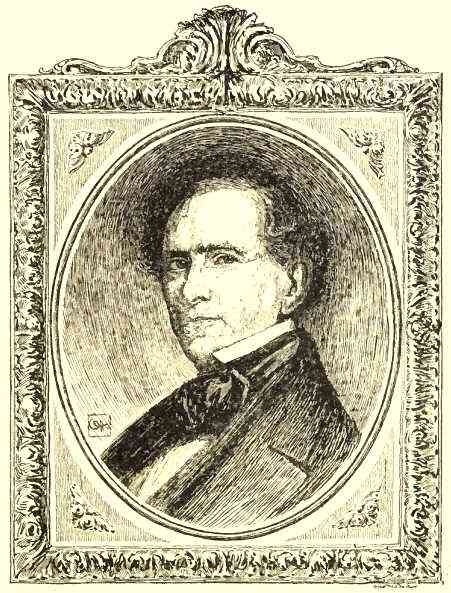
Franklin Pierce.
From a painting by Healy, in 1852, at the Corcoran Art Gallery.
Thus was first voiced by a public authority Judge Douglas's new and
taking heresy of "squatter sovereignty," that Congress, though
possessing by Article IV., Section iii., Clause 2 of the Constitution,
general authority over the Territories, is not permitted to touch
slavery there, but must leave it for each territorial populace "to vote
up or vote down." At the South this doctrine of Douglas's was dubbed
"nonintervention," and its real aim to secure Kansas a pro-slavery
character avowed. It was consequently popular there as useful toward the
repeal, although repudiated the instant its working bade fair to render
Kansas free.
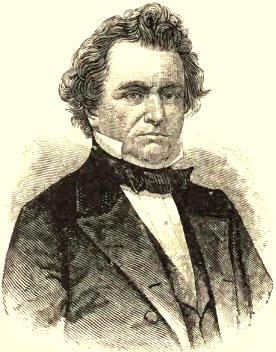
Stephen A. Douglas.
[1855]
This was soon the prospect. Organizations had been formed to aid
anti-slavery emigrants from the northern States to Kansas. The first was
the Kansas Aid Society, another a Massachusetts corporation entitled the
New England Emigrant Aid Society. There were others still. Kansas began
to fill up with settlers of strong northern sympathies. They were in
real minority at the congressional election of November, 1854, and in
apparent minority at the territorial election the next March. The vote
against them on the last occasion, however, was largely deposited by
Missourians who came across the border on election day, voted, and
returned. This was demonstrated by the fact that there were but 2,905
legal voters in the Territory at the time, while 5,427 votes were cast
for the pro-slavery candidates alone. These early successes gave the
pro-slavery party and government in Kansas great vantage in the
subsequent congressional contest. The first Legislature convened at
Pawnee, July 2, 1855, enacted the slave laws of Missouri, and ordered
that for two years all state officers should be appointed by legislative
authority, and no man vote in the Territory who would not swear to
support the fugitive slave law.
The free-state settlers, now a majority, ignored this Legislature and
its acts, and at once set to work to secure Kansas admission to the
Union as a State without slavery. The Topeka convention, October 23,
1855, formed the Topeka constitution, which was adopted December 14th,
only forty-six votes being polled against it. This showed that
pro-slavery men abstained from voting. January 15, 1856, an election was
held under this constitution for state officers, a state legislature,
and a representative in Congress. The House agreed, July 3d, by one
majority, to admit Kansas with the Topeka constitution, but the Senate
refused. The Topeka Legislature assembled July 4th, but was dispersed by
United States troops.
[1856-1857]
This was done under command from Washington. President Pierce, backed by
the Senate with its steady pro-slavery majority, was resolved at all
hazards to recognize the pro-slavery authorities of Kansas and no other,
and, as it seemed, to force it to become a slave State; but fortunately
the House had an anti-slavery majority which prevented this. The friends
of freedom in Kansas had also on their side the history that was all
this time making in Kansas itself. During the summer of 1856 that
Territory was a theatre of constant war. Men were murdered, towns
sacked. Both sides were guilty of violence, but the free-state party
confessedly much the less so, having far the better cause. Nearly all
admitted that this party was in the majority. Even the governors, all
Democrats, appointed by Pierce, acknowledged this, some of them, to all
appearance, being removed as a punishment for the admission. Governor
Geary, in office from September, 1856, to March, 1857, and Governor
Walker, in office from May, 1857, were just and able men, and their
decisions, in most things favorable to the free-state cause, had much
weight with the country.
Walker's influence in the Territory led the free-state men to take part
in the territorial election of October, 1857, where they were entirely
triumphant. But the old, pro-slavery Legislature had called a
constitutional convention, which met at Lecompton, September, 1857, and
passed the Lecompton constitution. This constitution sanctioned slavery
and provided against its own submission to popular vote. It ordained
that only its provision in favor of slavery should be so submitted. This
pro-slavery clause was adopted, but only because the free-state men
would not vote. The Topeka Legislature submitted the whole constitution
to popular vote, when it was overwhelmingly rejected. The President and
Senate, however, urged statehood under the Lecompton constitution,
although popular votes in Kansas twice more, April, 1858, and March,
1859, had adopted constitutions prohibiting slavery, the latter being
that of Wyandotte. But the House still stood firm. Kansas was not
admitted to the Union till January 29, 1861, when her chief foes in the
United States Senate had seceded from the Union. She came in with the
Wyandotte constitution and hence as a free State.
It was during the debate upon Kansas affairs in 1856 that Preston S.
Brooks, a member of the House from South Carolina, made his cowardly
attack upon Charles Sumner. Sumner had delivered a powerful speech upon
the crime against Kansas, worded and delivered, naturally but
unfortunately, with some asperity. In this speech he animadverted
severely upon South Carolina and upon Senator Butler from that State.
This gave offence to Brooks, a relative of Butler, and coming into the
Senate Chamber while Sumner was busy writing at his desk, he fell upon
him with a heavy cane, inflicting injuries from which Sumner never
recovered, and which for four years unfitted him for his senatorial
duties. Sumner's colleague, Henry Wilson, in an address to the Senate,
characterized the assault as it deserved. He was challenged by Brooks,
but refused to fight on the ground that duelling was part of the
barbarism which Brooks had shown in caning Sumner. Anson Burlingame,
representative from Massachusetts, who had publicly denounced the
caning, was challenged by Brooks and accepted the challenge, but, as he
named Canada for the place of meeting, Brooks declined to fight him for
the ostensible reason that the state of feeling in the North would
endanger his life upon the journey. A vote to expel Brooks had a
majority in the House, though not the necessary two-thirds. He resigned,
but was at once re-elected by his South Carolina constituency.
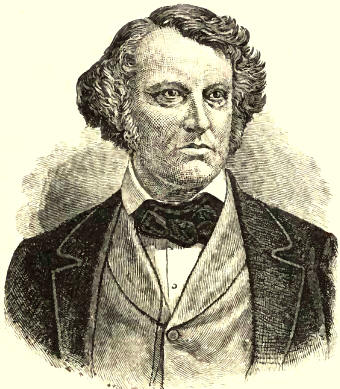
Charles Sumner.
While the fierce Kansas controversy had been raging, the South had grown
cold toward the Douglas doctrine of popular sovereignty, and had
gradually adopted another view based upon Calhoun's teachings. This was
to the effect that Congress, not under Article IV., section iii., clause
2, but merely as the agent of national sovereignty, rightfully
legislates for the Territories in all things, yet, in order to carry out
the constitutional equality of the States in the Territories, is obliged
to treat slaves found there precisely like any other property. If one
citizen wishes to hold slaves, all the rest opposing, the general
Government must support him. It is obvious how antagonistic this thought
was to that of Douglas, since, according to the latter, a majority of
the inhabitants in a Territory could elect to exclude slavery as well as
to establish it.
The new southern or Calhoun theory assumed startling significance for
the Nation when, in 1857, it was proclaimed in the Dred Scott decision
of the United States Supreme Court as part of the innermost life of our
Constitution. Dred Scott was a slave of an army officer, who had taken
him from Missouri first into Illinois, a free State, then into
Wisconsin, covered by the Missouri Compromise, then back into Missouri.
Here the slave learned that by decisions of the Missouri courts his life
outside of Missouri constituted him free, and in 1848, having been
whipped by his master, he prosecuted him for assault. The decision was
in his favor, but was reversed when appeal was taken to the Missouri
Supreme Court. Dred Scott was now sold to one Sandford, of New York. Him
also he prosecuted for assault, but as he and Sandford belonged to
different States this suit went to the United States Circuit Court.
Sandford pleaded that this lacked jurisdiction, as the plaintiff was not
a citizen of Missouri but a slave.
It was this last issue which made the case immortal. The Circuit Court
having decided in the defendant's favor, the plaintiff took an appeal to
the Supreme Court. Here the verdict was against the citizenship of the
negro, and therefore against the jurisdiction of the court below. The
upper court did not stop with this simple dictum, hard and dubious as it
was, but proceeded to lay down as law an astounding course of
pro-slavery reasoning. In this it confined the ordinance of 1787 to the
old northwestern territory, declared the Missouri Compromise and all
other legislation against slavery in Territories unconstitutional, and
the slave character portable not only into all the Territories but into
all the States as well, slavery having everywhere all presupposition in
its favor and freedom being on the defensive. The denial of Scott's
citizenship was based solely upon his African descent, the inevitable
implication being that no man of African blood could be an American
citizen.
This decision rendered jubilant all friends of slavery, as also the
ultra Abolitionists, but correspondingly disheartened the sober friends
of human liberty. How, it was asked, is the cause of freedom to be
advanced when the supreme law of the land, as interpreted by the highest
tribunal existing for that purpose, virtually establishes slavery in New
England itself, provided any slave-master wishes to come there with his
troop? But anti-slavery men did not despair. Patriots had of course to
obey the court till its opinion should be reversed, yet its opinion was
at once repudiated as bad law. Men like Sumner, Wilson, Chase, Giddings,
Seward, and Lincoln, appealing to both the history and the letter of the
Constitution, and to the course of legislation and of judicial decisions
on slavery even in the slave States, had been elaborating and
demonstrating the counter theory, under which our fundamental law
appeared as anything but a "covenant with hell."
The pith of this counter theory was that slaves were property not by
moral, natural, or common law, but only by state law, that hence
freedom, not slavery, was the heart and universal presupposition of our
government, and that slavery, not freedom, was bound to show reasons for
its existence anywhere. This being so, while Calhoun and Taney were
right as against Douglas in ascribing to Congress all power over the
Territories, it was as impossible to find slaves in any United States
Territory as to find a king there. Slaves taken into Territories
therefore became free. Slaves taken into any free State became free.
Slaves carried from a slave State on to the high seas became free. Even
the fugitive slave clause of the Constitution must be applied in the way
least favorable to slavery.
On the other hand Douglas was right in his view that citizens and not
States were the partners in the Territories. As to the assertion of
incompatibility between citizenship and African blood, it would not
stand historical examination a moment. If it was true that the framers
of the Constitution did not consciously include colored persons in the
"ourselves and our posterity" for whom they purposed the "Blessings of
Liberty," neither did they consciously exclude, as is clear from the
fact that nearly everyone of them expected blacks some time to be free.