
[1820]
Slavery would most likely never have imperilled the life of this nation
had it not been for the colossal industrial revolution sketched above.
Cotton had been grown here since, 1621, and some exportation of it is
said to have occurred in 1747. Till nearly 1800 very little had gone
from the United States to England, for by the old process a slave could
clean but five or six pounds a day. In 1784, an American ship which
brought eight bags to Liverpool was seized, on the ground that so much
could not have been the produce of the United States. Jay's treaty, as
first drawn, consented that no cotton should be exported from America.
It changed the very history of the country when, in 1793, Eli Whitney
invented the saw-gin, by which a slave could clean 1,000 pounds of
cotton per day. Slavery at once ceased to be a passive, innocuous
institution, promising soon to die out, and became a means of gain, to
be upheld and extended in all possible ways. The cotton export, but
189,316 pounds in 1791, and a third less in 1792, rose to 487,600 pounds
in 1793, to 1,610,760 pounds in 1794, to 6,276,300 pounds in 1795, and
to 38,118,041 pounds in 1804. Within five years after Whitney's
invention, cotton displaced indigo as the great southern staple, and the
slave States had become the cotton-field of the world. In 1869 the
export was nearly 1,400,000,000 pounds, worth about $161,500,000.
[Footnote: Johnson, in Lalor's Cyclopaedia, Art. "Slavery."]
So profitable was slavery to vast numbers of individuals because of this
its new status, that men would not notice how, after all, it militated
against the nation's supreme interests. It polluted social relations in
obvious ways, setting at naught among slaves family ties and the behests
of virtue, influences that reacted terribly upon the whites. The entire
government of slaves had a brutalizing tendency, more pronounced as time
passed. "Plantation manners" were cultivated, which, displaying
themselves in Congress and elsewhere, in all discussions and measures
relating to the execrable institution, made the North believe that the
South was drifting toward barbarism. This was an exaggeration, yet
everyone knew that schools in the South were rare and poor, and thought
and speech little free as compared with the same in the North. Political
power, like the slaves, was in the hands of a few great barons, totally
merciless toward even southerners who differed from them. It is of course
not meant that virtue, kindliness, intelligence, and fair-mindedness
were ever wanting in that section, but they flourished in spite of the
slave-system.
Economically slavery was an equal evil, taking as was the superficial
evidence to the contrary. No cruelty could make the slave work like a
free man, while his power to consume was enormous. Infants, aged, and
weak had to be supported by the owner. Even the best slaves were
improvident. Everywhere slave labor tended to banish free. Upon slave
soil scarcely an immigrant could be led to set foot. Poor whites grew
steadily poorer, their lot often more wretched than that of slaves.
Invention, care, forethought were as good as unknown among them. Slave
labor proved incompetent even for agriculture, impoverishing the richest
soil in comparatively few years, whence the perpetual impulse of the
slave-owners to acquire new territory. The dishonesty of blacks and the
danger of slave insurrections made property insecure, at the same time
that the system diminished in every community the number of its natural
defenders. The result was that the South, the superior of the North in
natural resources, was, by 1800, rapidly becoming the inferior in every
single element of prosperity.
[1831]
One of these insurrections was the event of 1831 in Virginia,
originating near the southern border. Four slaves in alliance with three
whites commenced it by killing several families and pressing all the
slaves they could find into their service, until the force was nearly
two hundred. They spread desolation everywhere. Fifty-five white persons
were murdered before the insurrection was in hand. Virginia and North
Carolina called out troops, and at last all the insurgents were captured
or killed. The leader was a black named Nat Turner, who believed himself
called of God to give his people freedom. He had heard voices in the air
and seen signs on the sky, which, with many other portents, he
interpreted as proofs of his divine commission. When all was over Turner
escaped to the woods, dug a hole under some fence-rails and lived there
for six weeks, coming out only at midnight for food. Driven thence by
discovery, he still managed to hide here and there about the plantations
in spite of a whole country of armed men in search of him, until at last
he was accidentally confronted in the bush by a white man with levelled
rifle. He was hanged, November 11th, and sixteen others later. His wife
was tortured for evidence, but in vain. Twelve negroes were transported.
Very many were, without trial, punished in inhuman ways, the heads of
some impaled along the highway as a warning. Partly in consequence of
this horrible affair, originated a stout movement for the abolition of
slavery in Virginia. This was favored by many of the ablest men in the
Old Dominion, but they were overruled.
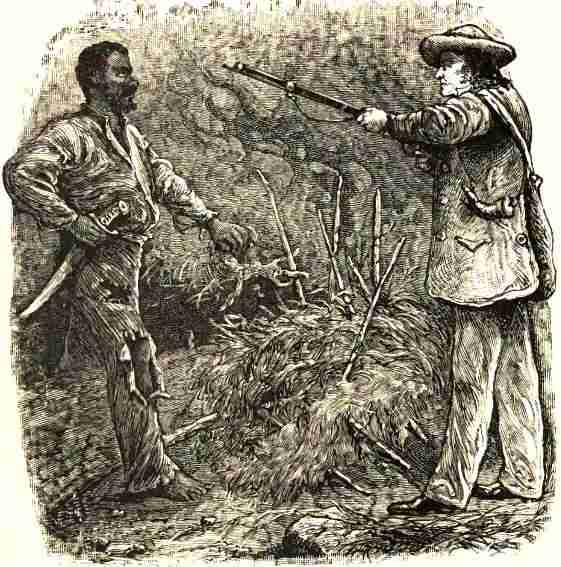
The Discovery of Nat Turner.
Danger from the blacks necessitated the most rigid laws concerning them.
Time had been when it was thought not dangerous to teach slaves to read.
In 1742 Commissary Garden, of the English Society for Propagating the
Gospel, founded a negro school in Charleston, where slaves were taught
by slave teachers, these last being the society's property. Honest Elias
Neale, the society's catechist in New York, engaged in the same work
there, and afterward catechists were so employed in Philadelphia. That
organization did much to stir up the planters to teach their slaves the
rudiments of Christianity. [Footnote: Eggleston in Century, May, 1888.]
Now, all this was changed. The strictest laws were made to keep every
slave in the most abject ignorance, to prevent their congregating, and
to make it impossible for abolitionists or abolitionist literature or
influence to get at them.
[1816]
Inconvenient and perilous as slavery was, southern devotion to it for
many reasons strengthened rather than weakened. The masses did not
perceive the ruin the system was working, which, moreover, consisted
with great profits to vast numbers of influential men and to many
localities. Border States little by little gave up the hope of becoming
free, the old anti-slavery convictions of their best men faltering, and
the practical problem of emancipation, really difficult, being too
easily decided insoluble. More significant, owing to a variety of
circumstances, the abolition spirit itself greatly subsided early in the
present century. Completion of the emancipation process in the North was
assured by the action of New York in 1817, proclaiming a total end to
slavery there from July 4, 1827. The view that each State was absolute
sovereign over slavery within its own borders, responsibility for it and
its abuses there ending with the State's own citizens, was now
universally accepted. Success in securing the act of 1807, making the
slave trade illegal from January 1, 1808, and affixing to it heavy
penalties, lulled multitudes to sleep. This act, however, had effect
only gradually, and its beneficence was greatly lessened in that it left
confiscated negroes to the operation of the local law.
Such quietude was furthered through the formation of the American
Colonization Society in 1816, by easy philanthropists and statesmen,
North as well as South, who swore by the Constitution as admitting no
fundamental amendment, admired its three great compromises, loved all
brethren of the Union except agitators, and deprecated slavery and the
black race about equally; its mission negro deportation, but its actual
efforts confined to the dumping of free blacks, reprobates, and
castaways in some remote corner of the universe, for the convenience of
slave-holders themselves. [Footnote: 3 Schouler's United States, 198.]
[1839]
Meantime much was occurring to harden northern hostility to slavery into
resolute hatred, a fire which might smoulder long but could not die out.
The fugitive slave law for the rendition of runaways found in free
States operated cruelly at best, and was continually abused to kidnap
free blacks. The owner or his attorney or agent could seize a slave
anywhere on the soil of freedom, bring him before the magistrate of the
county, city, or town corporate in which the arrest was made, and prove
his ownership by testimony or by affidavit; and the certificate of such
magistrate that this had been done was a sufficient warrant for the
return of the poor wretch into bondage. Obstruction, rescue, or aid
toward escape was fined in the sum of five hundred dollars. This is the
pith of the fugitive slave act of 1793. It might have been far more
mischievous but for the interpretation put upon it in the celebrated
case of Prigg versus Pennsylvania.
Mr. Prigg was the agent of a Maryland slave-owner. He had in 1839
pursued a slave woman into Pennsylvania, and when refused her surrender
by the local magistrate carried her away by force. He was indicted in
Pennsylvania for kidnapping, an amicable lawsuit made up, and an appeal
taken to the United States Supreme Court. Here, in an opinion prepared
by Justice Story, the Pennsylvania statute under which the magistrate
had acted, providing a mode for the return of fugitives by state
authorities, was declared unconstitutional on the ground that only
Congress could legislate on the subject; but it was added that while a
free State had no right in any way to block the capture of a runaway, as
for example by ordering a jury trial to determine whether a seized
person had really been a slave, so as to protect free persons of dark
complexion, yet States might forbid their officers to aid in the
recovery of slaves. As the act of 1793 did not name any United States
officials for this service it became nearly inoperative. Spite of this
terrible construction of the Constitution, which Chief Justice Taney
thought should have included an assertion of a State's duty by
legislation to aid rendition, many northern States passed personal
liberty laws, besetting the capture of slaves with all possible
difficulties thought compatible with the Constitution. The South
denounced all such laws whatever as unconstitutional, and perhaps some
of them were.
[1835]
Constitutional or not, they were needed. There were regular expeditions
to carry off free colored persons from the coasts of New York and New
Jersey, many of them successful. The foreign slave-trade, with its
ineffable atrocities, proved defiant of law and preternaturally
tenacious of life. A lucrative but barbarous domestic trade had sprung
up between the Atlantic States, Virginia and North Carolina especially,
and those on the Gulf, for the supply of the southern market. Families
were torn apart, gangs of the poor creatures driven thousands of miles
in shackles or carried coastwise in the over-filled holds of vessels, to
live or die–little matter which–under unknown skies and strange,
heartless masters.
The slave codes of the southern States grew severer every year, as did
legislation against free colored people. Laws were passed rendering
emancipation more difficult and less a blessing when obtained. The
Mississippi and Alabama constitutions, 1817 and 1819 respectively, and
all those in the South arising later, were shaped so as to place general
emancipation beyond the power even of Legislatures. Congress was even
thus early–so it seemed at the North–all too subservient to the
slave-holders, partly through the operation of the three-fifths rule,
partly from fear that opposition would bring disunion, partly in that
ambitious legislators were eager for southern votes. As to the Senate,
the South had taken care, Vermont, Kentucky and Tennessee having evened
the score, all before 1800, to allow no new northern State to be
admitted unless matched by a southern. In addition to all this, the
North had a vast trade with the South, and northern capitalists held to
an enormous amount mortgages on southern property of all sorts, so that
large and influential classes North had a pecuniary interest in
maintaining at the South both good nature and business prosperity.