
[1840]
During the War of 1812 we had in England an industrial spy, whose
campaign there has perhaps accomplished more for the country than all
our armies did. It was Francis C. Lowell, of Boston. Great Britain was
just introducing the power loom. The secret of structure was guarded
with all vigilance, yet Lowell, passing from cotton factory to cotton
factory with Yankee eyes, ears, and wit, came home in 1814, believing,
with good reason, as it proved, that he could set up one of the machines
on American soil. Broad Street in Boston was the scene of his initial
experiments, but the factory to the building of which they led was at
Waltham. It was owned by a company, one of whose members was Nathan
Appleton. Water furnished the motive power. By the autumn of 1814 Lowell
had perfected his looms and placed them in the factory. Spinning
machinery was also built, mounting seventeen hundred spindles. English
cotton-workers did not as yet spin and weave under the same roof, so
that the Lowell Mill at Waltham may, with great probability, be
pronounced the first in the world to carry cloth manufacture
harmoniously through all its several successive steps from the raw stuff
to the finished ware.
From this earliest establishment of the power-loom here, the
cotton-cloth business strode rapidly forward. Fall River, Holyoke,
Lawrence, Lowell, and scores of other thriving towns sprung into being.
Every year new mills were built. In 1831 there were 801; in 1840, 1,240;
in 1850, 1,074. Henceforth, through consolidation, the number of
factories decreased, but the number of spindles grew steadily larger.
This rise of great manufacturing concerns was facilitated by a new order
of corporation laws. There had been corporations in the country before
1830, as the Waltham case shows; but the system had had little
evolution, as incorporation had in each case to proceed from a special
legislative act. In 1837 Connecticut passed a statute making this
unnecessary and enabling a group of persons to become a corporation on
complying with certain simple requirements. New York placed a similar
provision in its constitution of 1846. The Dartmouth College decision of
the United States Supreme Court in 1819, interpreting an act of
incorporation as a contract, which, by the Constitution, no State can
violate, still further humored and aided the corporation system.
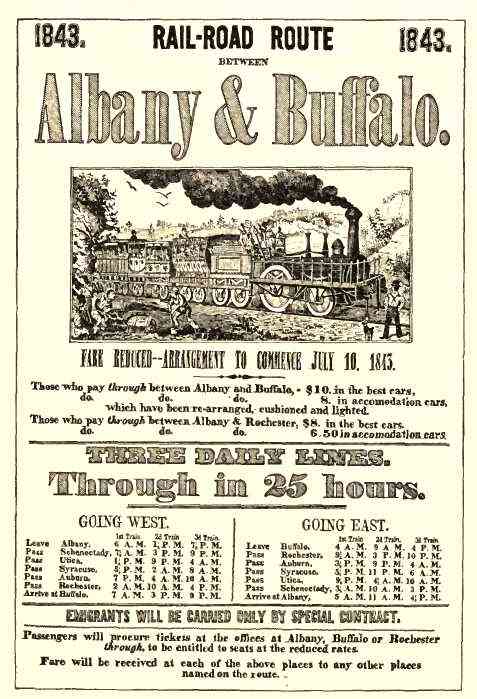
From an Old Time-table. (Furnished by the ABC Pathfinder Railway Guide.)
In 1816 the streets of Baltimore were lighted with gas. A gas-light
company was incorporated in New York in 1823. Not till 1836, however,
did the Philadelphia streets have gas lights. The first savings-banks
were established in Philadelphia and Boston in 1816. Baltimore had one
two years later. Portable fire-proof safes were used in 1820. The Lehigh
coal trade flourished this year, and also the manufacture of iron with
coal. The whale fishery, too, was now beginning. The first factory in
Lowell started in 1821. In 1822 there was a copper rolling mill in
Baltimore, the only one then in America, and Paterson, N. J., began the
manufacture of cotton duck. Patent leather was made in the United States
by 1819. In 1824 Amesbury, Mass., had a water-power manufactory of
flannel. The next year the practice of homoeopathy began in America, and
matches of a rude sort were displacing the old tinder-box. The next
year after this Hartford produced axes and other edged tools.
Lithography, of which there had been specimens so early as 1818, was a
Boston business in 1827. Pittsburgh manufactured damask table linen in
1828. The same year saw paper made from straw, and planing machinery in
operation. The insuring of lives began in this country in 1812.
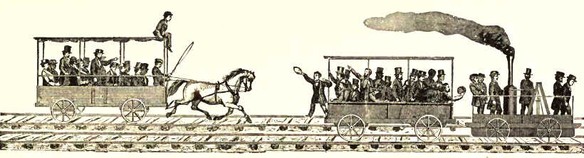
Trial between Peter Cooper's Locomotive "Tom Thumb" and one of Stockton's
and Stokes' Horse Cars. From "History of the First Locomotive in
America."
The first figured muslin woven by the power-loom in America, and perhaps
in the world, was produced at Central Falls, R. I., in 1829. Calico
printing began at Lowell the same year, also the manufacture of cutlery
at Worcester, of sewing-silk at Mansfield, Conn., of galvanized iron in
New York City. With the new decade chloroform was invented, in 1831,
being first used as a medicine, not as an anaesthetic. Reaping machines
were on trial the same year, and three years later machine-made wood
screws were turned out at Providence. About the same time, 1832, pins
were made by machinery, hosiery was woven by a power-loom process, and
Colt perfected his revolver. In 1837 brass clocks were put upon the
American market, and by 1840 extensively exported. Also in 1837 Nashua
was making machinists' tools. By 1839 the manufacture of iron with hard
coal was a pronounced success. In 1840 daguerreotypes began to appear.
Steam fire-engines were seen the next year.
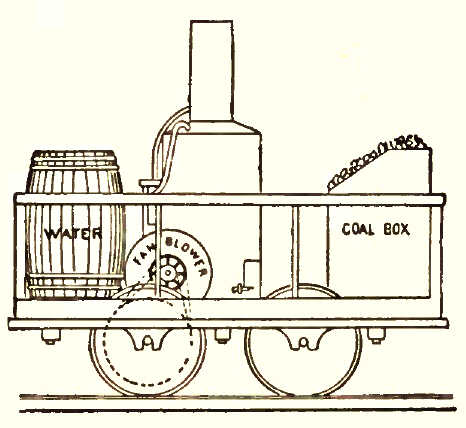
Peter Cooper's Locomotive, 1829.
So early as 1816 the New York and Philadelphia stages made the distance
from city to city between sun and sun. The National Road from Cumberland
was finished to Wheeling in 1820, having been fourteen years in
construction and costing $17,000,000. It was subsequently extended
westward across Ohio and Indiana. It was thirty-five feet wide,
thoroughly macadamized, and had no grade of above five degrees. Over
parts of this road no less than 150 six-horse teams passed daily,
besides four or five four-horse mail and passenger coaches. In Jackson's
time, when for some months there was talk of war with France and extra
measures were thought proper for assuring the loyalty of Louisiana,
swift mail connections were made with the Mississippi by the National
Road. Its entire length was laid out into sections of sixty-three miles
apiece, each with three boys and nine horses, only six hours and
eighteen minutes being allowed for traversing a section, viz., a rate of
about ten miles an hour. Great men and even presidents travelled by the
public coaches of this road, though many of them used their own
carriages. James K. Polk often made the journey from Nashville to
Washington in his private carriage. Keeping down the Cumberland River to
the Ohio, and up this to Wheeling, he would strike into the National
Road eastward to Cumberland, Md. He came thus so late as 1845, to be
inaugurated as President; only at this time he used the new railway from
Cumberland to the Relay House, where he changed to the other new railway
which had already joined Baltimore with Washington.
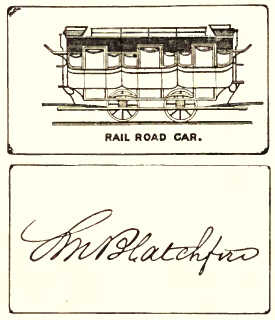
Obverse and Reverse of a Ticket used in 1838 on the New York & Harlem
Railroad.
The first omnibus made its appearance in New York in 1830, the name
itself originating from the word painted upon this vehicle. The first
street railway was laid two years later. The era of the stage coach was
at this time beginning to end, that of canals and railroads opening. Yet
in the remoter sections of the country the old coach was destined to
hold its place for decades still. Where roads were fair it would not
uncommonly make one hundred miles between early morning and late
evening, as between Boston and Springfield, Springfield and Albany. So
soon as available the canal packet was a much more easy and elegant
means of travel. The Erie Canal was begun in 1817, finished to Rochester
in 1823, the first boat arriving October 8th. The year 1825 carried it
to Buffalo. The Blackstone Canal, between Worcester and Providence, was
opened its whole length in 1828; the next year many others, as the
Chesapeake and Delaware, the Cumberland and Oxford in Maine, the
Farmington in Connecticut, the Oswego, connecting the Erie Canal with
Lake Ontario, also the Delaware and Hudson, one hundred and eight miles
long, from Honesdale, Pa., to Hudson River. The Welland Canal was
completed in 1830.
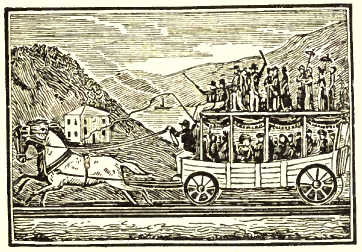
Baltimore & Ohio Railroad, 1830.
Salt-water transportation had meantime been much facilitated by the use
of steam. It had been thought a great achievement when, in 1817, the
Black Ball line of packet ships between New York and Liverpool was
regularly established, consisting of four vessels of from four hundred
to five hundred tons apiece. But two years later a steamship crossed the
Atlantic to Liverpool from Savannah. It took her twenty-five
days–longer than the time in which the distance often used to be
accomplished under sail. In 1822 there was a regular steamboat between
Norfolk and New York, though no steamboat was owned in Boston till 1828.
The Atlantic was first crossed exclusively by steam-power in 1838, and
the first successful propeller used in 1839. The last-named year also
witnessed the beginning of a permanent express line between Boston and
New York, by the Stonington route. The next year, the Adams Express
Company was founded, doing its first business between these two cities
over the Springfield route, in competition with that by the Stonington.
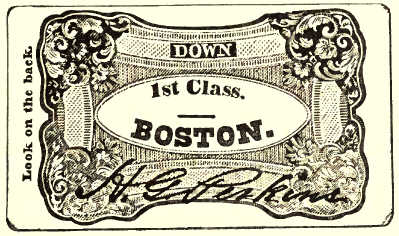
Old Boston & Worcester Railway Ticket (about 1837).
But all these improvements were soon to be overshadowed by the work of
the railway and locomotive. The first road of rails in America was in
the Lehigh coal district of Pennsylvania. Its date is uncertain, but not
later than 1825. In 1826, October 7th, the second began operation, at
Quincy, Mass., transporting granite from the quarries to tide-water,
about three miles. This experiment attracted great attention, showing
how much heavier loads could be transported over rails than upon common
roads, and with how much greater ease and less expense ordinary weights
could be carried. The same had been demonstrated in England before.
Locomotives were not yet used in either country, but only horse-power.
The conviction spread rapidly that not only highway transportation but
even that by canals would soon be, for all large burdens, either quite
superseded or of secondary importance. In 1827 the Maryland Legislature
chartered a railroad from Baltimore to Wheeling. The projectors, though
regarding it a bold act, promised an average rate between the two cities
of at least four miles per hour. Subscriptions were offered for more
than twice the amount of the stock. The Massachusetts Legislature the
same year appointed commissioners to look out a railway route between
Boston and Hudson River. Also in this year a railway was completed at
Mauch Chunk, Pa., for transporting coal to the landing on the Lehigh.
The descent was by gravity, mules being used to haul back the cars.
In most country parts, the new railway projects encountered great
hostility. Engineers were not infrequently clubbed from the fields as
they sought to survey. Learned articles appeared in the papers arguing
against the need of railways and exhibiting the perils attending them.
When steam came to be used, these scruples were re-enforced by the
alleged danger that the new system of travel would do away with the
market for oats and for horses, and that stage-drivers would seek wages
in vain.
The first trip by a locomotive was in 1828, over the Carbondale and
Honesdale route in Pennsylvania. The engine was of English make, and run
by Mr. Horatio Allen, who had had it built. This was a year before the
first steam railroad was opened in England. July 4, 1828, construction
upon the Baltimore & Ohio Railroad was begun. It, like the other early
roads, was built of stone cross-ties, with wooden rails topped with
heavy straps of iron. Such ties were soon replaced by wooden ones, as
less likely to be split by frost, but the wooden rail with its iron
strap might be seen on branch lines, for instance, between Monocacy
Bridge and Frederick City, Md., so late as the Civil War.
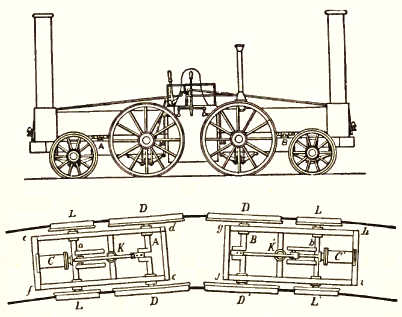
The "South Carolina," 1831, and plan of its running gear.
The first railroad for passengers in this country went into operation
between Charleston and Hamburg, S. C., in 1830. The locomotive had been
gotten up in New York, the first of American make. It had four wheels
and an upright boiler. This year the railroad between Albany and
Schenectady was begun, and fourteen miles of the Baltimore & Ohio opened
for use. In 1831 Philadelphia was joined to Pittsburgh by a line of
communication consisting of a railway to Columbia, a canal thence to
Hollidaysburg, another railway thence over the Alleghanies to Johnstown,
and then on by canal. The railway over the mountains consisted of
inclined planes mounted by the use of stationary engines. It is
interesting to notice the view which universally prevailed at first,
that the locomotive could not climb grades, and that where this was
necessary stationary engines would have to be used. Not till 1836 was it
demonstrated that locomotives could climb. Up to the same date, also,
locomotives had burned wood, but this was now found inferior to coal,
and began to be given up except where it was much the cheaper fuel.
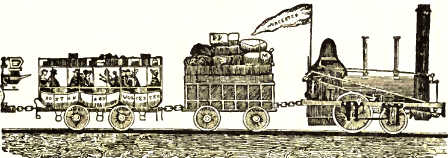
Boston & Worcester Railroad, 1835.
From 1832 the railway system grew marvellously. The year 1833 saw
completed the South Carolina Railroad between Charleston and the
Savannah River, one hundred and thirty-six miles. This was the first
railway line in this country to carry the mails, and the longest
continuous one then in the world. Two years later Boston was connected
by railway with Providence, with Lowell, and with Worcester, Baltimore
with Washington, and the New York & Erie commenced. In 1839 Worcester
was joined to Springfield in the same manner, and in 1841 a passenger
could travel by rail from Boston to Rochester, changing cars, however,
at least ten times.