
[1835]
By the census of 1830 the United States had a population of 12,866,020,
the increase having been for the preceding ten years about sufficient to
double the inhabitants in thirty years. There were twenty-four States,
Indiana having been taken into the Union in 1816, Mississippi in 1817,
Illinois in 1818, Alabama in 1819, Maine in 1820, and Missouri, the
last, in 1821. Florida, Michigan, and Arkansas were the Territories. The
area, now that Florida had been annexed, was 725,406 square miles.
Comparatively little of the soil of Michigan, Iowa, Minnesota, and
Wisconsin had as yet been occupied, though settlements were making on
most of the larger streams. The southwest had at this time filled up
more rapidly than the northwest. In 1830 the centre of population for
the Union was farther south than it has ever been at any other time.
Except in Louisiana and Missouri, not over thirty thousand inhabitants
were to be found west of the Mississippi. The vast outer ranges of the
Louisiana purchase remained a mysterious wilderness. Indianapolis in
1827 contained twenty-five brick houses, sixty frame, and about eighty
log houses; also a court-house, a jail, and three churches. Chicago was
laid out in 1830. Thither in, 1834 went one mail per week, from Niles,
Mich., on horseback. In 1833 it was incorporated as a town, having 175
houses and 550 inhabitants. That year it began publishing a newspaper
and organized two churches. In 1837 it was a city, with 4,170
inhabitants. The Territory of Iowa had in 1836, 10,500 inhabitants; in
1840, 43,000. At this time Wisconsin had 31,000. So early as 1835 Ohio
had nearly or quite 1,000,000 inhabitants. Sixty-five of its towns had
together 125 newspapers. Between 1830 and 1840 Ohio's population rose
from 900,000 to 1,500,000; Michigan's, from 30,000 to 212,000; and the
whole country's, from 13,000,000 to 17,000,000. Before 1840, eight
steamers connected Chicago with Buffalo.
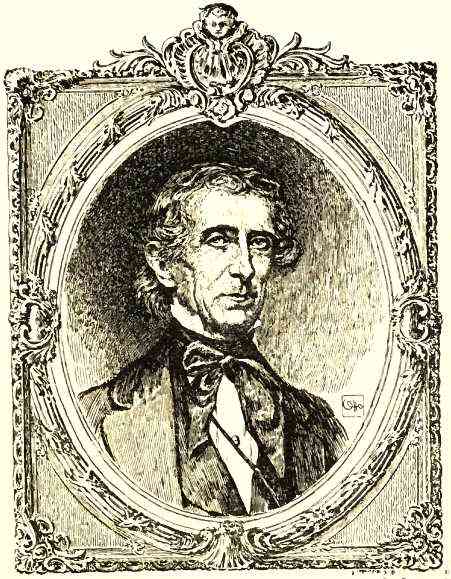
John Tyler
From a photograph by Brady.
By 1840 nearly all the land of the United States this side the
Mississippi had been taken up by settlers. The last districts to be
occupied were Northern Maine, the Adirondack region of New York, a strip
in Western Virginia from the Potomac southward through Kentucky nearly
to the Tennessee line, the Pine Barrens of Georgia, and the extremities
of Michigan and Wisconsin. Beyond the Father of Waters his shores were
mostly occupied, as well as those of his main tributaries, a good way
from their mouths. The Missouri Valley had population as far as Kansas
City. Arkansas, Missouri, and Iowa Territory had many settlements at
some distance from the streams. The aggregate population of the country
was 17,069,453, the average density twenty-one and a tenth to the square
mile. The mass of westward immigration was as yet native, since the
great rush from Europe only began about 1847. This was fortunate, as
fixing forever the American stamp upon the institutions of western
States. To compensate each new commonwealth for the non-taxation of the
United States land it contained, it received one township in each
thirty-six as its own for educational purposes, a provision to which is
due the magnificent school system of Michigan, Wisconsin, Iowa,
Minnesota, and their younger sisters.
Farther east, too, there had, of course, been growth, but it was slower.
In 1827 Hartford had but 6,900 inhabitants; New Haven, 7,100; Newark, N.
J., 6,500, and New Brunswick about the same. The State of New York paid
out, between 1815 and 1825, nearly $90,000 for the destruction of
wolves, showing that its rural population had attained little density.
The entire country had vastly improved in all the elements of
civilization. A national literature had sprung up, crowding out the
reprints of foreign works which had previously ruled the market. Bryant,
Cooper, Dana, Drake, Halleck, and Irving were now re-enforced by writers
like Bancroft, Emerson, Hawthorne, Holmes, Longfellow, Poe, Prescott,
and Whittier. Educational institutions were multiplied and their methods
bettered, The number of newspapers had become enormous. Several
religious journals were established previous to 1830, among them the New
York Observer, which dates from 1820, and the Christian Register, from
1821. Steam printing had been introduced in 1823. The year 1825 saw the
first Sunday paper; it was the New York Sunday Courier. Greeley began
his New York Tribune only in 1841.
Fresh news had begun to be prized, as shown by the competition between
the two great New York sheets, the Journal of Commerce and the Morning
Enquirer, each of which, in 1827, established for this purpose swift
schooner lines and pony expresses. The Journal oj Commerce in 1833 put
on a horse express between Philadelphia and New York, with relays of
horses, enabling it to publish congressional news a day earlier than any
of its New York contemporaries. Other papers soon imitated this example,
whereupon the Journal extended its relays to Washington. Mails came to
be more numerous and prompt. More letters were written, and, from 1839,
letters were sent in envelopes. Postage-stamps were not used till 1847.
Most of the principal cities in the country, including Rochester and
Cincinnati, published dailies before 1830. Baltimore and Louisville had
each a public school in 1829. This year witnessed in Boston the
beginning work of the first blind asylum in the country. In Hartford
instruction had already been given to the deaf and dumb since 1817.
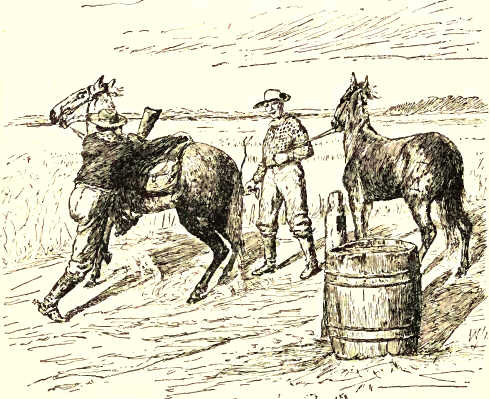
A Pony Express.
By the fourth decade of the century the American character had assumed a
good deal of definiteness and greatly interested foreign travellers.
There was, by those who knew what foreign manners were, much foolish
aping of the same. English visitors noted Brother Jonathan's drawl in
talking, his phlegmatic temperament, keen eye, and blistering
inquisitiveness. Jonathan was a rover and a trader, everywhere at home,
everywhere bent upon the main chance. He ate too rapidly, chewed and
smoked tobacco, and spat indecently. He drank too much. During the first
quarter of the century nearly everyone used liquor, and drunkenness was
shamefully common. Every public entertainment, even if religious, set
out provision of free punch. At hotels, brandy was placed upon the
table, free as water to all. The smaller sects often held preaching
services in bar-rooms for lack of better accommodations. On such
occasions the preacher was not infrequently observed, without affront to
anyone, to refresh himself from behind the bar just before announcing
his text.
In 1824 commenced in Boston a temperance movement which accomplished in
this matter the most happy reform. It swept New England, passing thence
to all the other parts of the Union. By the end of 1829 over a thousand
temperance societies were in existence. The distilling and importation
of spirits fell off immensely. It became fashionable not to drink, and
little by little drinking came to be stigmatized as immoral.
By the time of which we now speak, the old habit of expressing
solicitude for the fate of the Union had passed away. Whig like
Democrat–so different from old Federalist-swore by "the people." Every
American believed in America. Travelling abroad, the man from this
country was wont to assume, and if opposed to contend, ill-manneredly
sometimes, that its institutions were far the best in the world. No one
wished a change. The unparalleled prosperity of all contributed to this
satisfaction. Cities and towns came up in a day. Public improvements
were to be seen making in every direction. There was no idle aristocracy
on the one hand, no beggars on the other. Self-respect was universal.
The people held the power. If men attained great wealth, as not a few
did, they usually did not waste it but invested it. Business enterprise
was intense and common. Character entered into credit as an element
along with financial resources. People did not crowd into cities, but
loved and built up the country rather. Laws and penalties were become
more mild. In 1837 a man was flogged at the whipping-post in Providence,
R. I., for horse-stealing, perhaps the last case of the kind in the
country. Prisons were now made clean and healthy, and the idea of
reforming the criminal instead of taking vengeance upon him was
spreading. Reformatories for children had been opened in New York,
Boston, and Philadelphia. There were institutions for homeless children,
for the sick poor, for the insane, and for other unfortunate classes.
By this time the Methodists and Baptists had become extremely strong in
numbers. In 1833 the Massachusetts constitution was altered, abolishing
obligatory contributions for the support of the ministry of the standing
order. Connecticut had made the same change fifteen years before, in its
constitution of 1818. In many localities the newer denominations,
hitherto sects, were more influential than the old one, and in this
abolition of ecclesiastical taxes they had with them Jews, atheists,
deists, agnostics, and heathen.
About 1825 began a period of peculiar religious enthusiasm. Missions to
the heathen were instituted. Revivals were numerous and often shook
whole neighborhoods for weeks and months. About this date Millerism
began to make converts. William Miller, from whom it took its name,
preached far and wide that the world would be destroyed in 1843,
securing multitudes of disciples, who clung to his general belief even
after his prophecy as to the specific date for the final catastrophe was
seen to have failed. Mormonism was also founded, in 1830, and the Book
of Mormon published by Joseph Smith. A church of this order, organized
this year at Manchester, N. Y., removed the next to Kirtland, O., and
thence to Independence, Mo. Driven from here by mob violence, they built
the town of Nauvoo, Ill. Meeting in this place too with what they
regarded persecution, several of their members being prosecuted for
polygamy, they were obliged to migrate to Salt Lake City, where,
however, they were not fully settled until 1848.
As part of the same general stir we may perhaps register the
anti-masonic movement. One William Morgan, a Mason residing in Western
New York, was reported about to expose in a publication the secrets of
that order. The Masons were desirous of preventing this and made several
forcible efforts to that end. Morgan was soon missing, and the exciting
assumption was almost universally made that the Masons had taken him
off. There was much evidence of this; but conviction was found
impossible because, as was alleged, judges, juries, and witnesses were
nearly all Masons. An intense and widespread feeling was developed that
Masonry held itself superior to the laws, was therefore a foe to the
Government and must be destroyed. The Anti-Masons became a mighty
political party. Masons were driven from office. In 1832 anti-masonic
nominations were made for President and Vice-President, which had much
to do with the small vote of Clay in that year. It was this party that
brought to the front politically William H. Seward, Millard Fillmore,
and Thurlow Weed.
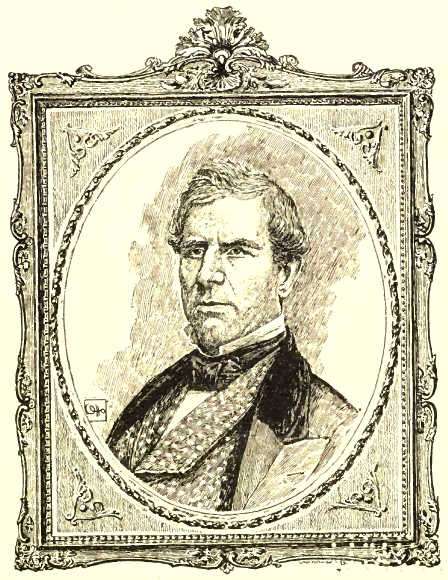
Thurlow Weed. From an unpublished Photograph by Disderi, Paris, in 1861.
In the possession of Thurlow Weed Barnes.
In 1833 Massachusetts, New York, and Pennsylvania passed laws
suppressing lotteries, but the gambling mania seemed to transform itself
into a craze for banks. In many parts this was such that actual riots
took place when subscriptions to the stock of banks were opened, the
earliest comers subscribing the whole with the purpose of selling to
others at an advance. To make a bank was thought the great panacea for
every ill that could befall. In this we see that the American people,
bright as they were, could be duped.
Less wonder, then, at the success of the Moon Hoax, perpetrated in 1835.
It was generally known that Sir John Herschel had gone to the Cape of
Good Hope to erect an observatory. One day the New York Sun came out
with what purported to be part of a supplement to the Edinburgh Journal
of Science, giving an account of Herschel's remarkable discoveries. The
moon, so the bogus relation ran, had been found to be inhabited by human
beings with wings. Herschel had seen flocks of them flying about. Their
houses were triangular in form. The telescope had also revealed beavers
in the moon, exhibiting most remarkable intelligence. Pictures of some
of these and of moon scenery accompanied the article. The fraud was so
clever as to deceive learned and unlearned alike. The sham story was
continued through several issues of the Sun, and gave the paper an
enormous sale. As it arrived in the different places, crowds scrambled
for it, nor would those who failed to secure copies disperse until some
one more fortunate had read to them all that the paper said upon the
subject. Several colleges sent professorial deputations to the Sun
office to see the article, and particularly the appendices, which, it
was alleged, had been kept back. Richard Adams Locke was the author of
this ingenious deception, which was not exploded until the arrival of
authentic intelligence from Edinburgh.
Party spirit sometimes ran terribly high. A New York City election in
1834 was the occasion of a riot between men of the two parties,
disturbances continuing several days. Political meetings were broken up,
and the militia had to be called out to enforce order. Citizens armed
themselves, fearing attacks upon banks and business houses. When it was
found that the Whigs were triumphant in the city, deafening salutes were
fired. Philadelphia Whigs celebrated this victory with a grand barbecue,
attended, it was estimated, by fifty thousand people. The death of
Harrison was malignantly ascribed to overeating in Washington, after his
long experience with insufficient diet in the West. Whigs exulted over
Jackson's cabinet difficulties. Jackson's "Kitchen Cabinet," the power
behind the throne, gave umbrage to his official advisers. Duff Green,
editor of the United States Telegraph, the President's "organ," was one
member; Isaac Hill, of New Hampshire, and Amos Kendall, first of
Massachusetts, then of Kentucky, were others, these three the most
influential. All had long worked, written, and cheered for Old Hickory.
In return he gave them good places at Washington, and now they enjoyed
dropping in at the White House to take a smoke with the grizzly hero and
help him curse the opposition as foes of "the people."
Major Eaton, Old Hickory's first Secretary of War, had married a
beautiful widow, maiden name Peggy O'Neil, of common birth, and much
gossipped about. The female members of other cabinet families refused to
associate with her, the Vice-President's wife leading. Jackson took up
Mrs. Eaton's cause with all knightly zeal. He berated her traducers and
persecutors in long and fierce personal letters. His niece and
housekeeper, Mrs. Donelson, one of the anti-Eatonites, he turned out of
the White House, with her husband, his private secretary. The breach was
serious anyway, and might have been far more so but for the healing
offices of Van Buren, who used all his courtliness and power of place to
help the President bring about the social recognition of Mrs. Eaton. He
called upon her, made parties in her honor, and secured her entree to
the families of the greatest foreign ministers. Mrs. Eaton triumphed,
but the scandal would not down.
When Jackson wrote his foreign message upon the French spoliation
claims, his cabinet were aghast and begged him to soften its tone. Upon
his refusal, it is said, they stole to the printing-office and did it
themselves. But the proofs came back for Jackson's perusal. The lad who
brought them was the late Mr. J. S. Ham, of Providence, R. I. He used to
say that he had never known what profane swearing was till he listened
to General Jackson's comments as those proofs were read.
Jackson and Quincy Adams were personal as well as political foes. When
the President visited Boston, Harvard College bestowed on him the degree
of Doctor of Laws. Adams, one of the overseers, opposed this with all
his might. As "an affectionate child of our Alma Mater, he would not be
present to witness her disgrace in conferring her highest literary
honors upon a barbarian." Subsequently he would refer, with a sneer, to
"Dr. Andrew Jackson." The President's illness at Boston Adams declared
"four-fifths trickery" and the rest mere fatigue. He was like John
Randolph, said Adams, who for forty years was always dying. "He is now
alternately giving out his chronic diarrhoea and making Warren bleed him
for a pleurisy, and posting to Cambridge for a doctorate of laws,
mounting the monument of Bunker's Hill to hear a fulsome address and
receive two cannon-balls from Edward Everett."
To be sure, manifestations of a contrary spirit between the political
parties were not wanting. The entire nation mourned for Madison after
his death in 1836, as it had on the decease of Jefferson and John Adams
both on the same day, July 4, 1826.
A note or two upon costume may not uninterestingly close this chapter.
Enormous bonnets were fashionable about 1830. Ladies also wore Leghorn
hats, with very broad brims rolled up behind, tricked out profusely with
ribbons and artificial flowers. Dress-waists were short and high. Skirts
were short, too, hardly reaching the ankles. Sleeves were of the
leg-of-mutton fashion, very full above the elbows but tightening toward
the wrist. Gentlemen still dressed for the street not so differently
from the revolutionary style. Walking-coats were of broadcloth, blue,
brown, or green, to suit the taste, with gilt buttons. Bottle-green was
a very stylish color for evening coats. Blue and the gilt buttons for
street wear were, however, beginning to be discarded, Daniel Webster
being one of the last to walk abroad in them. The buff waistcoat, white
cambric cravat, and ruffled shirt still held their own. Collars for full
dress were worn high, covering half the cheek, a fashion which persisted
in parts of the country till 1850 or later.