
[1837]
Partly Jackson's personal influence, partly his able aides, partly
favoring circumstances had, during his administrations, brought the
Democracy into excellent condition, patriotic, national in general
spirit, with a creed that, however imperfect–close construction being
its integrating idea–was, after all, definite, consistent, and
thoughtful. Yet in 1840 the Democrats, who four years before had chosen
Van Buren by an electoral vote of 170 to 73, had to surrender, with the
same Van Buren for candidate, to the Whigs by a majority of 234
electoral votes to 60; only five States, and but two of them northern,
going for the democratic candidate.
There were several causes for this defeat. Jackson had made many enemies
as well as many friends, some of these within his own party, while the
entire opposition to him was indescribably bitter on account of the
personal element entering into the struggle. The commendably national
spirit of the Whig Party told well in its favor. Upon this point its
attitude proved far more in accord with the best sentiment of the nation
than that of the Democracy, sound as the latter was at the core and
nobly as its chief had behaved in the nullification crisis.
More influential still was the financial predicament into which on
Jackson's retirement his successor and the country were plunged. The
commercial distress which seemed to spring from Jackson's measures was
now first fully realized. Anger and pain from the death of the bank had
not abated. Ardent hatred prevailed toward the "pet" banks, extending to
the party whose darlings they were, while the Specie Circular was held
to have ruined most of the others. The subsequent legislation for
distributing the treasury surplus among the States, by removing the
deposits from the pet banks, destroyed many of these as well. They had
been using this government money for the discount of loans to business
men, and were not in condition instantly to pay it back. Hence the panic
of 1837. First the New York City banks suspended, soon followed by the
others throughout that State, all sustained in their course by an act of
the Legislature. Suspension presently occurred everywhere else. The
financial pressure continued through the entire summer of 1837, banks,
corporations, and business men going to the wall, and all values greatly
sinking. Boston suffered one hundred and sixty-eight business failures
in six months.
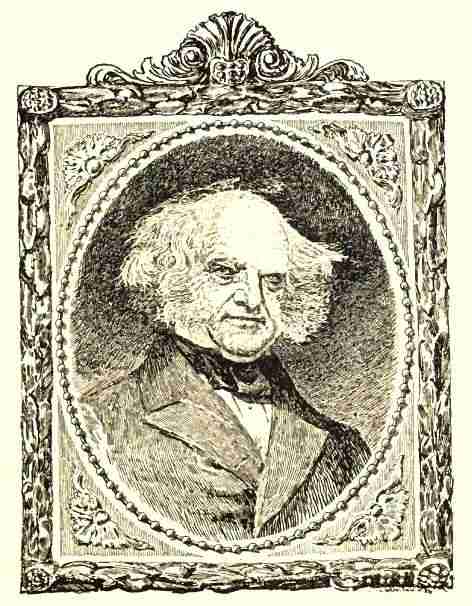
Martin Van Buren.
From a photograph by Brady.
One of Van Buren's earliest acts after assuming office was to call an
extra session of Congress for September 4, 1837, to consider the
financial condition of the country. When it convened, an increase of the
whig vote was apparent, though the Democrats were still in the majority.
On the President's recommendation, agitation now began in favor of the
sub-treasury or independent treasury plan, still in use to-day, of
keeping the government moneys. This had been first broached in 1834-35
by Whigs. The Democrats then opposed it; but now they took it up as a
means of counteracting the whig purpose to revive a national bank.
There was soon less need of any such special arrangement, as the
treasury was swiftly running dry. In June of the preceding year, 1836,
both parties concurring, an act had passed providing that after January
1, 1837, all surplus revenue should be distributed to the States in
proportion to their electoral votes. It was meant to be a loan, to be
recalled, however, only by vote of Congress, but it proved a donation.
Twenty-eight millions were thus paid in all, never to return. Such a
disposition of the revenue had now to be stopped and reverse action
instituted. Importers called for time on their revenue bonds, which had
to be allowed, and this checked income. This special session was needed
to authorize an issue of ten millions in treasury notes to tide the
Government over the crisis.
[1840]
Another influence which now worked powerfully against the Democracy was
hostility to slavery. This campaign–it was the first–saw a "Liberty
Party" in the field, with its own candidates, Birney and Earle. The
abolition sentiment, of which more will be said in a subsequent chapter,
was growing day by day, and little as the Whigs could be called an
antislavery party on the whole, their rank and file were very much more
of that mind than those of the opposition. Jackson had ranted wildly
against the despatch of abolition literature through the mails. The
second Seminole War, 1835-42, was waged mainly in deference to
slave-holders, to recover for them their Florida runaways, and, by
removal of the Seminoles beyond the Mississippi, to break up a popular
resort for escaped negroes. The Indians, under Osceola, whose wife, as
daughter to a slave-mother, had been treacherously carried back into
bondage, fought like tigers. After their massacre of Major Dade and his
detachment, Generals Gaines, Jesup, Taylor, Armistead, and Worth
successively marched against them, none but the last-named successful in
subduing them. Over 500 persons had been restored to slavery, each one
costing the Government, as was estimated, at least $80,000 and the lives
of three white soldiers.
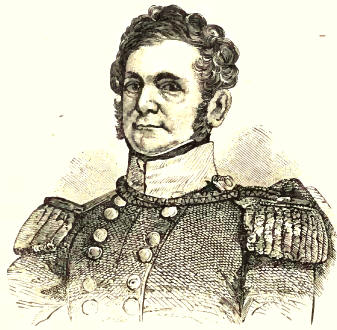
General William J. Worth.
[1839]
Van Buren was to the slavocrats even more obsequious than Jackson. His
spirit was shown, among other things, by the Amistad case, in 1839. The
schooner Amistad was sailing between Havana and Puerto Principe with a
cargo of negroes kidnapped in Africa. Under the lead of a bright negro
named Cinque the captives revolted and killed or confined all the crew
but two, whom they commanded to steer the ship for Africa. Instead,
these directed her to the United States coast, where she was seized off
Long Island by a war vessel and brought into New London. The negroes
were, even by Spanish law, not slaves but free men, as Spain had
prohibited the slave trade. Yet when their case was tried before the
district court, Mr. Van Buren spared no effort to procure their release
to the Spanish claimants. He even had a government vessel all ready to
convey the poor victims back to Cuba. The district court having decided
for the blacks, the government attorney appealed to the circuit court,
thence also to the supreme court. Final judgment happily re-affirmed
that the men were free. The supreme court trial was the occasion of one
of John Quincy Adams's most splendid forensic victories, he being the
counsel for the negroes.
The attitude of the administration in this affair greatly injured the
party in the North, the more as it but illustrated a spirit and policy
which had grown characteristic of the party's head. In several instances
previous to this time, when ships conveying slaves from one of the
United States to another, entered the ports of the Bahama Islands
through stress of weather, England had, while freeing them, allowed some
compensation. Now, having emancipated the slaves in her own West Indian
possessions, she declined longer to continue that practice. Her first
refusal touched the slaves on the ship Enterprise, which had put in at
Port Hamilton in 1835. Jackson's administration in vain sought
indemnity, Van Buren, then Secretary of State, designating this business
as "the most immediately pressing" before the English embassy.
[1840]
In the same pro-slavery interest an increasing proportion of the
Democracy, though not Van Buren himself, had come to favor the
annexation of Texas. The southwestern boundary of the United States had
ever since the purchase in Florida in 1819 been recognized as the Sabine
River, west of this lying the then foreign country of Texas. France had
claimed the Rio Grande as Louisiana's western bound, but Mr. Monroe, to
placate the North in the Florida annexation, had receded from this
claim. Texas and Coahuila became a state in the new Mexican republic,
which Spain recognized in 1821; but in 1836 Texas declared itself
independent. It was ill-governed and weighed down with debt, and hence
almost immediately, in 1837, asked membership in the American Union. Its
annexation was bitterly opposed all over the North, so bitterly in fact
that the northern Democrats would not have dared, even had they wished,
to favor the scheme. Yet so strong was the southern influence in the
party by 1840 that the democratic platform that year urged the
"re-annexation" of Texas, the term assuming that as a part of Louisiana
it had always been ours since 1803. This was a fact, but it was now
asseverated by the Democracy for a selfish sectional purpose, and the
cry brought thousands of votes to the Whigs.
It proved good politics for the Whigs in 1840 to pass over Clay and
adopt as their candidate William Henry Harrison. He had indeed been
unsuccessful in 1836, owing to the great popularity of Jackson, all
whose influence went for Van Buren; but now that "Little Van," or
"Matty," as Jackson used to call him, stood alone, Harrison had a better
chance. His political record had been inconspicuous but honorable.
Nothing could be alleged against his character. He was a gentleman of
some ability, while his brilliant military record in 1812, now revived
to the minutest detail, gave him immense popularity. Every surviving
Tippecanoe or Thames veteran stumped his vicinity for the old war-horse.
Many wavering Democrats in the South, especially those of the
nullification stripe, were toled to the whig ticket by the nomination of
John Tyler for Vice-President. "Tippecanoe and Tyler too" rang through
the land as the whig watchword for the campaign. During the
electioneering every hamlet was regaled with portrayals of Harrison's
simple farm life at North Bend, where, a log cabin his dwelling, and
hard cider–so one would have supposed–his sole beverage, he had been a
genuine Cincinnatus. "Tippecanoe and Tyler" were therefore elected;
their popular vote numbering 1,275,017, against 1,128,702 polled for Van
Buren.
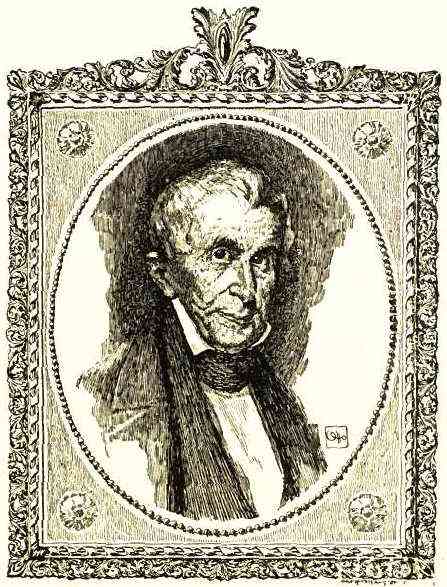
William Henry Harrison
From a Copy at the Corcoran Art Gallery of a painting by Beard in 1840.
However, this whig success, for a moment so imposing, proved superficial
and brief. Harrison died at the end of his first month in office, and
Tyler, coming in, showed that though training under the whig banner, he
had not renounced a single one of his democratic principles. The Whigs
scorned and soon officially repudiated him During the entire four years
that he held office there was constant deadlock between him and the
slight whig majority in Congress, which gave the Democrats main control
in legislation. The panic of 1837 was forgotten, while the hold of the
Democracy upon the country was so firm that its gains in Congress and
its triumphs in the States once more went steadily on.