
[1816]
It was a delicate question after the Louisiana purchase how much
territory it embraced east of the Mississippi. Louisiana had under
France, till 1762, reached the Perdido, Florida's western boundary at
present, and was "retroceded" by Spain to France in 1800 "with the same
extent that it had when France possessed it." The United States of
course succeeded to whatever France thus recovered. Spain claimed still
to own West Florida, the name given by Great Britain on receiving it
from France in 1763 to the part of Louisiana between the Perdido and the
Mississippi. Spain had never acquired the district from France, but
obtained it by conquest from Great Britain during our Revolution.
This claim by Spain, based only on the "retro" in the treaty of 1800,
our Government viewed as fanciful, regarding West Florida undoubtedly
ours through the Louisiana purchase. Spain was intractable, first of
herself, later still more so through Napoleon's dictation. Hence our
offer, in Jefferson's time, to avoid war, of a lump sum for the two
Floridas was spurned by her. In 1810 and 1811, to save it from
anarchy–also to save it from Great Britain or France, now in the
whitest heat of their contest for Spain–we occupied West Florida, as
certainly entitled to it against those powers, yet with no view of
precluding further negotiations with Spain. When in 1812 Louisiana
became a State, its eastern boundary ran as now, including a goodly
portion of the region in debate.
[1817]
The necessity of acquiring East Florida, too, was more and more
apparent. That country was without rule, full of filibusterers,
privateers, hostile refugee Creeks and runaway negroes, of whose
services the English had availed themselves freely during the war of
1812, when Spaniards and English made Florida a perpetual base for
hostile raids into our territory. A fort then built by the English on
the Appalachicola and left intact at the peace with some arms and
ammunition, had been occupied by the negroes, who, from this retreat,
menaced the peace beyond the line. Spain could not preserve law and
order here. This was perhaps a sufficient excuse for the act of General
Gaines in crossing into Florida and bombarding the negro fort, July 27,
1816. Amelia Island, on the Florida coast, a nest of lawless men from
every nation, was in 1817 also seized by the United States with the same
propriety. Knowledge that Spain resented these acts encouraged the
Floridians. Collisions continually occurred all along the line, finally
growing into general hostility. Such was the origin of the First
Seminole War.
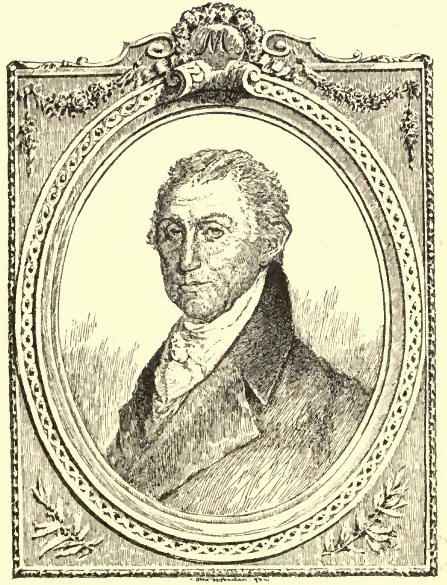
James Monroe. From a painting by Gilbert Stuart–now the property of T.
Jefferson Coolidge.
[1818]
December, 1817, Jackson was placed in command in Georgia. To clear out
the filibusterers, the chief source of the Indians' discontent ever
since before the Creek War, the hero of New Orleans, mistakenly
supposing himself to be fortified by his Government's concurrence,
boldly took forcible possession of all East Florida. Ambrister and
Arbuthnot, two officious English subjects found there, he put to death.
This procedure was quite characteristic of Old Hickory. He acted upon
the theory that by the law of nations any citizen of one land making war
upon another land, the two being at peace, becomes an outlaw.
International law has no such doctrine, and most likely the maxim
occurred to Jackson rather as an excuse after the act than in the way of
forethought. Nor was it ever proved that the two victims were guilty as
Jackson alleged. With him this probably made little difference. Having
undertaken to quiet the Floridian outbreaks he was determined to
accomplish his end, whatever the consequences of some of his means.
With the country the New Orleans victor, who had now dared to hang a
British subject, was ten times a hero, but the deed confused and
troubled Monroe's cabinet not a little. Calhoun wished General Jackson
censured, while all his cabinet colleagues disapproved his high-handed
acts and stood ready to disavow them with reparation. On this occasion
Jackson owed much to one whom he subsequently hated and denounced, viz.,
Quincy Adams, by whose bold and acute defence of his doubtful doings,
managed with a fineness of argument and diplomacy which no then American
but Adams could command, he was formally vindicated before both his own
Government and the Governments of England and Spain.
The posts seized had of course to be given up, yet our bold invasion had
rendered Spain willing at last to sell Florida, while Great Britain,
wishing our countenance in her opposition to the anti-progressive,
misnamed Holy Alliance of continental monarchs, concurred. Spain after
all got the better of the bargain, as we surrendered all claim to Texas,
which the Louisiana purchase had really made ours.
[1823]
The Florida imbroglio nursed to its first public utterance a sentiment
which has ever since been spontaneously taken as a principle of American
public policy, almost as if it were a part of our law itself. Spain's
American dependencies had been sensible enough to avail themselves of
that land's distraction in Napoleon's time, to set up as states on their
own account. She naturally wanted them back. Ferdinand VII. withheld
till 1820 his signature of the treaty ceding Florida, in order to
prevent–which, after all, it did not–our recognition of these
revolted provinces as independent nations. Backed by the powerful
Austrian minister, Metternich, and by the Holy Alliance, France, having
aided Ferdinand to suppress at home the liberal rebellion of 1820-23,
began to moot plans for subduing the new Spanish-American States. Great
Britain opposed this, out of motives partly commercial, partly
philanthropic, partly relating to international law, yet was unwilling
so early to recognize the independence of those nations as the United
States had done.
Assured at least of England's moral support, President Monroe in his
message of December, 1823, declared that we should consider any attempt
on the part of the allied monarchs "to extend their system to any
portion of this hemisphere as dangerous to our peace and safety," and
any interposition by them to oppress the young republics or to control
their destiny, "as a manifestation of an unfriendly disposition toward
the United States." This, in kernel, is the first part of Monroe's
doctrine.
The second part added: "The American continents, by the free and
independent condition which they have assumed and maintain, are
henceforth not to be considered as subjects for future colonization by
any European powers." The meaning of this was that the mere hap of first
occupancy on the continent by the citizens of any country would not any
longer be recognized by us as giving that country a title to the spot
occupied.
These important doctrines–for though akin in principle they are really
two–were no sudden creation of individual thought, but the result
rather of slow processes in the public mind. Germs of the first are
traceable to Washington; express statements of both, yet not essentially
detracting from Monroe's originality, to Jefferson. Both were put in
form by Quincy Adams, Monroe's Secretary of State. Especially Monroe's,
we believe, is the second, a resolution to which Russia's advance down
the Pacific coast, and more still the recent vexations from the
proximity of Spain in Florida, had pushed him.