
It has always been admitted that Congress may lay taxes to build and
improve light-houses, public docks, and all such properties whereof the
United States is to hold the title. The general improvement of harbors,
on the other hand, the Constitution meant to leave to the States,
allowing each to cover the expense by levying tonnage duties. The
practice for years corresponded with this. The inland commonwealths,
however, as they were admitted, justly regarded this unfair unless
offset by Government's aid to them in the construction of roads, canals,
and river ways.
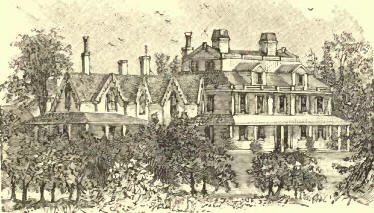
Webster's Home at Marshfield. Mass.
The War of 1812 revealed the need of better means for direct
communication with the remote sections of the Union. Transportation to
Detroit had cost fifty cents per pound of ammunition, sixty dollars per
barrel of flour. All admitted that improved internal routes were
necessary. The question was whether the general Government had a right
to construct them without amendment to the Constitution.
The Whigs, like the old Federalists, affirmed such right, appealing to
Congress's power to establish post-roads, wage war, supervise
inter-state trade, and conserve the common defence and general welfare.
As a rule, the Democrats, being strict constructionists, denied such
right. Some of them justified outlay upon national rivers and commercial
harbors under the congressional power of raising revenue and regulating
commerce. Others conceded the rightfulness of subsidies to States even
for bettering inland routes. Treasury surplus at times, and the many
appropriations which, by common consent, had been made under Monroe and
later for the old National Road, encouraged the whig contention; but the
whig policy had never met general approval down to the time when the
whole question was taken out of politics by the rise of the railroad
system after 1832. The National Road, meantime, extending across Ohio
and Indiana on its way to St. Louis, was made over in 1830 to the States
through which it passed.
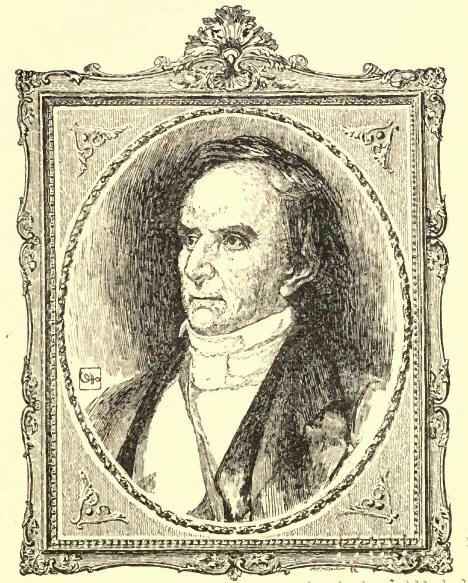
Daniel Webster. From a picture by Healy at the State Department,
Washington.
The Whig Party deserves great praise as the especial repository, through
several decades, of the spirit of nationality in our country. It
cherished this, and with the utmost boldness proclaimed doctrines
springing from it, at a time when the Democracy, for no other reason
than that it had begun as a state rights party, foolishly combated
these. Yet Whiggism was mightier in theories than in deeds, in political
cunning than in statesmanship. It was far too fearful, on the whole,
lest the country should not be sufficiently governed. To secure power it
allied itself now with the Anti-Masons, strong after 1826 in New
England, New York, and Pennsylvania; and again with the Nullifiers of
South Carolina, Georgia, and Tennessee, led by Calhoun, Troup, and
White. It did the latter by making Tyler, an out-and-out Nullifier, its
Vice-President in 1840.
A leading Whig during nearly all his political career was John Quincy
Adams, one of the ablest, most patriotic, and most successful presidents
this country has ever had. He possessed a thorough education, mainly
acquired abroad, where, sojourning with his distinguished father, he had
enjoyed while still a youth better opportunities for diplomatic training
than many of our diplomatists have known in a lifetime. He went to the
United States Senate in 1803 as a Federalist. Disgusted with that party,
he turned Republican, losing his place. From 1806 to 1809 he was
professor in Harvard College. In the latter year Madison sent him
Minister to St. Petersburg. He was commissioner at Ghent, then Minister
to England, then Monroe's Secretary of State, then President.
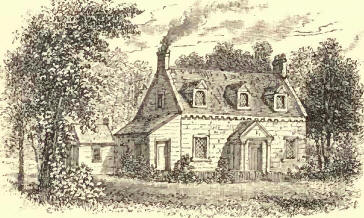
The House in which Henry Clay was Born.
But Mr. Adams's best work was done in the House of Representatives after
he was elected to that body in 1830. He sat in the House until his
death, in 1848–its acknowledged leader in ability, in activity, and in
debate. Friend and foe hailed him as the "Old Man Eloquent," nor were
any there anxious to be pitted against him. He spoke upon almost every
great national question, each time displaying general knowledge; legal
lore, and keenness of analysis surpassed by no American of his or any
age.
Webster was, however, the great orator of the party. Reared upon a farm
and educated at Dartmouth College, he went to Congress from New
Hampshire as a Federalist in 1813. Removing to Boston, he soon entered
Congress from Massachusetts, first as representative, then as senator,
and from 1827 was in the Senate almost continuously till 1850. He was
Secretary of State under Harrison and Tyler, and again in the
Taylor-Fillmore cabinet from 1850.
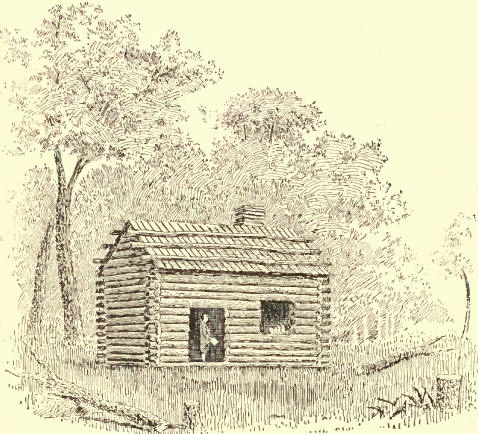
The School-house of the Slashes.
As an orator Webster had no peer in his time, nor have the years since
evoked his peer. He was an influential party leader, and repeatedly
thought of for President, though too prominent ever to be nominated. On
two momentous questions, the tariff and slavery, he vacillated, his
dubious action concerning the latter costing him his popularity in New
England.
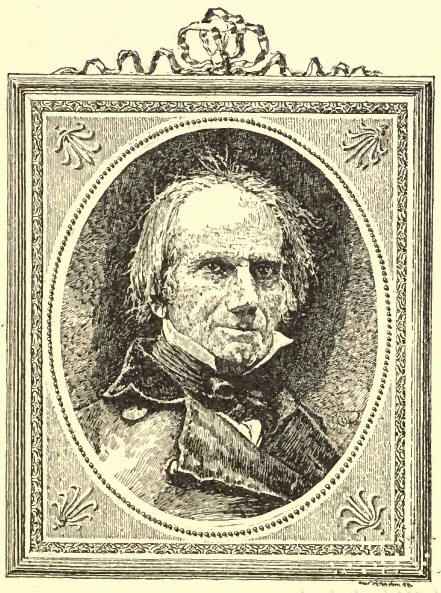
Henry Clay. From a photograph by Rockwood of an old daguerreotype.
Yet in many respects the most interesting figure in the party was Henry
Clay. He was born amid the swamps of Hanover County, Va., and had grown
up in most adverse surroundings. His father, a Baptist clergyman, died
while he was an infant, leaving him destitute. In "The Slashes," as the
neighborhood where Clay passed his childhood was called, he might often
have been seen astride a sorry horse with a rope bridle and no saddle,
carrying his bag of grain to the mill. He had attended only district
schools. After obtaining the rudiments of a legal education in Richmond
by service as a lawyer's clerk, he removed to Kentucky. He was soon
famous as a criminal lawyer, and a little later as a politician. The
rest of his life was spent in Congress or cabinet.
Clay's speeches read ill, but were powerful in their delivery. He spoke
directly to the heart. As he proceeded, his tall and awkward form swayed
with passion. His voice was sweet and winsome. Once Tom Marshall was to
face him in joint debate over a salary grab for which Clay had voted.
Clay had the first word, and as he warmed to his work Marshall slunk
away through the crowd in despair. "Come back," said Clay's haters to
him; "you can answer every point." "Of course," replied Marshall, "but I
can't get up there and do it now." The common people shouted for Clay as
they shouted for neither Webster nor Adams. He had infinite fund of
anecdote, remembered everyone he had ever seen, and was kindly to all.
John Tyler is said to have wept when Clay failed of the Presidential
nomination in the Whig Convention of 1839.
[1840]
Clay's vices and inconsistencies were readily forgiven. He had denounced
duelling as barbarous, yet when sharp-tongued John Randolph referred to
him and Adams as having, in 1825, formed "the coalition of Blifil and
Black George, the combination of the Puritan and the blackleg"–for Clay
gambled–Clay challenged him. They met, the diminutive Randolph being in
his dressing-gown. Neither was hurt, as Randolph fired in air and Clay
was no shot. Being asked why he did not kill Randolph, Clay said: "I
aimed at the part of his gown where I thought he was, but when the
bullet got there he had moved." In 1842, when Lord Ashburton was in
Washington, there was a famous whist game, my lord, with Mr. Crittenden,
playing against Clay and the Russian Minister, Count Bodisco, while
Webster looked on. "What shall the stake be?" asked his lordship. "Out
of deference to Her Majesty," said Clay, "we will make it a sovereign."
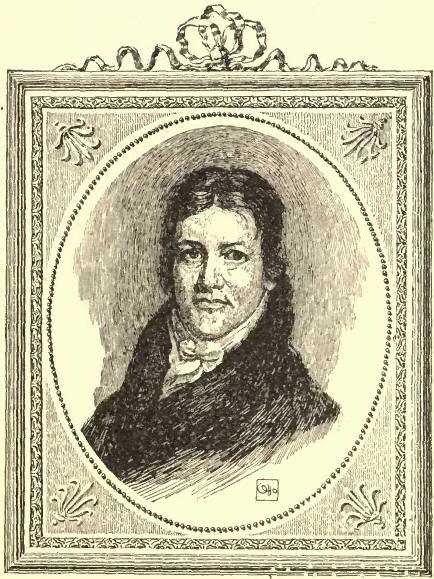
John Randolph.
From a picture by Jarvis in 1811, at the New York Historical Society.
Emphatically patriotic, super-eminent in debate, ambitious, adventurous
in political diplomacy, a hard worker, incessant in activity for his
party, temperate upon the slavery question, whole-souled in every
measure or policy calculated to advance nationality, this versatile man
may be put down as foremost among the leaders of the Whig Party from its
origin till his death.