[1748]
The Peace of Aix-la-Chapelle had been made only because the contestants
were tired of fighting. In America, at least, each at once began taking
breath and preparing to renew the struggle. Not a year passed that did
not witness border quarrels more or less bloody. The French authorities
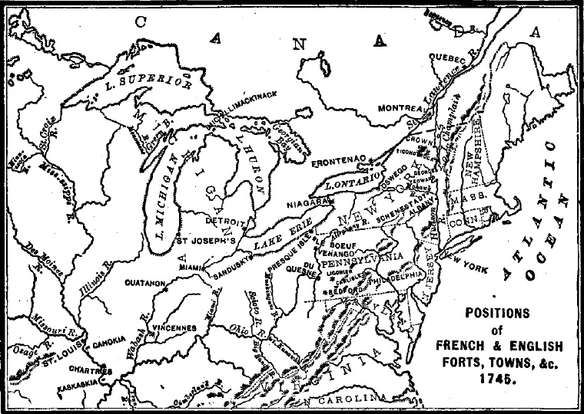
filled the Ohio and Mississippi valleys with military posts; English
settlers pressed persistently into the same to find homes. In this
movement Virginia led, having in 1748 formed, especially to aid western
settlement, the Ohio Company, which received from the king a grant of
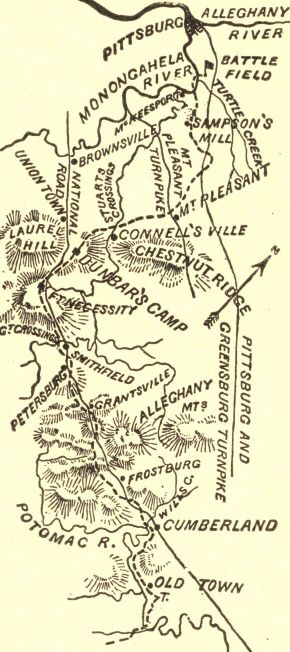
five hundred thousand acres beyond the Alleghanies. A road was laid out
between the upper Potomac and the present Pittsburgh, settlements were
begun along it, and efforts made to conciliate the savages.
Map showing Position of French and English Forts and Settlements.
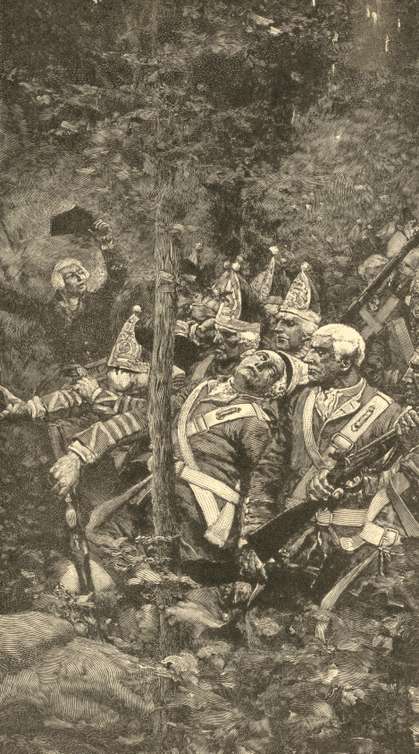
The Ambuscade.
[1754]
One of the frontier villages was at what is now Franklin, Penn., and the
location involved Virginia with the colony of Pennsylvania. As
commissioner to settle the dispute George Washington was sent out.
The future Father of his Country was of humble origin. Born in
Westmoreland County, Va., "about ten in ye morning of ye 11th day of
February, 1731-32," as recorded in his mother's Bible, he had been an
orphan from his earliest youth. His education was of the slenderest. At
sixteen he became a land surveyor, leading a life of the roughest sort,
beasts, savages, and hardy frontiersmen his constant companions,
sleeping under the sky and cooking his own coarse food. No better man
could have been chosen to thread now the Alleghany trail.
Washington reported the French strongly posted in western Pennsylvania
on lands claimed by the Ohio Company. Virginia fitted out an expedition
to dislodge them. Of this Washington commanded the advance. Meeting at
Great Meadows the French under Contrecoeur, commander of Fort Du Quesne
(Pittsburgh); he was at first victorious, but the French were
re-enforced before he was, and Washington, after a gallant struggle, had
to capitulate. This was on July 3, 1754. The French and Indian War had
begun.
Baddock's Route.
[1755]
The English Government bade the colonies defend their frontier, and in
this interest twenty-five delegates from the seven northern colonies met
at Albany on June 19, 1754. Benjamin Franklin represented Pennsylvania,
and it was at this conference that he presented his well-considered
plan, to be described in our chapter on Independence, for a general
government over English America. The Albany Convention amounted to
little, but did somewhat to renew alliance with the Six Nations.
[footnote: Increased from five to six by the accession of the
Tuscaroras.]
In this decisive war England had in view four great objects of conquest
in America: 1. Fort Du Quesne; 2. The Ontario basin with Oswego and Fort
Niagara; 3. The Champlain Valley; 4. Louisburg. The British ministry
seemed in earnest. It sent Sir Edward Braddock to this side with six
thousand splendidly equipped veterans, and offered large sums for
fitting out regiments of provincials. Braddock arrived in February,
1755, but moved very languidly. This was not altogether his fault, for
he had difficulties with the governors and they with their legislatures.
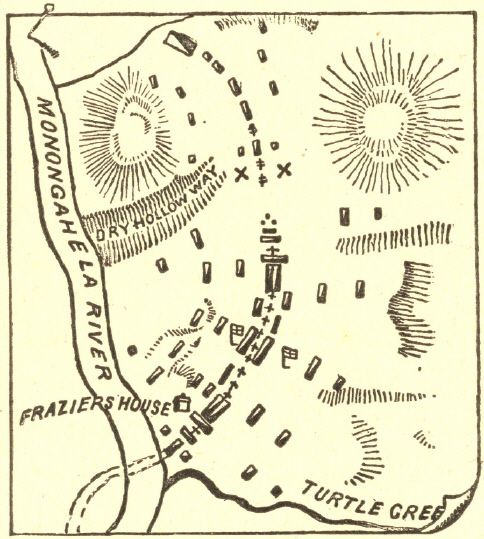
Map of Braddock's Field.
At last off for Fort Du Quesne, he took a needlessly long route, through
Virginia instead of Pennsylvania. He scorned advice, marching and
fighting stiffly according to the rules of the Old World military art,
heeding none of Franklin's and Washington's sage hints touching savage
modes of warfare. The consequence was this brave Briton's defeat and
death. As he drew near to Fort Du Quesne, he fell into a carefully
prepared ambuscade. Four horses were shot under him. Mounting a fifth he
spurred to the front to inspire his men, forbidding them seek the
slightest cover, as Washington urged and as the provincials successfully
did. The regulars, obeying, were half of them killed in their tracks,
the remainder retreating, in panic at first, to Philadelphia. Braddock
died, and was buried at Great Meadows, where his grave is still to be
seen.
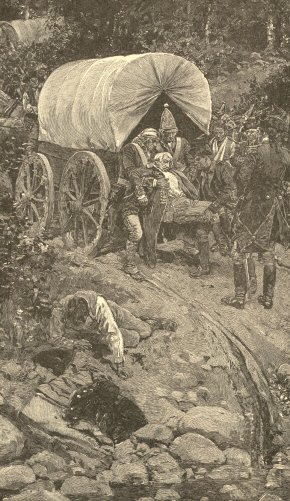
The Death of Braddock.
Washington was the only mounted officer in this action who was not
killed or fatally wounded, a fact at the time regarded specially
providential. On his return, aged twenty-three, the Rev. Samuel Davies,
afterward President of the College of New Jersey, referred to him in his
sermon as "that heroic youth, Colonel Washington, whom I cannot but hope
Providence has preserved in so signal a manner for some important
service to his country."
[1757]
The early part of this war witnessed the tragic occurrence immortalized
by Longfellow's "Evangeline," the expulsion of the French from Acadia.
The poem is too favorable to these people. They had never become
reconciled to English rule, and were believed on strong evidence to be
active in promoting French schemes against the English. It was resolved
to scatter them among the Atlantic settlements. The act was savage, and
became doubly so through the unmeant cruelties attending its execution.
The poor wretches were huddled on the shore weeks too soon for their
transports. Families were broken up, children forcibly separated from
parents. The largest company was carried to Massachusetts, many to
Pennsylvania, some to the extreme South. Not a few, crushed in spirit,
became paupers. A number found their way to France, a number to
Louisiana, a handful back to Nova Scotia.
Braddock was succeeded by the fussy and incompetent Earl of Loudon,
1756-57, whom Franklin likened to Saint George on the sign-posts,
"always galloping but never advancing." He gathered twelve thousand men
for the recapture of Louisburg, but exaggerated reports of the French
strength frightened him from the attempt. Similar inaction lost him Fort
William Henry on Lake George. The end of the year 1757 saw the English
cause on this side at low ebb, Montcalm, the tried and brilliant French
commander, having outwitted or frightened the English officers at every
point.
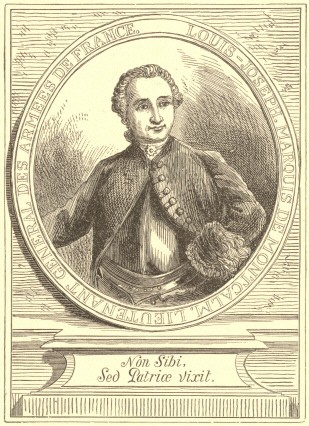
Montcalm.
From this moment all changes. William Pitt, subsequently Lord Chatham,
now became the soul of the British ministry. George III. had dismissed
him therefrom in 1757, but Newcastle found it impossible to get on
without him. The great commoner had to be recalled, this time to take
entire direction of the war.
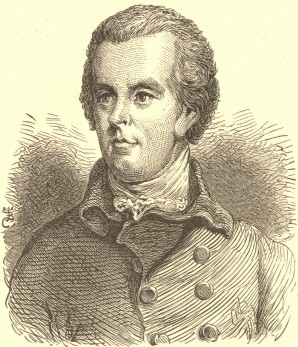
William Pitt.
[1758]
Pitt had set his mind on the conquest of Canada. He superseded Loudon
early in 1758 by General Amherst, who was seconded by Wolfe and by
Admiral Boscawen, both with large re-enforcements. They were to reduce
Louisburg. It was an innovation to assign important commands like these
to men with so little fame and influence, but Pitt did not care. He
believed his appointees to be brave, energetic, skilful, and the event
proved his wisdom. Louisburg fell, and with it the whole of Cape Breton
Island and also Prince Edward.
Unfortunately General Abercrombie had not been recalled with Loudon. The
same year, 1758, he signally failed to capture Ticonderoga, leaving the
way to Montreal worse blocked than before. Fort Du Quesne, however,
General Forbes took this year at little cost, rechristening it
Pittsburgh in honor of the heroic minister who had ordered the
enterprise.
[1759]
In the year 1759 occurred a grand triple movement upon Canada. Amherst,
now general-in-chief, was to clear the Champlain Valley, and Prideaux
with large colonial forces to reduce Fort Niagara. Both had orders,
being successful in these initial attacks, to move down the St. Lawrence
and unite with Wolfe, who was to sail up that river and beset Quebec.
Prideaux was splendidly successful, as indeed was Amherst in time,
though longer than he anticipated in securing Ticonderoga and Crown
Point.
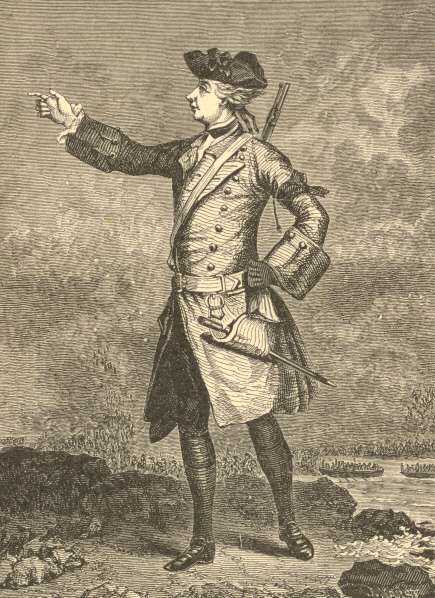
General Wolfe.
Meantime Wolfe at Quebec was trying in all ways to manoeuvre the crafty
Montcalm out of his impregnable works. Failing, he in his eagerness
suffered himself to attempt an assault upon the city, which proved not
only vain but terribly costly. A weaker commander would now have given
up, but Wolfe had red hair, and the grit usually accompanying.
Undaunted, he planned the hazardous enterprise of rowing up the St.
Lawrence by night, landing with five thousand picked men at the foot of
the precipitous ascent to the Plains of Abraham, and scaling those
heights to face Montcalm from the west. The Frenchman, stunned at the
sight which day brought him, lost no time in attacking. In the hot
battle which ensued, September 13, 1759, both commanders fell, Wolfe
cheering his heroes to sure victory, Montcalm urging on his forlorn hope
in vain. The English remained masters of the field and in five days
Quebec capitulated.
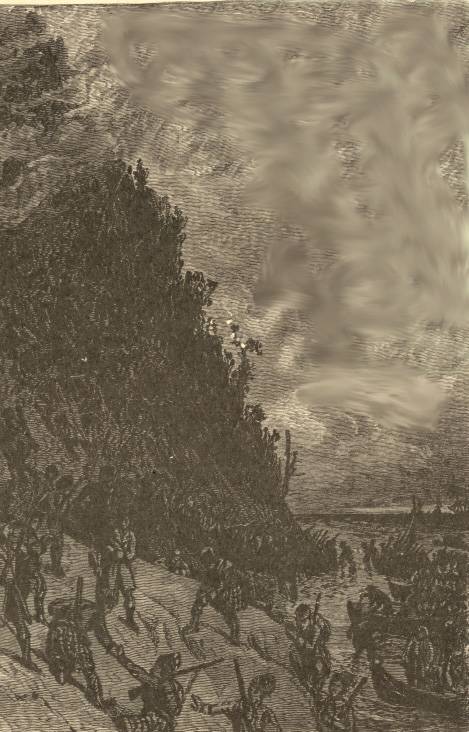
Landing of Wolfe.
[1760-1763]
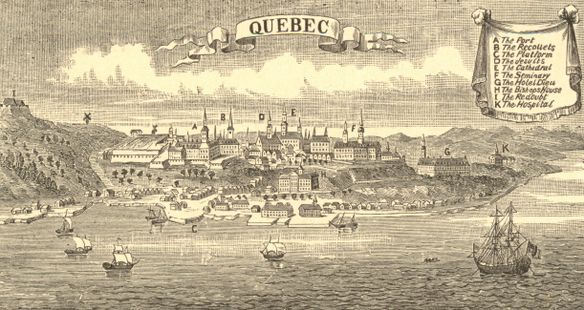
Quebec in 1730–From an old Print.
Vaudreuil, the French commander at Montreal, sought to dislodge the
English ere the ice left the river in the spring of 1760, and succeeded
in driving them within their works. Each side then waited and hoped for
help from beyond sea so soon as navigation opened. It came the earlier
to the English, who were gladdened on May 11th by the approach of a
British frigate, the forerunner of a fleet. They now chased Vaudreuil
back into Montreal, where they were met by Haviland from Crown Point and
by Amherst from Oswego. France's days of power in America were ended.
Her fleet of twenty-two sail intended for succor met total destruction
in the Bay des Chaleurs and by the Peace of Paris, 1763, she surrendered
to her victorious antagonist every foot of her American territory east
of the Mississippi, save the city of New Orleans.
The Indians were thus left to finish this war alone. Pontiac, the brave
and cunning chief of the Ottawas, aghast at the rising might of the
English, and the certain fate of his race without the French for
helpers, organized a conspiracy including nearly every tribe this side
the Mississippi except the Six Nations, to put to the sword all the
English garrisons in the West. Fatal success waited upon the plan. It
was in 1763 Forts Sandusky, St. Joseph (southeast of Lake Michigan),
Miami (Fort Wayne), Presque Isle (Erie, Pa.), Le Boeuf, Venango, and
Pittsburgh were attacked and all but the last destroyed, soldiers and
settlers murdered with indescribable barbarities. Pittsburgh held out
till re-enforced, at dreadful cost in blood, by Colonel Bouquet and his
Highlanders, who marched from Philadelphia.
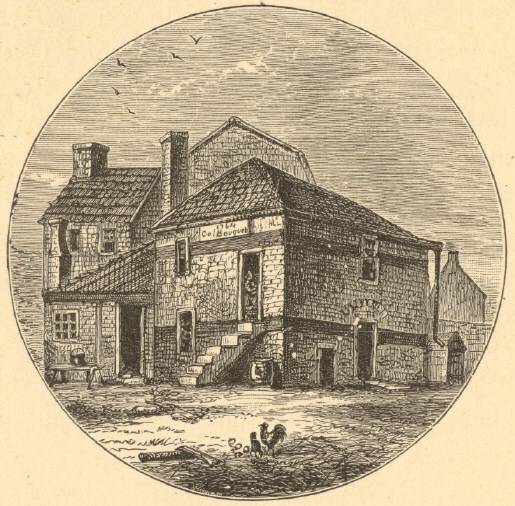
Bouquet's Redoubt at Pittsburgh.
The hottest and longest conflict was at Detroit, Major Gladwyn
commanding, where Pontiac himself led the onset, heading perhaps a
thousand men. The siege was maintained with fearful venom from May 11th
till into October. The English tried a number of sallies, brave, fatal,
vain, and were so hard pressed by their bloodthirsty foe that only
timely and repeated re-enforcements saved them. At last the savages,
becoming, as always, disunited and straitened for supplies, sullenly
made peace; and at the call of the rich and now free Northwest, caravans
of English immigrants thronged thither to lay under happiest auspices
the foundations of new States.
END OF VOLUME l.