Totem of the Sioux.
[1659-1672]
Working upward from the mouth of the St. Lawrence to the source of this
and of the Mississippi, and then down the latter river, Franciscans and
Jesuits their pioneers, braving dreadful hardships and dangers in
efforts, more courageous than successful, to convert the Indians, the
French had come to control that great continental highway and boldly to
claim for France the entire heart of North America.
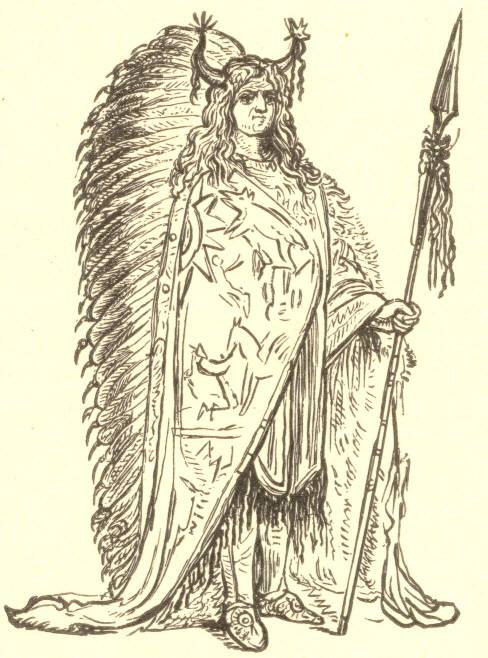
A Sioux Chief.
In 1659, Groseilliers and Radisson penetrated beyond Lake Superior, and
dwelt for a time among the Sioux, who knew of the Mississippi River.
Next year Groseilliers went thither again, accompanied by the Jesuit
Menard and his servant, Guerin. In 1661 Menard and Guerin pushed into
what is now Wisconsin, and may have seen the Mississippi. These
explorations made the French familiar with the copper mines of Lake
Superior, and awakened the utmost zeal to see the Great River of which
the Indians spoke. La Salle probably discovered the Ohio in 1670, and
traced it down to the falls at Louisville. His main eulogist holds that
he even reached the Mississippi at that time, some three years earlier
than Joliet, but this is not substantiated. We also reject the belief
that he reached the stream by way of the Chicago portage in 1671.
Totem of the Illinois.
[1676]
In 1672 Count Frontenac, Governor of New France, despatched Louis Joliet
to discover the Great River. He reached the Strait of Mackinaw in
December, and there Pere Marquette joined him. In May, next year, they
paddled their canoes up the Fox River and tugged them across the portage
into the Wisconsin, which they descended, entering the Father of Waters
June 17, 1673. They floated down to the mouth of the Arkansas and then
returned, their journey back being up the Illinois and Desplaines
Rivers. Joliet gave his name to the peak on the latter stream which the
city of Joliet, Ill., near by, still retains. Joliet arrived at Quebec
in August, 1674, having in four months journeyed over twenty-five
hundred miles.
It thus became known how close the upper waters of the great rivers, St.
Lawrence and Mississippi, were to each other, and that the latter
emptied into the Gulf of Mexico instead of the South Sea (Pacific); yet,
as the Rocky Mountains had not then been discovered, it was for long
believed that some of the western tributaries of the Great River led to
that western ocean.
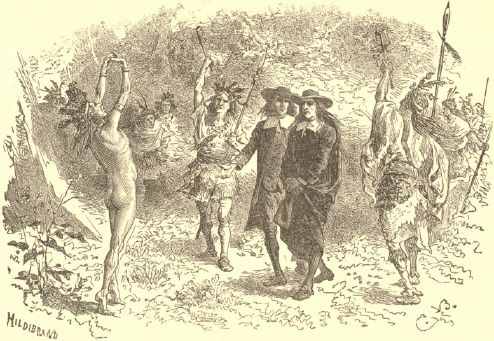
The Reception of Joliet and Marquette by the Illinois.
[1682]
In 1676 Raudin, and three years later, Du Lhut, visited the Ojibwas and
Sioux west of Lake Superior. Du Lhut reached the upper waters of the
Mississippi at Sandy Lake. He went there again in 1680. In 1682 La Salle
crossed the Chicago portage and explored the lower Mississippi all the
way to the Gulf, taking possession of the entire valley in the name of
France and naming it Louisiana. Nicholas Perrot travelled by way of the
Fox and Wisconsin Rivers to the upper Mississippi in 1685, and again in
1688. It is in his writings that the word "Chicago" first appears in
literature.
There were thus between the two great valleys, 1, the Superior route; 2,
the Wisconsin and Fox route; 3, the Illinois River route, whether by the
Kankakee, La Salle's way, or by the south branch of the Chicago River,
Joliet's way; and 4, the route by the Wabash and Ohio. The Wabash, too,
could be approached either from Lake Erie or from Lake Michigan, through
St. Joseph's River. At high water, canoes often passed from Lake
Michigan into the Mississippi without portage.
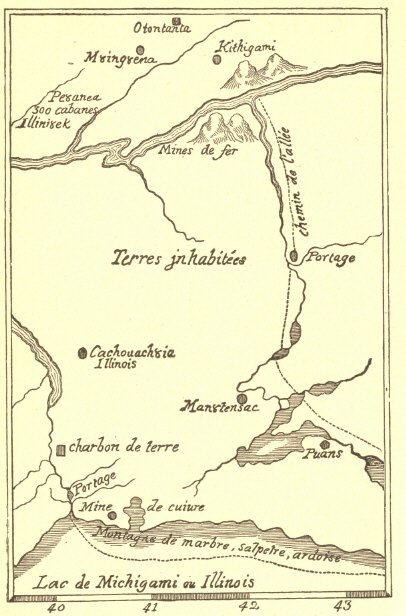
A Part of the Map Published in Paris by Thevenot as
"Marquette's Map." It shows the route taken by Joliet across Wisconsin
from the Baie des Puans (now Green Bay) to the Mississippi River, also
part of the return journey, that is, from the present site of Chicago,
northward along lake Michigan.
[1685-1690]
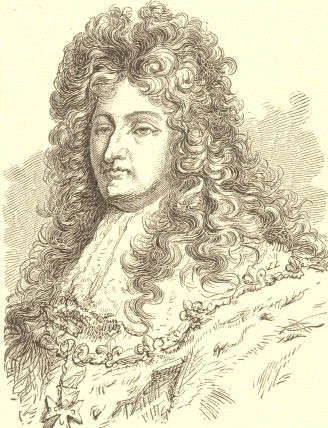
Louis XIV.
La Salle had the ambition to get to the South Sea from the Mississippi.
Governor De la Barre, who followed Frontenac, opposing him, he repaired
to France, where he succeeded in winning Louis XIV. to his plan. At the
head of a well-equipped fleet he sailed for the mouth of the
Mississippi, reaching land near Matagorda Bay on the first day of the
year 1685. Not finding the Mississippi, La Salle's officers mutinied.
The expedition broke up into parties, wandering here and there,
distressed by Indian attacks and by treachery among themselves. La Salle
was shot by his own men. Nearly all his followers perished, but a small
party at last discovered the river and ascended it to Fort St. Louis on
the Illinois, reaching France via Quebec. In this expedition France
took possession of Texas, nor did she ever relinquish the claim till, in
1763, the whole of Louisiana west of the Mississippi was ceded to Spain,
La Salle's ill-starred attempt led later to the planting of French
colonies by D'Iberville at Biloxi Island, in Mobile Bay, soon abandoned,
and at Poverty Point, on the Mississippi; and still later to the
settlement of New Orleans and vicinity. Growth in these parts was slow,
however. So late as 1713 there were not over three hundred whites in the
entire Mississippi Valley.

Coins Struck In France for the Colonies.
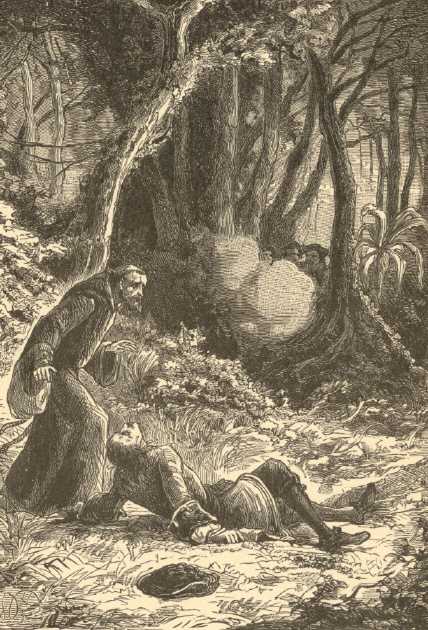
Assassination of La Salle.
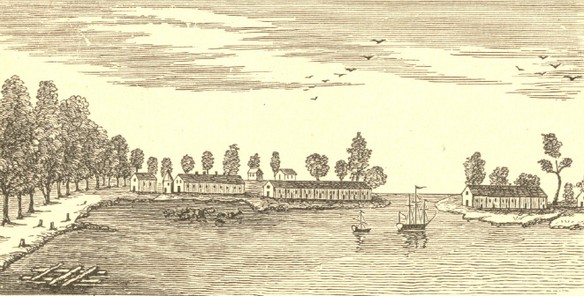
New Orleans in 1719.
By this time French traders had set foot on every shore of the great
lakes and explored nearly every stream tributary thereto. The English,
pushing westward more and more, were trying to divide with them the
lucrative business of fur-trading, and each nation sought to win to
itself all the Indians it could. The Mohawks and their confederates of
the Five Nations, now equipped and acquainted with fire-arms, spite of
alternate overtures and threats from the French, remained firm friends
to the English, who more and more invaded those vast and fertile western
ranges. It grew to be the great question of the age this side the
Atlantic, whether England or France should control the continent. King
William's war, declared in 1689, was therefore certain to rage in
America as well as in Europe.

Signature of D'Iberville.
One sees by a glance at the map what advantage France had in this
struggle. It possessed the best fishing grounds and fur-producing
districts, and fish and furs were at first the only exports of value
from the north of America. The French, too, held all the water-ways to
the heart of the continent. Coming up Lake Champlain they could threaten
New York and New England from the rear. The colonies farther south they
shut in almost as straitly, French bullets whistling about any
Englishman's ears the instant he appeared beyond the mountains.
In other respects England had the advantage. In population English
America had become as superior as French America was territorially,
having 1,116,000 white inhabitants in 1750, to about 80,000 French. The
English colonies were also more convenient to the mother-country, and
the better situated for commerce both coastwise and across the ocean.
Among the English, temper for mere speculation and adventure decayed
very early, giving way to the conviction that successful planting
depended wholly upon persistent, energetic toil.
A piece of fortune more important yet was their relatively free
religious and political system. Toleration in religion was large.
Self-government was nearly complete internally, and indeed externally,
till the navigation acts. Canada, on the other hand, was oppressed by a
feudal constitution in the state, settlers being denied the fee simple
of their lands, and by Jesuits in Church. "New France could not grow,"
says Parkman, "with a priest on guard at the gate to let in none but
such as pleased him. In making Canada a citadel of the state religion,
the clerical monitors of the Crown robbed their country of a
transatlantic empire." Thus the Huguenots, France's best emigrants to
America, did not come to New France, but to New England and the other
Protestant colonies.
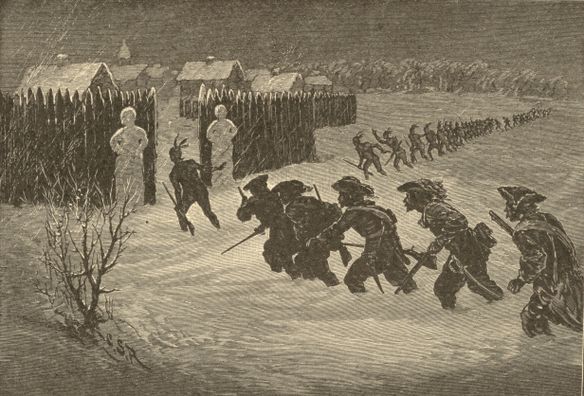
The Attack on Schenectady.
The Indian hostilities which heralded King William's War began August
13, 1688. Frontenac prepared to capture Albany and even Manhattan. He
did not accomplish so much; but on the night of February 8, 1689-90, his
force of ninety Iroquois and over a hundred Frenchmen fell upon
Schenectady, killed sixty, and captured eighty or ninety more. Only a
corporal's guard escaped to Albany with the sad news. This attack had
weighty influence, as occasioning the first American congress. Seven
delegates from various colonies assembled at New York on May 1, 1690, to
devise defence against the northern invaders.
The eastern Indians were hardly at rest from Philip's War when roused by
the French to engage in this. An attack was made upon Haverhill, Mass.,
and Hannah Dustin, with a child only a few days old, another woman, and
a boy, was led captive to an Indian camp up the Merrimac. The savages
killed the infant, but thereby steeled the mother's heart for revenge.
One night the three prisoners slew their sleeping guards and, seizing a
canoe, floated down to their home. Dover was attacked June 27, 1689,
twenty-three persons killed, and twenty-nine sold to the French in
Canada. Indescribable horrors occurred at Oyster River, at Salmon Falls,
at Casco, at Exeter, and elsewhere.
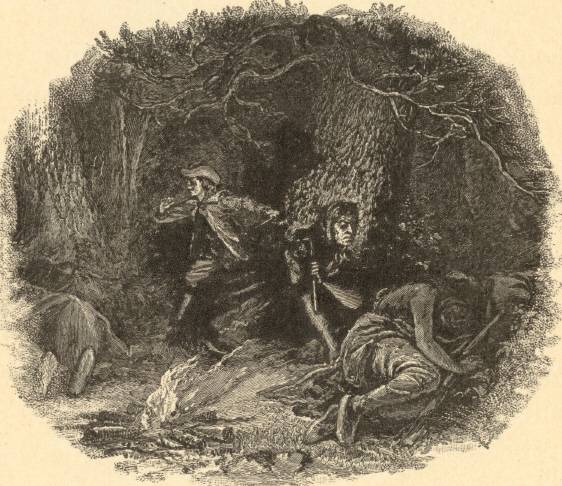
Hannah Dustin's Escape.
[1702]
In 1702 Queen Anne's War began, and in this again New England was the
chief sufferer. The barbarities which marked it were worse than those of
Philip's War. De Rouville, with a party of French and savages, proceeded
from Canada to Deerfield, Mass. Fearing an attack, the villagers meant
to be vigilant, but early on a February morning, 1704, the wily enemy,
skulking till the sentinels retired at daylight, managed to effect a
surprise. Fifty were killed and one hundred hurried off to Canada. Among
these were the minister, Mr. Williams, and his family. Twenty years
later a white woman in Indian dress entered Deerfield. It was one of the
Williams daughters. She had married an Indian in Canada, and now refused
to desert him. Cases like this, of which there were many in the course
of these frightful wars, seemed to the settlers harder to bear than
death. Massachusetts came so to dread the atrocious foe, that fifteen
pounds were offered by public authority for an Indian man's scalp, eight
for a child's or a woman's.
[1705]
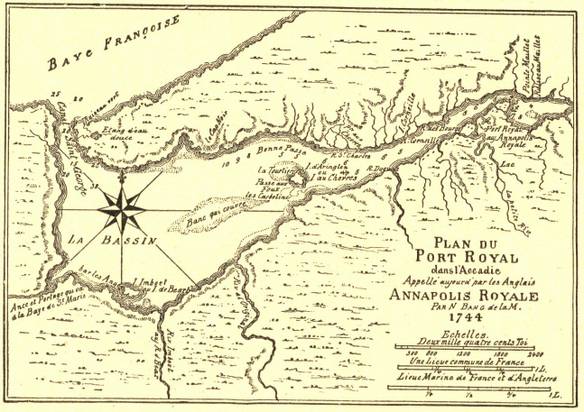
Plan of Port Royal, Nova Scotia.
Governor Spotswood urged aggression on the French to the west; Governor
Hunter of New York had equal zeal for a movement northward. New York
raised 600 men and the same number of Iroquois, voting 10,000 pounds of
paper money for their sustenance. Connecticut and New Jersey sent 1,600
men. A force of 4,000 in all mustered at Albany under Nicholson of New
York. They were to co-operate against Montreal with the naval expedition
of 1711, commanded by Sir Hoveden Walker. Walker failed ignominiously,
and Nicholson, hearing of this betimes, saved himself by retreating.
Sir William Phips had captured Port Royal in 1690, and Acadia was
annexed to Massachusetts in 1692. In 1691 the French again took formal
possession of Port Royal and the neighboring country. In 1692 an
ineffectual attempt was made to recover it, but by the Treaty of
Ryswick, 1697, it was explicitly given back to France.
[1710]
At the inception of Queen Anne's War, in 1702, there were several
expeditions from New England to Nova Scotia; in 1704 and 1707 without
result. That of 1710 was more successful. It consisted of four regiments
and thirty-six vessels, besides troop and store ships and some marines.
Port Royal capitulated, and its name was changed to Annapolis, in honor
of Queen Anne. Acadia never again came under French control, and was
regularly ceded to England by the Treaty of Utrecht, 1713.
Notwithstanding this, however, French America still remained
substantially intact.
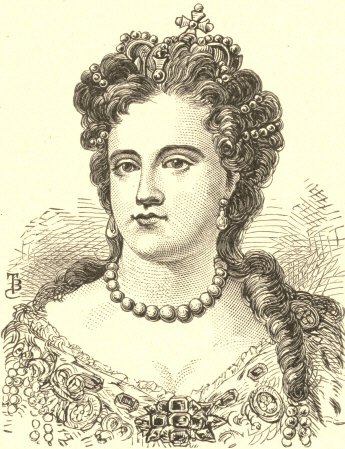
Queen Anne.
[1714]
If the great struggle for the Ohio Valley now became a silent one, it
was none the less earnest. Spotswood had opened a road across the Blue
Ridge in 1716. In 1721 New Yorkers began settling on Oswego River, and
they finished a fort there by 1726. Closer alliance was formed with the
Five Nations. The French governor of Quebec in 1725 pleaded that Niagara
must be fortified, and on his successor was urged the necessity of
reducing the Oswego garrison. It was partly to flank Oswego that the
French pushed up Lake Champlain to Crown Point and built Fort St.
Frederick.
The Treaty of Utrecht had left Cape Breton Island to France. The French
at once strongly fortified Louisburg and invited thither the French
inhabitants of Acadia and Newfoundland, which had also been ceded to
Great Britain. Many went, though the British governors did much to
hinder removal. This irritated the French authorities, and the Indian
atrocities of 1723-24 at Dover and in Maine are known to have been
stimulated from Montreal. Father Rasle, an astute and benevolent French
Jesuit who had settled among the Indians at Norridgewock, became an
agent of this hostile influence. In an English attack, August 12, 1724,
Rasle's settlement was broken up and himself killed. The Indians next
year made a treaty, and peace prevailed till King George's War.
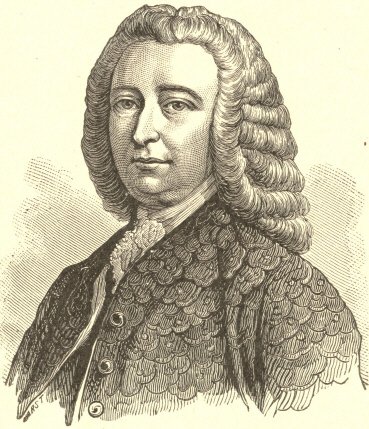
Governor Shirley.
[1745]
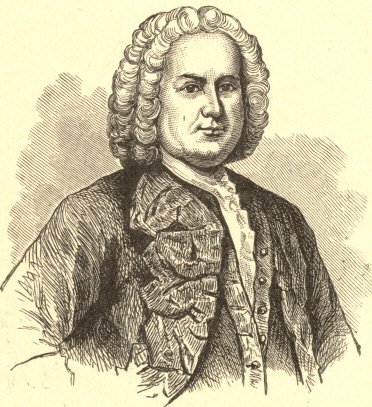
Sir William Pepperrell.
This opened in 1744, England against France once more, and in 1745 came
the capture of Louisburg, then the Gibraltar of America. This was
brought about through the energy of Governor Shirley, of Massachusetts,
the most efficient English commander this side the Atlantic. That
commonwealth voted to send 3,250 men, Connecticut 500, New Hampshire and
Rhode Island each 300. Sir William Pepperrell, of Kittery, Me.,
commanded, Richard Gridley, of Bunker Hill fame, being his chief of
artillery. The expedition consisted of thirteen armed vessels, commanded
by Captain Edward Tyng, with over 200 guns, and about ninety transports.
The Massachusetts troops sailed from Nantasket March 24th, and reached
Canso, April 4th. "Rhode Island," says Hutchinson, "waited until a
better judgment could be made of the event, their three hundred not
arriving until after the place had surrendered." The expedition was very
costly to the colonies participating, and four years later England
reimbursed them in the sum of 200,000 pounds. Yet at the disgraceful
peace of Aix-la-Chapelle, in 1748, she surrendered Louisburg and all
Cape Breton to France again.
[1746-1748]
In 1746 French and Indians from Crown Point destroyed the fort and
twenty houses at Saratoga, killing thirty persons, and capturing sixty.
Orders came this year from England to advance on Crown Point and
Montreal, upon Shirley's plan, all the colonies as far south as Virginia
being commanded to aid. Quite an army mustered at Albany. Sir William
Johnson succeeded in rousing the Iroquois, whom the French had been
courting with unprecedented assiduity. But D'Anville's fleet threatened.
The colonies wanted their troops at home. Inactivity discouraged the
soldiers, alienated the Indians. At last news came that the Canada
project was abandoned, and in 1748 the Peace of Aix-la-Chapelle was
declared.
This very year France began new efforts to fill the Ohio Valley with
emigrants. Virginia did the same. To anticipate the English, the French
sent Bienville to bury engraved leaden plates at the mouths of streams.
They also fortified the present sites of Ogdensburg and Toronto. Even
now, therefore, France's power this side the Atlantic was not visibly
shaken. The continental problem remained unsolved.