
[1686]
The English conquest of New Netherland from the Dutch speedily followed
the Stuarts' return to the throne. Cromwell had mooted an attack on
Dutch America, and, as noticed in Chapter I., Connecticut's charter of
1662 extended that colony to include the Dutch lands. England based her
claim to the territory on alleged priority of discovery, but the real
motives were the value of the Hudson as an avenue for trade, and the
desire to range her colonies along the Atlantic coast in one unbroken
line. The victory was not bloody, nor was it offensive to the Dutch
themselves, who in the matter of liberties could not lose. King Charles
had granted the conquered tract to his brother, the Duke of York,
subsequently James II., and it was in his honor christened with its
present name of New York.
The Duke's government was not popular, especially as it ordered the
Dutch land-patents to be renewed–for money, of course; and in 1673,
war again existing between England and Holland, the Dutch recovered
their old possession. They held it however for only fifteen months,
since at the Peace of 1674 the two belligerent nations mutually restored
all the posts which they had won.
The reader already has some idea of Sir Edmond Andros's rule in America.
New York was the first to feel this, coming under the gentleman's
governorship immediately on being the second time surrendered to
England. Such had been the political disorder in the province, that
Andros's headship, stern as it was, proved beneficial. He even, for a
time, 1683-86, reluctantly permitted an elective legislature, though
discontinuing it when the legislatures of New England were suppressed.
This taste of freedom had its effect afterward.
[1690]
When news of the Revolution of 1688 in England reached New York, Andros
was in Boston. Nicholson, Lieutenant-Governor, being a Catholic and an
absolutist, and the colony now in horror of all Catholics through fear
of French invasion from Canada, Jacob Leisler, a German adventurer,
partly anticipating, partly obeying the popular wish, assumed to
function in Nicholson's stead. All the aristocracy, English or Dutch,
and nearly all the English of the lower rank were against him. Leisler
was passionate and needlessly bitter toward Catholics, yet he meant
well. He viewed his office as only transitory, and stood ready to
surrender it so soon as the new king's will could be learned; but when
Slaughter arrived with commission as governor, Leisler's foes succeeded
in compassing his execution for treason. This unjust and cruel deed
began a long feud between the popular and the aristocratic party in the
colony.
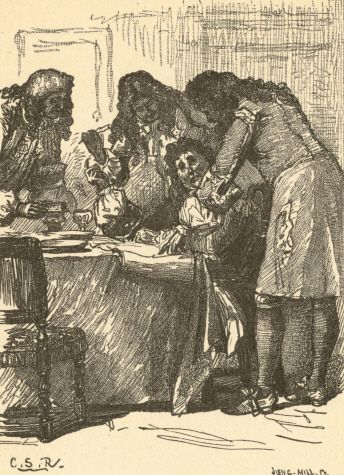
Sloughter signing Leisler's Death Warrant.
[1700]
From this time till the American Revolution New York continued a
province of the Crown. Royal governor succeeded royal governor, some of
them better, some worse. Of the entire line Bellomont was the most
worthy official, Cornbury the least so. One of the problems which
chiefly worried all of them was how to execute the navigation acts,
which, evaded everywhere, were here unscrupulously defied. Another care
of the governors, in which they succeeded but very imperfectly, was to
establish the English Church in the colony. A third was the
disfranchisement of Catholics. This they accomplished, the legislature
concurring, and the disability continued during the entire colonial
period.
Hottest struggle of all occurred over the question of the colony's right
of self-taxation. The democracy stood for this with the utmost
firmness, and even the higher classes favored rather than opposed. The
governors, Cornbury and Lovelace, most frantically, but in vain,
expostulated, scolded, threatened, till at last it became admitted by
law in the colony that no tax whatever could, on any pretext, be levied
save by act of the people's representatives.
Dutch America, it will be remembered, had reached southward to the
Delaware River, and this lower portion passed with the rest to the Duke
of York in 1664. The territory between the Hudson and the Delaware,
under the name of New Jersey, he made over to Lord Berkeley and Sir
George Carteret, proprietaries, who favored the freest institutions,
civil and religious. The population was for long very sparse and, as it
grew, very miscellaneous. Dutch, Swedes, English, Quakers, and Puritans
from New England were represented.
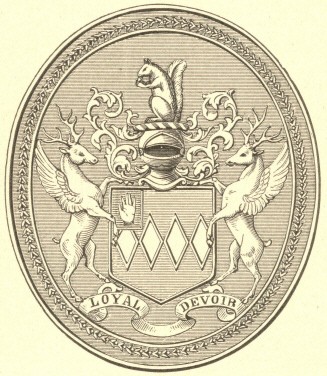
Seal of the Carterets.
After the English recovery Berkeley disposed of his undivided half of
the province, subsequently set off as West Jersey, to one Bylling, a
Quaker, who in a little time assigned it to Lawrie, Lucas, Penn, and
other Quakers. West Jersey became as much a Quaker paradise as
Pennsylvania. Penn with eleven of his brethren, also bought, of
Carteret's heirs, East Jersey, but here Puritan rather than Quaker
influence prevailed.
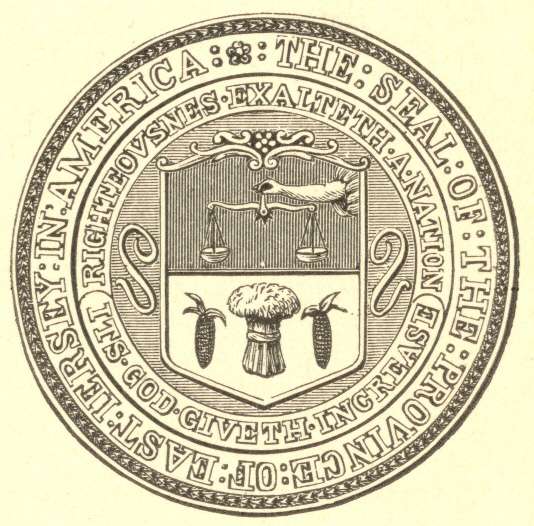
Seal of East Jersey.
The Jersey plantations came of course under Andros, and after his fall
its proprietors did not recover their political authority. For twelve
years, while they were endeavoring to do this, partial anarchy cursed
the province, and at length in 1702 they surrendered their rights to the
Crown, the Jerseys, now made one, becoming directly subject to Queen
Anne. The province had its own legislature and, till 1741, the same
governors as New York. It also had mainly the same political
vicissitudes, and with the same result.
William Penn, the famous Quaker, received the proprietorship of
Pennsylvania in payment of a claim for sixteen thousand pounds against
the English Government. This had been left him by his father, Sir
William Penn, a distinguished naval commander in the Dutch war of
1665-67, when he had borne chief part in the conquest of Jamaica.
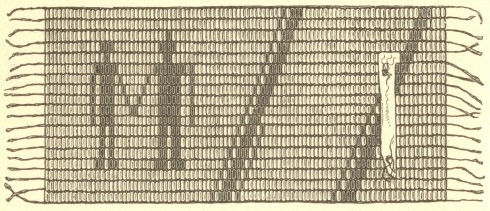
Wampum received by Penn in Commemoration of the Indian Treaty.
William Penn was among the most cultivated men of his time, polished by
study and travel, deeply read in law and philosophy. He had fortune, and
many friends at court, including Charles II. himself. He needed but to
conform, and great place was his. But conform he would not. True to the
inner light, braving the scoffs of all his friends, expelled from Oxford
University, beaten from his own father's door, imprisoned now nine
months in London Tower, now six in Newgate, this heroic spirit
persistently went the Quaker way. In despair of securing in England
freedom for distressed consciences he turned his thoughts toward
America, there to try his "holy experiment."
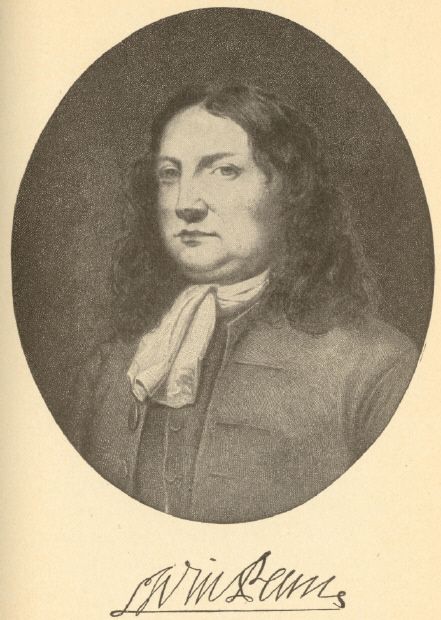
William Penn; From the copy by Francis Race in the
National Museum, Philadelphia.
The charter from Charles II. was drawn by Penn's own hand and was nobly
liberal. It ordained perfect religious toleration for all Christians,
and forbade taxation save by the provincial assembly or the English
Parliament. Under William and Mary, greatly to his grief, Penn was
forced to sanction the penal laws against Catholics; but they were most
leniently administered, which brought upon the large-minded proprietary
much trouble with the home government.
As Pennsylvania, owing to the righteous and loving procedure of Penn
toward them, suffered nothing from the red men to the west, so was it
fortunately beyond Andros's jurisdiction on the east. Once, from 1692,
for two years, the land was snatched from Penn and placed under a royal
commission. Returning to England in 1684, after a two years' sojourn in
America to get his colony started, the Quaker chief became intimate and
a favorite with James II., devotedly supporting his Declaration of
Indulgence toward Catholics as well as toward all Protestant dissenters.
He tried hard but vainly to win William and Mary to the same policy.
This attitude of his cost him dear, rendering him an object of suspicion
to the men now in power in England. Twice was he accused of treasonable
correspondence with the exiled James II., though never proved guilty.
From 1699 to 1701 he was in America again, thereafter residing in
England till his death in 1718. He had literally given all for his
colony, his efforts on its behalf having been to him, so he wrote in
1710, a cause of grief, trouble, and poverty.
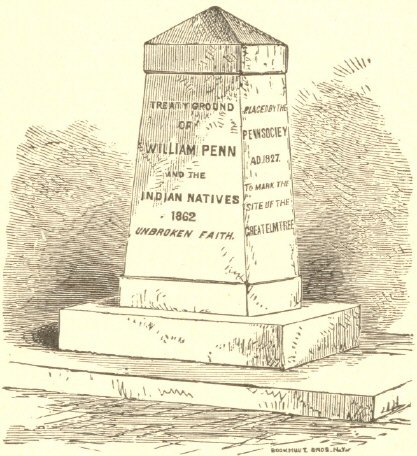
The Treaty Monument, Kensington.
But the colony itself was amazingly prosperous. There were internal
feuds, mainly petty, some serious. George Keith grievously divided the
Quakers by his teachings against slavery, going to law, or service as
magistrates on the part of Quakers, thus implying that only infidels or
churchmen could be the colony's officials.
Fletcher's governorship in 1693-94, under the royal commission, evoked
continual opposition, colonial privileges remaining intact in spite of
him. The people from time to time subjected their ground-law to changes,
only to render it a fitter instrument of freedom. In everything save the
hereditary function of the proprietary, it was democratic. For many
years even the governor's council was elective. The colony grew,
immigrants crowding in from nearly every European country, and wealth
multiplied to correspond.
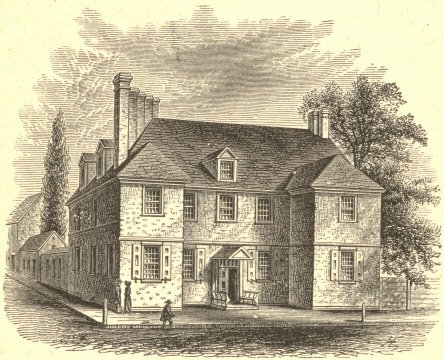
The Penn Mansion in Philadelphia.
We have, dating from 1698, a history of Pennsylvania by one Gabriel
Thomas, full of interesting information. Philadelphia was already a
"noble and beautiful city," containing above 2,000 houses, most of them
"stately," made of brick; three stores, and besides a town house, a
market house, and several schools. Three fairs were held there yearly,
and two weekly markets, which it required twenty fat bullocks, besides
many sheep, calves, and hogs, to supply. The city had large trade to New
York, New England, Virginia, West India, and Old England. Its exports
were horses, pipe-staves, salt meats, bread-stuffs, poultry, and
tobacco; its imports, fir, rum, sugar, molasses, silver, negroes, salt,
linen, household goods, etc. Wages were three times as high as in
England or Wales. All sorts of "very good paper" were made at
Germantown, besides linen, druggets, crapes, camlets, serges, and other
woollen cloths. All religious confessions were represented.
In 1712, such his poverty, the good proprietary was willing to sell to
the Crown, but as he insisted upon maintenance of the colonists' full
rights, no sale occurred. English bigots and revenue officials would
gladly have annulled his charter, but his integrity had gotten him
influence among English statesmen, which shielded the heritage he had
left even when he was gone.
It is particularly to be noticed that till our Independence Delaware was
most intimately related to Pennsylvania. Of Delaware the fee simple
belonged not to Penn, but to the Duke of York, who had conquered it from
the Dutch, as they from the Swedes. Penn therefore governed here, not as
proprietary but as the Duke's tenant. In 1690-92, and from 1702,
Delaware enjoyed a legislature by itself, though its governors were
appointed by Penn or his heirs during the entire colonial period.