
[1675]
Simultaneously with the Stuart Restoration another cloud darkened the
New England sky. Since the Pequot War, Indians and whites had in the
main been friendly. This by itself is proof that our fathers were less
unjust to the red men than is sometimes charged. They did assume the
right to acquire lands here, and they had this right. The Indians were
not in any proper sense owners of New England. They were few–by 1660
not more numerous than the pale-faces–and, far from settling or
occupying the land, roamed from place to place. Had it been otherwise
they, as barbarians, would have had no such claim upon the territory as
to justify them in barring out civilization. However, the colonists did
not plead this consideration. Whenever districts were desired to which
Indians had any obvious title, it was both law and custom to pay them
their price. In this, Roger Williams and William Penn were not peculiar.
If individual white men sometimes cheated in land trades, as in other
negotiations, the aggrieved side could not, and did not, regard this as
the white man's policy.
Yet little by little the Indians came to distrust and hate the rival
race. It did not matter to the son of the forest, even if he thought so
far, that the neighborhood of civilization greatly bettered his lot in
many things, as, for instance, giving him market for corn and peltry,
which he could exchange for fire-arms, blankets, and all sorts of
valuable conveniences. The efforts to teach and elevate him he
appreciated still less. As has been said, he loved better to disfurnish
the outside of other people's heads than to furnish the inside of his
own. What he felt, and keenly, was that the newcomers treated him as an
inferior, were day by day narrowing his range, and slowly but surely
reducing his condition to that of a subject people. Dull as he was, he
saw that one of three fates confronted him: to perish, to migrate, or to
lay aside his savage character and mode of life. Such thoughts frenzied
him.
The beautiful fidelity of Massasoit to the people of Plymouth is already
familiar. His son Alexander, who succeeded him, was of a spirit
diametrically the reverse. Convinced that he was plotting with the
Narragansets for hostile action, the Governor and Council of Plymouth
sent Major Winslow to bring him to court–for it must be remembered that
Massasoit's tribe, the Pokanokets, had through him covenanted, though
probably with no clear idea of what this meant, to be subject to the
Plymouth government. Alexander, for some reason, became fatally ill
while at Plymouth under arrest, dying before reaching home. The Indians
suspected poison.
His brother Philip now became sachem. Philip already had a grudge
against the whites, and was rendered trebly bitter by the indignity and
violence, if nothing worse, to which Alexander had been subjected. He
resolved upon war, and in 1675 war was begun.
We shall never certainly know to what extent Philip was an organizer. We
believe correct the view of Hubbard, the contemporary historian, that he
had prepared a wide-spread and pretty well arranged conspiracy among
the main tribes of New England Indians, which might have been fatal but
for "the special providence of God," causing hostilities to break out
ere the savages were ready. Palfrey challenges this view of the case,
but on insufficient grounds.
One Sausaman, an educated Indian, previously Philip's secretary, had
left him and joined the Christian Indians settled at Natick. There were
by this time several such communities, and also, according to Cotton
Mather, many able Indian preachers. At the risk of his life, as he
insisted, Sausaman had warned the Plymouth magistrates that danger
impended. He was soon murdered, apparently by Philip's instigation. At
least Philip never denied this, nor did he after this time ever again
court friendly relations with Plymouth, which he had constantly done
hitherto. On the contrary, re-enforcements of strange Indians, all ready
for the war-path, were continually flocking to his camp, squaws and
children at the same time going to the Narraganset country, manifestly
for security.
The Plymouth authorities, preparing for war, yet sent a kind letter to
the sachem advising him to peace. In vain. At Swanzey, the town nearest
Mount Hope, Philip's home, Indians at once began to kill and ravage, and
Majors Bradford and Cudworth marched thither with a force of Plymouth
soldiers. A Massachusetts contingent re-enforced them there, and they
prepared to advance. Seeing it impossible to hold his own against so
many, Philip crossed to Pocasset, now Tiverton, and swept rapidly round
to Dartmouth, Middleborough, and Taunton, burning and murdering as he
went. He then retired again to Tiverton, but in a few days started with
all his warriors for central Massachusetts.
Here the Nipmucks, already at war, which indicated an understanding
between them and the Pokanokets, had attacked Mendon. The day after
Philip joined them there was a fight at Brookfield, the Nipmucks and
their allies being victorious. They proceeded to burn the town nearly
entire, though the inhabitants who survived, after a three days' siege
in a fortified house, were relieved by troops from Boston just in the
nick of time.
The Connecticut Valley was next the theatre of war. Springfield,
Hatfield, Deerfield, and Northfield were attacked the last two having to
be abandoned. At Hadley the onset occurred on a fast-day. The men rushed
from their worship with their muskets, which were ready to hand in
church, and hastily formed for battle. Bewildered by the unexpected
assault, they were on the point of yielding, when, according to
tradition, an aged hero with long beard and queer clothing appeared,
placed himself at their head and directed their movements. His evident
acquaintance with fighting restored order and courage. The savages were
driven pell-mell out of town, but the pursuers looked in vain for their
deliverer. If the account is correct, it was the regicide, General
Goffe, who had been a secret guest in the house of the Rev. Mr. Russell.
He could not in such danger refrain from engaging once again, as he had
so often done during the Civil War in England, in the defence of God's
people.
From Hadley a party went to Deerfield to bring in the wheat that had
been left when the town was deserted. Ninety picked men, the "flower of
Essex," led by Captain Lothrop, attended the wagons as convoy. On their
return, about seven o'clock in the morning, by a little stream in the
present village of South Deerfield, since called Bloody Brook in memory
of the event, the soldiers dispersed somewhat in quest of grapes, then
ripe, when a sudden and fatal volley from an ambush was delivered upon
them. The men had left their muskets in the wagons and could not regain
them. Lothrop was shot dead, and but seven or eight of his company
escaped alive. A monument marks the spot where this tragic affair
occurred.
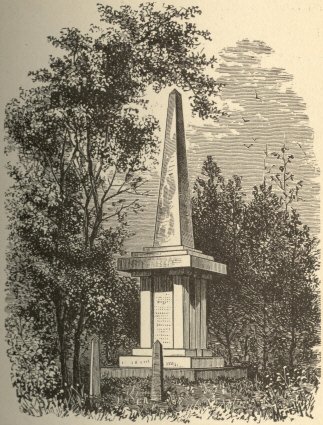
The Monument at Bloody Brook.
So early as July, 1675, Massachusetts and Connecticut, acting for the
New England Confederation, had effected a treaty with the strong tribe
of the Narragansets in southern Rhode Island, engaging them to remain
neutral and to surrender any of Philip's men coming within their
jurisdiction. This agreement they did not keep. After the attacks on
Springfield and Hatfield in October, great numbers of the Pokanoket
braves came to them, evidently welcomed. To prevent their becoming a
centre of mischief, Connecticut, Massachusetts, and Plymouth despatched
a thousand men to punish the Narragansets. They met the foe at the old
Palisade, in the midst of a dense swamp in what is now South Kingstown,
Rhode Island. The terrible cold which rendered this Narraganset campaign
so severe had turned the marsh into a bridge, and at once on their
arrival the soldiers, weary and hungry as they were from their long
march, and spite of its being Sunday, advanced to the attack.
Massachusetts was in front, then Plymouth, then Connecticut. Long and
bitter was the fight. The Indians, perfect marksmen, took deadly aim at
the leaders. Five captains were killed outright and as many more
mortally wounded. The fort was taken, re-taken, and taken again, the
whites at last, to make sure work, setting fire to the wigwams. The
storming party lost in killed and wounded one-fifth of its number. This
Swamp Fight, as it was called, broke forever the strength of the
Narragansets, the tribe and its allies dispersing in all directions.
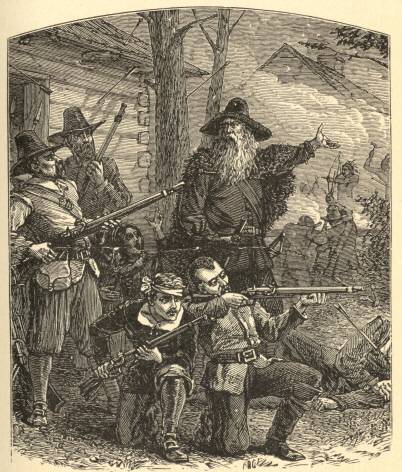
Goffe at Hadley.
[1676]
In 1676 central Massachusetts was again aflame. Lancaster was sacked and
burned, its inhabitants nearly all either carried captive or put to
death with indescribable atrocities. Mrs. Rowlandson, wife of the
Lancaster Minister, also her son and two daughters, were among the
captives. We have this brave woman's story as subsequently detailed by
herself. Her youngest, a little girl of six, wounded by a bullet, she
bore in her arms wherever they marched, till the poor creature died of
cold, starvation, and lack of care. The agonized mother begged the
privilege of tugging along the corpse, but was refused. She with her son
and living daughter were ransomed, after wandering up and down with the
savages eleven weeks and five days.
From Mrs. Rowlandson's narrative we have many interesting facts touching
the Indians' habits of life. They carried ample stores from Lancaster,
but soon squandered them, and were reduced to a diet of garbage, horses'
entrails, ears, and liver, with broth made of horses' feet and legs. The
liver they seemed to prefer raw. Their chief food was ground-nuts. They
also ate acorns, artichokes, beans, and various sorts of roots. They
especially delighted in old bones, which, being heated to drive out
maggots and worms, they first boiled for soup, then ground for use as
meal.
The captive lady often saw Philip. At his request she made a shirt and a
cap for his son, for which he paid her. Says Hubbard, "Such was the
goodness of God to these poor captive women and children that they found
so much favor in the sight of their enemies that they offered no wrong
to any of their persons save what they could not help, being in many
wants themselves. Neither did they offer any uncivil carriage to any of
the females, nor ever attempt the chastity of any of them." So soon as
negotiations were opened for Mrs. Rowlandson's release, Philip told her
of this, and expressed the hope that they would succeed. When her ransom
had arrived he met her with a smile, saying: "I have pleasant words for
you this morning; would you like to hear them? You are to go home
to-morrow," Twenty pounds were paid for her, raised by some ladies of
Boston, aided by a Mr. Usher.
Hostilities now bore southeastward. Philip was in his glory. All the
towns of Rhode Island and eastern Massachusetts were in terror, nearly
all in actual danger. At Medfield twenty whites were killed. Deserted
Mendon was burned. Weymouth was attacked, and eleven persons were
massacred in the edge of Plymouth. In Groton and Marlborough every house
was laid in ashes, as were all in lower Rhode Island up to Warwick, and
in Warwick all but one. Sachem Canonchet of the Narragansets drew into
ambush at Pawtuxet a band of Plymouth soldiers, of whom only one
escaped. Canonchet was subsequently taken by Captain Denison and
executed. Rehoboth lost forty houses, Providence nearly as many.
The Connecticut Valley was invaded afresh. Springfield, Hadley,
Northampton, and Hatfield were once more startled by the war-whoop and
the whiz of the tomahawk. Captain Turner, hearing of an Indian camp at
the falls of the Connecticut, now called by his name, in Montague,
advanced with a troop of one hundred and eighty horse, arriving in sight
of the encampment at daylight. Dismounting and proceeding stealthily to
within sure shot, they beat up the Indians' quarters with a ringing
volley of musketry. Resistance was impossible. Those who did not fall by
bullet or sword rushed to the river, many being carried over the falls.
Three hundred savages perished, the English losing but one man. A large
stock of the enemy's food and ammunition was also destroyed. Though so
splendidly successful, the party did not return to Hadley without
considerable loss, being set upon much of the way by Indians who had
heard the firing at the falls and sped to the relief of their friends.
Turner was killed in the meadows by Green River; his subordinate,
Holyoke, then commanding the retreat.
[1678]
Turner's victory brought the war to a crisis. The red men lacked
resources. The whites had learned the secrets of savage warfare. They
could no longer be led into ambush, while their foe at no time during
the war ventured to engage them in open field. Large parties of Indians
began to surrender; many roving bands were captured. Hostilities
continued still many months in Maine, the whites more and more uniformly
successful, till the Treaty of Casco, April 12, 1678, at last terminated
the war.
Hunted by the English backward and forward, Philip was at last driven to
his old home upon Mount Hope. Here Captain Church, one of the most
practised of Indian fighters, surprised him on the morning of August 12,
1676, encamped upon a little upland, which it is believed has been
exactly identified near a swamp at the foot of the mountain. By
residents in the neighborhood it is known as Little Guinea. At the first
firing Philip, but partially dressed, seized gun and powder-horn and
made for the swamp, Captain Church's ambush was directly in his front.
An Englishman's piece missed fire, but an Indian sent a bullet through
the Great Sachem's heart.
In this fearful war at least six hundred of the English inhabitants
either fell in battle or were murdered by the enemy, A dozen or more
towns were utterly destroyed, others greatly damaged, Some six hundred
buildings, chiefly dwelling-houses, were consumed by fire, and over a
hundred thousand pounds of colonial money expended, to say nothing of
the immense losses in goods and cattle.
Not without propriety has the Pokanoket chief been denominated a king.
If not a Charlemagne or a Louis XIV., he yet possessed elements of true
greatness. While he lived his mind evidently guided, as his will
dominated and prolonged, the war. This is saying much, for the Indian's
disinclination to all strenuous or continuous exertion was pronounced
and proverbial. Philip's treatment of Mrs. Rowlandson must be declared
magnanimous, especially as, of course, he was but a savage king, who
might reasonably request us not to measure him by our rules. The other
party to the war we have a right to judge more rigidly, and just
sentence in their case must be severe. Philip's sorrowing, innocent wife
and son were brought prisoners to Plymouth, and their lot referred to
the ministers. After long deliberation and prayer it was decided that
they should be sold into slavery, and this was their fate.