
[1660]
The Commonwealth in England went to pieces at the death of Oliver
Cromwell, its founder. The Stuart dynasty came back, but, alas!
unimproved. Charles II. was a much meaner man than his father, and James
II. was more detestable still. The rule of such kings was destined to
work sad changes in the hitherto free condition of Massachusetts. This
colony had sympathized with the Commonwealth more heartily than any of
the others. Hither had fled for refuge Goffe and Whalley, two of the
accomplices in the death of Charles I. Congregational church polity was
here established by law, to the exclusion of all others, even of
episcopacy, for whose sake Charles was harrying poor Covenanters to
death on every hillside in Scotland. Nor would his lawyers let the king
forget Charles I.'s attack on the Massachusetts charter, begun so early
as 1635, or the grounds therefor, such as the unwarranted transfer of it
to Boston, or the likelihood that but for the outbreak of the Civil War
it would have been annulled by the Long Parliament itself. Obviously
Massachusetts could not hope to be let alone by the home government
which had just come in.
At first the king, graciously responding to the colony's humble
petition, confirmed the charter granted by his father; but no sooner had
he done so than the hot royalists about him began plotting to overthrow
the same, and their purpose never slumbered till it was accomplished.
Massachusetts was too prosperous and too visibly destined for great
power in America to be suffered longer to go its independent way as
hitherto.
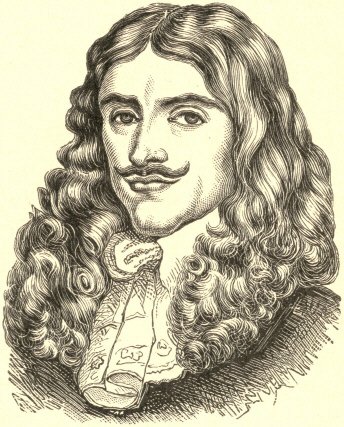
King Charles II.
[1661]
The province–as yet, of course, excluding Plymouth with its twelve
towns and five thousand inhabitants–contained at this time, 1660, about
twenty-five thousand souls, living in fifty-two towns. These were nearly
all on the coast; Dedham, Concord, Brookfield, Lancaster, Marlborough,
and the Connecticut Valley hamlets of Springfield, Hadley, and
Northampton being the most noteworthy exceptions. Though agriculture was
the principal business, fishing was a staple industry, its product going
to France, Spain, and the Straits. Pipe-staves, fir-boards, much
material for ships, as masts, pitch and tar, also pork and beef, horses
and corn, were shipped from this colony to Virginia, in return for
tobacco and sugar either for home consumption or for export to England.
Some iron was manufactured. The province enjoyed great prosperity.
Boston stood forth as a lively and growing centre, and an English
traveller about this time declared some of its merchants to be "damnable
rich."
As their most precious possession the colonists prized their liberties,
which they claimed in virtue of their original patent. In a paper which
it put forth on June 10, 1661, the General Court asserted for the colony
the right to elect and empower its own officers, both high and low, to
make its laws, to execute the same without appeal so long as they were
not repugnant to those of England, and to defend itself by force and
arms when necessary, against every infringement of its rights, even from
acts of Parliament or of the king, if prejudicial to the country or
contrary to just colonial legislation. In a word Massachusetts, even so
early, regarded itself to all intents and purposes an independent State,
and would have proclaimed accordingly had it felt sufficiently strong.
[1664]
Manifestly the king would not grant so much. On the occasion of his
confirming the charter he demanded that the oath of allegiance be taken
by the people of the colony; that justice be administered there in his
name; and that the franchise be extended to all freemen of sufficient
substance, with the liberty to use in worship, public and private, the
forms of the English Church. The people obeyed but in part, for they
would not even appear to admit the king's will to be their law. The
franchise was slightly extended, in a grudging way, but no new religious
privileges were at this time conceded. Unfortunately political and
religious liberty were now in conflict. It was worse for the Baptists
and Quakers that the king favored them, and the treatment which they
received in the colony inclined them to the royalist side in the
controversy.
In July, 1664, commissioners arrived in Boston with full authority to
investigate the administration of the New England charters. Such a
procedure not being provided for in the Massachusetts document, the
General Court, backed by the citizens almost to a man, successfully
prevented complainants from appearing before the commission. The
commissioners having summoned the colony as defendant in a certain case,
a herald trumpeted proclamation through the streets, on the morning set
for the trial, inhibiting all from aiding their designs. The trial
collapsed, and the gentlemen who had ordered it, baffled and disgusted,
moved on to New Hampshire, there also to be balked by a decree of the
Massachusetts Governor and Council forbidding the towns so much as to
meet at their behest.
[1668]
Vengeance for such defiance was delayed by Charles II.'s very vices.
Clarendon's fall had left him surrounded by profligate aides, too timid
and too indolent to face the resolute men of Massachusetts. They often
discussed the contumacy of the colony, but went no further than words.
Massachusetts was even encouraged, in 1668, forcibly to reassert its
authority in Maine, against rule either by the king or by Sir Ferdinanda
Gorges's heir as proprietary.
Its charter had assigned to the colony land to a point three miles north
of the Merrimac. Bold in the favor of the Commonwealth, the authorities
measured from the head-waters of that river. But Plymouth had originally
claimed all the territory west of the Kennebec, and had sold it to
Gorges. Charles II. favored the Gorges heirs against Massachusetts, and
for some years previous to 1668 Massachusetts' power over Maine had been
in abeyance. Ten years later, in 1678, to make assurance doubly sure,
Massachusetts bought off the Gorges claimants, at the round price of
twelve hundred and fifty pounds sterling.
[1673]
From 1641 Massachusetts had borne sway in New Hampshire as well,
ignoring John Mason's claim under Charles I.'s charters of 1629 and
1635, still urged by one of Mason's grandsons, backed by Charles II.
Here Massachusetts was beaten. In July, 1679, New Hampshire was
permanently separated from her, and erected into a royal province, of a
nature to be explained in a subsequent chapter, being the earliest
government of this kind in New England.
[1662]
These territorial assumptions on the part of Massachusetts much
increased the king's hostility. This probably would not have proved
fatal had it not been re-enforced by the determination of the merchants
and manufacturers of the mother-country to crush what they feared was
becoming a rival power beyond seas. They insisted upon full enforcement
of the Navigation Laws, which made America's foreign trade in a cruel
degree subservient to English interest. So incorrigible was the colony,
it was found that this end could be compassed only by the abrogation of
the charter, so that English law might become immediately valid in
Massachusetts, colonial laws to the contrary notwithstanding.
Accordingly, in 1684, the charter was vacated and the colonists ceased
to be free, their old government with its popular representation giving
way to an arbitrary commission.
The other New England colonies–Plymouth, Rhode Island, Connecticut, and
New Haven–had made haste to proclaim Charles II. so soon as restored to
the throne, and to begin carrying on their governments in his name. That
beautiful and able man, the younger Winthrop, sped to London on
Connecticut's behalf, and, aided by his colony's friends at court, the
Earls of Clarendon and Manchester and Viscount Say and Seal, in 1662
secured to Connecticut, now made to include New Haven, a charter so
liberal that it continued till October 5, 1818, the ground law of the
State, then to be supplanted only by a close vote. Under this paper,
which declared all lands between the Narragansett River and the Pacific
Ocean Connecticut territory, Connecticut received every whit of that
right to govern itself which Charles was so sternly challenging in the
case of Massachusetts.
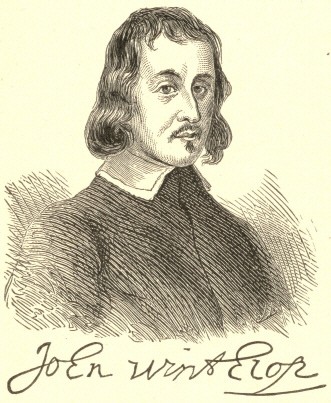
John Winthrop the Younger.
From this time on, as indeed earlier, Connecticut was for many years
perhaps the most delightful example of popular government in all
history. Connecticut and New Haven together had about ten thousand
inhabitants. Their rulers were just, wise, and of a mind truly to serve
the people. Here none were persecuted for their faith. Education was
universal. Few were poor, none very rich. Nearly all supplies were of
domestic production, nothing as yet being exported but a few cattle.
Under the second Charles Rhode Island fared quite as well as
Connecticut. This was remarkable, inasmuch as the little colony of three
thousand souls, in their four towns of Providence, Newport, Portsmouth,
and Warwick, insisted on "holding forth the lively experiment"–and it
proved lively indeed–"of full liberty in religious concernments."
Charles did not oppose this, and Clarendon favored it, a motive of both
here, as with Connecticut, being to rear in New England a power friendly
to the Crown, that should rival and check Massachusetts. Both these
commonwealths were granted absolute independence in all but name. No
oath of allegiance to the king was demanded. Appeals to England were not
provided for.
[1680]
Though having no quarrel with the king, the two southern colonies were
not without their trials. Connecticut, besides continual fear of the
Dutch and the Indians, was much agitated by the controversy over the
question whether children of moral parents not church members should be
baptized, a question at length settled affirmatively by the so-called
Half-Way Covenant. It also had its boundary disputes with Massachusetts,
with Rhode Island–for Connecticut took the Narragansett River of its
charter to be the bay of that name–and with New York, which, by the
Duke of York's new patent, issued on the recovery of that province from
the Dutch in 1674, reached the Connecticut River. During England's war
with Holland, 1672-74, all the colonies stood in some fear of Dutch
attacks.
[1685]
Rhode Island had worse troubles than Connecticut. It, too, had boundary
disputes, serious and perpetual; but graver by much were its internal
feuds, caused partly by the mutual jealousy of its four towns, partly by
the numerous and jarring religious persuasions here represented.
Government was painfully feeble. Only with utmost difficulty could the
necessary taxes be raised. Warwick in particular was for some time in
arrears to John Clark, of Newport, for his invaluable services in
securing the charter of 1663. Quakers and the divers sorts of Baptists
valiantly warred each against other, using, with dreadful address, those
most deadly of carnal weapons, tongue and pen. On George Fox's visit to
the colony, Roger Williams, zealous for a debate, pursued the eminent
Quaker from Providence to Newport, rowing thither in his canoe and
arriving at midnight, only to find that his intended opponent had
departed, The latter's champion was ready, however, and a discussion of
four days ensued.
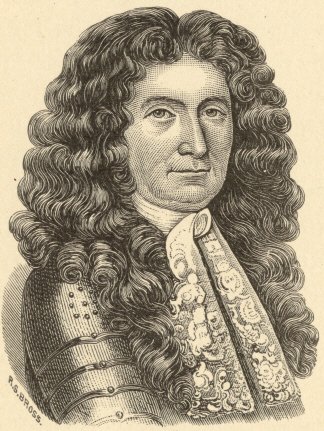
Sir Edmond Andros.
Before its sentence of death reached Massachusetts Charles II. was no
more, and James II., his brother, had ascended the throne. It was for a
time uncertain what sort of authority the stricken colony would be
called to accept. Already, as Duke of York, James II. had been
Proprietary of Maine east of the Kennebec (Sagadahoc), as well as of
Delaware, New Jersey, and New York. Now that he had the problem of
ruling Massachusetts to solve, it naturally occurred to the king to make
Sir Edmond Andros, already governor of New York, master also over the
whole of English America from the Saint Croix to the Delaware.
In southern New England the reign of Andros wrought no downright
persecution. He suspended the charters, and, with an irresponsible
council in each colony, assumed all legislative as well as
administrative power. Rhode Island submitted tamely. Her sister colony
did the same, save that, at Hartford, according to good tradition, in
the midst of the altercation about delivering the charter, prolonged
into candle-light, suddenly it was dark, and the precious document
disappeared to a secure place in the hollow trunk of an oak. This tree,
henceforth called the Charter Oak, stood till prostrated by a gale on
August 20, 1856.
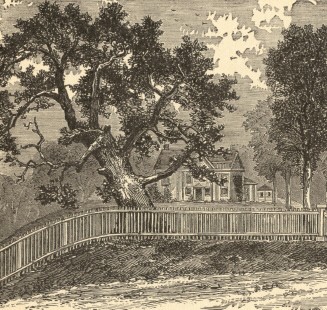
The Charter Oak at Hartford.
But in Massachusetts the colonists' worst fears were realized. Andros,
with a council of his own creation, made laws, levied taxes, and
controlled the militia. He had authority to suppress all
printing-presses and to encourage Episcopacy. In the latter interest he
opened King's Chapel to the Prayer Book. His permission was required for
any one to leave the colony. Extortionate fees and taxes were imposed.
Puritans had to swear on the Bible, which they regarded wicked, or be
disfranchised. Personal and proprietary rights were summarily set at
naught, and all deeds to land were declared void till renewed–for
money, of course. The citizens were reduced to a condition hardly short
of slavery.
[1688]
There is no describing the joy which pervaded New England as the news of
the Revolution of 1688 flew from colony to colony. Andros slunk away
from Boston, glad to escape alive. Drums beat and gala-day was kept. Old
magistrates were reinstated. Town meetings were resumed. All believed
that God had interposed, in answer to prayer, to bring deliverance to
his people from popery and thraldom.
This revolution, ushering in the liberal monarchy of William and Mary,
restored to Rhode Island and Connecticut their old charter governments
in full. New Hampshire, after a momentary union with Massachusetts
again, became once more a royal province. As to Massachusetts itself, a
large party of the citizens now either did not wish the old state of
things renewed, or were too timid to agree in demanding back their
charter as of right. Had they been bold and united, they might have
succeeded in this without any opposition from the Crown. Instead, a new
charter was conferred, creating Massachusetts also a royal province, yet
with government more liberal than the other provinces of this order
enjoyed. The governor was appointed by the Crown, and could convene,
adjourn, or dissolve the Legislature. With the consent of his council he
also created the judges, from whose highest sentence appeal could be
taken to the Privy Council. The governor could veto legislation, and the
king annul any law under three years old.
[1690-1697]
If in these things the new polity was inferior to the old, in two
respects it was superior; Suffrage was now practically universal, and
every species of religious profession, save Catholicism, made legal.
Also, Massachusetts territory was enlarged southward to take in all
Plymouth, eastward to embrace Maine (Sagadahoc) and Nova Scotia. Maine,
henceforth including Sagadahoc, that is, all land eastward to the Saint
Croix, remained part of Massachusetts till March 15, 1820, when it
became a member of the Union by itself. Nova Scotia, over which Phips's
conquest of Port Royal in 1690 had established a nominal rather than a
real English authority, was assigned to France again by the Treaty of
Ryswick, 1697.
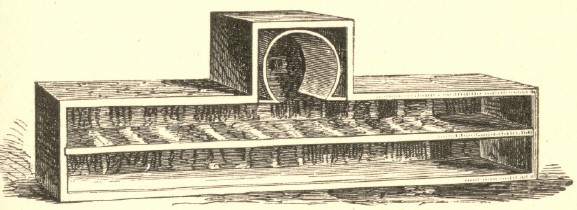
Box in which the Connecticut Charter was kept.