
[1637]
Troubles between the Indians and the whites arose so early as 1636. John
Oldham was murdered on Block Island by a party of Pequot Indians. Vane
of Massachusetts sent Endicott to inflict punishment. The Pequots in
turn attacked the fort at Saybrook, and in 1637 threatened Wethersfield.
They were planning a union with the Narragansets for the destruction of
the English, when Roger Williams informed the Massachusetts colony of
their designs and, at the urgent request of the governor and council,
hastened to the chief of the Narragansets and dissuaded him from
entering into the alliance.
The moment was critical. Captain Mason with about ninety English and
seventy Mohegans, under their sachem, Uncas (a sub chief, who with his
district, Mohegan, had rebelled against the Pequot sachem, Sassacus),
was sent from Hartford down the Connecticut River. Entering the Sound,
he sailed past the mouth of the Thames and anchored in Narragansett Bay,
at the foot of Tower Hill, near Point Judith. He knew that keen-eyed
scouts from the Pequot stronghold on the west bank of the Mystic River,
near Groton, had, as his three little ships skirted the shore, been
watching him, to give warning of his approach. He therefore resolved to
come upon the enemy from an unlooked-for quarter. This plan was directly
contrary to his instructions, which required him to land at the mouth of
the Thames and attack the fort from the west side. He hoped, marching
westward across the country, to take the enemy by surprise on their
unprotected rear, while the Indians, trusting in the strength of their
fort, as it fronted the west, should believe themselves secure.
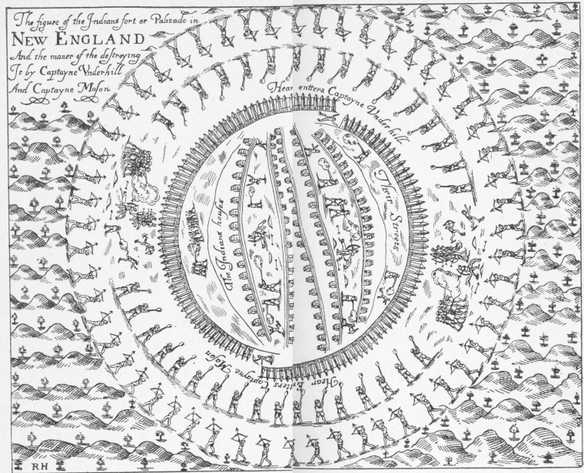
Attack on the Fort of the Pequots on the Mystic River
"The figure of the Indians fort or Palizado in NEW ENGLAND And the maner
of the destroying It by Captayne Underhill and Captayne Manson"
Thirteen men had been sent back to the Thames with the vessels. Two
hundred Narragansets had joined the expedition, though their sachem,
Miantonomoh, thought the English too weak to fight the dreaded Pequots.
Mason's enterprise was admirably planned, and he was as fortunate as he
was bold and skilful. He divided his men into two parties. One, led by
Underhill, climbed the steep ascent on the south side of the Indian
village; the other, directed by Mason himself, mounted the northern
slope. The garrison was buried in slumber, made more profound by
carousals the preceding night. One Indian was heard to cry out
"Englishmen" before the volley of musketry from the attacking force told
that the white enemy had come. Mason entered a wigwam and fought, as did
the others, hand-to-hand with the now awakened and desperate foe. Coming
out with a firebrand and exclaiming "We must burn them," he set fire to
the wigwam. The flames were quickly carried through the fort by the
northeast wind. Underhill from his side applied powder. So rapidly did
the flames spread that the English had difficulty in making good their
escape, while the Pequots who escaped the sword were doomed to perish by
fire. In an hour's time from four hundred to six hundred had fallen,
more than half of them women and children. Of the Englishmen two were
killed and about twenty wounded. In this dreadful slaughter the
Narragansets had little share, for they had shown such fear that Mason
had said to Uncas, "Tell them not to fly, but stand at what distance
they please and see whether Englishmen will now fight or not."
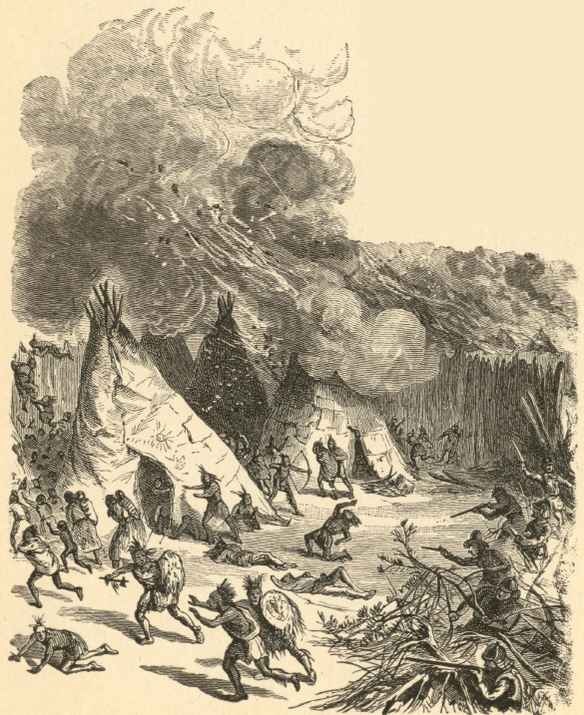
Attack on the Pequot Fort.
With the approach of day three hundred Pequots advanced from a second
fort intending to fight, but they were struck with horror at the sight
of their dead fellow-warriors. Keeping the enemy at bay, the English
marched to the vessels, which had arrived at Pequot Harbor, and, placing
the wounded on board, continued their march to Saybrook. The remnant of
the Pequots sought to escape from the country, moving westward along the
Sound. Captain Stoughton, sent with one hundred and twenty Massachusetts
men, was guided by the Narragansets to a swamp in which a little band of
those hostile savages had hidden. The men were slain, offering little
resistance. The women and children were divided among the Indian allies
or sold into slavery by the colonists of Massachusetts Bay.
Mason and Stoughton together sailed from Saybrook along the shore, while
Uncas with his men tracked the fugitives by land. At Guilford a Pequot
sachem was entrapped, shot, and his head thrust into the crotch of an
oak-tree near the harbor, giving the place the name of Sachem's Head.
Near the town of Fairfield a last stand was made by the hunted redskins,
in a swamp, to which the English were guided by a renegade Pequot. The
tribe with whom the Pequots had taken shelter, also the women and
children, were allowed to give themselves up. The men were shot down or
broke through and escaped. The wife of Mononotto fell into the hands of
the English. This Indian squaw had once shown kindness to two captive
girls, and by Winthrop's orders she was kindly treated in return. The
Pequots, once so powerful, were well-nigh exterminated. Those taken
prisoners were spared only to be held in bondage, Mononotto's wife with
the rest. Some were absorbed by the Narragansets, others by the
Mohegans, while the settlers of Connecticut, upon whom the war had
fallen so heavily, came into possession of the Pequot land.
[l638]
For nearly forty years the New England colonies were not again molested,
the merciless vigor with which they had fought making a lasting
impression upon their blood-thirsty foes. The cruel slavery to which the
surviving natives were subjected, the English justified by the example
of the Jews in their treatment of the Canaanites.
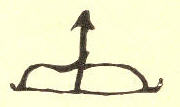
Signature of Miantonomoh.
[1642]
The Narraganset chief, Miantonomoh, had become the friend and ally of
the English by a treaty ratified in 1636, mainly through the good
offices of Roger Williams, In 1638, after the destruction of the
Pequots, there was a new treaty, embracing Uncas with his bold Mohegans,
and stipulating that any quarrel between Miantonomoh and Uncas should be
referred to the English. In 1642 Miantonomoh was accused of plotting
against the English, and summoned before the General Court at Boston.
Though acquitted he vowed revenge upon Uncas as the instigator of the
charge. His friendship for Roger Williams, as also for Samuel Gorton,
the purchaser of Shawomet, or Warwick, R. I., which was claimed by
Massachusetts, had perhaps created a prejudice against him. At any rate,
when a quarrel arose between Uncas and Sequasson, Miantonomoh's friend
and ally, while the latter naturally sided with Sequasson, the
sympathies of the English were with Uncas, who had aided them against
the Pequots. With the consent of Connecticut and Massachusetts
Miantonomoh took the field against Uncas, who had attacked Sequasson. He
was defeated and taken prisoner. Carried to Hartford he was held to
await the decision of the Commissioners of the United Colonies at
Boston. They would not release him, yet had no valid ground for putting
him to death. The case was referred to five clergymen, and they voted
for his execution. For this purpose the commissioners gave orders to
turn the brave warrior over to Uncas, English witnesses to be present
and see that no cruelty was perpetrated. The sentence was carried into
effect near Norwich. Cutting a piece of flesh from the shoulder of his
murdered enemy, Uncas ate it with savage relish, declaring it to be the
sweetest meat he had ever tasted.
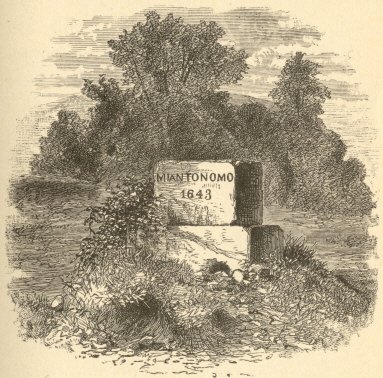
The Grave of Miantonomoh.
[1640-1643]
The Dutch, too, as we have to some extent seen already, felt the horrors
of Indian warfare. Kieft, the Dutch director-general, a man cruel,
avaricious, and obstinate, angered the red men by demanding tribute from
them as their protector, while he refused them guns or ammunition. The
savages replied that they had to their own cost shown kindness to the
Dutch when in need of food, but would not pay tribute. Kieft attacked.
Some of the Indians were killed and their crops destroyed. This roused
their revengeful passions to the utmost. The Raritan savages visited the
colony of De Vries, on Staten Island, with death and devastation. Reward
was offered for the head of anyone of the murderers. An Indian never
forgot an injury. The nephew of one of the natives who twenty years
before had been wantonly killed went to sell furs at Fort Amsterdam, and
while there revenged his uncle's murder by the slaughter of an
unoffending colonist. Spite of warlike preparations by Kieft and his
assembly in 1641-42, the tribe would not give up the culprit. The
following year another settler was knifed by a drunken Indian. Wampum
was indeed offered in atonement, while an indignant plea was urged by
the savages against the liquor traffic, which demoralized their young
men and rendered them dangerous alike to friend and foe. But
remonstrance and blood-money could not satisfy Kieft. At Pavonia and at
Corlaer's Hook [footnote: now in the New York City limits, just below
Broadway Ferry, East River] the Dutch fell venomously upon the sleeping
and unsuspecting enemy. Men, women, and children were slaughtered, none
spared. In turn the tribes along the lower Hudson, to the number of
eleven, united and desperately attacked the Dutch wherever found. Only
near the walls of Fort Amsterdam was there safety. The governor
appointed a day of fasting, which it seems was kept with effect. The
sale of liquor to the red men was at last prohibited, and peace for a
time secured.
Soon, however, the redskins along the Hudson were again up in arms. The
noted Underhill, who with Mason had been the scourge of the Pequots,
came to the fight with fifty Englishmen as allies of the Dutch. Not
waiting to be attacked, the Indians laid waste the settlements, even
threatening Fort Amsterdam itself. At a place now known as Pelham Neck,
near New Rochelle, lived the famous but unfortunate Mrs. Hutchinson, a
fugitive from the persecuting zeal of Massachusetts. Here the implacable
savages butchered her and her family in cold blood. Her little
granddaughter alone was spared, and led captive to a far-off wigwam
prison. Only at Gravesend, on Long Island, was a successful stand made,
and that by a woman, Lady Deborah Moody, another exile from religious
persecution, who with forty stout-hearted men defended her plantation
and compelled the savages to beat a retreat.
[1645]
The colony was in extremity. New Haven refused to aid, because, as a
member of the New England confederacy, it could not act alone, and
because it was not satisfied that the Dutch war was just. An appeal was
made by Kieft's eight advisers to both the States-General and the West
India Company in Holland. The sad condition of the colonists was fully
set forth, and the responsibility directly ascribed to the mismanagement
of Kieft. At the same time, undismayed by the gloomy outlook, the
courage of the sturdy Dutchmen rose with the emergency. Small parties
were sent out against the Connecticut savages in the vicinity of
Stamford. Indian villages on Long Island were surprised and the natives
put to the sword. In two instances at least the victors disgraced
humanity by torturing the captured.
In these engagements Underhill was conspicuous and most energetic.
Having made himself familiar with the position of the Indians near
Stamford, he sailed from Manhattan with one hundred and fifty men,
landed at Greenwich, and, marching all day, at midnight drew near the
enemy. His approach was not wholly unannounced, for the moon was full.
The fight was desperate and bloody. The tragedy that had made memorable
the banks of the Mystic in the destruction of the Pequot fort was now
almost equalled. After the example of his old comrade Mason, Underhill
fired the village. By flame, shot, or sword more than five hundred human
beings perished.
While New Netherland was awaiting some message of cheer from Holland, a
company of Dutch soldiers came from Curacoa, but they did little to
follow up the successes already gained. Again the Eight sent a memorial
to the company, boldly condemning the conduct of the director and
demanding his recall. Their remonstrances were at last heeded, and the
removal of the unpopular governor resolved upon. In 1647 Kieft set sail
for Holland, but the ship was wrecked, and he with nearly all on board
was drowned.
It was high time for a change. In the two years, 1643-45, while sixteen
hundred Indians had been slain, Manhattan had become nearly depopulated.
In 1645 peace was concluded, not only with the smaller tribes in the
vicinity, but also with the powerful Mohawks about Fort Orange, and
finally with all the Indians belonging to the Five Nations or
acknowledging their authority. A pleasing incident of this treaty was
the promise of the Indians to restore the eight-year-old granddaughter
of Mrs. Hutchinson, a promise which they faithfully performed in 1646.
The great compact was made under the shadow of the Fort Amsterdam walls,
and the universal joy was expressed by a day of thanksgiving.
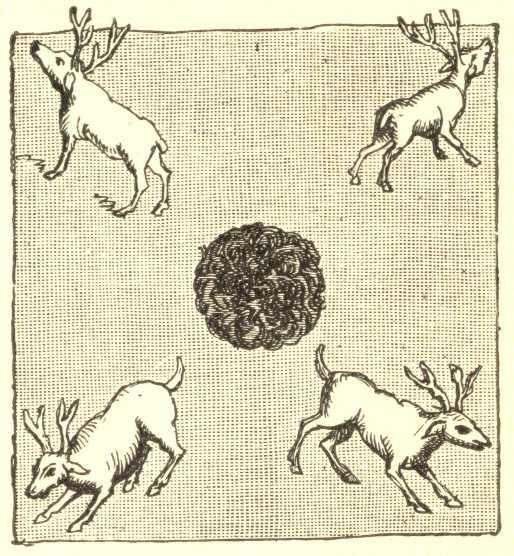
Totem or Tribe Mark of the Five Nations.
[1650-1660]
An interval of peace for ten years was now enjoyed, when the killing of
a squaw for stealing some peaches led to an attack by several hundred of
the infuriated savages upon New Amsterdam. They were repulsed here, but
crossing to the shore of New Jersey they laid waste the settlements
there. Staten Island, too, was swept with fire and sword. One hundred
people were slain, 150 more taken captive, 300 made homeless. Peace was
again effected and maintained for three years, when fresh quarrels
began. It was not until 1660 that a more general and lasting treaty was
brought about, on which occasion a Mohawk and a Minqua chief gave
pledges in behalf of the Indians, and acted as mediators between the
contending parties.