[1609]
While the French explorer, Champlain, was sailing along the shores of
the lake which bears his name, another equally adventurous spirit, Henry
Hudson, was on his way to the western world. Hoping to open a passage to
India by a voyage to the north, Hudson, an English navigator, offered in
1609 to sail under the authority of the Dutch East India Company. Driven
back by ice and fog from a northeast course, he turned northwest.
Searching up and down near the parallel of 40 degrees, he entered the
mouth of the great river which perpetuates his name. He found the
country inviting to the eye, and occupied by natives friendly in
disposition. The subsequent career of this bold mariner has a mournful
interest. He never returned to Holland, but, touching at Dartmouth, was
restrained by the English authorities, and forbidden longer to employ
his skill and experience for the benefit of the Dutch. Again entering
the English service and sent once more to discover the northwest
passage, he sailed into the waters of the bay which still bears his
name, where cold and hunger transformed the silent discontent of his
crew into open mutiny, and they left the fearless navigator to perish
amid the icebergs of the frozen north.
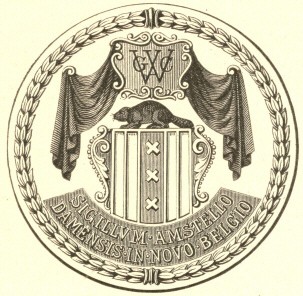
Seal of New Amsterdam.
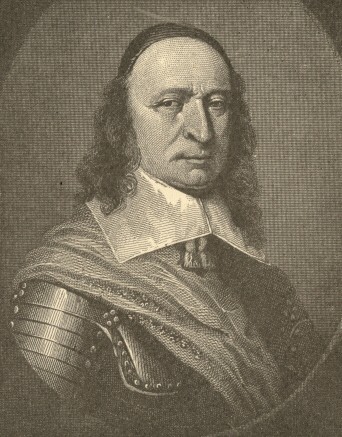
Peter Stuyvesant.
[1614-1618]
Hudson had sent to Holland a report of the Great River and the country
bordering it, rich in fur-bearing animals, and it had excited eager
interest. Private individuals sent expeditions thither and carried on a
profitable trade with the natives. A few Dutch were here when, in 1613,
Captain Argall sailed from Virginia against the French at Port Royal,
Acadia, now Annapolis in Nova Scotia, who were encroaching upon the
English possessions on the coast of Maine. He compelled them to
surrender. On his return, he visited the Dutch traders of Manhattan
Island, and forced them also, as it had been discovered by Cabot in
1497, to acknowledge the sovereignty of England over this entire region.
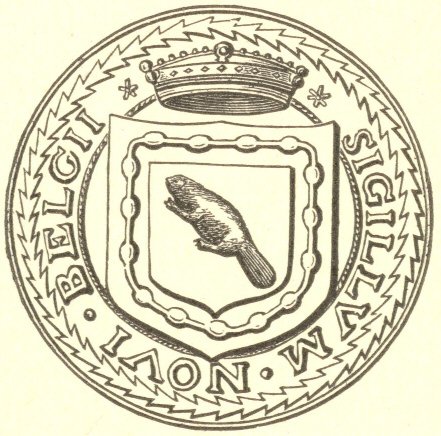
Seal of New Netherland.
It was in 1614 that the Dutch States-General, in the charter given to a
company of merchants, named the Hudson Valley New Netherland. To
facilitate trade this company made a treaty with the Five Nations and
subordinate tribes, memorable as the first compact formed between the
whites and the savages. In it the Indians were regarded as possessing
equal rights and privileges with their white brethren. The treaty was
renewed in 1645, and continued in force till the English occupation,
1664. In 1618, the charter of the New Netherland Company having expired,
the Dutch West India Company was offered a limited incorporation, but it
was not until 1621 that it received its charter, and it was two years
later that it was completely organized and approved by the
States-General. By this company were sent out Mey, as Director, to the
Delaware or South River, and Tienpont to the Hudson or North River. Four
miles below Philadelphia Fort Nassau was erected, and where Albany now
stands was begun the trading-post called Fort Orange.
[1626]
In 1626 Tienpont's successor, Peter Minuit, a German, born at Wesel, was
appointed Director-General of New Netherland. He bought of the Indians,
for the sum of twenty-four dollars, the entire island of Manhattan, and
a fort called New Amsterdam was built. The State of New York dates its
beginning from this transaction.
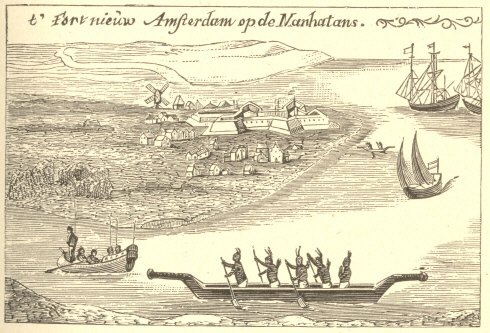
Earliest Picture of New Amsterdam.
By their usually honest dealing with the natives the Dutch settlers
gained the friendship of the Five Nations, whose good-will was partly on
this account transferred to the English colonists later. The Dutch were
not only friendly to the red men, but tried to open social and
commercial relations with the Plymouth colonists as well. Governor
Bradford replied, mildly urging the Dutch to "clear their title" to a
territory which the English claimed by right of discovery.
[1630-1633]
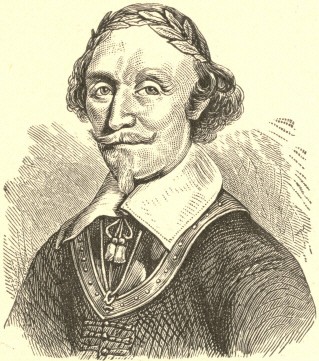
De Vries.
The present State of Delaware soon became the scene of attempts at
settlement. De Vries began, in 1632, a colony on the banks of the
Delaware, but it was quickly laid waste by the savages, who had been
needlessly provoked by the insolence of the commander left in charge of
the colony. In 1633 Minuit was succeeded by Van Twiller, and a fort was
erected at Hartford, though the English claimed this country as theirs.
Emigrants from the Plymouth colony began the settlement of Windsor, in
spite of the protests of the Dutch. Long Island was invaded by
enterprising New Englanders, regardless of the claim of New Netherland
thereto.
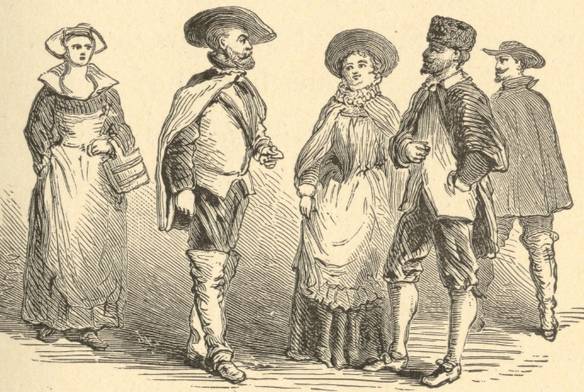
Costumes of Swedes.
This "irrepressible conflict" between two races was by no means abated
by the introduction of a third. As early as 1626, Gustavus Adolphus,
King of Sweden and the hero of the Thirty Years' War, had entertained
the idea of establishing colonies in America, and in pursuance of that
object had encouraged the formation of a company, not only for trading
purposes but also to secure a refuge for the "oppressed of all
Christendom." To Usselinx, an Antwerp merchant, the originator of the
Dutch West India Company, belongs the honor of first suggesting to the
king this enterprise. The glorious death of Gustavus on the victorious
field of Lutzen in 1632 deferred the execution of a purpose which had
not been forgotten even in the midst of that long and arduous campaign.
But a few days before he fell, the Protestant hero had spoken of the
colonial prospect as "the jewel of his kingdom."
[1638]
In 1638 Minuit, who had already figured as governor of New Netherland,
having offered his services to Sweden, was intrusted with the leadership
of the first Swedish colony to America. After a few days' stay at
Jamestown the new-comers finally reached their wished-for destination on
the west shore of the Delaware Bay and River. Proceeding up the latter,
one of their first acts was to build a fort on a little stream about two
miles from its junction with the Delaware, which they named Fort
Christina, in honor of the young queen of Sweden. Near this spot stands
the present city of Wilmington. The country from Cape Henlopen to the
falls at Trenton received the title of New Sweden.
[1650]
It was in this very year that Kieft came to supersede Van Twiller, who
had given just cause for complaint by his eagerness to enrich himself at
the expense of the West India Company. During the administration of
Kieft occurred the long and doubtful conflict with the natives detailed
in the succeeding chapter. Arbitrary and exacting, he drove the Indians
to extremities, and involved the Dutch settlements in a war which for a
time threatened their destruction. Not till 1645 was peace
re-established, and in 1647 the unpopular governor was recalled. In 1647
not more than three hundred fighting men remained in the whole province.
Its total population was between fifteen hundred and two thousand. In
1652 New Amsterdam had a population of seven or eight hundred. In 1664
Stuyvesant put the number in the province at ten thousand, about fifteen
hundred of whom were in New Amsterdam.
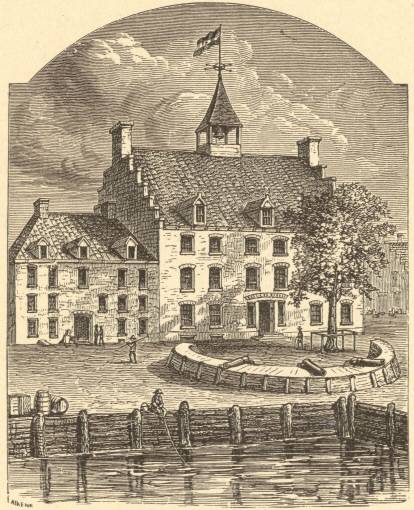
The old Stadt Huys at New Amsterdam.
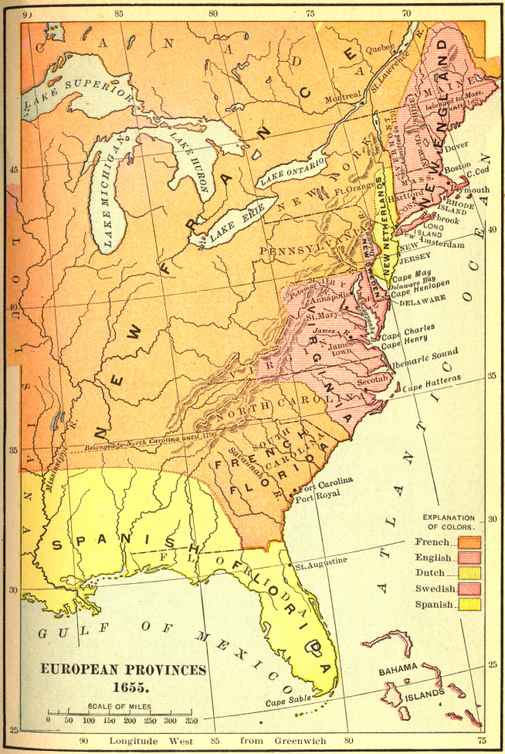
Illustration: European Provinces 1655. Map of the eastern North
America. Latitude 25 to 50 North, Longitude 75 to 95 West.
[1655-1663]
The next governor, Stuyvesant, was the last and much the ablest ruler
among those who directed the destinies of New Netherland. His
administration embraced a period of seventeen years, during which he
renewed the former friendly relations with the savages, made a treaty
with New England, giving up pretensions to Connecticut as well as
relinquishing the east end of Long Island, and compelled the Swedes, in
1655, to acknowledge the Dutch supremacy. It was while he was absent on
his expedition against the Swedes, leaving New Amsterdam unprotected,
that the river Indians, watchful of their opportunity, invaded and laid
waste the surrounding country. In 1663 the savages attacked the village
on the Esopus, now Kingston, and almost destroyed it. It was not until
the energetic governor made a vigorous campaign against the Esopus
tribe, whom he completely subdued, that peace was established on a firm
footing.
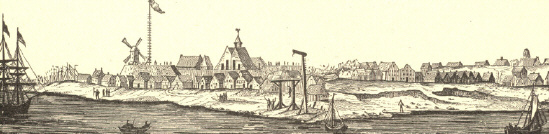
New Amsterdam in the middle of the Seventeenth Century.
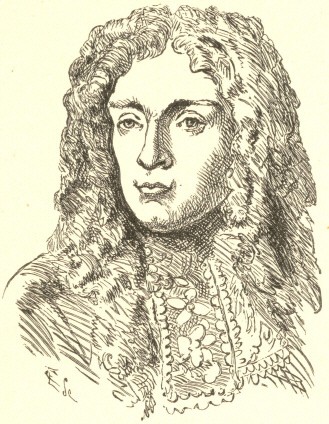
The Duke of York, afterwards James II.
[1664]
But the Dutch sway in their little part of the New World was about to
end. The English had never given over their claim to the country by
virtue of their first discovery of the North American continent. The New
Netherlanders, tired of arbitrary rule, sighed for the larger freedom of
their New England neighbors. Therefore, when in 1664 Charles II. granted
to his brother, the Duke of York, the territory which the Dutch were
occupying, and sent a fleet to demand its submission, the English
invader was welcomed.
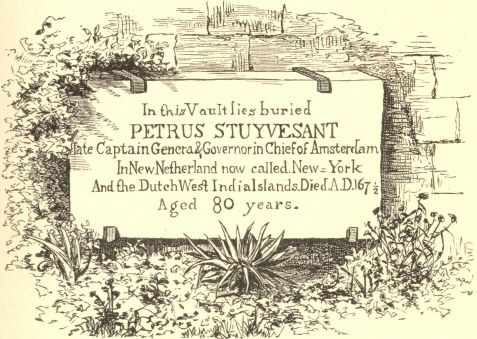
The Tomb of Stuyvesant. "In this Vault lies buried PETRUS
STUYVESANT late Captain Genral & Governor in Chief of Amsterdam, In New
Netherland now called New York and the Dutch West India Islands. Died
A.D. 1672 Aged 80 years."
Almost the only resistance came from the stout-hearted governor, who
could hardly be dissuaded from fighting the English single-handed, and
who signed the agreement to surrender only when his magistrates had, in
spite of him, agreed to the proposed terms. But the founders of the
Empire State have left an indelible impress upon the Union, which their
descendants have helped to strengthen and perpetuate. They were honest,
thrifty, devout, tolerant of the opinions of others. As Holland
sheltered the English Puritans from ecclesiastical intolerance, so New
Netherland welcomed within her borders the victims of New England
bigotry and narrowness.