
[1630]
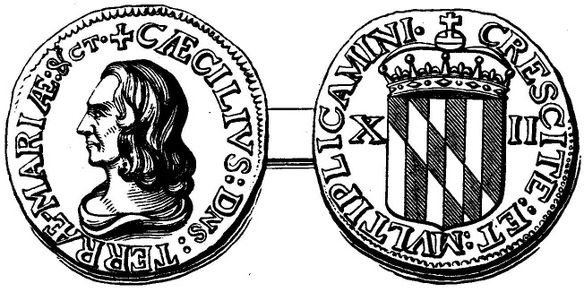
Maryland Shilling.
The very year that witnessed the landing of the Pilgrims records the
beginning of another attempt to colonize the New World. While Secretary
of State, having been appointed in 1619, Sir George Calvert, a member of
the Virginia Company from 1609 until its dissolution in 1624, determined
to plant a colony for himself. In the memorable year 1620 he bought of
Lord Vaughan the patent to the south-eastern peninsula of Newfoundland,
the next he sent colonists thither with a generous supply of money for
their support. In 1623 King James gave him a patent, making him
proprietary of this region. In 1625 Calvert boldly declared himself a
Catholic, and resigned his office of Secretary. Spite of this he was
soon afterwards ennobled, and his new title of Lord Baltimore is the
name by which he is best known. Visiting his little settlement in 1627
he quickly came to the conclusion that the severity of the climate would
make its failure certain. He therefore gave up this enterprise, but
determined to repeat the attempt on the more favorable soil of Virginia.
Confident of the goodwill of Charles I., to whom he had written for a
grant of land there, he did not await a reply, but sailed for Virginia,
where he arrived in 1629. In 1632 the king issued a patent granting to
Baltimore and his heirs a territory north and east of the Potomac,
comprising what we now call Maryland, all Delaware, and a part of
Pennsylvania. The name Maryland was given it by the king in, honor of
his queen, Henrietta Maria. But before this charter had received royal
signature Lord Baltimore had breathed his last, and his son Cecil
succeeded to his honors and possessions.
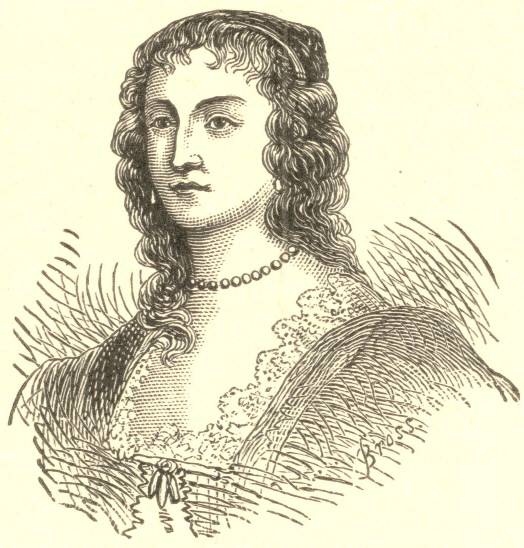
Henrietta Maria.
The Maryland charter made the proprietary the absolute lord of the soil.
He was merely to acknowledge fealty by the delivery of two Indian arrows
yearly to the king at Windsor. He could make laws with the consent of
the citizens, declare war or peace, appoint officers of government; in
fact, in most respects he had regal power. The colonists were, however,
to remain English subjects, with all the privileges of such. If they
were not represented in Parliament, neither were they taxed by the
Crown. If the proprietary made laws for them, these must not be contrary
to the laws of England. And they were to enjoy freedom of trade, not
only with England but with foreign countries.
[1634-1635]
This charter, as will be readily seen, could not please the Virginians,
since the entire territory conveyed by it was part of the grant of 1609
to the London Company for Virginia. But as this and subsequent charters
had been annulled in 1624, the new colony was held by the Privy Council
to have the law on its side, and Lord Baltimore was left to make his
preparations undisturbed. He fitted out two vessels, the Ark and the
Dove, and sent them on their voyage of colonization. They went by the
way of the West Indies, arriving off Point Comfort in 1634. Sailing up
the Potomac, they landed on the island of St. Clement's, and took formal
possession of their new home. Calvert explored a river, now called the
St. Mary's, a tributary of the Potomac, and being pleased with the spot
began a settlement. He gained the friendship of the natives by
purchasing the land and by treating them justly and humanely.
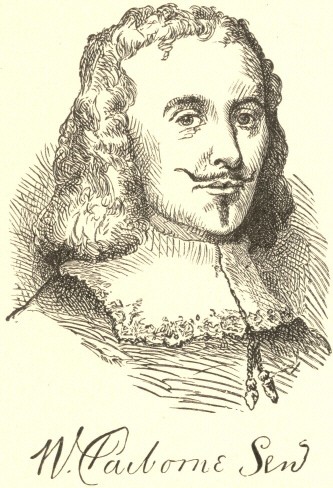
Supposed Portrait of William Clayborne.
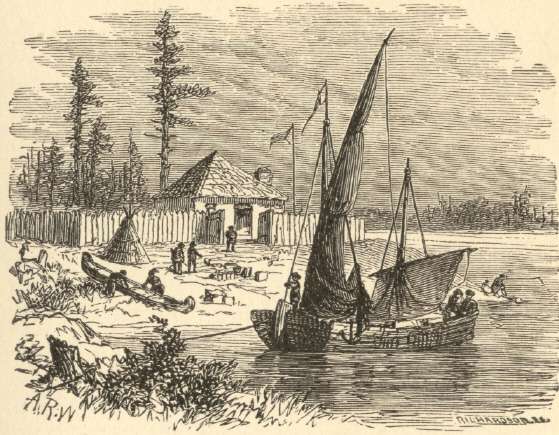
Clayborne's Trading Post on Kent Island.
The proprietary was a Catholic, yet, whether or not by an agreement
between him and the king, as Gardiner supposes, did not use either his
influence or his authority to distress adherents of the Church of
England. The two creeds stood practically upon an equality. But if
religious troubles were avoided, difficulties of another sort were not
slow in arising. About the year 1631, Clayborne, who had been secretary
of the Virginia colony, had chosen Kent Island in Chesapeake Bay as a
station for trading with the Indians. This post was in the very midst of
Maryland, and Calvert notified Clayborne that he should consider it a
part of that province. Clayborne at once showed himself a bitter enemy.
The Indians became suspicious and unfriendly, Clayborne, so it was
believed, being the instigator of this temper. An armed vessel was sent
out, with orders from Clayborne to seize ships of the St. Mary's
settlement. A fight took place, Clayborne fleeing to Virginia. Calvert
demanded that he should be given up. This was refused, and in 1637 he
went to England. A committee of the Privy Council decided that Kent
Island belonged to Maryland.
[1638]
In 1635 the first Maryland assembly met, consisting of the freemen of
the colony and the governor, Leonard Calvert, the proprietary's brother,
who was presiding officer. Lord Baltimore repudiated its acts, on the
ground that they were not proposed by him, as the charter directed. The
assembly which gathered in 1638 retaliated, rejecting the laws brought
forward by the proprietary.
[1639]
For a time the colony was without laws except the common law of England.
But Baltimore was too wise and conciliatory to allow such a state of
affairs to continue. He gave authority to the governor to assent to the
acts of the assembly, which he himself might or might not confirm.
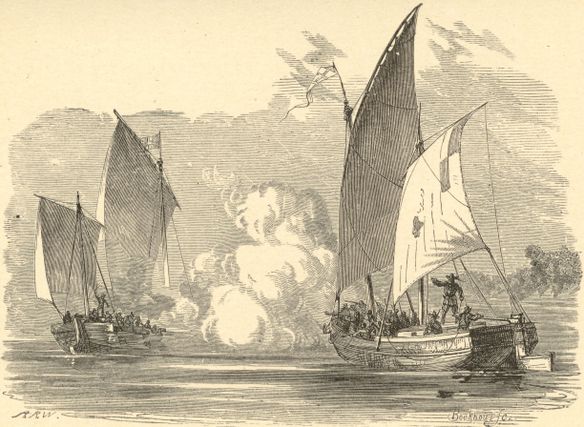
Fight between Clayborne and the St. Mary's Ship.
Accordingly in 1639 the assembly met and passed various acts, mostly
relating to civil affairs. One, however, was specially noteworthy, as
giving to the "Holy Church" "her rights and liberties," meaning by this
the Church of Rome, for, as Gardiner says, the title was never applied
to the Church of England. It was at the same time expressly enacted that
all the Christian inhabitants should be in the enjoyment of every right
and privilege as free as the natural-born subjects of England. If Roger
Williams was the first to proclaim absolute religious liberty, Lord
Baltimore was hardly behind him in putting this into practice. As has
been neatly said, "The Ark and the Dove were names of happy omen: the
one saved from the general wreck the germs of political liberty, and the
other bore the olive-branch of religious peace."
[1646]
During the civil war in England the affairs of Maryland were in a very
disturbed condition. Clayborne, Maryland's evil genius, seized the
opportunity to foment an insurrection, possessed himself once more of
Kent Island, and compelled the governor to flee to Virginia. Returning
in 1646, Calvert was fortunate enough to recover the reins of
government, but the following year witnessed the close of his
administration and his short though useful and eventful life. Few men
intrusted with almost absolute authority have exercised it with so much
firmness and at the same time with so much ability, discretion, and
uprightness.
[1650]
His successor, Greene, a Catholic, was not likely to find favor with the
Puritan Parliament of England, and Baltimore, in 1648, to conciliate the
ruling powers and to refute the charge that Maryland was only a retreat
for Romanists, removed the governor and appointed instead one who was a
Protestant and a firm supporter of Parliament. The council was also
changed so as to place the Catholics in the minority. The oath of the
new governor restrained him from molesting any person, especially if of
the Roman Catholic persuasion, on account of religious profession. The
way was thus opened for the Act of Toleration passed in 1649. This law,
after specifying certain speeches against the Trinity, the Virgin, or
the saints as punishable offences, declared that equal privileges should
be enjoyed by Christians of all creeds. Whatever the motives of
Baltimore, his policy was certainly wise and commendable.
A new and troublesome element was now introduced into the colony. Some
Puritans who had not been tolerated among the stanch Church-of-England
inhabitants of Virginia were invited by Governor Stone to Maryland.
Their home here, which they named Providence, is now known as Annapolis.
The new-comers objected to the oath of fidelity, refused to send
burgesses to the assembly, and were ready to overthrow the government
whose protection they were enjoying. Opportunity soon offered.
Parliament had already in 1652 brought Virginia to submission. Maryland
was now accused of disloyalty, and when we notice among the
commissioners appointed by the Council of State, the name of Clayborne,
it is not difficult to understand who was the author of this charge. The
governor was removed, but being popular and not averse to compromise,
was quickly restored. Then came the accession of Cromwell to power as
Protector of England. Parliament was dissolved. The authority of its
commissioners of course ceased. Baltimore seized this opportunity to
regain his position as proprietary. He bade Stone to require the oath of
fidelity to the proprietary from those who occupied lands, and to issue
all writs in his name. He maintained that the province now stood in the
same relations to the Protectorate which it had borne to the royalist
government of Charles I.
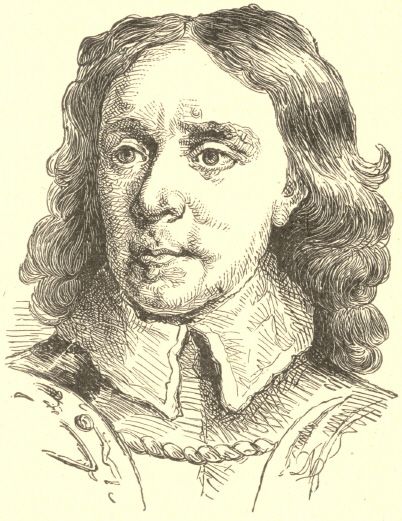
Oliver Cromwell.
So thought Cromwell, but not so Clayborne or the Maryland Puritans. They
deposed Stone, and put in power Fuller, who was in sympathy with their
designs. There resulted a reversal of the acts of former assemblies, and
legislation hostile to the Catholics. The new assembly, from which
Catholics were carefully excluded by disfranchisement, at once repealed
the Act of Toleration. Protection was withdrawn from those who professed
the popish religion, and they were forbidden the exercise of that faith
in the province. Severe penalties were threatened against "prelacy" and
"licentiousness" thus restricting the benefits of their "Act concerning
Religion" to the Puritan element now in power. The authority of the
proprietary himself was disputed, and colonists were invited to take
lands without his knowledge or consent.
[1656]
Baltimore adopted vigorous measures. By his orders Stone made a forcible
attempt to regain control of the province, but was defeated at
Providence and taken prisoner. His life was spared, but four of his men
were condemned and executed. Baltimore again invoked the powerful
intervention of Cromwell, and again were the enemies of Maryland sternly
rebuked for their interference in the affairs of that province, and told
in plain language to leave matters as they had found them. In 1656,
after an inquiry by the Commissioners of Trade, the claims of Baltimore
were admitted to be just, and he promptly sent his brother Philip to be
a member of the council and secretary of the province. The legislation
of the usurping Puritans was set aside, religious toleration once more
had full sway, and a general pardon was proclaimed to those who had
taken part in the late disturbances.
In the meantime, Fendall, who had been appointed governor by Baltimore,
plotted to make himself independent of his master, and, with the
connivance of the assembly, proceeded to usurp the authority which was
lawfully vested in the proprietary. But the attempt was a miserable
failure. Philip Calvert was immediately made governor by the now
all-powerful proprietary, who had the favor and support of Charles II.,
just coming to the throne. Peace and prosperity came back to the colony
so sorely and frequently vexed by civil dissensions. The laws were just
and liberal, encouraging the advent of settlers of whatever creed, while
the rule of the Calverts was wise and benign, such as to merit the
respect and admiration of posterity. In 1643 Virginia and Maryland
together had less than twenty thousand inhabitants. In 1660 Maryland
alone, according to Fuller, had eight thousand. Chalmers thinks there
were no fewer than twelve thousand at this date.