
[1612]
The Pilgrims who settled New England were Independents, peculiar in
their ecclesiastical tenet that the single congregation of godly
persons, however few or humble, regularly organized for Christ's work,
is of right, by divine appointment, the highest ecclesiastical authority
on earth. A church of this order existed in London by 1568; another,
possibly more than one, the "Brownists," by 1580. Barrowe and Greenwood
began a third in 1588, which, its founders being executed, went exiled
to Amsterdam in 1593, subsequently uniting with the Presbyterians there.
These churches, though independent, were not strictly democratic, like
those next to be named.
Soon after 1600 John Smyth gathered a church at Gainsborough in
Lincolnshire, England, which persecution likewise drove to Amsterdam.
Here Smyth seceded and founded a Baptist church, which, returning to
London in 1611 or 1612, became the first church of its kind known to
have existed in England. From Smyth's church at Gainsborough sprang one
at Scrooby, in Nottinghamshire, and this, too, exiled like its parent,
crossed to Holland, finding home in Leyden in 1607 and 1608. Of this
church John Robinson was pastor, and from its bosom came the Plymouth
Colony to New England.
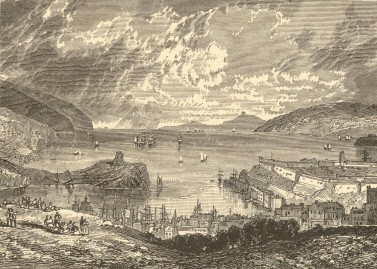
Plymouth Harbor, England.
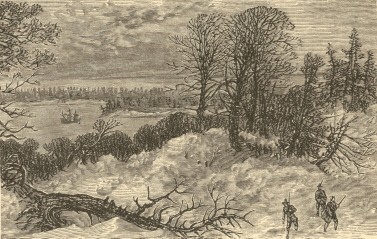
Harbor of Provincetown, Cape Cod, where the Pilgrims landed.
[1620]
This little band set out for America with a patent from the Virginia
Company, according to James I.'s charter of 1606, but actually began
here as labor-share holders in a sub-corporation of a new organization,
the Plymouth Company, chartered in 1620. Launching in the Mayflower from
Plymouth, where they had paused in their way hither from Holland, they
arrived off the coast of Cape Cod in 1620, December 11th Old Style,
December 21st New Style, and began a settlement, to which they gave the
name Plymouth. Before landing they had formed themselves into a
political body, a government of the people with "just and equal laws."
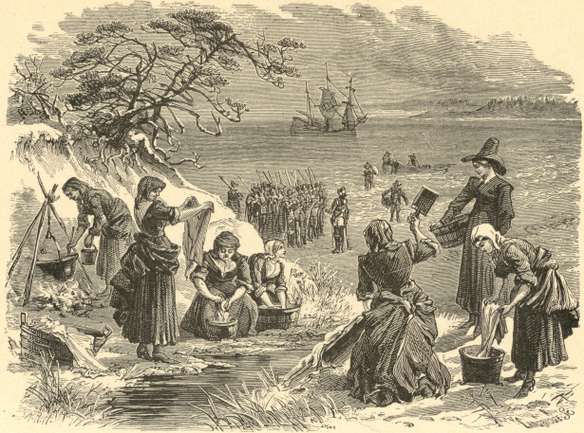
The Life of the Colony at Cape Cod.
They based their civil authority upon this Mayflower compact,
practically ignoring England. Carver was the first governor, Bradford
the second. The colony was named Plymouth in memory of hospitalities
which its members had received at Plymouth, England, the name having no
connection with the "Plymouth" of the Plymouth Company. The members of
the Plymouth Company had none but a mercantile interest in the
adventure, merely fitting out the colonists and bearing the expense of
the passage for all but the first. On the other hand, the stock was not
all retained in England. Shares were allotted to the Pilgrims as well,
one to each emigrant with or without means, and one for every 10 pounds
invested.
Plymouth early made a treaty with Massasoit, the chief of the
neighboring Wampanoags, the peace lasting with benign effects to both
parties for fifty years, or till the outbreak of Philip's War, discussed
in a later chapter. The first winter in Plymouth was one of dreadful
hardships, of famine, disease and death, which spring relieved but in
part. Yet Plymouth grew, surely if slowly. It acquired rights on the
Kennebec, on the Connecticut, at Cape Ann. It was at first a pure
democracy, its laws all made in mass-meetings of the entire body of
male inhabitants; nor was it till 1639 that increase of numbers forced
resort to the principle of representation. In 1643 the population was
about three thousand.
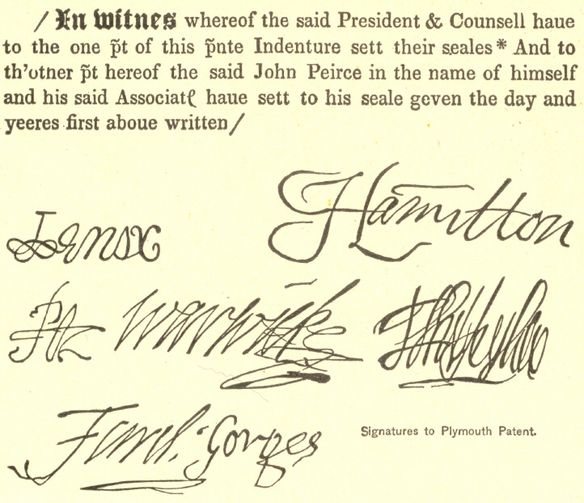
Signatures to Plymouth Patent.
/In witnes whereof the said President & Counsell haue to the one pt of
this pute Indenture sett their seales* And to th'other pt hereof the
said John Peirce in the name of himself and his said Associate haue sett
to his seale geven the day and yeeres first aboue written/
[1626-1630]
Between 1620 and 1630 there were isolated settlers along the whole New
England coast. White, a minister from Dorchester, England, founded a
colony near Cape Ann, which removed to Salem in 1626. The Plymouth
Company granted them a patent, which Endicott, in charge of more
emigrants, brought over in 1628. It gave title to all land between the
Merrimac and Charles Rivers, also to all within three miles beyond each.
These men formed the nucleus of the colony to which in 1629 Charles I.
granted a royal charter, styling the proprietors "the Governor and
Company of the Massachusetts Bay in New England." Boston was made the
capital. Soon more emigrants came, and Charlestown was settled.
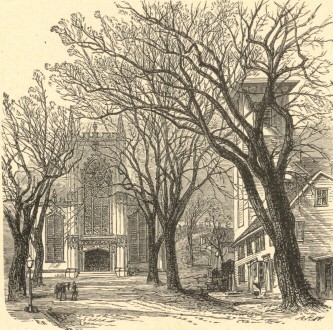
Site of First Church and Governor Bradford's House at Plymouth.
It was a momentous step when the government of this colony was
transferred to New England. Winthrop was chosen Governor, others of the
Company elected to minor offices, and they, with no fewer than one
thousand new colonists, sailed for this side the Atlantic. In
Massachusetts, therefore, a trading company did not beget, as elsewhere,
but literally became a political state. Many of the Massachusetts men,
in contrast with those of Plymouth, had enjoyed high consideration at
home. Yet democracy prevailed here too. The Governor and his eighteen
assistants were chosen by the freemen, and were both legislature and
court. As population increased and scattered in towns, these chose
deputies to represent them, and a lower house element was added to the
General Court, though assistants and deputies did not sit separately
till 1644.
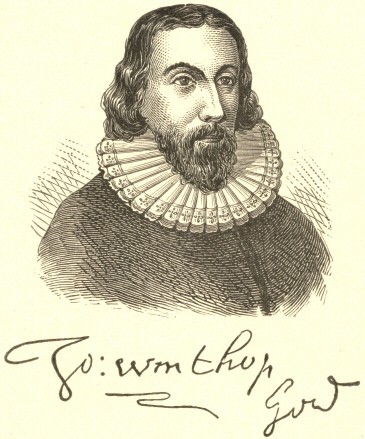
Governor Winthrop.
[1631]
At this time Massachusetts had a population of about 15,000. To all New
England 21,200 emigrants came between 1628 and 1643, the total white
population at the latter date being about 24,000.
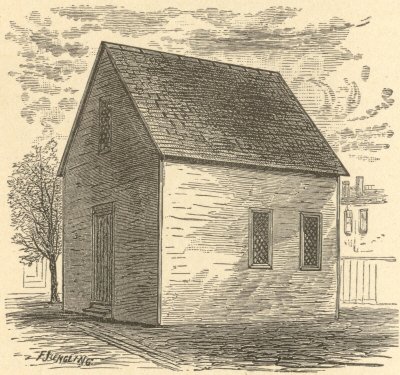
First Church in Salem.
So early as 1631 this colony decreed to admit none as freemen who were
not also church members. Thus Church and State were made one, the
government a theocracy. The Massachusetts settlers, though in many
things less extreme than the Pilgrims, were decided Puritans, sincere
but formal, precise, narrow, and very superstitious. They did not,
however, on coming hither, affect or wish to separate from the Church of
England, earnestly as they deprecated retaining the sign of the cross in
baptism, the surplice, marriage with ring, and kneeling at communion.
Yet soon they in effect became Separatists as well as Puritans, building
independent churches, like those at Plymouth, and repudiating episcopacy
utterly.
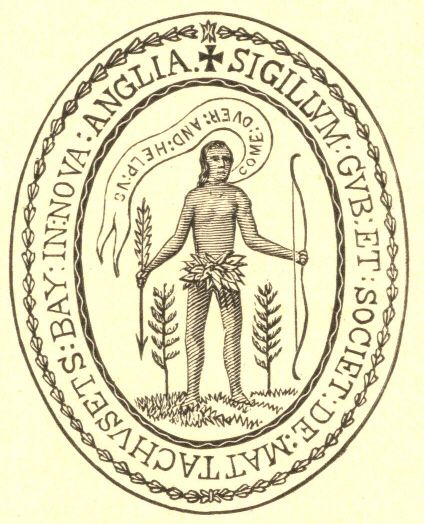
Seal of Massachusetts Bay Company.
[1635]
Much as these Puritans professed and tried to exalt reason in certain
matters, in civil and religious affairs, where they took the Old
Testament as affording literal and minute directions for all sorts of
human actions for all time, they could allow little liberty of opinion.
This was apparent when into this theocratic state came Roger Williams,
afterward the founder of Rhode Island. Born in London, England, about
1607, of good family, he was placed by his patron, Coke, at the Charter
House School. From there he went to Pembroke College, Cambridge. In 1631
he arrived in Boston. Somewhat finical in his political, moral, and
religious ideas, he found it impossible, having separated from the
Church of England, in which he had been reared, to harmonize here with
those still favoring that communion. At Salem he was invited by a little
company of Separatists to become their teacher. His views soon offended
the authorities. He declared that the king's patent could confer no
title to lands possessed by Indians. He denied the right of magistrates
to punish heresy, or to enforce attendance upon religious services. "The
magistrate's power," he said, "extends only to the bodies, goods, and
outward state of men."
Alarmed at his bold utterances, the General Court of Massachusetts,
September 2, 1635, decreed his banishment for "new and dangerous
opinions, against the authority of magistrates." His fate was not,
therefore, merely because of his religious views. The exile sought
refuge at Seekonk, but this being within the Plymouth jurisdiction, he,
on Governor Winslow's admonition, moved farther into the wilderness,
settling at Providence. He purchased land of the natives, and, joined by
others, set up a pure democracy, instituting as a part thereof the
"lively experiment," for which ages had waited, of perfect liberty in
matters of religious belief. Not for the first time in history, but more
clearly, earnestly, and consistently than it had ever been done before,
he maintained for every man the right of absolute freedom in matters of
conscience, for all forms of faith equal toleration.
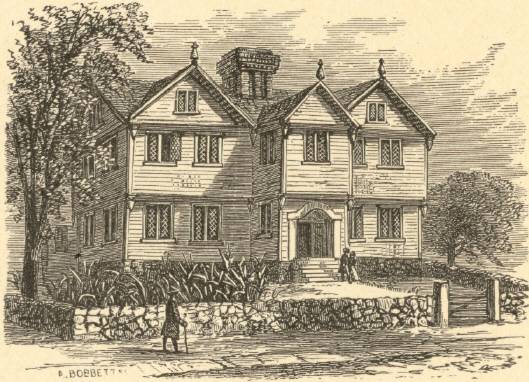
Roger Williams' House at Salem.
[1638]
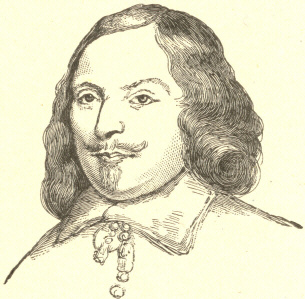
Edward Winslow.
Some friends of Mrs. Anne Hutchinson established a colony on Aquidneck,
the Indian name for Rhode Island. Williams went to England and secured
from Parliament a patent which united that plantation with his in one
government. Charles II.'s charter of 1663 added Warwick to the first two
settlements, renewing and enlarging the patent, and giving freest scope
for government according to Williams' ideas. Mrs. Hutchinson, a woman of
rare intellect and eloquence, who maintained the right of private
judgment and pretended to an infallible inner light of revelation, was,
like Williams, a victim of Puritan intolerance. She and her followers
were banished, and some of them, returning, put to death, 1659-60. She
came to Providence, then went to Aquidneck, where her husband died in
1642. She next settled near Hurl Gate, within the Dutch limits, where
herself and almost her entire family were butchered by the Indians in
1643.
In 1633 the Dutch erected a fort where Hartford now is, but some English
emigrants from Plymouth Colony, in defiance of a threatened cannonade,
sailed past and built a trading-house at Windsor, where, joined by
colonists, from about Boston, they soon effected a settlement.
Wethersfield and Hartford were presently founded. In 1630 the Plymouth
Company had granted Connecticut to the Earl of Warwick, who turned it
over to Lord Brooke, Lord Say-and-Seal, and others. Winthrop the
Younger, son of Governor Winthrop, of Massachusetts, commissioned by
these last, built a fort at Saybrook. Till the expiration of his
commission the towns immediately upon the Connecticut were under the
government of Massachusetts. Their population in 1643 was three
thousand. A convention of these towns met at Hartford, January 14, 1639,
and formed a constitution, like that of Massachusetts Bay, thoroughly
republican in nature. Connecticut breathed a freer spirit than either
Massachusetts or New Haven, being in this respect the peer of Plymouth.
At Hartford Roger Williams was always welcome.
Meantime, in 1638, having touched at Boston the year before, Davenport,
Eaton, and others from London began planting at New Haven. The Bible was
adopted as their guide in both civil and religious affairs, and a
government organized in which only church members could vote or be
elected to the General Court. The colony flourished, branching out into
several towns. In 1643 it numbered twenty five hundred inhabitants.
As early as 1622, Mason and Gorges were granted land partly in what is
now Maine, partly in what is now New Hampshire; and in 1623 Dover and
Portsmouth were settled. Wheelwright, a brother-in-law of Mrs.
Hutchinson, with others, purchased of the natives the southeast part of
New Hampshire, between the Merrimac and the Piscataqua, and in 1638
Exeter was founded. In the same year with Wheelwright's purchase, Mason
obtained from the council of the Plymouth Company a patent to this same
section, and the tract was called New Hampshire. These conflicting
claims paved the way for future controversies and lawsuits. The settlers
here were not Puritans, nor were they obliged to be church members in
order to be deputies or freemen.
The settlement of Maine goes back to 1626, when the Plymouth Company
granted lands there both to Alexander and to Gorges. In 1639 Gorges
secured a royal charter to re-enforce his claim. Large freedom, civil
and religious, was allowed. For many years the Maine settlements were
small and scattered, made up mostly of such as came to hunt and fish for
a season only.
[1650]
From 1643 to 1684 Massachusetts, Plymouth, Connecticut, and New Haven
formed a confederation under the style of the United Colonies of New
England. Maine, Providence, and Rhode Island sought membership, but were
refused as being civilly and religiously out of harmony with the
colonies named. Connecticut, offensive to the Dutch, and exposed to
hostilities from them, was the most earnest for the union, while at the
same time the most conservative as to its form. It was a loose league,
leaving each colony independent save as to war and peace, Indian
affairs, alliances and boundaries. Questions pertaining to these were to
be settled by a commission of two delegates from each of the four
colonies, meeting yearly, voting man by man, six out of the eight votes
being necessary to bind.
The confederacy settled a boundary dispute between New Haven and New
Netherland in 1650. It received and disbursed moneys, amounting some
years to 600 pounds, for the propagation of the gospel in New England,
sent over by the society which Parliament incorporated for that purpose
in 1649. It was also of more or less service in securing united action
against the savages in Philip's War. The union was, however, of little
immediate service, useful rather as an example for the far future. Its
failure was due partly to the distance of the colonies apart, and to the
strength of the instinct for local self-government, a distinguishing
political trait of New England till our day. Its main weakness, however,
was the overbearing power and manner of Massachusetts, especially after
her assumption of Maine in 1652. In 1653 the Plymouth, New Haven, and
Connecticut commissioners earnestly wished war with New Netherland, but
Massachusetts proudly forbade–a plain violation of the articles. After
this there was not much heart in the alliance. The last meeting of the
commissioners occurred at Hartford, September 5, 1684.