
[1606]
We have now arrived at the seventeenth century. In 1606 King James I.
issued the first English colonial charter. It created a first and a
second Virginia Company, the one having its centre in London, and coming
to be known as the London Company; the other made up of Bristol, Exeter,
and Plymouth men, and gradually taking the title of the Plymouth
Company. This latter company, the second, or Plymouth Company,
authorized to plant between 38 degrees and 45 degrees north, effected a
settlement in 1607 at the mouth of the Kennebec River. Little came of it
but suffering, the colonists, after a severe winter, returning to
England.
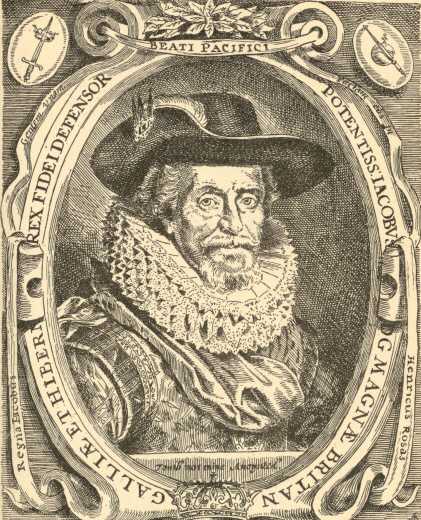
King James I. Mr. Henry Irving's Collection.
[1607]
A colony of one hundred and five planters sent out by the first or
London Company, proceeded, also in 1607, to Chesapeake Bay, entering
James River, to which they indeed gave this name, and planted upon its
banks Jamestown, the first permanent English colony on the continent.
This London Company consisted of a council in England, appointed by the
king, having the power to name the members of a local council which was
to govern the colony, the colonists themselves having no voice.
It is well known that the very earliest population of the Old Dominion
was not of the highest, but predominantly idle and thriftless. Vagabonds
and homeless children picked up in the streets of London, as well as
some convicts, were sent to the colony from England to be indented as
servants, permanently, or for a term of years. Persons of the better
class, to be sure, came as well, and the quality of the population, on
the whole, improved year by year. Settlement here followed a centrifugal
tendency, except as this was repressed by fear of the Indians. In 1616
the departments of Virginia were Henrico, up the James above the
Appomattox mouth, West and Shirley Hundreds, Jamestown, Kiquoton, and
King's Gift on the coast near Cape Charles–a wide reach of territory to
be covered by a total population of only three hundred and fifty.
[1608]
A little exporting was immediately begun. So early as May 20, 1608,
Jamestown sent to England a ship laden with iron ore, sassafras, cedar
posts, and walnut boards. Another followed on June 2d, with a cargo all
of cedar wood. This year or the next, small quantities of pitch, tar,
and glass were sent. From 1619 tobacco was so common as to be the
currency. About 1650 it was largely exported, a million and a half
pounds, on the average, yearly. The figure had risen to twelve million
pounds by 1670. At the middle of the century, corn, wheat, rice, hemp,
flax, and fifteen varieties of fruit, as well as excellent wine were
produced. A wind-mill was set up about 1620, the first in America. It
stood at Falling Creek on the James River. The pioneer iron works on the
continent were in this colony, hailing from about the date last named.
Community of property prevailed at Jamestown in all the earliest years,
as it did at Plymouth. After the event noted by John Rolfe: "about the
last of August [1619] came in a Dutch man of warre that sold us twenty
Negars," slavery was a continual and increasing curse, as is attested
by the laws concerning slaves. It encouraged indolence and savagery of
habit and nature. Virginian slaves, however, were better treated than
those farther south. They were tolerably clothed, fed, and housed.
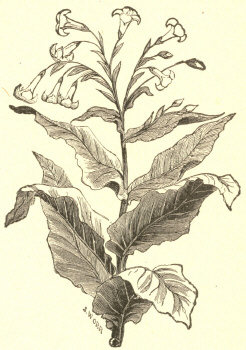
Tobacco Plant.
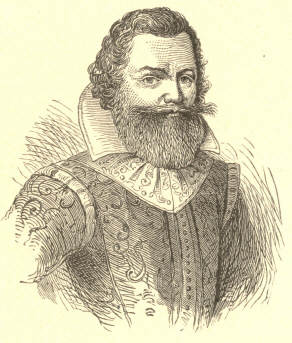
Captain John Smith.
There was in Virginia little of that healthful social and political
contact which did so much to develop civilization at the North. Of town
life there was practically nothing. Even so late as 1716 Jamestown had
only a sorry half-dozen structures, two of which were church and
court-house. Fifteen years later Fredericksburg had, besides the manor
house of Colonel Willis and its belongings, only a store, a tailor shop,
a blacksmith shop, a tavern or "ordinary," and a coffeehouse. Richmond
and Petersburg still existed only on paper, and if we come down to the
middle of the eighteenth century, Williamsburg, the capital of the
province, was nothing but a straggling village of two hundred houses,
without a single paved street. Only the College and the governor's
"palace" were of brick. The county-seats were mostly mere glades in the
woods, containing each its court-house, prison, whipping-post, pillory,
and ducking-stool, besides the wretched tavern where court and
attendants put up, and possibly a church. Hardships and dissensions
marked the whole early history of this infant state. At one time only
forty settlers remained alive, at another meal and water were the sole
diet. Hoping for instant riches in gold, poor gentlemen and vagabonds
had come, too much to the exclusion of mechanics and laborers. For
relief from the turbulence and external dangers of this period, the
colony owed much to Captain John Smith, who, after all allowance for his
boasting, certainly displayed great courage and energy in emergencies.
He, too, it was who did most to explore the country up the James and
upon Chesapeake Bay.
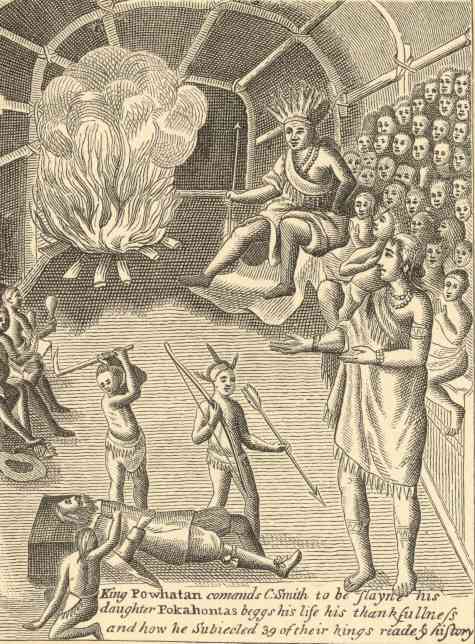
"King Powhatan commands C:Smith to be flayne his daughter
Pokahontas beggs his life his thankfullness and how he subiecled 39 of
their kings reade ye history"
Pocahontas saving Captain Smith's
Life. From Smith's "General History."
[1609-1610]
A new charter was granted in 1609, the council in England being now
appointed by the stockholders instead of the king, and the governor of
the colony being named by this council. Lord Delaware was made Governor
and Captain-General of Virginia, and many more colonists sent out. By a
wreck of two of the vessels there was delay in the arrival of the newly
chosen officers. Smith, then Percy, meantime continued to exercise
authority. This, again, was a critical period. Indians were troublesome.
Tillage having been neglected from the first, provisions became
exhausted, and a crisis long referred to as "the starving time" ensued.
The colony had actually abandoned Jamestown and shipped for England,
when met in James River by Lord Delaware, coming with relief. They at
once returned, and an era of hope dawned. This was in June, 1610. One
hundred and fifty new settlers accompanied Delaware. Planting was
vigorously prosecuted, the Indians placated, and still further
accessions of people and cattle secured from England.
[1612]
Delaware's brief, mild sway was always a benediction, in pleasing
contrast with the severities of Dale and Argall, who successively
governed after his departure. Under Dale, death was the penalty for
slaughtering cattle, even one's own, except with the Governor's leave,
also of exporting goods without permission. A baker giving short weight
was to lose his ears, and on second repetition to suffer death. A
laundress purloining linen was to be flogged. Martial law alone
prevailed; even capital punishment was ordained without jury. Such
arbitrary rule was perhaps necessary, so lawless were the mass of the
population. It at any rate had the excellent effect of rousing the
Virginians to political thought and to the assertion of their rights. In
1612 a change took place in the Company's methods of governing its
colony. The superior council was abolished, its authority transferred to
the corporation as a whole, which met as an assembly to elect officers
and enact laws for the colony. The government thus became more
democratic in form and spirit.
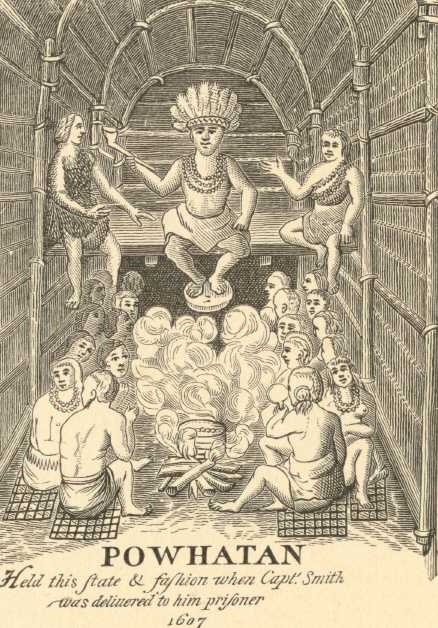
"POWHATAN Held this state & fashion when Capt.' Smith was
delivered to him prisoner. 1607"
The Council of Powhatan. From Smith's "General History,"
[1614-1619]
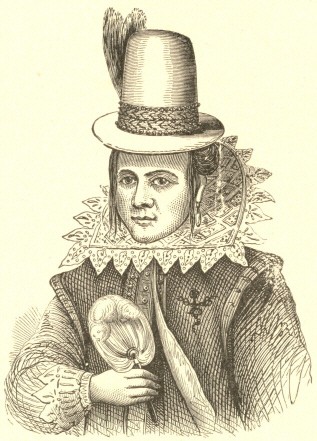
The year 1614 was distinguished by the marriage of Pocahontas, daughter
of the native chief Powhatan, to the English colonist Rolfe. With him
she visited England, dying there a few years later. The alliance secured
the valuable friendship of Powhatan and his subjects–only till
Powhatan's death, however. Thenceforth savage hostilities occurred at
frequent intervals. In 1622 they were peculiarly severe, over three
hundred settlers losing their lives through them. Another outbreak took
place about 1650, this time more quickly suppressed. We shall see in a
later chapter how Bacon's Rebellion was occasioned by Indian troubles.
As James I. broke with Parliament, a majority of the Virginia
shareholders proved Liberals, and they wrought with signal purpose and
effect to realize their ideas in their colony. To this political
complexion of the Virginia Company not only Virginia itself, but, in a
way, all America is indebted for a start toward free institutions.
During the governorship of George Yeardley, was summoned an assembly of
burgesses, consisting of two representatives, elected by the
inhabitants, from each of the eleven boroughs or districts which the
colony had by this time come to embrace. It met on June 10, 1619, the
earliest legislative body in the New World. This was the dawn of another
new era in the colony's history.
Pocahantas
[1622-1625]
In 1622 arrived Sir Thomas Wyatt, bringing a written constitution from
the Company, which confirmed to the colony representative government and
trial by jury. The assembly was given authority to make laws, subject
only to the Governor's veto. This enlargement of political rights was
due to the growth of the sentiment of popular liberty in England. In the
meetings of the London Company debates were frequent and spirited
between the court faction and the supporters of the political rights of
the colonists. James I., dissatisfied with the authority which he had
himself granted, appointed a commission to inquire into the Company's
management, and also into the circumstances of the colony. A change was
recommended, the courts decided as the king wished, and the Company was
dissolved, The colony, while still allowed to govern itself by means of
its popular assembly, was thus brought directly under the supervision of
the Crown. Charles I., coming to the throne in 1625, gave heed to the
affairs of the colony only so far as necessary to secure for himself the
profits of the tobacco trade, It was doubtless owing to his indifference
that the colony continued to enjoy civil freedom. He again appointed
Yeardley Governor, a choice agreeable to the people; and in 1628, by
asking that the assembly be called in order to vote him a monopoly of
the coveted trade, he explicitly recognized the legitimacy and authority
of that body.
[1642]
Yeardley was succeeded by Harvey, who rendered himself unpopular by
defending in all land disputes the claims arising under royal grant
against those based upon occupancy. Difficulties of this sort pervaded
all colonial history.
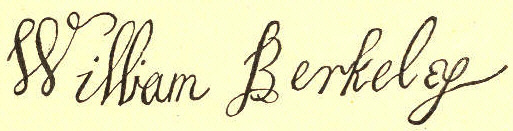
In 1639 Wyatt held the office, succeeded in 1642 by Berkeley, during
whose administration the colony attained its highest prosperity.
Virginians now possessed constitutional rights and privileges in even a
higher degree than Englishmen in the northern colonies. The colonists
were most loyal to the king, and were let alone. They were also attached
to the Church of England, ever manifesting toward those of a different
faith the spirit of intolerance characteristic of the age.
[1650]
During the civil war in England, Virginia, of course, sided with the
king. When Cromwell had assumed the reins of government he sent an
expedition to require the submission of the colony. An agreement was
made by which the authority of Parliament was acknowledged, while the
colony in return was left unmolested in the management of its own
affairs.
Signature of Berkeley.