
[1498]
As we have seen, Spain by no means deserves the entire credit of
bringing the western continent to men's knowledge. Columbus himself was
an Italian. So was Marco Polo, his inspirer, and also Toscanelli, his
instructor, by whose chart he sailed his ever-memorable voyage. To
Portugal as well Columbus was much indebted, despite his rebuff there.
Portugal then led the world in the art of navigation and in enthusiasm
for discovery. Nor, probably, would Columbus have asked her aid in vain,
had she not previously committed herself to the enterprise of reaching
India eastward, a purpose brilliantly fulfilled when, in 1498, Vasco da
Gama rounded the Cape of Good Hope and sailed to Calicut, on the coast
of Malabar. Already before this Spain and Portugal were rivals in the
search for new lands, and Pope Alexander VI. had had to be appealed to,
to fix their fields. By his bull of May 3, 4, 1493, he ordained as the
separating line the meridian passing through a point one hundred leagues
west of the Azores, where Columbus had observed the needle of his
compass to point without deflection toward the north star. Portugal
objecting to this boundary as excluding her from the longitude of the
newly found Indies, by the treaty of Tordesillas, June 7, 1494, the two
powers, with the Pope's assent, moved the line two hundred and seventy
leagues still farther west. At this time neither party dreamed of the
complications destined subsequently to arise in reference to the
position of this meridian on the other side of the globe.
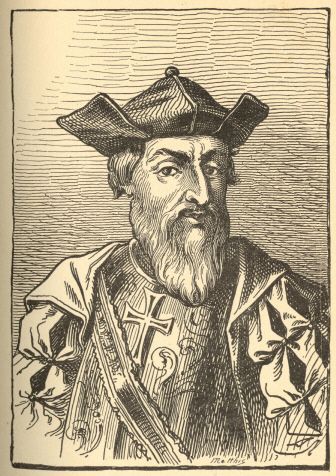
Vasco da Gama; From an old print.
The meridian of the Tordesillas convention had been supposed still to
give Spain all the American discoveries likely to be made, it being
ascertained only later that by it Portugal had obtained a considerable
part of the South American mainland Brazil, we know, was, till in 1822
it became independent, a Portuguese dependency. Spain, however, retained
both groups of the Antilles with the entire main about the Gulf of
Mexico, and became the earliest great principality in the western world.
[1506-1513]
Before the death of Columbus, Spain had taken firm possession of Cuba,
Porto Rico, and St. Domingo, and she stood ready to seize any of the
adjoining islands or lands so soon as gold, pearls, or aught else of
value should be found there. Cruises of discovery were made in every
direction, first, indeed, in Central and South America. In 1506 de Solis
sailed along the eastern coast of Yucatan. In 1513 the governor of a
colony on the Isthmus of Darien, Vasco Nunez de Balboa, from the top of
a lofty mountain on the isthmus, saw what is now called the Pacific
Ocean. He designated it the South Sea, a name which it habitually bore
till far into the eighteenth century. From this time the exploration and
settlement of the western coast, both up and down, went on with little
interruption, but this history, somewhat foreign to our theme, we cannot
detail.
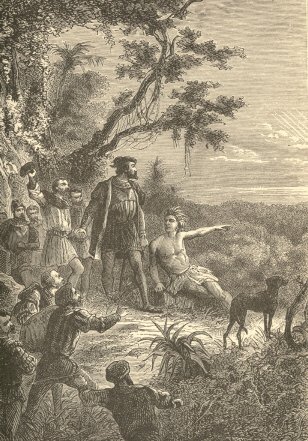
Balboa discovering the Pacific Ocean.
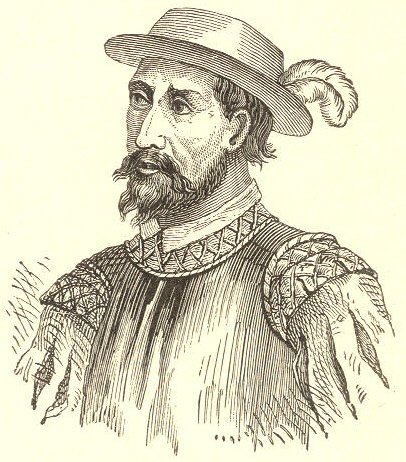
Ponce de Leon.
The same year, 1513, Ponce de Leon, an old Spanish soldier in the wars
with the Moors, a companion of Columbus in his second voyage, and till
now governor of Porto Rico, began exploration to the northward. Leaving
Porto Rico with three ships, he landed on the coast of an unknown
country, where he thought to find not only infinite gold but also the
much-talked-about fountain of perpetual youth. His landing occurred on
Easter Sunday, or Pascua Florida, March 27, 1513, and so he named the
country Florida. The place was a few miles north of the present town of
St. Augustine. Exploring the coast around the southern extremity of the
peninsula, he sailed among a group of islands, which he designated the
Tortugas. Returning to Porto Rico, he was appointed governor of the new
country. He made a second voyage, was attacked by the natives and
mortally wounded, and returned to Cuba to die.
[1518-1520]
Juan de Grijalva explored the south coast of the Gulf of Mexico, from
Yucatan toward the Panuco. Interest attaches to this enterprise mainly
because the treasure which Grijalva collected aroused the envy and greed
of the future conqueror of Mexico, Hernando Cortez.
In 1518, Velasquez, governor of Cuba, sends Cortez westward, with eleven
ships and over six hundred men, for the purpose of exploration. He
landed at Tabasco, thence proceeded to the Island of San Juan de Ulua,
nearly opposite Vera Cruz, where he received messengers and gifts from
the Emperor Montezuma. Ordered to leave the country, he destroyed his
ships and marched directly upon the capital. He seized Montezuma and
held him as a hostage for the peaceable conduct of his subjects. The
Mexicans took up arms, only to be defeated again and again by the
Spaniards. Montezuma became a vassal of the Spanish crown, and
covenanted to pay annual tribute. Attempting to reconcile his people to
this agreement he was himself assailed and wounded, and, refusing all
nourishment, soon after died. With re-enforcements, Cortez completed
the conquest of the country, and Mexico became a province of Spain.
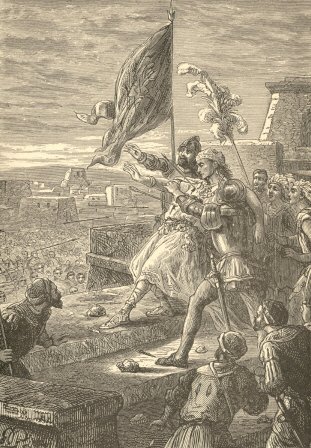
Montezuma mortally wounded by his own subjects.
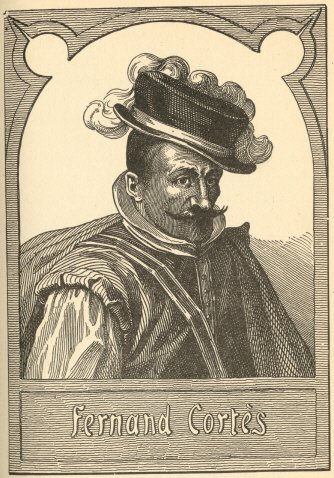
Hernando Cortes. From an old print.
Vasquez de Ayllon, one of the auditors of the Island of Santo Domingo,
sent two ships from that island to the Bahamas for Indians to be sold as
slaves. Driven from their course by the wind, they at length reached the
shore of South Carolina, at the mouth of the Wateree River, which they
named the Jordan, calling the country Chicora. Though kindly treated by
the natives, the ruthless adventurers carried away some seventy of
these. One ship was lost, and most of the captives on the others died
during the voyage. Vasquez was, by the Emperor Charles V., King of
Spain, made governor of this new province, and again set sail to take
possession. But the natives, in revenge for the cruel treatment which
they had previously received, made a furious attack upon the invaders.
The few survivors of the slaughter returned to Santo Domingo, and the
expedition was abandoned. These voyages were in 1520 and 1526.
In connection with the subject of Spanish voyages, a passing notice
should be given to one, who, though not of Spanish birth, yet did much
to further the progress of discovery on the part of his adopted country.
Magellan was a Portuguese navigator who had been a child when Columbus
came back in triumph from the West Indies. Refused consideration from
King Emmanuel, of Portugal, for a wound received under his flag during
the war against Morocco, he renounced his native land and offered his
services to the sagacious Charles V., of Spain, who gladly accepted
them, With a magnificent fleet, Magellan, in 1519, set sail from
Seville, cherishing Columbus's bold purpose, which no one had yet
realized, of reaching the East Indies by a westward voyage, After
touching at the Canaries, he explored the coast of South America, passed
through the strait now called by his name, discovered the Ladrone
Islands, and christened the circumjacent ocean the Pacific.
The illustrious navigator now sailed for the Philippine Islands, so
named from Philip, son of Charles V., who succeeded that monarch as
Philip II. By the Tordesillas division above described, the islands were
properly in the Portuguese hemisphere, but on the earliest maps, made by
Spaniards, they were placed twenty-five degrees too far east, and this
circumstance, whether accidental or designed, has preserved them to
Spain even to the present time. At the Philippine Islands Magellan was
killed in an affray with the natives. One of his ships, the Victoria,
after sailing around the Cape of Good Hope, arrived in Spain, having
been the first to circumnavigate the globe. The voyage had taken three
years and twenty-eight days.
[1528-1540]
The disastrous failure of the expedition of Vasquez de Ayllon to Florida
did not discourage attempts on the part of others in the same direction.
Velaspuez, governor of Cuba, jealous of the success of Cortez in Mexico,
had sent Pamphilo de Narvaez to arrest him. In this attempt Narvaez had
been defeated and taken prisoner. Undeterred by this failure he had
solicited and received of Charles V. the position of governor over
Florida, a territory at that time embracing the whole southern part of
what is now the United States, and reaching from Cape Sable to the
Panuco, or River of Palms, in Mexico. With three hundred men he, in
1528, landed near Appalachee Bay, and marched inland with the hope of
opening a country rich and populous. Bitterly was he disappointed.
Swamps and forests, wretched wigwams with their squalid inmates
everywhere met his view, but no gold was to be found. Discouraged, he
and his followers returned to the coast, where almost superhuman toil
and skill enabled them to build five boats, in which they hoped to work
westward to the Spanish settlements. Embarking, they stole cautiously
along the coast for some distance, but were at last driven by a storm
upon an island, perhaps Galveston, perhaps Santa Rosa, where Narvaez and
most of his men perished. Four of his followers survived to cross Texas
to the Gulf of California and reach the town of San Miguel on the west
coast of Mexico. Here they found their countrymen, searching as usual
for pearls, gold, and slaves, and by their help they made a speedy
return to Spain, heroes of as remarkable an adventure as history
records. These unfortunates were the first Europeans to visit New
Mexico. Their narrative led to the exploration of that country by
Coronado and others, and to the discoveries of Cortez in Lower
California.
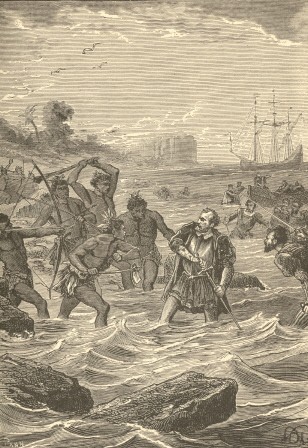
Death of Magellan.
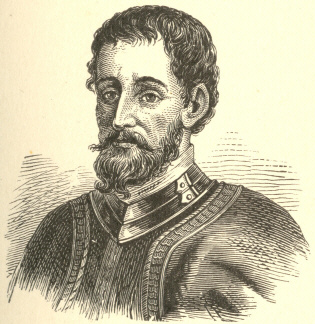
Ferdinand de Soto.
Ferdinand de Soto, eager to rival the exploits of Cortez in Mexico, and
of his former commander, Pizarro, in Peru, offered to conquer Florida at
his own expense. Appointed governor-general of Florida and of Cuba, he
sailed with seven large and three small vessels. From Espiritu Santo Bay
he, in 1539, marched with six hundred men into the country of the
Appalachians and discovered the harbor of Pensacola. After wintering at
Appalachee he set out into the interior, said to abound in gold and
silver. Penetrating northeasterly as far as the Savannah, he found only
copper and mica. From here he marched first northwest into northern
central Georgia, then southwest into Alabama. A battle was fought with
the natives at Mavila, or Mobile, in which the Spaniards suffered
serious loss. Ships that he had ordered arrived at Pensacola, but de
Soto determined not to embark until success should have crowned his
efforts. He turned back into the interior, into the country of the
Chickasaws, marched diagonally over the present State of Mississippi to
its northwest corner, and crossed the Mississippi River near the lowest
Chickasaw Bluff. From this point the general direction of the Spanish
progress was southwest, through what is now Arkansas, past the site of
Little Rock, till at last a river which seems to have been the Washita
was reached. Down this stream de Soto and his decimated force
floated–two hundred and fifty of his men had succumbed to the hardships
and perils of his march–arriving at the junction of the Red with the
Mississippi River on Sunday, April 17, 1542. At this point de Soto
sickened and died, turning over the command to Luis de Moscoso. Burying
their late leader's corpse at night deep in the bosom of the great
river, and constructing themselves boats, the survivors of this
ill-fated expedition, now reduced to three hundred and seventy-two
persons, made the best of their way down the Mississippi to the Gulf,
and along its coast, finally reaching the Spanish town near the mouth of
the Panuco in Mexico.
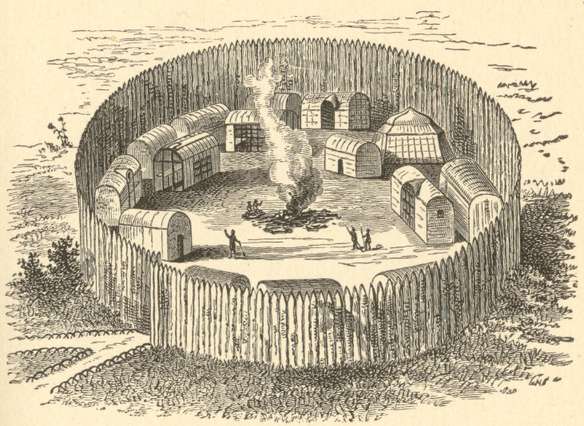
A Palisaded Indian Town in Alabama.
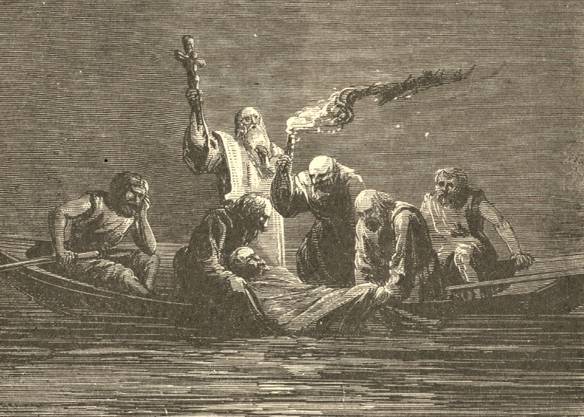
Burial of de Soto in the Mississippi at night.
[1562]
Thus no settlement had as yet been made in Florida by the Spanish. The
first occupation destined to be permanent was brought about through
religious jealousy inspired by the establishment of a French Protestant
(Huguenot) colony in the territory. Ribault, a French captain
commissioned by Charles IX., was put in command of an expedition by that
famous Huguenot, Admiral Coligny, and landed on the coast of Florida, at
the mouth of the St. John's, which he called the River of May. This was
in 1562. The name Carolina, which that section still bears, was given to
a fort at Port Royal, or St. Helena. Ribault returned to France, where
civil war was then raging between the Catholics and the Protestants or
Huguenots. His colony, waiting for promised aid and foolishly making no
attempt to cultivate the soil, soon languished. Dissensions arose, and
an effort was made to return home. Famine having carried off the greater
number, the colony came to an end. In 1564 Coligny sent out Laudonniere,
who built another fort, also named Carolina, on the River of May. Again
misfortunes gathered thickly about the settlers, when Ribault arrived
bringing supplies.
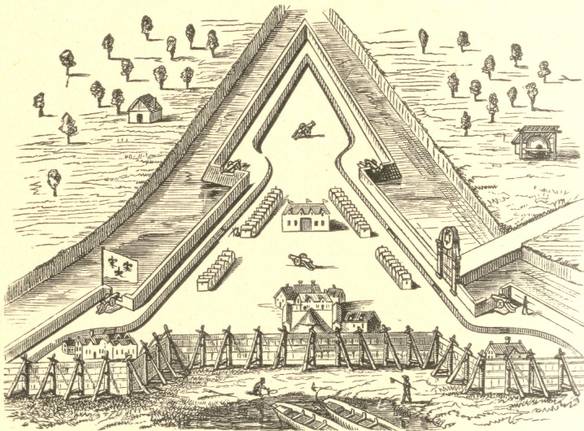
Fort Carolina on the River of May.
[1565]
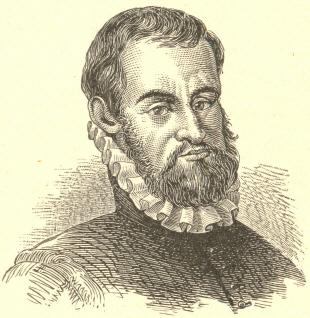
Pedro Melendez.
But Spain claimed this territory, and Pedro Melendez a Spanish soldier,
was in 1565 sent by Philip II. to conquer it from the French, doubly
detested as Protestants. He landed in the harbor and at the mouth of the
river, to both of which he gave the name St. Augustine. Melendez lost no
time in attacking Fort Carolina, which he surprised, putting the
garrison mercilessly to the sword. The destruction of the French colony
was soon after avenged by Dominic de Gourgues, who sailed from France to
punish the enemies of his country. Having accomplished his purpose by
the slaughter of the Spanish garrison he returned home, but the French
Protestants made no further effort to colonize Florida.
Spain claimed the land by right of discovery, but, although maintaining
the feeble settlement at St. Augustine, did next to nothing after this
to explore or civilize this portion of America. The nation that had sent
out Columbus was not destined to be permanently the great power of the
New World. The hap of first landing upon the Antilles, and also the warm
climate and the peaceable nature of the aborigines, led Spain to fix her
settlements in latitudes that were too low for the best health and the
greatest energy. Most of the settlers were of a wretched class,
criminals and adventurers, and they soon mixed largely with the natives.
Spain herself greatly lacked in vigor, partly from national causes,
partly from those obscure general causes which even to this day keep
Latin Europe, in military power and political accomplishments, inferior
to Teutonic or Germanic Europe.
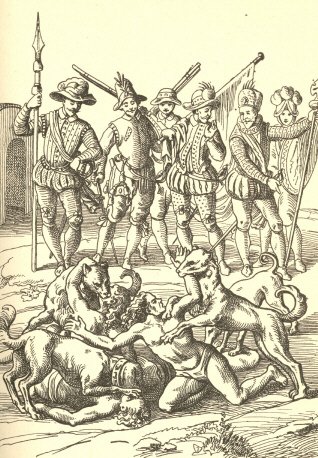
Indians devoured by dogs. From an old print.
[1570]
Moreover, the Spaniards found their first American conquests too easy,
and the rewards of these too great. This prevented all thought of
developing the country through industry, concentrating expectation
solely upon waiting fortunes, to be had from the natives by the sword or
through forced labor in mines, Their treatment of the aborigines was
nothing short of diabolical. Well has it been said: "The Spaniards had
sown desolation, havoc, and misery in and around their track. They had
depopulated some of the best peopled of the islands and renewed them
with victims deported from others. They had inflicted upon hundreds of
thousands of the natives all the forms and agonies of fiendish cruelty,
driving them to self-starvation and suicide, as a way of mercy and
release from an utterly wretched existence. They had come to be viewed
by their victims as fiends of hate, malignity, and all dark and cruel
desperation and mercilessness in passion. The hell which they denounced
upon their victims was shorn of its worst terror by the assurance that
these tormentors were not to be there. Las Casas, the noble missionary,
the true soldier of the cross, and the few priests and monks who
sympathized with him, in vain protested against these cruelties."
To all these causes we must add the narrow colonial policy of Spain.
Imitating Venice and ancient Carthage instead of Greece, she held her
dependencies under the straitest servitude to herself as conquered
provinces, repressing all political or commercial independence. A
similar restrictive policy, indeed, hampered the colonies of other
nations, but it was nowhere else so irrational or blighting as in
Spanish America.