[1000]
There is no end to the accounts of alleged discoveries of America before
Columbus. Most of these are fables. It is, indeed, nearly certain that
hardy Basque, Breton, and Norman fishermen, adventuring first far north,
then west, had sighted Greenland and Labrador and become well acquainted
with the rich fishing-grounds about Newfoundland and the Saint Lawrence
Gulf. Many early charts of these regions, without dates and hitherto
referred to Portuguese navigators of a time so late as 1500, are now
thought to be the work of these earlier voyagers. They found the New
World, but considered it a part of the Old.
Important, too, is the story of supposed Norse sea-rovers hither,
derived from certain Icelandic manuscripts of the fourteenth century. It
is a pleasing narrative, that of Lief Ericson's sail in 1000-1001 to
Helluland, Markland, and at last to Vineland, and of the subsequent
tours by Thorwald Ericson in 1002, Thorfinn Karlsefne, 1007-1009, and of
Helge and Finnborge in 1011, to points still farther away. Such voyages
probably occurred. As is well known, Helluland has been interpreted to
be Newfoundland; Markland, Nova Scotia; and Vineland, the country
bordering Mount Hope Bay in Bristol, R. I. These identifications are
possibly correct, and even if they are mistaken, Vineland may still have
been somewhere upon the coast of what is now the United States.
In the present condition of the evidence, however, we have to doubt
this. No scholar longer believes that the writing on Dighton Rock is
Norse, or that the celebrated Skeleton in Armor found at Fall River was
a Northman's, or that the old Stone Mill at Newport was constructed by
men from Iceland. Even if the manuscripts, composed between three and
four hundred years after the events which they are alleged to narrate,
are genuine, and if the statements contained in them are true, the
latter are far too indefinite to let us be sure that they are applicable
to United States localities.
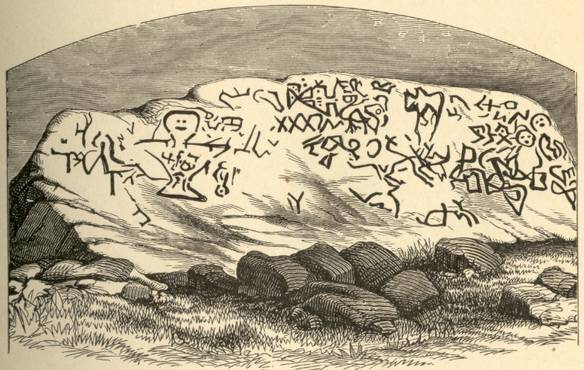
Dighton Rock.
[l260]
But were we to go so far as to admit that the Northmen came here and
began the settlements ascribed to them, they certainly neither
appreciated nor published their exploits. Their colony, wherever it was,
endured but for a day, and it, with its locality, speedily passed from
knowledge in Scandinavia itself. America had not yet, in effect, been
discovered.
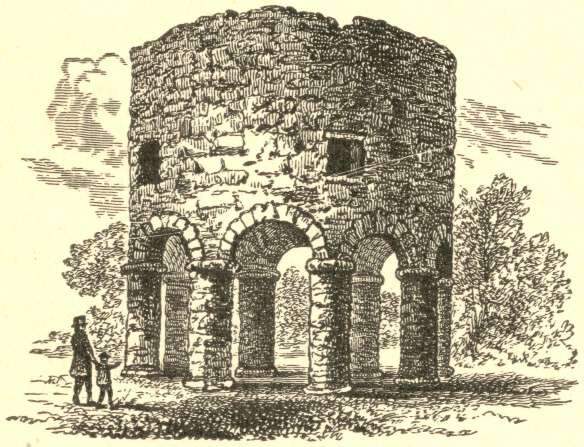
The Old Stone Mill at Newport, R. I.
[1300]
We must remember that long anterior to Columbus's day unbiassed and
thoughtful men had come to believe the earth to be round. They also knew
that Europe constituted but a small part of it. In the year 1260 the
Venetian brothers Niccolo and Maffeo Polo made their way to China, the
first men from Western Europe ever to travel so far. They returned in
1269, but in 1271 set out again, accompanied by Niccolo's son, a youth
of seventeen. This son was the famous Marco Polo, whose work, "The
Wonders of the World," reciting his extended journeys through China and
the extreme east and southeast of Asia, and his eventful voyage home by
sea, ending in 1295, has come down to our time, one of the most
interesting volumes in the world. Friar Orderic's eastern travels in
1322-1330, as appropriated by Sir John Mandeville, were published before
1371.
Columbus knew these writings, and the reading and re-reading of them had
made him an enthusiast. In Polo's book he had learned of Mangi and Far
Cathay, with their thousands of gorgeous cities, the meanest finer than
any then in Europe; of their abounding mines pouring forth infinite
wealth, their noble rivers, happy populations, curious arts, and benign
government. Polo had told him of Cambalu (Peking), winter residence of
the Great Khan, Kublai–Cambalu with its palaces of marble,
golden-roofed, its guard of ten thousand soldiers, its imperial stables
containing five thousand elephants, its unnumbered army, navy, and
merchant marine; of oxen huge as elephants; of richest spices, nuts
large as melons, canes fifteen yards long, silks, cambrics, and the
choicest furs; and of magic Cipango (Japan), island of pearls, whose
streets were paved with gold.
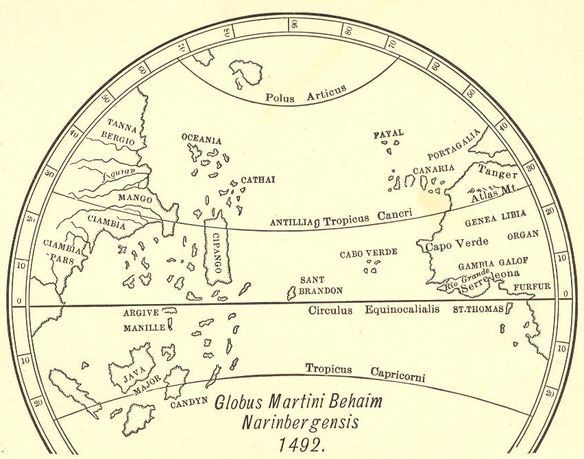
Globus Martini Behaim Narinbergensis 1492.
[1456]
Columbus believed all this, and it cooperated with his intense and even
bigoted religious faith to kindle in him an all-consuming ambition to
reach this distant Eden by sea, that he might carry the Gospel to those
opulent heathen and partake their unbounded temporal riches in return.
Poor specimen of a saint as Columbus is now known to have been, he
believed himself divinely called to this grand enterprise.
Christopher Columbus, or Christobal Colon, as he always signed himself
after he entered the service of Spain, was born in Genoa about 1456.
Little is certainly known of his early life. His father was a humble
wool-carder. The youth possessed but a sorry education, spite of his few
months at the University of Pavia. At the age of fourteen he became a
sailor, knocking about the world in the roughest manner, half the time
practically a pirate. In an all-day's sea fight, once, his ship took
fire and he had to leap overboard; but being a strong swimmer he swam,
aided by an oar, eight leagues to land.
[1470]
From 1470 to 1484 we find him in Portugal, the country most interested
and engaged then in ocean-going and discovery. Here he must have known
Martin Behem, author of the famous globe, finished in 1492, whereon Asia
is exhibited as reaching far into the same hemisphere with Europe.
Prince Henry of Portugal earnestly patronized all schemes for
exploration and discovery, and the daughter, Philippa, of one of his
captains, Perestrello, Columbus married. With her he lived at Porto
Santo in the Madeiras, where he became familiar with Correo, her
sister's husband, also a distinguished navigator. The islanders fully
believed in the existence of lands in the western Atlantic. West winds
had brought to them strange woods curiously carved, huge cane-brakes
like those of India described by Ptolemy, peculiarly fashioned canoes,
and corpses with skin of a hue unknown to Europe or Africa.
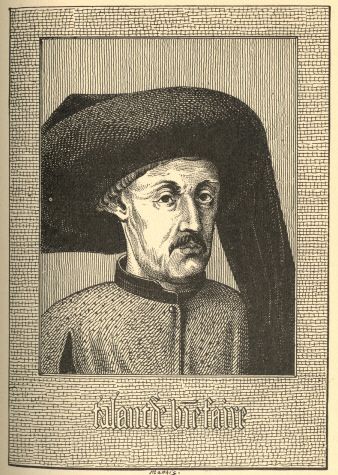
Prince Henry of Portugal–"The Navigator." From an old print
[1475-1484]
Reflecting on these things, studying Perestrello's and Correo's charts
and accounts of their voyages, corresponding with Toscanelli and other
savans, himself an adept in drawing maps and sea-charts, for a time his
occupation in Lisbon, cruising here and there, once far northward to
Iceland, and talking with navigators from every Atlantic port, Columbus
became acquainted with the best geographical science of his time.
This had convinced him that India could be reached by sailing westward.
The theoretical possibility of so doing was of course admitted by all
who held the earth to be a sphere, but most regarded it practically
impossible, in the then condition of navigation, to sail the necessary
distance. Columbus considered the earth far smaller than was usually
thought, a belief which we find hinted at so early as 1447, upon the
famous mappe-Monde of the Pitti Palace in Florence, whereon Europe
appears projected far round to the northwest. Columbus seems to have
viewed this extension as a sort of yoke joining India to Scandinavia by
the north. He judged that Asia, or at least Cipango, stretched
two-thirds of the way to Europe, India being twice as near westward as
eastward. Thirty or forty days he deemed sufficient for making it.
Toscanelli and Behem as well as he held this belief; he dared boldly to
act upon it.
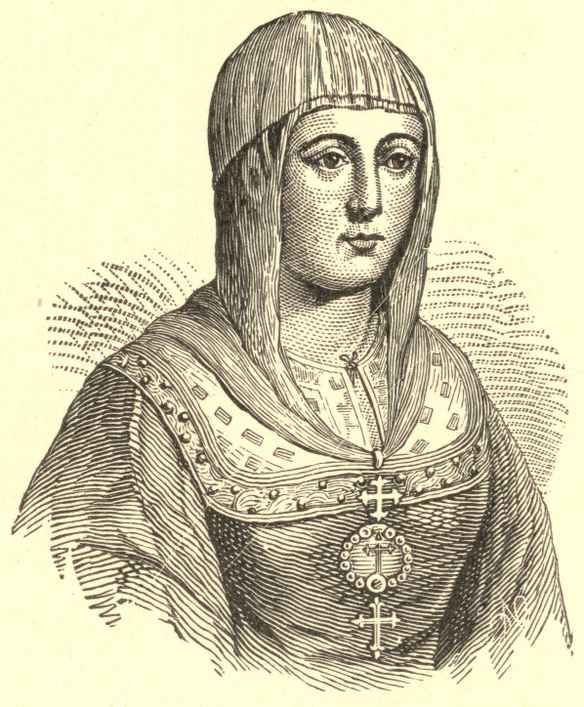
Queen Isabella of Spain.
But to do so required resources. There are indications that Columbus at
some time, perhaps more than once, urged his scheme upon Genoa and
Venice. If so it was in vain. Nor can we tell whether such an attempt,
if made, was earlier or later than his plea before the court of
Portugal, for this cannot be dated. The latter was probably in 1484.
King John II. was impressed, and referred Columbus's scheme to a council
of his wisest advisers, who denounced it as visionary. Hence in 1485 or
1486 Columbus proceeded to Spain to lay his project before Ferdinand and
Isabella.
On the way he stopped at a Franciscan convent near Palos, begging bread
for himself and son. The Superior, Marchena, became interested in him,
and so did one of the Pinzons–famous navigators of Palos. The king and
queen were at the time holding court at Cordova, and thither Columbus
went, fortified with a recommendation from Marchena. The monarchs were
engrossed in the final conquest of Granada, and Columbus had to wait
through six weary and heart-sickening years before royal attention was
turned to his cause. It must have been during this delay that he
despatched his brother Bartholomew to England with an appeal to Henry
VII. Christopher had brought Alexander Geraldinus, the scholar, and also
the Archbishop of Toledo, to espouse his mission, and finally, at the
latter's instance, Ferdinand, as John of Portugal had done, went so far
as to convene, at Salamanca, a council of reputed scholars to pass
judgment upon Columbus and his proposition. By these, as by the
Portuguese, he was declared a misguided enthusiast. They were too much
behind the age even to admit the spherical figure of the earth.
According to Scripture, they said, the earth is flat, adding that it was
contrary to reason for men to walk heads downward, or snow and rain to
ascend, or trees to grow with their roots upward.
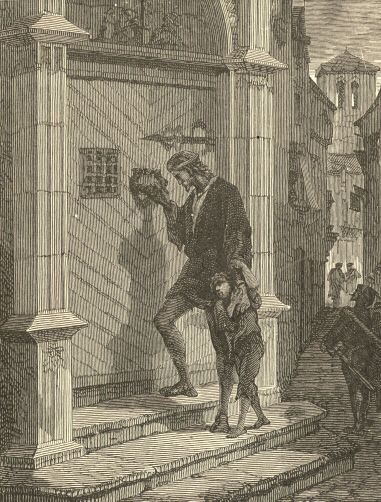
Columbus begging at the Franciscan Convent.
[1484-1492]
The war for Granada ended, Santangel and others of his converts at court
secured Columbus an interview with Isabella, but his demands seeming to
her arrogant, he was dismissed. Nothing daunted, the hero had started
for France, there to plead as he had pleaded in Portugal and Spain
already, when to his joy a messenger overtook him with orders to come
once more before the queen.
Fuller thought and argument had convinced this eminent woman that the
experiment urged by Columbus ought to be tried and a contract was soon
concluded, by which, on condition that he should bear one-eighth the
expense of the expedition, the public chest of Castile was to furnish
the remainder. The story of the crown jewels having been pledged for
this purpose is now discredited. If such pledging occurred, it was
earlier, in prosecuting the war with the Moors. The whole sum needed for
the voyage was about fifty thousand dollars. Columbus was made admiral,
also viceroy of whatever lands should be discovered, and he was to have
ten per cent of all the revenues from such lands. For his contribution
to the outfit he was indebted to the Pinzons.
This arrangement was made in April or May, 1492, and on the third of the
next August, after the utmost difficulty in shipping crews for this sail
into the sea of darkness, Columbus put out from Palos with one hundred
and twenty men, on three ships. These were the Santa Maria, the Nina,
and the Pinta. The largest, the Santa Maria, was of not over one hundred
tons, having a deck-length of sixty-three feet, a keel of fifty-one
feet, a draft of ten feet six inches, and her mast-head sixty feet above
sea-level. She probably had four anchors, with hemp cables.
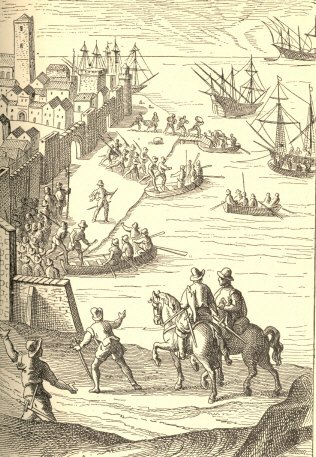
Embarkation of Christopher Columbus at Palos. From an old print.
From Palos they first bore southward to the Canary Islands, into the
track of the prevalent east winds, then headed west, for Cipango, as
Columbus supposed, but really toward the northern part of Florida. When
a little beyond what he regarded the longitude of Cipango, noticing the
flight of birds to the southwest, he was induced to follow these, which
accident made his landfall occur at Guanahani (San Salvador), in the
Bahamas, instead of the Florida coast.
Near midnight, between October 11th and 12th, Columbus, being on the
watch, descried a light ahead. About two o'clock on the morning of the
12th the lookout on the Pinta distinctly saw land through the moonlight.
When it was day they went on shore. The 12th of October, 1492,
therefore, was the date on which for the first time, so far as history
attests with assurance, a European foot pressed the soil of this
continent. Adding nine days to this to translate it into New Style, we
have October 21st as the day answering to that on which Columbus first
became sure that his long toil and watching had not been in vain.
[1493-1500]
The admiral having failed to note its latitude and longitude, it is not
known which of the Bahamas was the San Salvador of Columbus, whether
Grand Turk Island, Cat (the present San Salvador), Watling, Mariguana,
Acklin, or Samana, though the last named well corresponds with his
description. Mr. Justin Winsor, however, and with him a majority of the
latest critics, believes that Watling's Island was the place. Before
returning to Spain, Columbus discovered Cuba, and also Hayti or
Espagnola (Hispaniola), on the latter of which islands he built a fort.
In a second voyage, from Cadiz, 1493-1496, the great explorer discovered
the Lesser Antilles and Jamaica. In a third, 1498-1500, he came upon
Trinidad and the mainland of South America, at the mouth of the Orinoco.
This was later by thirteen months and a week than the Cabots' landfall
at Labrador or Nova Scotia, though a year before Amerigo Vespucci saw
the coast of Brazil. It was during this third absence that Columbus,
hated as an Italian and for his undeniable greed, was superseded by
Bobadilla, who sent him and his brother home in chains. Soon free again,
he sets off in 1502 upon a fourth cruise, in which he reaches the coast
of Honduras.
To the day of his death, however, the discoverer of America never
suspected that he had brought to light a new continent. Even during this
his last expedition he maintained that the coast he had touched was that
of Mangi, contiguous to Cathay, and that nineteen days of travel
overland would have taken him to the Ganges. He arrived in Spain on
September 12, 1504, and died at Segovia on May 20th of the next year.
His bones are believed to rest in the cathedral at Santo Domingo,
transported thither in 1541, the Columbus-remains till recently at
Havana being those of his son Diego. The latter, under the belief that
they were the father's, were transferred to Genoa in 1887, and deposited
there on July 2d of that year with the utmost ecclesiastical pomp.
[1500-1507]
As Columbus was ignorant of having found a new continent, so was he
denied the honor of giving it a name, this falling by accident, design,
or carelessness of truth, to Amerigo Vespucci, a native of Florence,
whose active years were spent in Spain and Portugal. Vespucci made three
voyages into the western seas. In the second, 1501, he visited the coast
of Brazil, and pushed farther south than any navigator had yet done,
probably so far as the island of South Georgia, in latitude 54 degrees.
His account of this voyage found its way into print in 1504, at
Augsburg, Germany, the first published narrative of any discovery of the
mainland. Although, as above noted, it was not the earliest discovery of
the main, it was widely regarded such, and caused Vespucci to be named
for many years as the peer, if not the superior of Columbus. The
publication ran through many editions. That of Strassburg, 1505,
mentioned Vespucci on its title-page as having discovered a new
"Southern Land." This is the earliest known utterance hinting at the
continental nature of the new discovery, as separate from Asia, an idea
which grew into a conviction only after Magellan's voyage, described in
the next chapter. In 1507 appeared at St. Die, near Strassburg, a
four-page pamphlet by one Lud, secretary to the Duke of Lorraine,
describing Vespucci's voyages and speaking of the Indians as the
"American race." This pamphlet came out the same year in another form,
as part of a book entitled "Introduction to Cosmography," prepared by
Martin Waldseemuller, under the nom de plume of "Hylacomylus." In this
book the new "part of the world" is distinctly called "THE LAND OF
AMERICUS, OR AMERICA," There is some evidence that Vespucci at least
connived at the misapprehension which brought him his renown–as
undeserved as it has become permanent–but this cannot be regarded as
proved.
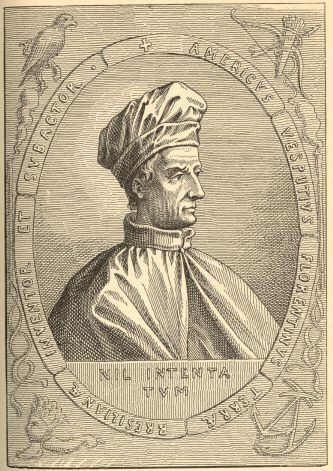
Amerigo Vespucci. Fac-simile of an old print.