The numerous varieties of ancient Americans reduce to two distinct types
–the Dolicocephalous or long-skulled, and the Brachycephalous or
short-skulled. Morton names these types respectively the Toltecan and
the American proper. The Toltecan type was represented by the primitive
inhabitants of Mexico and by the Mound-builders of our Mississippi
Valley; the American proper, by the Indians. The Toltecans made far the
closer approach to civilization, though the others possessed a much
greater susceptibility therefor than the modern Indians of our prairies
would indicate.
Of the Mound-builders painfully little is known. Many of their mounds
still remain, not less mysterious or interesting than the pyramids of
Egypt, perhaps almost equally ancient. The skeletons exhumed from them
often fly into dust as soon as exposed to air, a rare occurrence with
the oldest bones found in Europe. On the parapet-crest of the Old Fort
at Newark, 0., trees certainly five hundred years old have been cut, and
they could not have begun their growth till long after the earth-works
had been deserted. In some mounds, equally aged trees root in the
decayed trunks of a still anterior growth.
Much uncertainty continues to shroud the design of these mounds. Some
were for military defence, others for burial places, others for lookout
stations, others apparently for religious uses. Still others, it is
supposed, formed parts of human dwellings. That they proceeded from
intelligence and reflection is clear. Usually, whether they are squares
or circles, their construction betrays nice, mathematical exactness,
unattainable save by the use of instruments. Many constitute
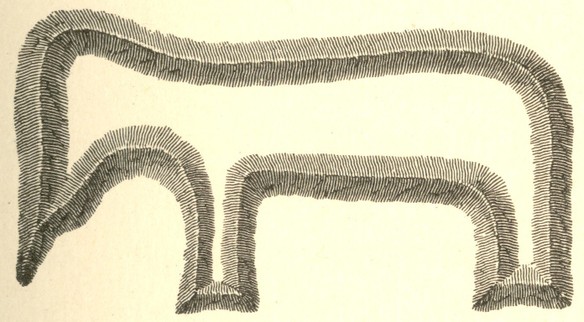
effigies–of birds, fishes, quadrupeds, men. In Wisconsin is a mound 135
feet long and well proportioned, much resembling an elephant; in Adams
County, 0., a gracefully curved serpent, 1,000 feet long, with jaws
agape as if to swallow an egg-shaped figure in front; in Granville, in
the same State, one in the form of a huge crocodile; in Greenup County,
Ky., an image of a bear, which seems leaning forward in an attitude of
observation, measuring 53 feet from the top of the back to the end of
the foreleg, and 105-1/2 feet from the tip of the nose to the rear of
the hind foot.