
[1901]
Upon invitation President and Mrs. McKinley visited the Pan-American
Exposition at Buffalo. September 5, 1901, the first day of his presence,
the Chief Magistrate delivered an address, memorable both as a sagacious
survey of public affairs and as indicating a modification of his
well-known tariff opinions in the direction of freer commercial
intercourse with foreign nations.
"We must not," he said, "repose in fancied security that we can forever
sell everything and buy little or nothing." ... "The period of
exclusiveness is past." "Reciprocity treaties are in harmony with the
spirit of the times; measures of retaliation are not." ... "If perchance
some of our tariffs are no longer needed for revenue or to encourage and
protect our industries at home, why should they not be employed to
extend and promote our markets abroad?" In connection with this thought
the President expressed his conviction that we must encourage our
merchant marine and, in the same commercial interest, construct a
Pacific cable and an Isthmian canal.
The projects of Mr. McKinley's statesmanship thus announced were
approved by nearly the entire public, but they were destined to be
carried out by other hands. On his second day at Buffalo, Friday,
September 6th, about four in the afternoon, the President stood in the
beautiful Temple of Music receiving the hundreds who filed past to shake
hands with him. A sinister fellow, resembling an Italian, tarried
suspiciously, and was pushed forward by the Secret Service attendants.
Next behind him followed a boyish-looking workman, his right hand
swathed in a handkerchief. As the first made way Mr. McKinley extended
his hand to the young man's unencumbered left. The next instant the
bandaged right arm raised itself and two shots rang on the air. The
President staggered back into the arms of a bystander, while his
treacherous assailant was borne to the floor.
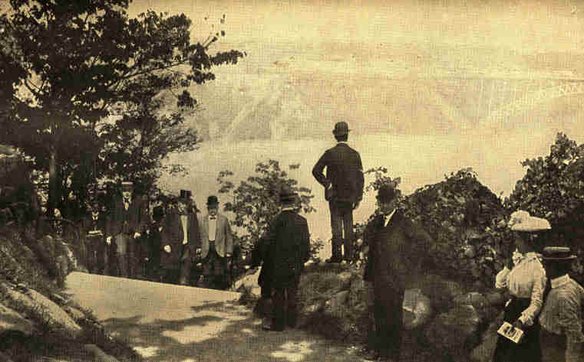
President McKinley at Niagara
Ascending the stairs from Luna Island, to Goat Island.
Copyright, 1901, by C. E. Dunlap.
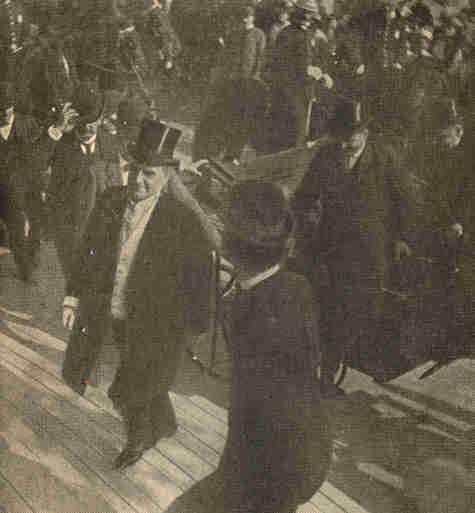
The last photograph of the late President McKinley.
Taken as he was ascending the steps of the Temple of Music, September 6. 1901.
Grievously wounded as he was in breast and in stomach, the President's
first thoughts were for others. He requested that the news be broken
gently to Mrs. McKinley, and, it was said, expressed regret that the
occurrence would be an injury to the exposition. As cries of "Lynch him"
arose from the maddened crowd, the stricken chief urged those about him
to see that no hurt befel the assassin. The latter was speedily secured
in prison to await the result of his black deed, while President
McKinley was without delay conveyed to the Emergency Hospital, where his
wounds were dressed.
Except for continued weakness and rapid heart action, the symptoms
during the early days of the succeeding week gave strong hopes of the
patient's recovery. At the home of Mr. Milburn, President of the
exposition, whose guest he was, President McKinley received the
tenderest care and most skilful treatment. So far allayed was anxiety
that the Cabinet officers left Buffalo, while Vice President Roosevelt
betook himself to a sequestered part of the Adirondacks. The President
himself, vigorous and naturally sanguine, did not give up till Friday, a
week from the date of his injury.
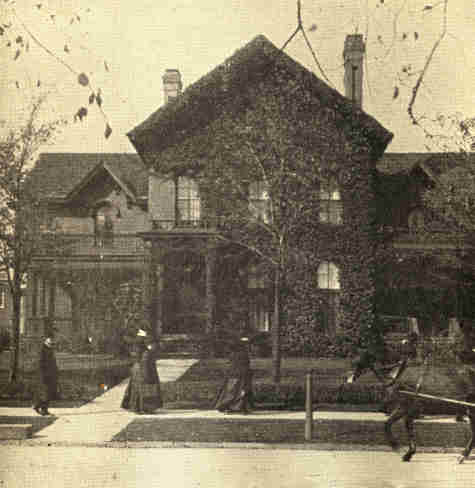
The Milburn Residence, where President McKinley died–Buffalo, N. Y.
Copyright, 1902, by Underwood & Underwood.
Upon that day his condition became alarming. The digestive organs
abdicated their functions, nourishment even by injection became
impossible, traces of septic poison were manifest. By night the world
knew that McKinley was a dying man. In the evening he regained
consciousness and bade farewell to those about him. "Good-by, good-by,
all; it is God's way; His will be done." The murmured words came from
his lips, "Nearer, my God, to Thee; e'en tho' it be a cross that raiseth
me."
At the early morning hour of 2.45, Saturday, September 14th, the rest
which is deeper than any sleep came to the sufferer. The autopsy showed
that death was due to gangrene of the tissues in the path of the wound,
the system having failed to repair the ravages of the bullet that had
entered the abdomen.
The next Monday morning, after a simple funeral ceremony at the Milburn
mansion, the remains were reverently borne to the Buffalo City Hall,
where, till midnight, mourning columns filed past the catafalque. The
body lay in state under the Capitol rotunda at Washington for a day, and
was borne thence, hardly a moment out of hearing of solemn bells or out
of sight of half-masted flags and dumb, mourning multitudes, to the old
home at Canton, Ohio. Here the late Chief Magistrate's fellow-townsmen,
his old army comrades, and other thousands joined the procession to the
cemetery or tearfully lined the streets as it passed.
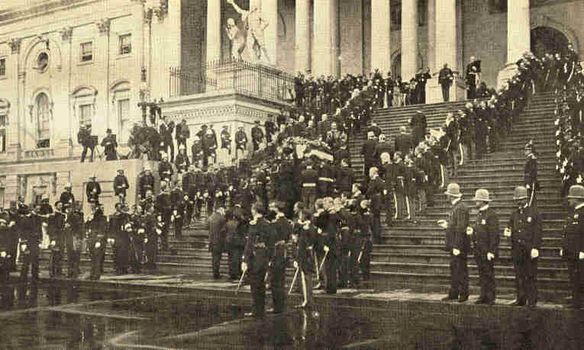
Ascending the Capitol steps at Washington, D, C.,
where the casket lay in state in the Rotunda.
On the day of the interment, September 19th, appropriate exercises,
attended by enormous concourses of people, occurred all over the
country, and even in foreign parts. In hardly an American town of size
could a single building contain the crowd, overflow meetings being
necessary, filling several churches or halls. Special commemorative
services were held in Westminster Cathedral by King Edward's orders.
No king was ever honored by obsequies so widespread or more sincere.
Messages of condolence poured in upon the widow from the four quarters
of the globe. Business was suspended. For five minutes telegraph clicks
and cable flashes ceased, and for ten minutes, upon many lines of
railway and street railway, every wheel stood still.
None but the rash undertook, at once after his lamented decease, to
assign President McKinley's name to its exact altitude on the roll of
America's illustrious men. Ardent eulogists spoke of him as beside the
nation's greatest statesman, Lincoln, while his most pronounced
opponents in life accorded him very high honor. During his career he had
been accused of opportunism, of inconsistency, of partiality to the
moneyed interests of the country. His views of great public questions
underwent change. One of his altered attitudes, much remarked upon, that
concerning silver, involved, as pointed out in the last chapter, no
change of essential principle. In regard to protection he at last swung
to Blaine's position favoring reciprocity, which, as author of the
McKinley Bill, he had been understood to oppose; but it should be
remembered that his final utterances on the subject contemplated an
industrial situation very different from that prevalent during his early
years in politics. The United States had become a mighty exporter of
manufactured products, competing effectively with England, Germany, and
France in the sale of such everywhere in the world.
American material supplied in large part the Russian Trans-Siberian
Railroad. American food-stuffs and meats wakened agrarian frenzy in
Germany. The island-hive of England buzzed loudly with jealous
foreboding lest America capture her world-markets. From an average of
close to $163,000,000 annually from 1887 to 1897 United States exports
of manufactured products reached in 1898 over $290.000,000, in 1899 over
$339,000,000, in 1900 nearly $434,000,000, and in 1901, $412,000,000. As
coal-producer the United States at last led Britain, American tin-plate
reached Wales itself, American locomotives the English colonies and even
the mother-country, while boots and shoes from our factories ruled the
markets of West Australia and South Africa. For bridge and viaduct
construction in British domains American bids heavily undercut British
bids both in price and in time limit.
His progressive insight into the tariff question betrayed Mr. McKinley's
mental activity and hospitality, as his final deliverances thereupon
exhibited fearlessness. None knew better than he that what he said at
Buffalo would be challenged by many in the name of party orthodoxy. Even
greater firmness was manifest when, at an earlier date, speaking at
Savannah, he ranked Robert E. Lee and Stonewall Jackson as among
America's "great" sons. With this brave tribute should be mentioned his
commendable nomination of the ex-Confederate Generals Fitz-Hugh Lee and
Joseph Wheeler as Major-Generals in the United States Army. Such words
and deeds showed skilled leadership also. Each was fittingly timed so as
best to escape or fend criticism and so as to impress the public deeply.
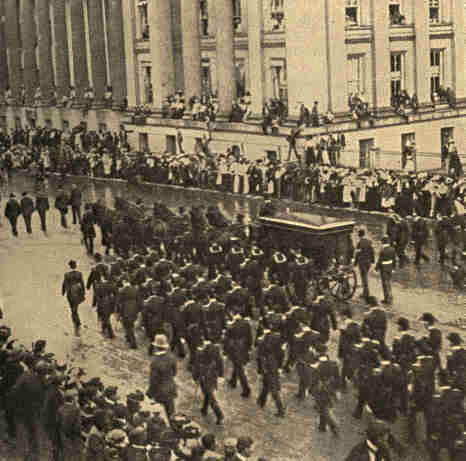
President McKinley's Remains Passing the United States Treasury,
Washington, D.C.
Copyright, 1901, by Underwood & Underwood.
Not a little of Mr. McKinley's apparent vacillation and of his
complaisance toward men and interests representing wealth was due to an
endowment of exquisite finesse which stooped to conquer, which led by
seeming to follow, or by yielding an inch took an ell. In him was rooted
by inheritance a quick sense of the manufacturer's point of view, for
his father and grandfather had been iron-furnace men, and a certain
conservative instinct, characteristic of his party, which deemed the
counsel of broadcloth wiser than the clamor of rags, and equally
patriotic withal. Notwithstanding this, history cannot but pronounce
McKinley's love of country, his whole Americanism, in fact, as sincere,
sturdy, and democratic as Abraham Lincoln's.
Mr. McKinley's power and breadth as a statesman were greatly augmented
by the responsibilities of the presidency. Before his accession to that
exalted office he had helped devise but one great public measure, the
McKinley Bill, and his speeches upon his chosen theme, protection, were
more earnest than varied or profound. But witness the largeness of view
marking the directions of April 7, 1900, to the Taft Philippine
Commission: "The Commission should bear in mind that the government
which they are establishing is designed not for our satisfaction or for
the expression of our theoretical views, but for the happiness, peace,
and prosperity of the people of the Philippine Islands, and the measures
adopted should be made to conform to their customs, their habits, and
even their prejudices, to the fullest extent consistent with the
accomplishment of the indispensable requisites of just and effective
government."
Most of President McKinley's appointments were wise; several of the most
important ones quite remarkably so. He managed discreetly in crises. He
saw the whole of a situation as few statesmen have done, penetrating to
details and obscure aspects, which others, even experts, had overlooked.
During the Spanish War his advice was always wise and helpful, and at
points vital. Courteous to all foreign powers, and falling into no
spectacular jangles with any, he was obsequious to none. No other ruler,
party to intervention in China during the Boxer rebellion in 1900, acted
there so sanely, or withdrew with so creditable a record.
What made it certain that Mr. McKinley's name would be forever
remembered with honor was not merely or mainly the fact that his
administration marked a great climacteric in our national career. His
intimates in office and in public life unanimously testified that in
shaping the nation's new destiny he played an active and not a passive
role. He dominated his cabinet, diligently attending to the advice each
member offered, but by no means always following it. Party bosses
seeking to lead him were themselves led, oftenest without being aware of
it, to accomplish his wishes.
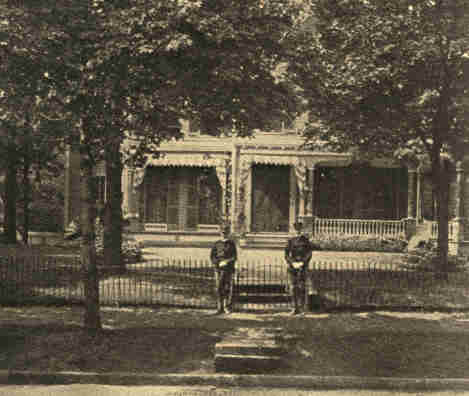
The Home of William McKinley, at Canton, Ohio.
Copyright, 1901, by Underwood & Underwood.
As a practical politician in the better sense of the word McKinley was a
master. Repeatedly, at critical junctures, he saved his following from
rupture, while the opposition became an impotent rout. Hardly a contrast
in American political warfare has been more striking than the pitiful
demoralization of the Democracy in the campaign of 1900 compared with
the closed ranks and solid front of the Republican array.
Anti-imperialists like Carnegie and Hoar, silver men like Senator
Stewart, and the low-tariff Republicans of the West united to hold aloft
the McKinley banner.
The result was not due, as some fancied, to Mr. Hanna. Nor did it mean
that there was no discord among Republicans, for there was much. The
discipline proceeded from the candidate's influence, from his
harmonizing personal leadership. This he exercised not through oratory,
for he had none of the tricks of speech, not even the knack of
story-telling, but by the mere force of his will and his wisdom.
Mr. McKinley's private character was pure, exemplary, and noble. His
life-long devotion to an invalid wife; his fidelity to his friends; the
charm, consideration, and tact of his demeanor toward everyone; and,
above all, the Christian sublimity of his last days created at once a
foundation and a crown for his fame.
Ex-President Cleveland said: "You will constantly hear as accounting for
Mr. McKinley's great success that he was obedient and affectionate as a
son, patriotic and faithful as a soldier, honest and upright as a
citizen, tender and devoted as a husband, and truthful, generous,
unselfish, moral, and clean in every relation of life. He never thought
of those things as too weak for his manliness."
A special grand jury forthwith indicted the assassin, who, talking
freely enough with his guards, refused all intercourse with the
attorneys assigned to defend him, and with the expert sent to test his
sanity. He was promptly placed upon trial, convicted, sentenced, and
executed, all without any of the unseemly incidents attending the trial
of Guiteau after Garfield's assassination. No heed was given to those
who, some of them from pulpits, fulminated anarchy as bad as that of the
anarchists by demanding that Czolgosz be lynched. These prompt but
perfectly orderly and dispassionate proceedings were a great credit to
the State of New York.
Leon Czolgosz, the murderer of President McKinley, was born in this
country, of Russian-Polish parentage, in 1875. He received some
education, was apprenticed to a blacksmith in Detroit, and later
employed in Cleveland and in Chicago. At the time of his crime he had
been working in a Cleveland wire mill. It was said that at Cleveland he
had heard Emma Goldman deliver an anarchist address, and that this
inspired his fell purpose. It was suspected that he was the tool of an
anarchist plot, and that the man preceding him in the line when he shot
the President was an accomplice, but there was no evidence that either
was true. There were indications that Czolgosz had made overtures to the
anarchists and been rejected as a spy. No accessories were found. Nor
did the dreadful act betoken that anarchism was increasing in our
country, or that any special propagandism in its favor was on. To all
appearance, it stood unrelated, so far as America was concerned.
Leon Czolgosz's heart had caught fire from the malignant passion of red
anarchy abroad, which had within seven years struck down the President
of France, the Empress of Austria, the King of Italy, and the Prime
Minister of Spain. In their fanatic diabolism its devotees impartially
hated government, whether despotic or free, and would, no doubt, gladly
have made America, the freest of the great commonwealths, for that
reason a hatching ground for their dark conspiracies.
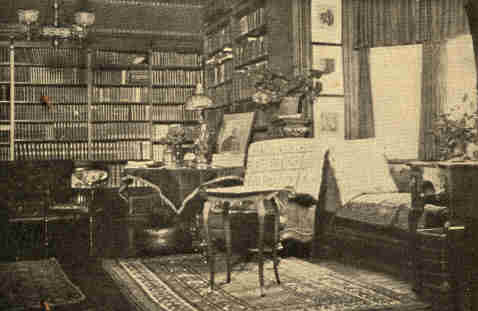
Interior of room in Wilcox House where
Theodore Roosevelt took the oath of Presidency.
They were no less hostile to one than to the other of our political
parties. The murder had no political significance, though certainly
calculated to rebuke virulent editorials and cartoons in political
papers, wont to season political debate with too hot personal condiment,
printed and pictorial. President McKinley had suffered from this and so
had his predecessor.
Upon such an occasion orderly government, both in the States and in the
nation, reasonably sought muniment against any possible new danger from
anarchy. McKinley's own State leading, States enacted statutes
denouncing penalties upon such as assailed, by either speech or act, the
life or the bodily safety of anyone in authority. The Federal Government
followed with a similar anti-anarchist law of wide scope.
Deeply as the country prized McKinley–and the sense of loss by his
death increased with the days–Vice-President Theodore Roosevelt took
over the presidency with as little jar as a military post suffers from
changing guard.