
The time had come for North and South America to unite in a noble
enterprise illustrating their community of interests. United States
people were deplorably ignorant of their southern neighbors, this
accounting in part for the paucity of our trade with them. They knew as
little of us. Our war with Spain had caused them some doubts touching
our intentions toward the Spanish-Americans. An exposition was a hopeful
means of bringing about mutual knowledge and friendliness. But the fair
could not be ecumenical. At Chicago and Paris World's Fairs had reached
perhaps almost their final development. To compete in interest, so soon,
with such vast displays, an exposition must specialize and condense.
On May 20th, the day of opening, a grand procession marched from Buffalo
to the Exposition grounds. Inspired by the music of twenty bands
representing various nations, the parade wound through the park gate up
over the Triumphal Bridge into the Esplanade. As the doors of the Temple
of Music were thrown open, ten thousand pigeons were released, which,
wheeling round and round, soared away to carry in all directions their
messages announcing that the Exposition had begun. The Hallelujah Chorus
was rendered, when Vice-President Roosevelt delivered the dedicatory
address.
The authors of the Pan-American, architects, landscape-gardeners,
sculptors, painters, and electricians, aimed first of all to create a
beautiful spectacle. Entering by the Park Gateway you passed from the
Forecourt, attractive by its terraces and colonnades, to the Triumphal
Bridge, a noble portal, with four monumental piers surmounted by
equestrian figures, "The Standard-bearers." This dignified entrance was
in striking contrast with the gaudy and barbarous opening to the Paris
Exposition. From the gate the whole panorama spread out before the eye.
Down the long court with its fountains, gardens, and encircling
buildings, you saw the Electric Tower soaring heavenward, fit expression
of the mighty power from Niagara, which at night made it so glorious.
The central court bore the form of a cross. At either side of the gate
lay transverse courts, each adorned with a lake, fountains, and sunken
gardens, and ending in curved groups of buildings. On the east was the
Government Group; on the west that devoted to horticulture, mines, and
the graphic arts. The intersection of the two arms formed the Esplanade,
spacious enough for a quarter of a million people, and commanding a
superb view. Connected by pergolas with the building in the transverse
ends two structures, the Temple of Music and the Ethnology Building,
stood like sentinels at the entrance to the Court of Fountains. A group
of buildings enclosed this court, terminating in the Electric Tower at
the north. From the Electric Tower round to the Gateway again all the
buildings were joined by cool colonnades. Beyond the Tower was the
Plaza, a charming little court, its sunken garden and band-stand
surrounded by colonnades holding statuary.
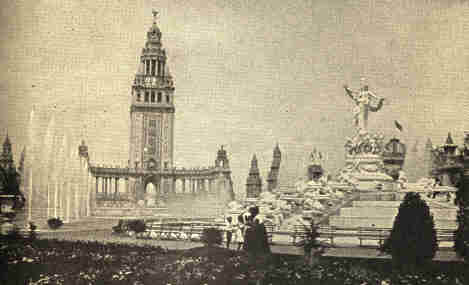
The Electric Tower and Fountains.
The broad and spacious gardens with their wealth of verdure, their
lakes, fountains, and statuary, formed a picture of indescribable charm.
Nothing here suggested exhibits. Instead, spectators yielded to the
spell of the beautiful scene. Chicago was serious and classic; Buffalo
romantic, picturesque, even frivolous. The thought seemed to have been
that, life in America being so intense, a rare holiday ought to bring
diversion and amusement. No style of architecture could have contributed
better to such gayety than the Spanish-Renaissance, light, ornate, and
infinitely varied, lending itself to endless decoration in color and
relief, and no more delicate compliment could have been paid our
southern neighbors than this choice of their graceful and attractive
designs. Each building was unique and original in plan. Domes,
pinnacles, colonnades, balconies, towers, and low-tiled roofs afforded
endless variety. The Electric Tower, designed by Mr. Howard, the central
point in the scheme of architecture, its background of columns and its
airy perforated walls and circular cupola with the Goddess of Light
above, combined massiveness with lightness. Other buildings were
strikingly quaint and pleasing, especially those suggesting the old
Southern Missions. All blended into the general scheme with scarcely a
discord. This harmony was not accidental, but resulted from combined
effort, each architect working at a general plan, yet not sacrificing
his individual taste. It was an object lesson in massive architecture,
showing how easily public edifices may be made beautiful each in itself,
and to increase each other's beauty by artistic grouping.
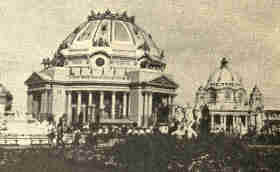
The Ethnology Building and United States Government Building.
Perhaps the most novel feature of the Fair was the coloring. Charles Y.
Turner's colors-scheme, original and daring, called forth much
criticism. With the Chicago White City the Rainbow City at Buffalo was a
startling contrast. But the artist knew what he was doing when he boldly
applied the gayest and brightest colors to buildings and columns, and
added to the quaint architecture that bizarre and oriental touch in
keeping with the festal purposes of the occasion. The rich, warm tones
formed a perfect background for the white statuary, the green foliage,
and the silvery fountains. The Temple of Music was a Pompeian red,
Horticultural Hall orange, with details of blue, green, and yellow. The
whole effect was fascinating, and at night, when the electric lights
illumined and softened the tones, fairy-like.
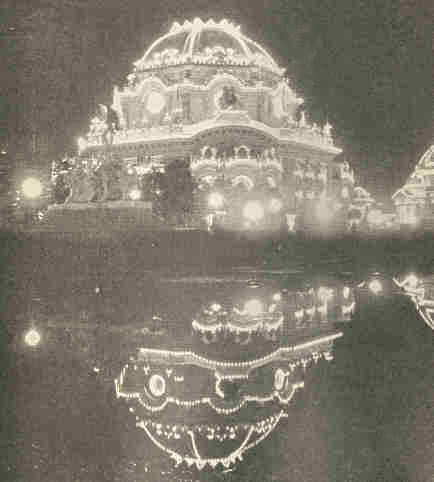
The Temple of Music by Electric Light.
But the coloring had a deeper meaning than this. Mr. Turner tried to
depict, in his gradations of tone, the struggle of Man to overcome the
elements, and his progress from barbarism to civilization. Thus, at the
Gate, the strongest primary colors were used in barbaric warmth, yet in
their warmth suggestive of welcome. As you advanced down the court the
tones became milder and lighter, until they culminated in the soft ivory
and gold of the Electric Tower, symbol of Man's crowning achievements.
Everywhere you found the note of Niagara, green, symbolizing the great
power of the falls.
Many forgot that in all this Mr. Turner was working from Greek models.
Color was lavishly used on the Athenian temples, rich backgrounds of red
or blue serving to throw the sculptural adornments into vivid relief.
Buffalo was in this a commentary on classic art, revealing what fine
effects may be produced by out-of-door coloring when suited to
surroundings. We saw that in our timid, conventional avoidance of
exterior colors we had missed something; that cheerful colors might well
supplant on our houses the eternal sombre of gray and brown, as they so
often and so gloriously do in nature.
The power sculpture may have in exterior decoration was also taught. At
Buffalo statues were not set up in long rows as in museums. Instead you
beheld noble and beautiful groups in natural environments of bright
green foliage with temples and blue sky above, or forming pediments and
friezes upon buildings. White nymphs and goddesses bent over fountains
or peeped from beneath trees or the ornate columns of pergolas. One was
greeted at every turn by these gleaming figures, a vital and integral
part of the landscape.
Carl Bitter, director of sculpture, aimed to make sculpture teach while
it decorated. He sought to tell in sculpture the story of man and
nature. In the lake fronting the Government Building stood a fountain of
Man. A half-veiled form, mysterious Man, occupied a pedestal composed of
figures of the five senses. Underneath the basin the Virtues struggled
with the Vices. Minor groups depicted the different ages. The most
remarkable was Mr. Konti's Despotic Age. The grim tyrant sat in his
chariot, driven by Ambition, who goaded on the four slaves in the
traces, while Justice and Mercy cowered in chains behind. In the
opposite court was told the story of Nature. Most striking there was Mr.
Elwell's figure of Kronos, standing, with winged arms, on a turtle. From
the Fountain of Abundance on the Esplanade, Flora was represented as
tossing garlands of flowers to the chubby cherubs at her feet. The main
court, dedicated to the achievements of man, had groups representing the
Human Intellect and Emotions. The sculptures about the Electric Tower
naturally related to the Falls. There were primeval Niagara and the
Niagara of today, as well as figures symbolic of the Lakes and the
Rivers.
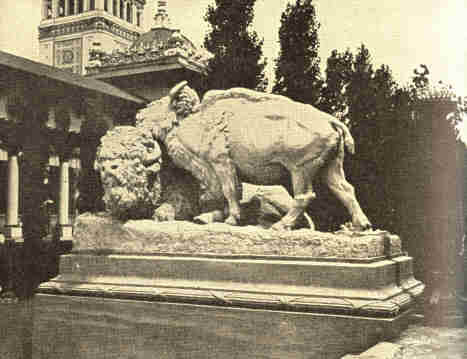
Group of Buffalos–Pan-American Exposition.
Copies of the most famous marbles, like the Playful Faun and the Venus
of Melos, embellished the Plaza. Many fine modern pieces adorned the
grounds, as Roth's stirring "Chariot Race" and St. Gaudens's equestrian
statue of General Sherman. Sculpture was profusely used to beautify
buildings. Wholly original and charming were the four groups for the
Temple of Music: Heroic Music, Sacred Music, Dance Music, and Lyric
Music. Perched in every corner were figures of children playing
different instruments.
Much of the sculpture, was careless in execution–not surprising when we
consider that over 500 pieces were set up in less than five months, and
that the artists' models had to be enlarged by machinery. But in vigor
and originality of thought and as a testimony to the progress which art
had made in this country, the exhibit was truly wonderful. All the arts
were employed. To many it was mainly an Art Exhibition, the artistic
feature making a stronger impression than any other. As a work of art
the Exposition could not but effect permanent good, demonstrating what
may be done to beautify our cities and dwellings and cultivating our
love for the beautiful in art and nature.
The supreme glory of the Exposition lay in its electrical illumination.
Niagara was used to create a city of light more dazzling than any dream.
"As the moment for the illumination approached, the band hushed and a
stillness fell upon the multitude. Suddenly dull reddish threads
appeared on the globes of the near-by lamp-pillars. A murmur of
expectation ran through the crowd. For an instant the great tower seemed
to pulse with a thread of life before the eye became sensible to what
had taken place. Then its surfaces gleamed with a faint flush like the
flush which church spires catch from the dawn. This deepened slowly to
pink and then to red. . . . In a moment the architectural skeletons of
the great buildings had been picked out in lines of red light. Then the
whole effect mellowed into luminous yellow. The material exposition had
been transfigured, and its glorified ghost was in its place. . . . Every
night this modern miracle was worked by the rheostat housed in a humble
shed somewhere in the inner recesses of the exposition."
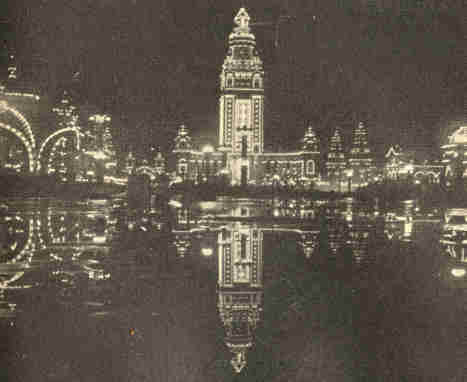
The Electric Tower at Night.
The centre of light was the Tower. It was suffused with the loveliest
glow of gold, ivory, and delicate green, all blending. The lights
revealed and interpreted the architecture softening the colors and
adding the subtle charm of mystery. A hundred beautiful hues were
reflected in the waters of the fountains. The floral effects made by
submerged lights in the basin were exquisite, and the witchery of the
scene was indescribable.
The chaining of Niagara for electric purposes was of course a prominent
feature of the fair. Electricity was almost, or quite, the sole motor
used on the grounds; 5,000 horsepower being directly from Niagara's
total of 50,000. Niagara circulated the salt water in the fisheries and
kept their water at the right temperature. It operated telephones,
phonographs, soda fountains, the big search-lights, the elevators, the
machines in the Machinery Building, the shows and illusions in the
Midway.
At Chicago we were ashamed of the Midway. We had since learned to play.
Buffalo used utmost ingenuity to provide sensations and novelties. The
Midway was made fascinating. You saw in it every variety of buildings,
representing all countries from Eskimodom to Darkest Africa. Cairo had
eight streets with 600 natives. The Hawaiian and Philippine villages
were centres of interest, revealing the every-day life of our new-won
lands. In Alt-Nurnberg you dined to the strains of a German orchestra.
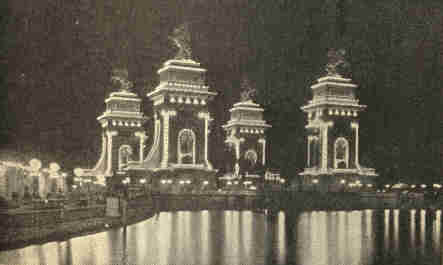
Triumphal Bridge and entrance to the Exposition,
showing electric display at night.
The magnificent amphitheatre, covering ten acres, a monument to American
athletics, was built after the marble Stadium of Lycurgus at Athens. An
Athletic Congress celebrated American supremacy in athletic sports. The
programme included basket-ball tournaments, automobile, bicycle, and
track and field championship races, lacrosse matches, and canoe "meets."
The exhibits at Buffalo, though less ample, naturally showed advance
over the corresponding ones at Chicago. The guns and ammunition of the
United States ordnance department excited interest, for we were now
making our own war supplies. A picturesque log building was devoted to
forestry. The Graphic Arts Building showed the great strides made in
printing and engraving. A model dairy was operated in a quaint little
cottage on the grounds. Fifty cows of the best breeds were tested and
the tests recorded.
A conservatory contained a very fine collection of food plants, alive
and growing, sent from South and Central America; also eight different
kinds of tea plants from South Carolina. A small coffee plantation and
some vanilla vines had been transplanted from Mexico. Nearly every
country in Spanish America was represented. Cuba, San Domingo, Ecuador,
Chile, Honduras, Mexico, and Canada had buildings. Sections in the
Government Building were devoted to exhibits from Porto Rico, the
Hawaiian Islands, and the Philippines.
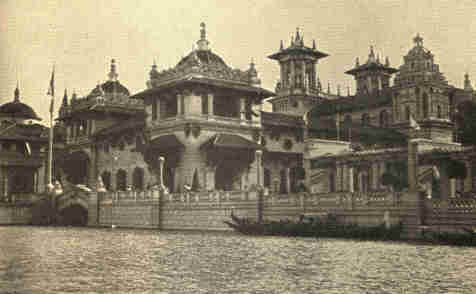
The Electricity Building.
The United States Government Building was most interesting. New
inventions made its exhibits live. In place of reading reports and
statistics, you saw scenes and heard sounds. Class-room songs and
recitations were reproduced by the graphophone. The biograph showed
naval cadets marching while at the same time you heard the band music.
Labor-saving machines were represented in full operation. Pictures by
wire, the mutoscope, and type-setting by electricity were among the
wonders shown. Every day a crew of the life-saving service gave a
demonstration, launching a life-boat and rescuing a sailor. Near by was
a field hospital, where wounded soldiers were cared for. Many of the
newest uses for electricity were displayed. Never before had lighting
been so brilliant or covered such large areas, or such speed in
telegraphy been attained, or telephoning reached such distances. The
akouphone, a blessing to the deaf, was exhibited, as were also the
powerful search-lights now a necessity at sea.