
[1900-1902]
The plan for a permanent census bureau was not realized in time for the
1900 enumeration, but the act authorizing this provided important
modifications in prior census procedure. Among several great
improvements it made the census director practically supreme in his
methods and over appointments and removals in his force.
Initial inquiries were restricted to (1) population, (2) mortality, (3)
agriculture, and (4) manufactures. Work on these topics was to be
completed not later than July 1, 1902. During the year after, special
reports were to be prepared on defective, criminal and pauper classes,
deaths and births, social data in cities, public indebtedness, taxation
and expenditures, religious bodies, electric light and power, telephone
and telegraph, water transportation, express business, street railways,
mines and mining. A few titles mentioned in the eleventh census were now
omitted.

Mr. Merriam, Director of the Census.
The enumeration extended to Alaska. Two men had charge of it there.
Enumerators went out afoot, by dog-teams, canoes, steamboats–up rivers,
over mountains, through forests. The Indian Territory was for the first
time canvassed like other portions of the Union, and so was the new
territory of Hawaii.
The United States were divided into 207 supervisor districts and 53,000
enumeration districts. Enumeration began June 1, 1900, continuing two
weeks in cities, elsewhere thirty days. Persons in the navy, army, and
on Indian reservations were numbered. For those in institutions there
were special enumerators. Each enumerator used a "street-book" or daily
record, individual slips for returns of persons absent when the
enumerator called, and an "absent family" schedule.
The returns were tabulated by an electrical device first employed ten
years before. Its work was automatic and so fine that it would even
obviate errors. For instance, age, sex, etc., being denoted by
punch-holes in cards, the machine would refuse to pass a card punched to
indicate that the person was three years old and married.
Nearly 2,000 employees toiled upon the census during the latter part of
1900, and nearly a thousand during the entire year, 1901. From July 14,
1900, piecemeal results were announced almost daily. By October the
population of the principal cities was out. A preliminary statement of
total population was given to the press, October 30, 1900, followed by a
verified one a month later. The first official report on population was
made December 6, 1901, within eighteen months from the completion of the
enumerators' work. Results were first issued in sixty bulletins, all
subsequently included in the first half of the first volume. Two volumes
were devoted to population, three to manufactures, two to agriculture,
and two to vital statistics. One contained an abstract of the whole.
Following these came volumes on special lines of inquiry.
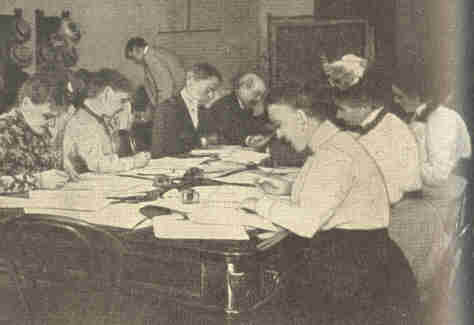
Census Examination.
The population of the United States, not including Porto Rico or the
Philippines, was found to be 76,303,387, an increase of not quite 21 per
cent. in the decade, or less than during any previous similar period of
our history. All the States and territories save Nevada were better
peopled than ever before. Nevada lost 10.6 per cent. of her inhabitants,
as against two and a half times that percentage between 1880 and 1890,
occupying in 1900 about the same tracks as in 1870. Oklahoma people
increased 518.2 per cent. Indian Territory, Idaho, and Montana came next
in rapidity of growth. Kansas, with 2.9 per cent. increase, and
Nebraska, with only 0.7 per cent., showed the slowest progress, the
figures resulting in considerable part from padded returns in 1890.
Vermont, Delaware, and Maine crawled on at a snail's pace. In numerical
advance New York, Pennsylvania, and Illinois led. Texas marched close to
them, overhauling Massachusetts. In percentage of increase the southern,
central, and western divisions were in the van.
Almost a third of our people were now urban, ten times the proportion of
1790. The rate of urban increase (36.8 per cent.) was, however, smaller
than during any preceding decade, except 1810-1820, and was notably less
than the 61.4 per cent. urban increase from 1880 to 1890. Numerically
also city growth was less than at the preceding census.
There were 545 places of 8,000 or more inhabitants, with an average
population of 45,857. Of the larger cities fully half adjoined the
Atlantic. Greater New York, a monster composite of nearly three and a
half millions, ranked first among American cities, and second only to
London among those of the world. Chicago, Philadelphia, St. Louis,
Boston, and Baltimore followed in the same order as a decade before. The
enterprising lake rivals, Cleveland and Buffalo, had raced past San
Francisco and Cincinnati. Pittsburgh, instead of New Orleans, now came
next after the ten just named.
There were, as in 1890, three cities of more than a million inhabitants
each. There were six of more than 500,000, as against four in 1890. Of
cities having between 400,000 and 500,000 people none appeared in 1900;
three in 1890. Five cities now had over 300,000 and less than 400,000, a
class not represented at all in 1890. Thirty-eight cities used in
numbering their people six figures or more each, a privilege enjoyed in
1890 by only twenty-eight. The cities of the Pacific coast showed
noteworthy increase.
Ohio, Indiana, Delaware, Kansas, and Nebraska and all the North Atlantic
States except Rhode Island, Connecticut, and Pennsylvania, lost in rural
population. Rhode Island, with 407 inhabitants to the square mile, was
the most densely peopled State. Massachusetts came next. Idaho, Montana,
New Mexico, Arizona, Wyoming, and Nevada could not show two souls to the
square mile. Alaska, doubled in population, had one in about ten square
miles. No western State had ten to the mile.
The Twelfth Census revealed slight change in the centre of population.
This now stood six miles southeast of Columbus, Ind., having moved west
only fourteen miles since 1890. In computing its position neither Hawaii
nor Alaska were considered. Never before had its occidental shunt been
less than thirty-six miles in a decade. For three score years it had not
fallen under forty per decade. What sent it southward two and a half
miles was the doubling of population in the Indian Territory and the
filling of Oklahoma. The trifling shift of fourteen miles westward
pointed significantly to the exhaustion of free land in the West and to
the immense growth of manufactures, mining, and commerce in eastern and
central States, retaining there the bulk of our immigrants and even
recalling people from the newer States and territories.
Males still bore about the same proportion to females as in 1890,
although females had increased at a rate 0.2 per cent. greater than
males. In the North Atlantic and South Atlantic groups the sexes were
equal in numbers.
At the South alone did the negro continue a considerable element.
Eighty-nine per cent. of the negroes lived there. At the North only
Pennsylvania had any large numbers. The country held 8,840,789, an
increase of 18.1 per cent. in ten years, the percentage of white
increase being 21.4 per cent. In West Virginia and Florida, also in the
black belts, especially that of Alabama, blacks multiplied faster than
whites. In Delaware and Georgia the pace was even. In Alabama as a
whole, however, the negro element had not relatively increased since
1850. Blacks outnumbered Caucasians in South Carolina and Mississippi,
no longer in Louisiana. In Mississippi the black majority shot up
phenomenally. Of the total population the negroes were now only 11.6 per
cent., barely one-ninth, as against one-fifth in 1790. Between 1890 and
1900 the proportion of the colored increased both at the North and at
the far South, diminishing in the border southern States. This indicated
migration both northward and southward from the belt of States just
south of Mason and Dixon's line.
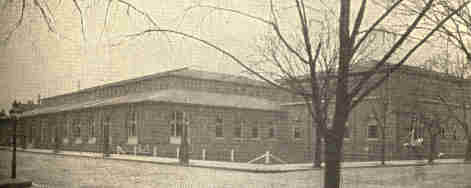
The Census Office, Washingtonl D. C.
The foreign-born fraction of our population, which had alternately risen
and fallen since 1860, now fell again, from 14.8 per cent. to 13.7 per
cent. The South retained its distinction as the most thoroughly American
section of the land, having a foreign nativity population varying from
7.9 per cent. in Maryland to only 0.2 per cent. in North Carolina.
The foreign born, conspicuous in the Northwest and the North Atlantic
States, were mostly confined to cities. They had augmented only 12.4 per
cent. as against 38.5 per cent. from 1880 to 1890. Nearly a third of the
recorded immigration from 1890 to 1900 was missing in the enumeration,
due only in part to census errors. Many foreigners had returned to their
native lands, most numerous among these being Canadians. The
preponderance of immigrants was no longer from Ireland, Canada, Great
Britain, and Germany, but from Austria-Hungary, Bohemia, Italy, Russia,
and Poland.
In 1900 the United States proper had 89,863 Chinese against 107,488 in
1890. Of Japanese there were 24,326 against only 2,039 in 1890. In the
Hawaiian Islands alone the Chinese numbered 25,767 and the Japanese
61,111. Natives of Germany still constituted the largest body of our
foreign born, being 25.8 per cent. of the whole foreign element compared
with 30.1 percent. in 1890. The proportion was about the same in 1900 as
in 1850.
The Irish were 15.6 per cent. of the foreign born. The figures had been
20.2 per cent. in 1890, and 42.8 per cent. in 1850. The proportion of
native Scandinavians and Danes had slightly increased. Poles. Bohemians,
Austrians, Huns, and Russians comprised 13.4 per cent. of the foreign
born as against 6.9 per cent. in 1890, and less than one-third per cent.
in 1850.
The congressional apportionment act based on the twelfth census, and
approved January 16, 1902, avoided the disagreeable necessity of cutting
down the representation of laggard States by increasing the House
membership from 357 to 386, a gain of twenty-nine members. Twelve of
these (reckoning Louisiana) came from west of the Mississippi, two from
New England, three each from Illinois and New York, four from the
southern States east of the Mississippi, two each from Pennsylvania and
New Jersey, and one from Wisconsin.
The number of farms shown by the twelfth census was over five and
one-half million, four times the number reported in 1850, and more than
a million above the number reported in 1890. This wonderful increase,
greater for the last decade than for any other except that between 1870
and 1880, denoted a vast augmentation of cultivated area in the South
and in the middle West. Oklahoma, Indian Territory, and Texas alone
added over two hundred thousand to the number of their farms. The
increase in value of farm resources exceeded the total value of
agricultural investments fifty years before.
In the abundant year of 1899 our cereal crops exceeded $1,484,000,000 in
value, more than half this being in corn. The hay crop was worth over
$445,000,000, that of potatoes $98,387,000, that of tobacco $56,993,000.
Next to corn stood cotton, the crop for this year reaching a value of
$323,758,000. The total value of farm and range animals in 1900 was
$2,981,722,945.
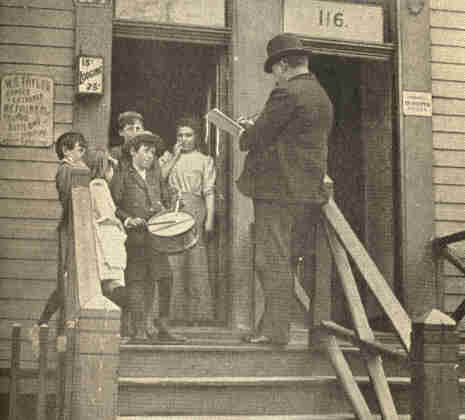
A Census-taker at work.
The census of 1850 reported 123,000 manufacturing establishments, with a
capital of $533,000,000. In 1900 there were 512,000 manufacturing
establishments, capitalized at $9,800,000,000, employing 5,321,000 wage
earners, and evolving $13,004,400,000 worth of product.
In ten years the number of manufacturing plants and the value of
products appeared to have increased some 30 per cent. The capital
invested had multiplied slightly more, about a third. The number of
hands employed had risen but a fifth, betokening the greater efficiency
of the individual laborer, and the substitution of machine work for that
of men's hands.
Of seventy-three selected industries in 209 principal cities, the most
money, $464,000,000, was invested in foundries and machine shops; the
next most, $363,000,000, in breweries. $289,000,000 are employed in iron
and steel manufacturing.
Our foreign commerce for the fiscal year 1899-1900 reached the
astounding total of $2,244,424,266, exceeding that of the preceding year
by $320,000,000. Our imports were $849,941,184, an amount surpassed only
in 1893. Our total exports were $1,394,483,082. The favorable balance of
trade had continued for some time, amounting for three years to $
1,689,849,387, much of which meant the lessening of United States
indebtedness abroad. The chief commodities for which we now looked to
foreign lands were first of all sugar, then hides, coffee, rubber, silk,
and fine cottons. In return we parted with cotton from the South and
bread-stuffs from the North, each exceeding $260,000,000 in value. Next
in volumes exported were provisions, meat, and dairy products, worth
$184,453,055. Iron and steel exports, including $55,000,000 and more in
machinery, were valued at about $122,000,000. The live-stock shipped
abroad was appraised at about $181,820,000. About 3-1/2 per cent. of our
imports came from Cuba, about 20 per cent. from Hawaii, and about 1 per
cent. from Porto Rico, Samoa, and the Philippines.
In 1902 the tables were turned somewhat. American exports fell off and
the home market was again invaded. Imported steel billets were sold at
the very doors of the Steel Corporation factories.
So abundant were the revenues the year named, exceeding expenditures by
$79,500,000, that war taxes were shortly repealed. "A billion dollar
Congress" would now have seemed economical. Our gross expenditures the
preceding year had been $1,041,243,523. For 1900 they were $988,797,697.
Our national debt, lessened during the year by some $28,000,000 or
$30,000,000, stood at $1,07 1,214,444.