
[1900]
McKinley and Bryan were presidential candidates again in 1900. It was
certain long beforehand that they would be, even when Admiral Dewey
announced that he was available. The admiral seemed to offer himself
reluctantly, and to be relieved when assured that all were sorry he had
done so.
McKinley was unanimously renominated. Unanimously also, yet against his
will, Governor Theodore Roosevelt, of New York, was named with him on
the ticket. The Democratic convention chose Bryan by acclamation; his
mate, ex-Vice-President Adlai E. Stevenson, by ballot.
The 1900 campaign called out rather more than the usual crop of one-idea
parties. The Prohibitionists, a unit now, took the field on the "army
canteen" issue, making much of the fact that our increased export to the
Philippines consisted largely of beer and liquors to curse our soldiers.
The anti-fusion or "Middle-of-the-road" Populists, the Socialist Labor
Party, the Socialist-Democrats, and the United Christian Party all made
nominations.
The Gold Democratic National Committee, while recommending State
committees to keep up their organizations, regarded it inexpedient to
name a ticket. They reaffirmed the Indianapolis platform of 1896, and
again recorded their antagonism to the Bryan Democracy. Certain
volunteer delegates who met in September found themselves unable to
tolerate either the commercialism which they said actuated the
Philippine war, or "demagogic appeals to factional and class passions."
They nominated Senator Caffery, of Louisiana, and Archibald M. Howe, of
Massachusetts. These gentlemen declined, whereupon it was decided to
have no ticket.
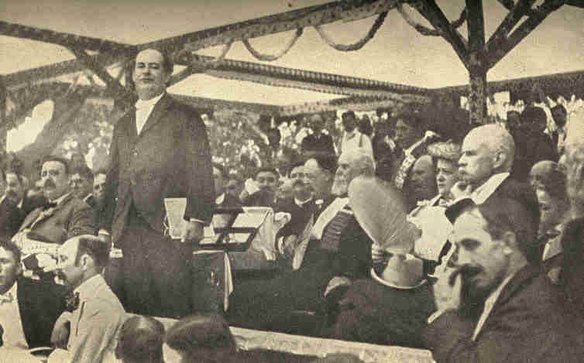
W. J. Bryan accepting the nomination for President at a Jubilee Meeting held at Indianapolis, August 8, 1900.
A number of loosely cohering bodies accorded the Democratic ticket their
support while making each its own declaration of doctrine. The Farmers'
Alliance and Industrial Union, through its Supreme Council, gave
anticipatory endorsement to the Democratic candidate so early as
February. May 10th the Fusion Populists nominated Bryan, naming,
however, Charles A. Towne instead of Stevenson for the vice-presidency.
Towne withdrew in Stevenson's favor. The Silver Republicans likewise
nominated Bryan, making no vice-presidential nomination. The
Anti-imperialist League, meeting in Indianapolis after the Democratic
convention, approved its candidates, its view as to the "paramount
issue," and its position thereon.
For a time after his able Indianapolis speech accepting the various
nominations, Mr. Bryan's election seemed rather probable spite of
incessant Republican efforts to break him down. He had personally gained
much strength since 1896. There was not a State in the Union whose
Democratic organization was not to all appearance solid for him, an
astounding change in four years. An organization of Civil War Veterans
was electioneering for him among old soldiers. Powerful Democratic and
independent sheets which had once vilified now extolled him. He was
sincere, straightforward, and fearless. His demand at Kansas City that
the platform read so and so or he would not run, while probably unwise,
showed him no trimmer.
Many Gold Democrats had returned to the party. The gold standard law,
approved March 14, 1900, made it impossible for a President, even if he
desired to do so, to place the country's money on an insecure basis
without the aid of a Congress friendly in both its branches to such a
design. There was, to be sure, effort to make this law appear imperfect;
to show that Mr. Bryan, if elected, could, without aid from Congress,
debauch the monetary system. But these assertions had little basis or
effect. Silver dollars could be legally paid by the Government for a
variety of purposes; but outside holders of silver could not get it
coined, and the Treasury could not buy more.
New issues–imperialism and the trusts–seemed certain to be
vote-winners for the Democracy. The cause of anti-imperialism had taken
deep hold of the public mind, drawing to its support a host of eminent
and respected Republicans. The Democratic platform expressly named this
the "paramount issue" of the campaign. The party in power defended its
Philippine policy in the manner sketched at the end of the last chapter,
ever asserting, of course, that so far as consistent with their welfare
and our duties the Filipinos must be accorded the largest possible
measure of self-government. In this tone was perceived some
sensitiveness to the anti-imperialist cry. Though Republican campaign
writers and speakers affected to ignore this issue, some of them denying
its existence, imperialism was more and more discussed.
After the Spanish War the question whether the United States should, the
inhabitants agreeing, keep any of the territory obtained from Spain,
divided the Democratic as well as the Republican ranks. So long as
expansion meant merely addition to United States territory and
population after the time-honored fashion, and this was at first all
that anyone meant by expansion, no end of prominent Democrats were
expansionists. But for their devotion to the policy of protection and
their determination to continue high protection at all costs, the
Republicans might have kept in existence this Democratic schism over
expansion.
According to the Constitution as almost unanimously interpreted (the
"insular cases" referred to in the last chapter had not yet been
decided), customs duties must be uniform at all United States ports. If
Luzon was part of the United States in the usual sense of the words,
rates of duty on given articles must be the same at Manila as at New
York. If the Philippine Islands and Porto Rico were parts of the United
States in the full sense, tariff rates at their ports could not be low
unless low in New York, New Orleans, San Francisco, and elsewhere.
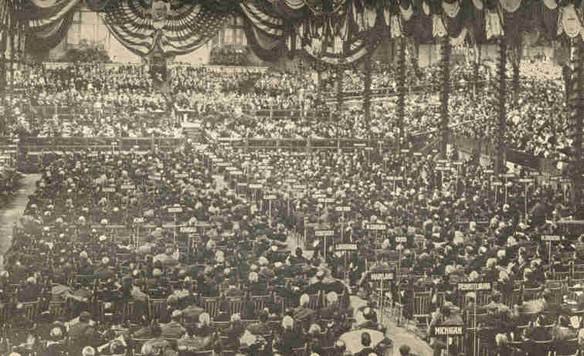
The Republican National Convention, held in Philadelphia, June 1, 1900.
No considerable or general tariff reduction for the United States proper
was to be thought of by the Republicans. But it would not do to maintain
in the ports of the new possessions the high duties established by law
in the United States proper. Were this done, the United States would in
effect be forcing its colonies to buy and sell in the suzerain country
alone, as was done by George III. through those Navigation Acts which
occasioned the Revolutionary War. Such a system was certain to be
condemned. If the expansion policy was to succeed in pleasing our people
a plan had to be devised by which duties at the new ports could be
reduced to approximate a revenue level while remaining rigidly
protective in the old ports.
Out of this dilemma was gradually excogitated the theory, which had been
rejected by nearly all interpreters of the Constitution, that the United
States can possess "appurtenant" territory, subject to, but not part of
itself, to which the Constitution does not apply save so far as Congress
votes that it shall apply. So construed, the Constitution does not ex
proprio vigore follow the flag. Under that construction, inhabitants of
the acquired islands could not plead a single one of its guaranties
unless Congress voted them such a right. If Congress failed to do this,
then, so far as concerned the newly acquired populations, the
Constitution might as well never have been penned. They were subjects of
the United States, not citizens.
The Republican party's first avowal of this "imperialist" theory and
policy was the Porto Rico tariff bill, approved April 12, 1900,
establishing for Porto Rico a line of customs duties differing from that
of the United States. This bill was at first disapproved by President
McKinley. "It is our plain duty," he said, "to abolish all customs
tariffs between the United States and Porto Rico, and give her products
free access to our markets." Until after its passage the bill was
earnestly opposed both by a number of eminent Republican statesmen
besides the President and by nearly all the leading Republican party
organs. Every possible plea–constitutional, humanitarian, prudential–
was urged against it. The bill passed, nevertheless.
The result was a momentous improvement in Democratic prospects. The
schism on expansion which had divided the Democratic party was closed at
once, while many Republicans who had deemed the taking over of the
Philippines simply a step in the nation's growth similar in nature to
all the preceding ones, and had laughed at imperialism as a Democratic
"bogy," changed their minds and sidled toward the Democratic lines.
In their long and able arguments against the Porto Rico tariff,
Republican editors and members of Congress provided the opposite party
with a great amount of campaign material. Often as a Republican on the
hustings or in the press declared imperialism not an issue, or at any
rate not an important one, he was drowned in a flood of recent
quotations from the most authoritative Republican sources proving that
it was not only an issue, but one of the most important ones which ever
agitated the Republic. As Democrats put it, Balaam prophesied in favor
of Israel.
Several minor matters were much dwelt upon by campaigners, with a net
result favorable to the Democrats. A great many in his own party
believed, no doubt wrongly, that the President's policy had in main
features been influenced by consideration for powerful financial
interests, or that at points these had in effect coerced him to courses
contrary to what he considered best. The commissariat scandal in the
Spanish War incensed many, as did the growth of army, navy, and
"militarism" incident to the new colonial policy.
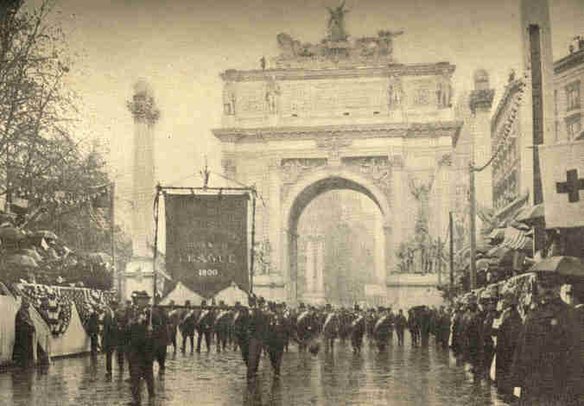
Parade of the Sound Money League,
New York, 1900. Passing the Reviewing Stand.
Then there was the awkwardness with which the Administration had treated
the Filipinos. In 1900 it seemed clear that these people could never be
brought under the flag otherwise than by coercion. Anti-imperialists
were not alone in the conviction that Aguinaldo's followers had been
needlessly contemned, harassed, and exasperated, and that had greater
frankness, tact, and forbearance been used toward them they would, of
their own accord, have sought the shelter of the Stars and Stripes.
Moreover, our measures toward the Filipinos had alienated Cuba, so that
the voluntary adhesion of this island to the United States, so desirable
and once so easily within reach, was no longer a possibility; while the
coercion of Cuba, in view of our profession when we took up arms for
her, would be condemned by all mankind as national perfidy.
The sympathy of official Republicanism with the British in the Boer War
tended to solidify the Irish vote as Democratic, but–and it was among
the novelties of the campaign–Republicans no longer feared to alienate
the Irish. The Government's apparent apathy toward the Boers also drove
into the Democratic ranks for the time a great number of Dutch and
German Republicans. Colored voters were in this hegira, believing that
the adoption of the "subject-races" notion into American public law and
policy would be the negro's despair. The championing of this movement by
the Republican party they regarded as a renunciation of all its
friendship for human liberty.
The Republican campaign watchword was "Protection." Press and platform
dilated on the fat years of McKinley's administration as amply
vindicating the Dingley Act. "The full dinner pail," said they, "is the
paramount issue." Trusts and monopolies they denounced, as their
opponents did, but they declared that these "had nothing to do with the
tariff." There was wide and intense hostility toward monopolistic
organizations. They were decried on all hands as depressing wages,
crushing small producers, raising the prices of their own products and
lowering those of what they bought, depriving business officials and
business travellers of positions, and working a world of other mischief
politically, economically, and socially. They had rapidly multiplied
since the Republicans last came into power, and nothing had been done to
check the formation of them or to control them.
Why, then, was not Democracy triumphant in the campaign of 1900? When
the lines were first drawn a majority of the people probably disapproved
the Administration's departure into fields of conquest, colonialism, and
empire. Republicans themselves denied that a "full dinner pail" was the
most fundamental of considerations. Few Republican anti-imperialists
were saved to the party by the venerable Senator Hoar's faith that after
a while it would surely retrieve the one mistake marring its record. Nor
was it that men like Andrew Carnegie could never stomach the Kansas City
and Chicago heresies, or that the Republicans had ample money, or yet
that votes were attracted to the Administration because of its war
record and its martial face. Agriculture had, to be sure, been
remunerative. Also, before election, the strike in the Pennsylvania hard
coal regions had, at the earnest instance of Republican leaders, been
settled favorably to the miners, thus enlisting extensive labor forces
in support of the status quo; but these causes also, whether by
themselves or in conjunction with the others named, were wholly
insufficient to explain why the election went as it did.
A partial cause of Mr. Bryan's defeat in 1900 was the incipient waning
of anti-imperialism, the conviction growing, even among such as had
doubted this long and seriously, that the Administration painfully
faulty as were some of its measures in the new lands, was pursuing there
absolutely the only honorable or benevolent course open to it under the
wholly novel and very peculiar circumstances.
A deeper cause–the decisive one, if any single cause may be pronounced
such–was the fact that Mr. Bryan primarily, and then, mainly owing to
his strong influence, also his party, misjudged the fundamental meaning
of the country's demand for monetary reform. The conjunction of good
times with increase in the volume of hard money made possible by the
world's huge new output of gold, might have been justly taken as
vindicating the quantity theory of money value, prosperity being
precisely the result which the silver people of 1896 prophesied as
certain in case the stock of hard money were amplified. Bimetallists
could solace themselves that if they had, with all other people, erred
touching the geology of the money question, in not believing there would
ever be gold enough to stay the fall of prices, their main and essential
reasonings on the question had proved perfectly correct. Good fortune,
it might have been held, had removed the silver question from politics
and remanded it back to academic political economy.
Probably a majority of the Democrats in 1900 felt this. At any rate the
Kansas City convention would have been quite satisfied with a formal
reaffirmation of the Chicago platform had not Mr. Bryan flatly refused
to run without an explicit platform restatement of the 1896 position.
His hope, no doubt, was to hold Western Democrats, Populists, and Silver
Republicans, his anti-imperialism meanwhile attracting Gold Democrats
and Republicans, especially at the East, who emphatically agreed with
him on that paramount issue. But it appeared as if most of this,
besides much else that was quite as well worth while, could have been
accomplished by frankly acknowledging and carefully explaining that gold
alone had done or bade fair to do substantially the service for which
silver had been supposed necessary; for which, besides, it would really
have been required but for the unexpected and immense increase in the
world's gold crop through a long succession of years.
The Republican leaders gauged the situation better. Mr. McKinley, to a
superficial view inconsistent on the silver question, was on this point
fundamentally consistent throughout. With all the more conservative
monetary reformers he merely wished the fall of prices stopped, and such
increment to the hard money supply as would effect that result. The
metal, the kind of money producing the needed increase was of no
consequence. When it became practically certain that gold alone, at
least for an indefinite time, would answer the end, he was willing to
relinquish silver except for subsidiary coinage.
The law of March 14, 1900, put our paper currency, save the silver
certificates, and also all national bonds, upon a gold basis, providing
an ample gold reserve. Silver certificates were to replace the treasury
notes, and gold certificates to be issued so long as the reserve was not
under the legal minimum. If it ever fell below that the Secretary of the
Treasury had discretion.
Other notable features of this law were its provision for refunding the
national debt in two per cent. gold bonds–a bold, but, as it proved,
safe assumption that the national credit was the best in the world–and
the clause allowing national banks to issue circulating notes to the par
value of their bonds.
Our money volume now expanded as rapidly as in 1896 advocates of free
coinage could have expected even with the aid of free silver. July 1,
1900. the circulation was $2,055,150,998. as against $1,650.223,0400
four years before. Nearly $163,000,000 in gold certificates had been
uttered. The gold coin in circulation had increased twenty per cent. for
the four years; silver about one-eighth; silver certificates one-ninth.
The Treasury held $222,844,953 of gold coin and bullion, besides some
millions of silver, paper, and fractional currency.
The Republican victory was the most sweeping since 1872. The total
popular vote was 13,970,300, out of which President McKinley scored a
clear majority of 443,054, and a plurality over Bryan of 832,280. Of the
Northern States Bryan carried only Colorado, Idaho, and Nevada. He lost
his own State and was shaken even in the traditionally "solid South."
Unnecessarily ample Republican supremacy was maintained in the
legislative branch of the Government.