
WAR, CONTROVERSY, PEACE
[1899-1901]
It was wholly problematical how long Aguinaldo unaided could dominate
Luzon, still more so whether he would rule tolerably, and more uncertain
yet whether centre or south would ever yield to him. The insurgents had
foothold in four or five Visayan islands, but were never admitted to
Negros, which of its own accord raised our flag. In Mindanao, the Sulu
Islands, and Palawan they practically had no influence. Governor Taft
was of opinion that they could never, unaided, have set up their sway in
these southern regions. But should they succeed in establishing good
government over the entire archipelago, clearly they must be for an
indefinite period incompetent to take over the international
responsibilities connected with the islands. To have at once conceded
their sovereignty could have subserved no end that would have been from
any point of view rational or humane.
The American situation was delicate. We were present as friends, but
could be really so only by, for the time, seeming not to be so. At
points we failed in tact. We too little recognized distinctions among
classes of Filipinos, tending to treat all alike as savages. When our
thought ceased to be that of ousting Spain, and attacked the more
serious question what to do next, our manner toward the Filipinos
abruptly changed. Our purposes were left unnecessarily equivocal. Our
troops viewed the Filipinos with ill-concealed contempt. "Filipinos"
and "niggers" were often used as synonyms.
Suspicion and estrangement reached a high pitch after the capture of
Manila, when Aguinaldo, instead of being admitted to the capital, was
required to fall still farther back, the American lines lying between
him and the prize. December 21, 1898, the President ordered our
Government extended with despatch over the archipelago. That the Treaty
of Paris summarily gave not only the islands but their inhabitants to
the United States, entirely ignoring their wishes in the matter, was a
snub. Still worse, it seemed to guarantee perpetuation of the friar
abuses under which the Filipinos had groaned so long. Outside Manila
threat of American rule awakened bitter hostility. In Manila itself
thousands of Tagals, lip-servants of the new masters, were in secret
communion with their kinsmen in arms.
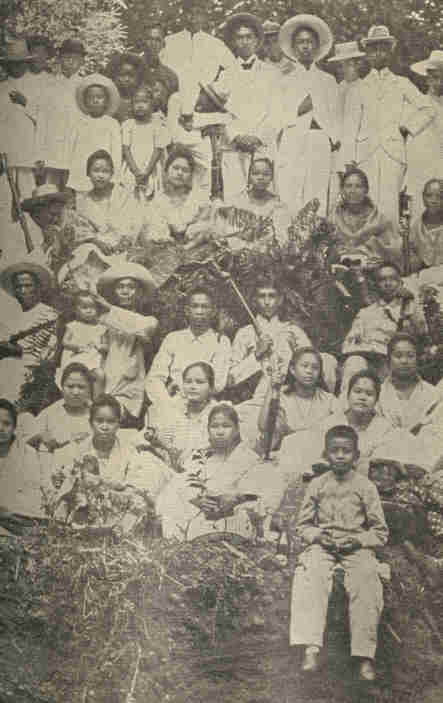
Native Tagals at Angeles, fifty-one miles from Manila.
No blood flowed till February 4, 1898, when a skirmish, set off by the
shot of a bullyragged American sentry, led to war. February 22, 1899,
the insurgents vainly attempted to fire Manila, but were pushed back
with slaughter, their forces scattered.
March 20, 1899, the first Philippine Commission–Jacob G. Schurman, of
New York; Admiral Dewey; General Otis; Charles Denby, ex-minister to
China; and Dean C. Worcester, of Michigan-began their labors at Manila.
They set to work with great zeal and discretion to win to the cause of
peace not only the Filipinos but the government of the Philippine
Republic itself. In this latter they succeeded. Their proclamation that
United States sway in the archipelago would be made "as free, liberal,
and democratic as the most intelligent Filipino desired," "a firmer and
surer self-government than their own Philippine Republic could ever
guarantee," operated as a powerful agent of pacification.
May 1, 1899, the Philippine Congress almost unanimously voted for peace
with the United States. Aguinaldo consented. Mabini's cabinet, opposing
this, was overturned, and a new one formed, pledged to peace. A
commission of cabinet members was ready to set out for Manila to
effectuate the new order.
A revolution prevented this. General Luna, inspired by Mabini, arrested
the peace delegates and charged them with treason, sentencing some to
prison, some to death. This occurred in May, 1899. After that time not
so much as the skeleton of any Philippine public authority–president,
cabinet, or other official–existed. Later opposition to the American
arms seemed to proceed in the main not from real Filipino patriotism,
but from selfishness, lust of power, and the spirit of robbery.
Everywhere and always Americans had to guard against treachery. In Samar
false guides led an expedition of our Marine Corps into a wilderness and
abandoned the men to die, cruelty which was deemed to justify
retaliation in kind. Eleven prisoners subsequently captured were shot
without trial as implicated in the barbarity. For this Major Waller was
court-martialed, being acquitted in that he acted under superior orders
and military necessity. A sensational feature of his trial was the
production of General Smith's command to Major Waller "to kill and
burn"; "make Samar a howling wilderness"; "kill everything over ten"
(every native over ten years old). General Smith was in turn
court-martialed and reprimanded. President Roosevelt thought this not
severe enough and summarily retired him from active service.
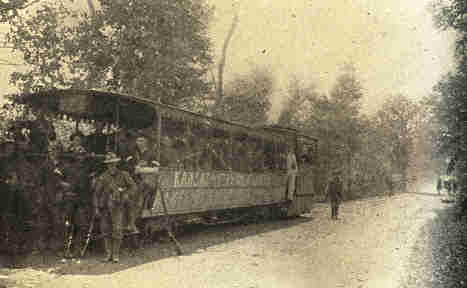
Bringing ammunition to the front for
Gen. Otis's Brigade, north of Manila.
Despite vigilant censorship by the War Department, rumors of other
cruelties on the part of our troops gained credence. It appeared that in
not a few instances American soldiers had tortured prisoners by the
"water cure," the victim being held open-mouthed under a stream of
water, the process sometimes supplemented by pounding on the abdomen
with rifle-butts.
These disgraces were sporadic, not general, and occurred, when they did
occur, under terrible provocation. Devotion to duty, however trying the
circumstances, was the characteristic behavior of our officers and men.
Deeds of daring occurred daily. On November 14, 1900, Major John A.
Logan, son of the distinguished Civil War general, lost his life in
battle near San Jacinto. December 19th the brave General Lawton was
killed in attacking San Mateo. Systematic opposition to our arms was at
last ended by an enterprise involving both nerve and cleverness in high
degree.
Our forces captured a message from Aguinaldo asking reenforcements. This
suggested to General Frederick Funston, who had served with Cuban
insurgents, a plan for seizing Aguinaldo. Picking some trustworthy
native troops and scouts, Funston, Captain Hazzard, Captain Newton, and
Lieutenant Mitchell, passed themselves off as prisoners and their forces
as the reenforcements expected. When the party approached Aguinaldo's
headquarters word was forwarded that reenforcements were coming, with
some captured Americans. Aguinaldo sent provisions, and directed that
the prisoners be treated with humanity. March 23, 1901, he received the
officers at his house. After brief conversation they excused themselves.
Next instant a volley was poured into Aguinaldo's body-guard, and the
American officers rushed upon Aguinaldo, seized him, his chief of staff,
and his treasurer. April 2, 1901, Aguinaldo swore allegiance to the
United States, and, in a proclamation, advised his followers to do the
same. Great and daily increasing numbers of them obeyed.
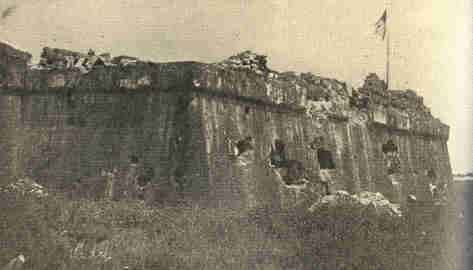
Fort Malate, Cavite.
To the Philippines, though Spain's de facto sovereignty there was hardly
more than nominal, our title, whether or not good as based on conquest,
was unimpeachable considered as a cession by way of war indemnity or
sale. Nor, according to the weight of authority, could the right of the
federal power to acquire these islands be denied. But did "the
Constitution follow the flag" wherever American jurisdiction went? If
not, what were the relations of those outlands and their peoples to the
United States proper? Could inhabitants of the new possessions emigrate
to the United States proper? Did our domestic tariff laws apply there as
well as here? Must free trade exist between the nation and its
dependencies? Were rights such as that of peaceable assemblage and that
to jury trial guaranteed to Filipinos, or could only Americans to the
manner born plead them?
On the fundamental question whether the dependencies formed part of the
United States the Supreme Court passed in certain so-called "insular
cases" which were early brought before it. Four of the justices held
that at all times after the Paris Treaty the islands were part and
parcel of United States soil. Four held that they at no time became
such, but were rather "territories appurtenant" to the country.
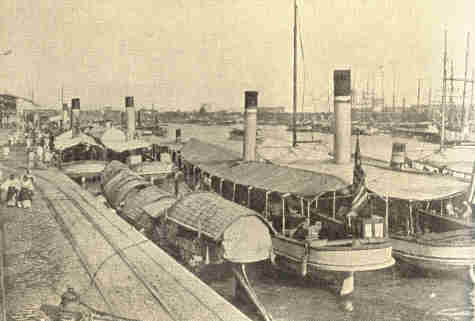
The Pasig River, Manila.
Mr. Justice Brown gave the "casting" opinion. Though reasoning in a
fashion wholly his own, he sided, on the main issue, with the latter
four of his colleagues, making it the decision of the court that Porto
Rico and the Philippines did not belong to the United States proper,
yet, on the other hand, were not foreign. The revenue clauses of the
Constitution did not, therefore, forbid tariffing goods from or going to
the islands. In the absence of express legislation, the general tariff
did not obtain as against imports from the dependencies. This reasoning,
it was observed, was equally applicable to mainland territories and to
Alaska. The court intimated that, so far as applicable, the
Constitution's provisions in favor of personal rights and human liberty
accompanied the Stars and Stripes beyond sea as well as between our old
shores.
Unsatisfactory to nearly all as was this utterance of a badly divided
court, it sanctioned the Administration policy and opened the way for
necessary legislation. It did nothing, however, to hush the
anti-imperialist's appeal, based more upon the Declaration of
Independence and the spirit of our national ideals.
It was said that having delivered the Filipinos from Spain "we were
bound in all honor to protect their newly acquired liberty against the
ambition and greed of any other nation on earth, and we were equally
bound to protect them against our own. We were bound to stand by them, a
defender and protector, until their new government was established in
freedom and in honor; until they had made treaties with the powers of
the earth and were as secure in their national independence as
Switzerland, Denmark, Belgium, Santo Domingo, or Venezuela." But we
ought to bind ourselves and promise the world that so soon as these ends
could be realized or assured we would leave the Filipinos to themselves,
Such was the view of eminent and respected Americans like George F.
Hoar, George S. Boutwell, Carl Schurz, and William J. Bryan.
These and others urged that the Filipinos had inalienable right to life
and to liberty; that our policy in the Philippines was in derogation of
those rights; that Japan, left to herself, had stridden farther in a
generation than England's crown colony of India in a century; that the
Filipinos could be trusted to do likewise; that our increments of
territory hitherto had been adapted to complete incorporation in the
American empire while the new were not; and that growth of any other
character would mean weakness, not strength. The mistakes, expense, and
difficulties incident to expansion, and the misbehavior and crimes of
some of our soldiers were exhibited in their worst light.
Rejoinder usually proceeded by denying the capacity of the Filipinos for
self-government without long training. Even waiving this consideration,
men found in international law no such mid-status between sovereignty
and non-sovereignty as anti-imperialists wished to have the United
States assume while the Filipinos were getting upon their feet. Many
made great point of minimizing the abuses of our military government and
of dilating upon native atrocities. The material wealth of the
archipelago was described in glowing terms. Only American capital and
enterprise were needed to develop it into a mine of national riches. The
military and commercial advantages of our position at the doorway of the
East, our duty to protect lives and property imperilled by the
insurgents, and our manifest destiny to lift up the Filipino races, were
dwelt upon. The argument having chief weight with most was that there
seemed no clear avenue by which we could escape the policy of American
occupation save the dishonorable and humiliating one of leaving the
islands to their fate–anarchy and intestine feuds at once, conquest by
Japan, Germany, or Spain herself a little later.
All demanded that abuses in connection with our rule should be punished
and the repetition of such made impossible, and that whatever power we
exercised should be lodged, without regard to party, in the hands of men
of approved fitness and high and humane character. American tutelage, if
it were to exist, must present to our wards the best and not the worst
side of our civilization, and do so with tact and sympathy.
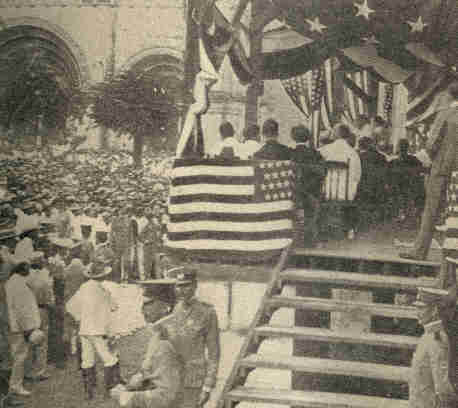
The Inauguration of Governor Taft, Manila, July 4. 1901.
On April 17, 1900, William H. Taft, of Ohio; Dean C. Worcester, of
Michigan; Luke E. Wright, of Tennessee; Henry C. Ide, of Vermont; and
Bernard Moses, of California, were commissioned to organize civil
government in the archipelago. Three native members were subsequently
added to the commission. Municipal governments were to receive attention
first, then governments over larger units. Local self-government was to
prevail as far as possible. Pending the erection of a central
legislature, the commission was invested with extensive legislative
powers. Civil government was actually inaugurated July 4, 1901. Judge
Taft was the first civil governor, General Adna R. Chaffee military
governor under him.
Educational work in the Philippines was pressed from the very beginning
of American control. Our military authorities reopened the Manila
schools, making attendance compulsory. In a short time the number of
schools in the archipelago doubled. By September, 1901, the commission
had passed a general school law, and had placed the schools throughout
the archipelago under systematic organization and able headship. About
1,000 earnest and capable men and women went out from the States to
teach Filipino youth. Five hundred towns received one or more American
teachers each. Associated with them there were in the islands some 2,500
Filipino teachers, mostly doing primary work.
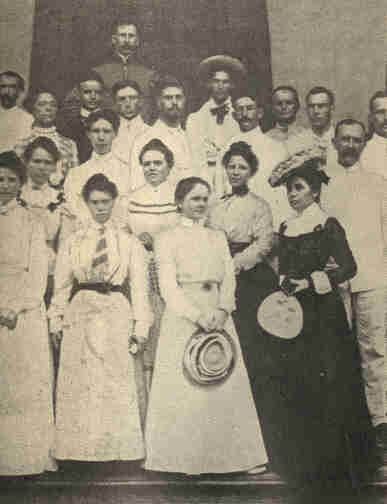
Group of American Teachers on the steps of the Escuela Municipal, Manila.
American teachers advanced into the interior to the neediest tribes.
Nine teachers early settled among the Igorrotes, scattered in towns
along the Agno River, and an industrial and agricultural school was soon
planned for Igorrote boys. Normal schools and manual training schools
were organized. Colonial history, whether ancient or modern, had never
witnessed an educational mission like this.