
PHILIPPINES AND FILIPINOS
[1899]
The Philippine Archipelago lies between 4 degrees 45 minutes and 21
degrees north latitude and 118 and 127 degrees east longitude. It
consists of nineteen considerable and perhaps fifteen hundred lesser
islands, an area nearly equal that of New Jersey, New York, and New
England combined. The island of Luzon comprises a third of this, that of
Mindanao a fifth or a sixth. The archipelago is rich in natural
resources, but mining and manufactures had not at the American
occupation been developed. Agriculture was the main occupation, though
only a ninth of the land surface was under cultivation. The islands were
believed capable of sustaining a population like Japan's 42,000,000.
Luzon boasted a glorious and varied landscape and a climate salubrious
and inviting, considering the low latitude. Manila hemp, sugar, tobaco,
coffee, and indigo were raised and exported in large amounts.
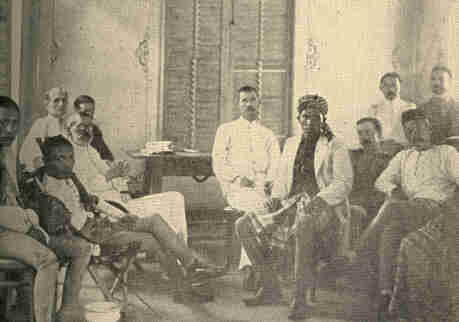
General Bates. The Sultan.
The Jolo Treaty Commission.
The islands lay in three groups, the Luzon, the Visaya (Negros, Panay,
Cebu, Bohol, Leyte, Samar, and islets), and the Mindanao, including
Palawan and the Sulu Islands. Some of these islands were in parts
unexplored. The Tagals and the Visayas, Christian and more or less
civilized Malay tribes, dominated respectively the first and the second
group. The Mindanao coasts held here and there a few Christian
Filipinos, but the chief denizens of the southern islands were the
fierce Arab-Malay Mohammedans known as Moros, most important and
dangerous of whose tribes were the Illanos.
In all, there were thirty or more races, with an even greater number of
different dialects. Northern Luzon housed the advanced Ilocoans,
Pampangos, Pangasinanes, and Cagayanes, with their hardy bronze heathen
neighbors, the Igorrotes. The Visayas had many degraded aborigines, the
Negritos among them. Over against the Moros in the Mindanao group one
could not ignore the warlike Visayan variation, or the swarming savages
of the interior, hostile alike to Moro and Visaya.
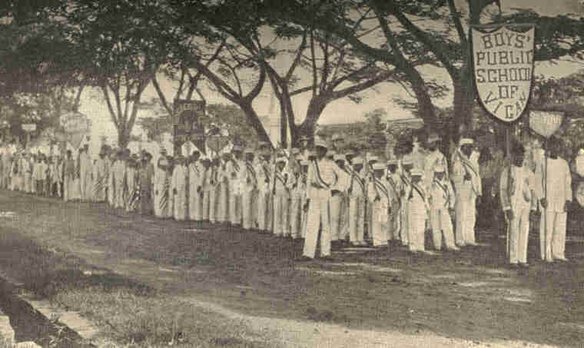
Three Hundred Boys in the Parade of July 4, 1902, Vigan, Ilocos.
The population of the islands numbered 8,000,000 or 10,000,000, 25,000
being Europeans. Half the islanders were Christians, eight or ten per
cent. Mohammedan, perhaps ten per cent. heathen. One considerable
fraction were Chinese, another of mixed extraction. Probably none of the
races were of pure Malay blood, though Malay blood predominated.
Mercantile pursuits were largely in Chinese hands. The Moros disdained
tillage and commerce alike, living on slave labor and captures in war.
Spain had done in the islands much more educational work than the
Americans at first recognized, though none of an advanced kind. Schools
were numerous but not general. Many Filipinos had studied in Europe.
There was a select class possessing information and manners which would
have admitted them to cultivated circles in Paris or London, and
thousands of Filipinos were intellectually the peers of average
middle-class Europeans. The University of St. Thomas graced Manila. Some
seventy colleges and academies at various centres professed to prepare
pupils for it.
Filipinos of aught like cosmopolitan intelligence numbered less than
100,000. Below them were the half-breeds, perhaps 500,000 strong, white,
yellow, or brown, according to the special blend of blood. They were
"intelligent but uneducated, active but not over industrious. They loved
excitement, military display, and the bustle and pomp of government."
Farther down still were the vast toiling masses neither knowing nor
caring much who governed them. Only in suffering were they experts,
having learned of this under the iron heel of Spain all there was to be
known.
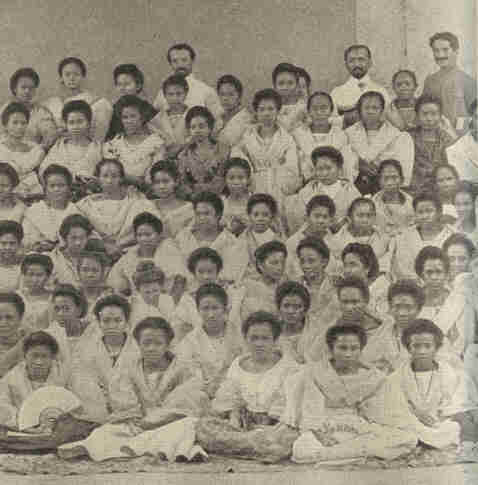
Girls' Normal Institute, Vigan, Ilocos, April, 1902.
In the Philippines one had incessantly before him social and economic
problems in their rudimentary form–populations the debris of centuries,
and the reactions upon them of their first contact with real
civilization. In case of any but the most advanced tribes the immediate
suggestion was despair, a feeling that they could never appropriate the
culture offered them. But the heartiness of the response which even such
communities made to our advances brought hope. Our methods were better
than the Spanish, and our progress correspondingly rapid; yet the task
we undertook bade fair to last centuries. Nor were its initial steps
undefaced by errors.
A Blue Book would not suffice to describe this motley material. We can
only illustrate.
The Iocoros were in a forward state, if not of civilization, of
preparation therefor. On all hands their youth were anxiously waiting to
be taught. Compared with Teutonic races they were superficial and
emotional, but they had great ambition and perseverance.
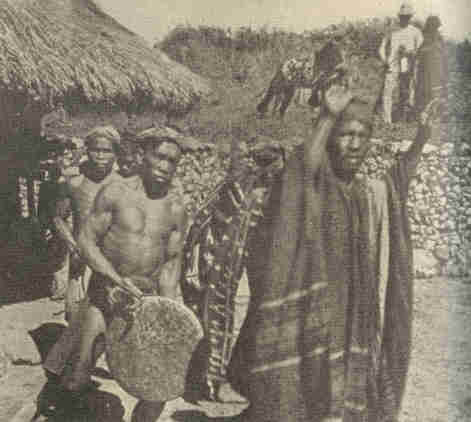
Igarrote Religious Dance, Lepanto.
A sharp contrast were the Igorrotes. These appeared to be at bottom
Malays, though Mongolian features marked many a face. They had withstood
all attempts to christianize them, and stubbornly clung to their
primitive mode of life as tillers of the soil. Mentally they were near
savagery, entirely without ambition or moral outlook. Nevertheless they
adhered to the American arms and rendered valuable porter service.
Their religion had elements of sun and ancestor worship. The one
tangible feature in it was the "kanyan," a drunken feast held on such
occasions–fifteen in all–as marriage, birth, death, and serious
illness. The feast began with an invocation to Kafunion, the sun god,
and a dance much like that of the American Indians. Then came the
drinking of tapi, a strong beer made from rice, and gorging with
buffalo, horse, or dog meat, the last being the greatest delicacy. Till
the Americans vetoed the practice, the Igorrotes were "head hunters."
The theory was that the brains of the captured head became the captor's.
The Igorrotes had magnificent chests and legs, and were extensively used
as burden-bearers. Sustained by only a few bowlfuls of rice and some
sweet potatoes, a man would carry fifty or even seventy-five pounds on
his head or back all day over the most difficult mountain trails. The
Igorrotes had a mild form of slavery, and, though good-natured and at
times industrious, appeared utterly without spirit of progress. It was
interesting to mark whether or not contact with a superior race would be
a stimulus to them.
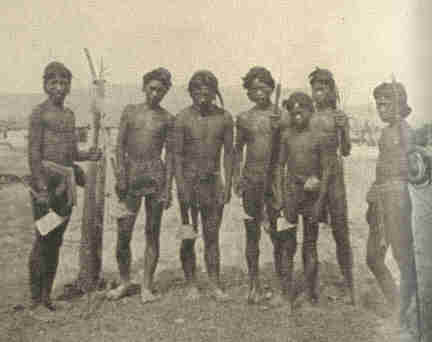
Igarrote Head Hunters with Head Axes and Spears.
A contrast, again, to the Igorrotes was presented by the Ilocoans, an
intelligent, industrious, Christian people, eager for education, yet
promising to cherish independent ideals the more dearly the more
prosperous and advanced they became.
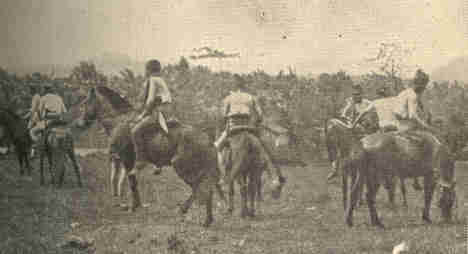
Native Moros-Interior of Jolo.
Most implacable of all the races were the Moros of the Sulu Islands.
Warlike, and despising labor, their terrible piracies had been curbed
only within fifty years, and their depredations and slave raiding by
land were never wholly prevented. They were suspiciously eager to
"assist" our forces in subduing the insurgents. The American authorities
negotiated a treaty with the Sultan and his dattos, involving their
submission to the United States. A provision of this treaty excited
reprobation, that permitting a slave to buy his freedom, a recognition
of slavery in derogation of the Thirteenth Amendment to the
Constitution. The provision was excused as an absolutely necessary
makeshift to put off hostilities till the United States had a freer
hand.
Spain never governed a colony well. Her whole record outre-mer was of a
piece with the enslavement and extermination of the gentle Caribs, with
which it began. In slavery and the slave trade Anglo-Saxon conquistadors
shared Spain's dishonor, but in sheer ugliness of despotism, in
wholesale, systematic, selfish exploiting, and in corrupt and clumsy
administration the Iberian monarchy surpassed all other powers ever
called to deal with colonies. The truth of this indictment was, if
possible, more manifest in the Philippines than anywhere else in the
Spanish world.
The religious orders, which early achieved the conversion of Tagals,
Visayas, and some other tribes, after generations of evangelical
devotion, ceased to be aggressive religiously, growing opulent and
oppressive instead. They were the pedestal of the civil government.
Their word could, and often did, cause natives to be deported, or even
put to death. One of their victims was that beautiful spirit, Dr. Rizal,
author of Noli me Tangere, the most learned and distinguished Malay ever
known. He had taken no part whatever in rebellion or sedition, yet,
because he was known to abominate clerical misrule, he was, without a
scintilla of evidence that he had broken any law, first expatriated,
then shot. This murder occurring December 30, 1896, did much to further
the rebellion then spreading.
"Once settled in his position, the friar, bishop, or curate usually
remained till superannuated, being therefore a fixed political factor
for a generation, while a Spanish civil or military officer never held
post over four years. The stay of any officer attempting a course at
variance with the order's wishes was invariably shortened by monastic
influence. Every abuse leading to the revolutions of 1896 and 1898 the
people charged to the friars; and the autocratic power which each friar
exercised over the civil officials of his parish gave them a most
plausible ground for belief that nothing of injustice, of cruelty, of
oppression, of narrowing liberty was imposed on them for which the friar
was not entirely responsible. The revolutions against Spain began as
movements against the friars." [footnote: Abridged from Report of Taft
Commission.]
Senator Hoar wrote: "I should as soon give back a redeemed soul to Satan
as give back the people of the Philippine Islands to the cruelty and
tyranny of Spain."
Freemasonry in the Philippines was a redoubtable antagonist to the
orders. There were other secret leagues, like the Liga Filipina, with
the same aim, most of them peaceful. Not so the "Katipunan," which
adopted as its symbol the well-known initials, "K. K. K.,"
"Kataas-Tassan, Kagalang-Galang, Katipunan," "sovereign worshipful
association." If the Ku-Klux Klan did not give the hint for the
society's symbol the programmes of the two organizations were alike. The
Katipunan was probably the most potent factor in the insurrection of
1896. Its cause was felt to be that of the whole Filipino people. In
December, 1897, the conflict, as in Cuba, had degenerated into a
"stalemate." The Spaniard could not be ousted, the Filipino could not be
subdued. Spain ended the trouble for the time by promising reform, and
hiring the insurgent leaders to leave the country. Only a small part,
400,000 Mexican dollars, of the promised sum was ever paid. This was
held in Hong-Kong as a trust fund against a future uprising.
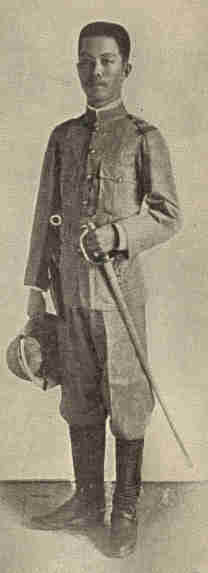
Emilio Aguinaldo.
Chief among the leaders shipped to Hong-Kong was Emilio Aguinaldo. He
was born March 22, 1869, at Cavite, of which town he subsequently became
mayor. His blood probably contained Spanish, Tagal, and Chinese strains.
He had supplemented a limited school education by extensive and eager
contact with books and men. To a surprising wealth of information the
young Filipino added inspiring eloquence and much genius for leadership.
He had the "remarkable gift of surrounding himself with able coadjutors
and administrators." The insurrection of 1896 early revealed him as the
incarnation of Filipino hostility to Spain. Judging by appearances–his
zeal in 1896, bargain with Spain in 1897, fighting again in Luzon in
1898, acquiescence in peace with the United States, reappearance in
arms, capture, and instant allegiance to our flag–he was a shifty
character, little worthy the great honor he received where he was known
and, for a long time, here. But if he lacked in constancy, he excelled
in enterprise. Spaniards never missed their reckoning more completely
than in thinking they had quieted Aguinaldo by sending him to China with
a bag of money.
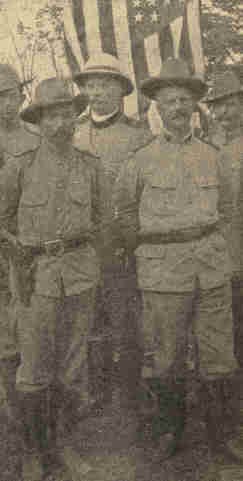
Gen. Frederick Funston, Gen. A. McArthur.
It being already obvious that Spain had not redressed, and had no
intention of redressing, abuses in the Philippines, Aguinaldo and his
aides planned to return. The American war was their opportunity.
Conferences were had with Consul Wildman at Hong-Kong and with Commodore
Dewey. Aguinaldo and those about him declared that Wildman, alleging
authority from Washington, promised the Filipinos independence; and
other Hong-Kong consuls and several press representatives received the
impression that this was the case. Wildman absolutely denied having
given any assurance of the kind. Admiral Dewey also denied in the most
positive manner that he had done so.
Whatever the understanding or misunderstanding at Hong-Kong, Aguinaldo
came home with Dewey in the evident belief that the American forces and
his own were to work for Filipino independence. He easily resumed his
leadership and began planning for an independent Filipino State. Dewey
furnished him arms and ammunition. The insurrection was reorganized on a
grander scale than ever, with extraordinary ability, tact, energy, and
success. Nearly every one of the Luzon provinces had its rebel
organization. In each Aguinaldo picked the leader and outlined the plan
of campaign. His scheme had unity; his followers were aggressive and
fearless. Everywhere save in a few strongholds Spain was vanquished. At
last only Manila remained. The insurgents must have captured 10,000
prisoners, though part of those they had at the Spanish evacuation were
from the Americans. They hemmed in Manila by a line reaching from water
to water. We could not have taken Manila as we did, by little more than
a show of force, had it not been for the fact that Spain's soldiers,
thus, hemmed in by Aguinaldo's, could not retreat beyond the range of
our naval guns. January 21, 1899, a Philippine Republic was set up, its
capital being Malolos, which effectively controlled at least the Tagal
provinces of Luzon. Its methods were irregular and arbitrary–natural in
view of the prevalence of war. Aguinaldo, its soul from the first
moment, became president.
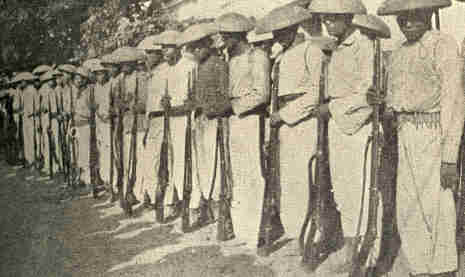
A Company of Insurrectos near Bongued, Abra Province,
just previous to surrendering early in 1901.
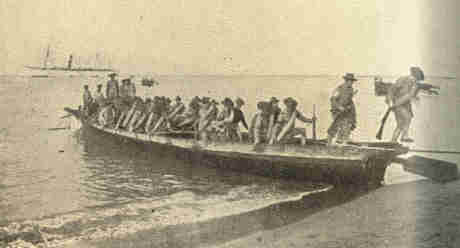
11th Cavalry Landing at Vigan, Ilocos, April, 1902.
The Philippine Republic wished and assumed to act for the archipelago,
taking the place of Spain. It, of course, had neither in law nor in fact
the power to do this, nor, under the circumstances, could the
Administration at Washington, however desirable such a course from
certain points of view, consent that it should at present even try. The
Philippine question divided the country, raising numerous problems of
fact, law, policy, and ethics, on which neither Congress nor the people
could know its mind without time for reflection.
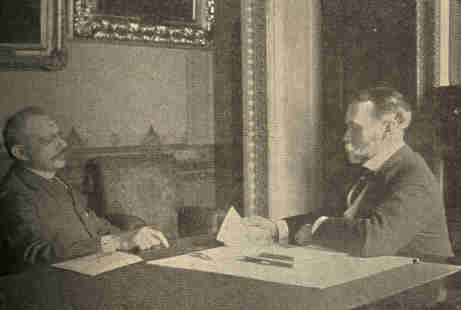
Copyright, 1899, by Frances B. Johnston.
Jules Cambon, the French Ambassador, acting for Spain,
receiving from the Honorable John Hay, the U. S. Secretary of State,
drafts to the amount of $20,000,000, in payment for the Philippines.
When our commissioners met at Paris to draft the Treaty of Peace, one
wished our demands in the Orient confined to Manila, with a few harbors
and coaling stations. Two thought it well to take Luzon, or some such
goodly portion of the archipelago. That the treaty at last called for
the entire Philippine domain, allowing $20,000,000 therefor, was
supposed due to insistence from Washington. Only the Vice-President's
casting vote defeated a resolution introduced in the Senate by Senator
Bacon, of Georgia, declaring our intention to treat the Filipinos as we
were pledged to treat the Cubans. After ratification the Senate passed a
resolution, introduced by Senator McEnery, of Louisiana, avowing the
purpose not to make the Filipinos United States citizens or their land
American territory, but to establish for them a government suited to
their needs, in due time disposing of the archipelago according to the
interests of our people and of the inhabitants.