
[1898-1902]
As if Santiago had not afforded "glory enough for all," some disparaged
Admiral Sampson's part in the battle, others Admiral Schley's. As
commander of the fleet, whose routine and emergency procedure he had
sagaciously prescribed, Sampson, though on duty out of sight of the
action at its beginning, was entitled to utmost credit for the brilliant
outcome. The day added his name to the list of history's great sea
captains.
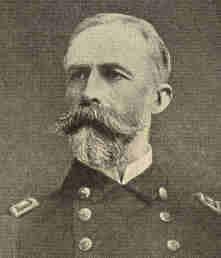
Admiral William T. Sampson.
Schley had the fortune to be senior officer during his chief's temporary
absence. He fought his ship, the Brooklyn, to perfection, and, while it
was not of record that he issued any orders to other commanders, his
prestige and well-known battle frenzy inspired all, contributing much to
the victory. The early accounts deeply impressed the public, and they
made Schley the central figure of the battle. Unfortunately Sampson's
first report did not even mention him. Personal and political partisans
took up the strife, giving each phase the angriest possible look.
Admiral Schley at length sought and obtained a court of inquiry.
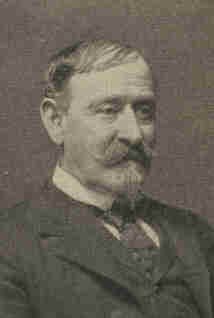
Admiral W. S. Schley
The court found Schley's conduct in the part of the campaign prior to
June 1, 1898 (which our last chapter had not space to detail),
vacillating, dilatory, and lacking enterprise. It maintained, however,
that during the battle itself, despite the Brooklyn's famous "loop,"
which it seemed to condemn, his conduct was self-possessed, and that he
inspired his officers and men to courageous fighting. Admiral Dewey,
president of the court, held in part a dissenting opinion, which carried
great weight with the country. He considered Schley the actual fleet
commander in the battle, thus giving him the main credit for the
victory.
Legally, it turned out, Sampson, not Schley, commanded during the hot
hours. Moreover, the evidence seemed to reveal that the court's
strictures upon Schley, like many criticisms of General Grant at Shiloh
and in his Wilderness campaign, were probably just. In both cases the
public was slow to accept the critics' view.
Both before and after his resignation, July 19, 1899, Secretary of War
Alger was subjected to great obloquy. Shafter's corps undoubtedly
suffered much that proper system and prevision would have prevented. The
delay in embarking at Tampa; the crowding of transports, the use of
heavy uniforms in Cuba and of light clothing afterward at Montauk Point,
the deficiency in tents, transportation, ambulances, medicines, and
surgeons, ought not to have occurred. Indignation swept the country when
it was charged that Commissary-General Eagan had furnished soldiers
quantities of beef treated with chemicals and of canned roast beef unfit
for use. A commission appointed to investigate found that "embalmed
beef" had not been given out to any extent. Canned roast beef had been,
and the commission declared it improper food.
The commission made it clear that the Quartermaster's Department had
been physically and financially unequal to the task of suddenly
equipping and transporting the enlarged army–over ten times the size of
our regular army–for which it had to provide. If wanting at times in
system the department had been zealous and tireless. At the worst it was
far less to blame than recent Congresses, which had stinted both army
and navy to lavish money upon objects far less important to the country.
The army system needed radical reform. There was no general staff, and
the titular head of the army had less real authority than the
adjutant-general with his bureau.
These imbroglios had little significance compared with the problems
connected with our new dependencies. The Senate ratified the peace
treaty February 6, 1899, by the narrow margin of two votes–forty-two
Republicans and fifteen others in favor, twenty-four Democrats and
three others opposing. But for the advocacy of the Democratic leader,
William J. Bryan, who thought that the pending problems could be dealt
with by Congress better than in the way of diplomacy, ratification would
have failed.
The ratification of the Treaty of Paris marked a momentous epoch in our
national life and policy. In a way, the very fact of a war with Spain
did this. A century and a quarter before a Spanish monarch had furnished
money and men to help the American colonies become free from England.
"The people of America can never forget the immense benefit they have
received from King Carlos III.," wrote George Washington. At that time a
Spaniard predicted that the American States, born a pigmy, would become
a mighty giant, forgetful of gratitude, and absorbed in selfish
aggression at Spain's expense. Our change to quasi-alliance with Great
Britain against Spain seemed to not a few the fulfilment of that
prophecy. Europe declared that we had hopelessly broken with our ideals.
Cynics there applied to the United States the Scriptures: "Hell from
beneath is moved for thee to meet thee at thy coming: it stirreth up the
dead for thee, even all the chief ones of the earth; it hath raised up
from their thrones all the kings of the nations. All they shall speak
and say unto thee, Art thou also become weak as we? art thou become like
one of us? . . . How art thou fallen from heaven, O Lucifer, son of the
morning!"
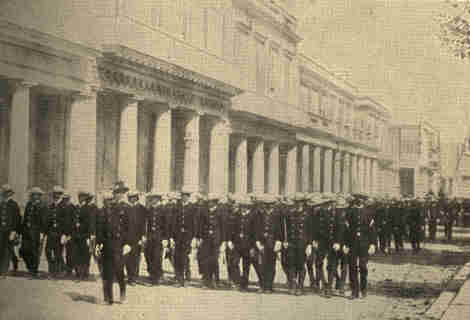
The New Cuban Police as organized by
ex-Chief of New York Police, McCullagh.
The United States did not heed these sneers. Hawaii had been annexed.
Sale tenure of the Samoan Islands west of 171 degrees west longitude,
including Tutuila and Pago-Pago harbor, the only good haven in the
group, was ours. These measures, which a few years earlier all would
have deemed radical, did not stir perceptible opposition. Nearly all
felt that they were justified, by considerations of national security,
to obtain naval bases or strategic points. Such motives also excused the
acquisition of Guam in the Pacific, ceded by Spain in Article II of the
Paris Treaty, and that of Porto Rico.
Civil government was established in Porto Rico with the happiest
results. The Insular Treasury credit balance trebled in a year,
standing, July 1, 1902, at $314,000. The exports for 1902 increased over
50 per cent., most of the advance being consigned to the United States.
The principal exports were sugar, tobacco, the superior coffee grown in
the island, and straw hats. Of the coffee, the year named, Europe took
$5,000,000 worth, America only $29,000 worth. Porto Rico imported from
Spain over $95,000 worth of rice, $500,000 worth of potatoes. The first
year under our government there were 13,000 fewer deaths than the year
before, improvement due to better sanitation and a higher standard of
living. Mutual respect between natives and Americans grew daily.
Touching Cuba, too, the course of the Administration evoked no serious
opposition. We were in the island simply as trustees for the Cubans. The
fourth congressional resolution of April 20, 1898, gave pledge as
follows: "The United States hereby disclaims any disposition or
intention to exercise sovereignty, jurisdiction, or control over said
island (Cuba) except for the pacification thereof, and asserts its
determination when that is completed to leave the government and control
of the island to its people." This "self-denying ordinance," than which
few official utterances in all our history ever did more to shape the
nation's behavior, was moved and urged, at first against strong
opposition, by Senator Teller, of Colorado. Senator Spooner thought it
likely that but for the pledge just recited European States would have
formed a league against the United States in favor of Spain.
December 13, 1898, a military government was established for "the
division of Cuba," including Porto Rico. The New Year saw the last
military relic of Spanish dominion trail out of Cuba and Cuban waters.
The Cuban army gradually disbanded. The work of distributing supplies
and medicines was followed by the vigorous prosecution of railroad,
highway and bridge repairing and other public works, upon which many of
the destitute found employment. Courts and schools were resumed.
Hundreds of new schools opened–in Santiago city 60, in Santiago
province over 300. Brigandage was stamped out. Cities were thoroughly
cleaned and sewer systems constructed. The death rate fell steadily to a
lower mark than ever before. In 1896 there were in Havana 1,262 deaths
from yellow fever, and during the eleven years prior to American
occupation an average of 440 annually. In 1901 there were only four.
Under the "pax Americana" industry awoke. New huts and houses hid the
ashes of former ones. Miles of desert smiled again with unwonted
tillage.
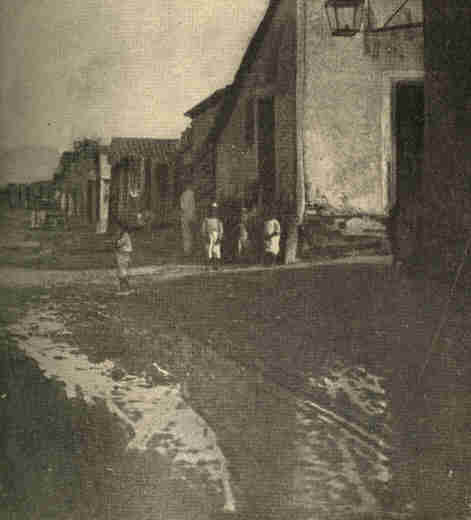
Showing Condition of Streets in Santiago
before Street Cleaning Department was organized.
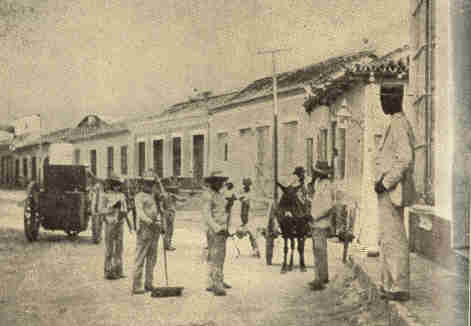
Santiago Street Cleaning Department.
A census of Cuba taken by the War Department, October 16, 1899, showed a
population of 1,572,797, a falling off of nearly 60,000 in the twelve
years since the last Spanish census, indicating the loss due to the
civil war. The average density of population was about that of Iowa,
varying, however, from Havana province, as thickly peopled as
Connecticut, to Puerto Principe, with denizens scattered like those of
Texas. Seventy per cent. of the island's inhabitants were Cuban
citizens, two per cent. were Spanish, eighteen per cent. had not
determined their allegiance, while about ten per cent. were aliens.
Eighty per cent. of the people in the rural districts could neither read
nor write.
In December, 1899, Governor Brooke retired in favor of General Leonard
Wood. A splendid object-lesson in good government having been placed
before the people, they were, in June, 1900, given control of their
municipal governments and the powers of these somewhat enlarged.
In July Governor Wood issued a call for a constitutional convention,
which met in November. The fruit of its deliberations was an instrument
modelled largely upon the United States Constitution. The bill of rights
was more specific, containing a guarantee of freedom in "learning and
teaching" any business or profession, and another calculated to prevent
"reconcentration." The Government was more centralized than ours. The
President, elected by an electoral college, held office four years, and
was not re-eligible twice consecutively. The Senate consisted of six
senators from each of the six departments, the term being six years.
One-third were elected biennially. The House of Representatives
consisted of one representative to every 25,000 people. One-half were
elected biennially. Four years was the term of office. The judicial
power vested in a Supreme Court and such other courts as might be
established by law. Suffrage was universal.
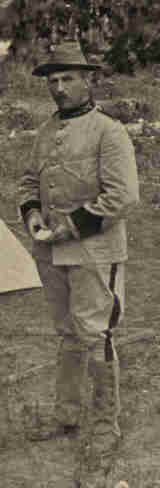
Governor-General Leonard A Wood
in the Uniform of Colonel of Rough Riders.
In his call for the convention, also in his opening address before it,
Governor Wood mentioned its duty to determine the relations between Cuba
and the United States. Jealous and suspicious, the convention, believing
the United States bound by its pledge to leave the island to the
unconditional control of its inhabitants, slighted these hints.
Meantime, at President McKinley's instance, Congress adopted, March 2,
1901, as a rider to the pending army appropriation bill, what was known
as "the Platt amendment," so called from its author, Senator Platt, of
Connecticut.
This enacted that in fulfilment of the congressional joint resolution of
April 20, 1898, which led to the freeing of Cuba, the President was to
leave the government and Control of the island to its people only when a
Government should be established there under a constitution defining the
future relations of the United States with Cuba. The points to be
safe-guarded were that Cuba should permit no foreign lodgment or
control, contract no excessive debt, ratify the acts of the military
government, and protect rights acquired thereunder, continue to improve
the sanitation of cities, give the United States certain coaling and
naval stations, and allow it to intervene if necessary to preserve Cuban
independence, maintain adequate government, or discharge international
obligations created by the Paris Treaty.
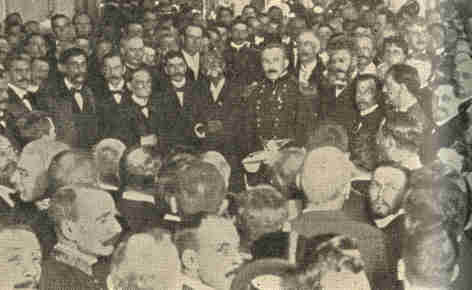
Judge Cruz Perez Gov. Gen. Wood.
General Maximo Gomez. T. E. Palma.
Governor-General Leonard A. Wood transferring the Island of Cuba to
President Tomaso Estrada Palma, as a Cuban Republic, May, 1902.
From copyrighted stereoscopic photograph. By Underwood & Underwood. N. Y.
A week before the Platt amendment passed, the Cuban convention adopted a
declaration of relations, "provided the future government of Cuba thinks
them advisable," not mentioning coaling stations or a right of
intervention, but declaring that "the governments of the United States
and Cuba ought to regulate their commercial relations by means of a
treaty based on reciprocity."
When the convention heard that the Platt amendment must be complied
with, a commission was sent to Washington to have this explained. Upon
its return the convention, June 12, 1901, not without much opposition,
adopted the amendment.
The first President of the Cuban Republic was Tomaso Estrada Palma. He
had been years an exile in the United States, and was much in sympathy
with our country. His home-coming was an ovation. In May, 1902, the
Stars and Stripes were hauled down, and the Cuban tricolor raised. The
military governor and all but a few of his soldiers left the island, as
the Spaniards had done less than three years before; yet with a record
of dazzling achievement that had in a few months done much to repair the
mischiefs of Spain's chronic misrule.
Cut off from her former free commercial intercourse with Spain, Cuba
looked to the United States as the main market for her raw sugar.
Advocates of reciprocity urged considerations of honor and fair dealing
with Cuba, where, it was said, ruin stared planters in the face. The
Administration and a majority of the Republicans favored the cause. Not
so senators and representatives from beet-sugar sections. The
"insurgents," as the opponents of reciprocity were called, urged that
raising sugar beets was a distinctively American industry, and that to
sacrifice it was to relinquish the principle of protection altogether.
The so-called "Sugar Trust" favored reciprocity, being accused of
expending large sums in that interest. Against it was pitted the "Sugar
Beet Trust," a new figure among combinations.
During the long session of the Fifty-seventh Congress, a Cuban
reciprocity bill being before the House, the sugar-beet interest
demonstrated its power. The House "insurgents," joining the Democratic
members, overrode the Speaker and the Ways and Means chairman, and
attached to the bill an amendment cutting off the existing differential
duty in favor of refined sugar. A locking of horns thus arose, which
outlasted the session, neither side being able to convince or outvote
the other. Sanguine Democrats thought that they espied here a hopeful
Republican schism like that of 1872.