
[1895-1898]
How early Cuban discontent with Spain's rule became vocal is not known.
An incipient revolt in 1766 was ruthlessly put down. Though the "Ever
Faithful Isle" did not rebel with the South American colonies under
Bolivar, it was never at rest, as attested by the servile revolts of
1794 and 1844, the "Black Eagle" rebellion of 1829, and the ten-years'
insurrection beginning in 1868. In 1894-1895, just as "Home Rule for
Cuba" had become a burning issue in Spain, martial law was proclaimed in
Havana, precipitating the last and successful revolution.
American interest in the island, material and otherwise, was great. The
barbarity and devastation marking the wars made a strong appeal to our
humane instincts; nor could Americans be indifferent to a neighboring
people struggling to be free. The suppression of filibustering
expeditions taxed our Treasury and our patience. Equally embarrassing
were the operations of Cuban juntas from our ports. To solve the complex
difficulty Presidents Polk, Buchanan, and Grant had each in his time
vainly sought to purchase the island. The Virginius outrage during
Grant's incumbency brought us to the very verge of war, prevented only
by the almost desperate resistance of Secretary Hamilton Fish.
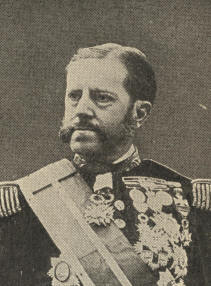
Governor-General Weyler.
When the final rebellion was under way the humane Governor-General
Martinez Campos was succeeded by General Weyler, ordered to down the
rebellion at all costs. Numberless buildings were burnt and plantations
destroyed, the insurgents retaliating in kind. Non-combatants were
huddled in concentration camps, where half their number perished.
American citizens were imprisoned without trial. One, Dr. Ruiz, died
under circumstances occasioning strong suspicions of foul play.
President Cleveland, while willing to mediate between Spain and the
Cubans, preserved a neutral attitude, refusing to recognize the
insurgents even as belligerents, though they possessed all rural Cuba
save one province. Only when about to quit office did Mr. Cleveland hint
at intervention.
Soon after McKinley's accession an anarchist shot Premier Canovas,
when Sagasta, his Liberal successor, promised Cuba reform and home rule.
Weyler was succeeded by Blanco, who revoked concentration, proclaimed
amnesty, and set on foot an autonomist government. Americans were loosed
from prison. Clara Barton, of the American Red Cross Society, hastened
with supplies to the relief of the wretched reconcentrados, turned loose
upon a waste. Spain, too, appropriated a large sum for reconcentrado
relief, promising implements, seed, and other means for restoring ruined
homes and plantations.
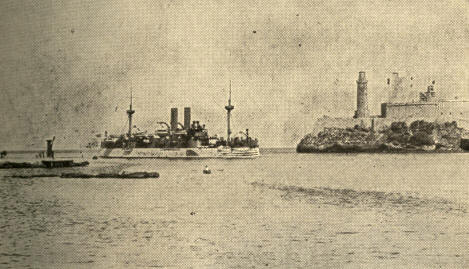
Copyright. 1898, by F. C. Hemment.
U. S. Battleship Maine Entering the Harbor of Havana, January, 1898.
But the iron had entered the Cuban's soul. The belligerents rejected
absolutely the offers of autonomy, demanding independence. The
"pacificos" were no better off than before, and relations between the
United States and Spain grew steadily more strained. Two incidents
precipitated a crisis.
A letter by the Spanish Minister at Washington, Senor de Lome, was
intercepted and published, holding President McKinley up as a
time-serving politician. De Lome forestalled recall by resigning; yet
his successor, Polo y Bernabe, could not fail to note on arriving in
Washington a chill diplomatic atmosphere.
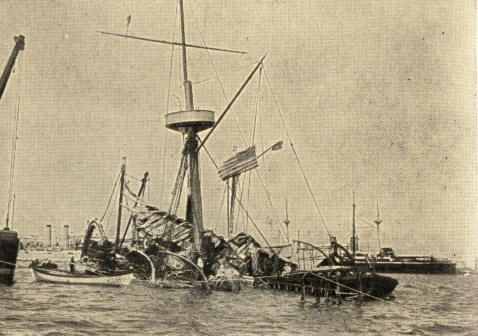
Wreck of U. S. Battleship Maine.
Photograph by F. C. Hemment.
In January, 1898, the United States battleship Maine was on a friendly
visit at Havana, where she was received with the greatest courtesy,
being taken to her harbor berth by the Spanish government pilot. At
9.40 on the evening of February 15th, the harbor air was rent by a
tremendous explosion. Where the Maine had been, only a low shapeless
hump was distinguishable. The splendid vessel, with officers and crew on
board to the number of 355, had sunk, a wreck. Of the 355, 253 never saw
day.
Strong suspicions gained prevalence that this was a deed of Spanish
treachery, or attributable, at the very least, to criminal indifference
on the part of the authorities. Some alleged positive connivance by
Spanish officials. War fever ran high. When, five days later, the
Spanish cruiser Vizcaya visited New York City, it was thought well to
accord her special protection. March, 9th, Congress placed in the
President's hands $50,000,000 to be used for national defence. The 21st,
a naval court of inquiry confirmed the view that the Maine disaster was
due to the explosion of a submarine mine. War fever became a fire.
"Remember the Maine" echoed up and down and across the land, the words
uttered with deep earnestness.
The war spirit welded North and South, permeating the Democracy even
more than the party in power. Democrats would have at once recognized
the Cuban Republic. This was at first the attitude of the Senate, which,
upon deliberation, wisely forbore. It, however, on April 20th, joined
the House in declaring the people of Cuba free and independent, adding
that Spain must forthwith relinquish her authority there. The President
was authorized to use the nation's entire army, navy, and militia to
enforce withdrawal. This was in effect a declaration of war. Minister
Woodford, at Madrid, received his passports; as promptly Bernabe
withdrew to Montreal. April 23d, 125,000 volunteers were called out.
April 26th an increase of the regular army to some 62,000 was
authorized. Soon came a call for 75,000 more volunteers. Responses from
all the States flooded the War Department.
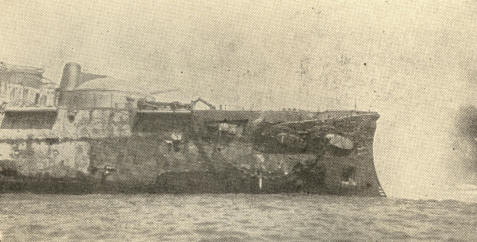
Bow of the Spanish Cruiser Almirante Oquendo.
From a Photograph by F. C. Hemment.
Copyright, 1898, by W. R. Hearst.
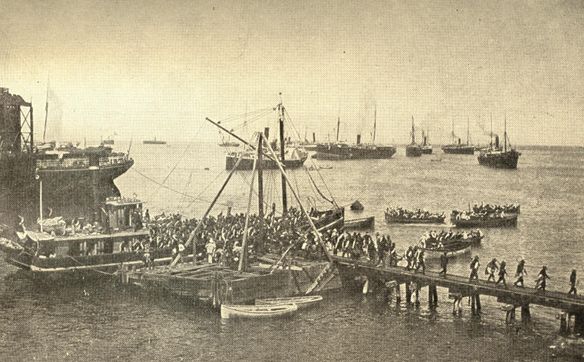
The Landing at Daiquiri. Transports in the Offing.
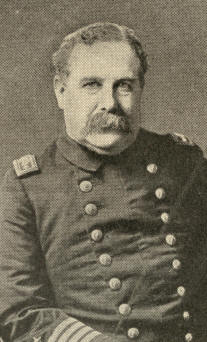
Captain Charles E. Clark.
Spain, ruled by a clique of privileged Catalonians, groaned under all
the oppressiveness of militarism, with none of its power. Plagued by
Carlism and anarchy at home, she was grappling, at tremendous outlay,
with two rebellions abroad. Yet all her many parties cried for war.
Popular subscriptions were taken to aid the impoverished treasury;
reserves were called out; in Cuba, Blanco summoned all able-bodied men.
The navy was supplemented by ships purchased wherever hands could be
laid upon them.
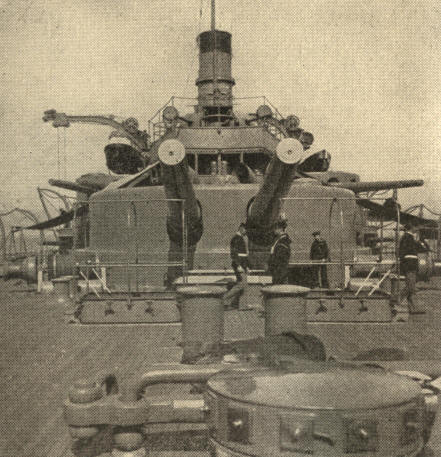
After Deck on the Oregon, Showing Two 13-inch,
Four 8-inch, and Two 6-inch Guns.
Copyright. 1899. by Strohmeyer & Wyman.
Owing to the parsimony of Congress, our equipment for a large army, or
even for our 25,000 regulars, if they were to go on a tropical campaign,
was totally inadequate. Our artillery had no smokeless powder. Many
infantry regiments came to camp armed with nothing but enthusiasm. No
khaki cloth for uniforms was to be had in the country. Canvas had to be
taken from that provided by the Post-Office Department for repairing
mail bags. While the utmost possible at short notice was done with the
just voted $50,000,000 defence fund, the comprehensive system of
fortifications long before designed had hardly been begun. The navy had
been treated least illiberally; still the construction budget had been
so cut that only a few of the proposed vessels had been transferred from
paper to the sea.
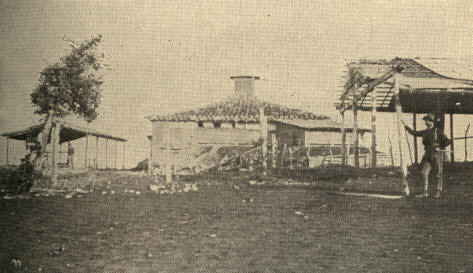
Blockhouse on San Juan Hill.
The United States navy which did exist was a noble one. Both its ships
and their crews were as fine as any afloat. Had the Spanish navy been
manned like ours the two would have been of about equal strength. Ours
boasted the more battleships, but Spain had several new and first-rate
armored cruisers, besides a flotilla of swift torpedo boats. The
Spaniards were, however, poor gunners, clumsy sailors, awkward and
careless mechanics; while American gunners had a deadly aim, and spared
no skill or pains in the care or handling of their ships.
American superiority in these points was tellingly proved by the
Oregon's unprecedented run from ocean to ocean. Before hostilities she
was ordered from San Francisco, via Cape Horn to join the Atlantic
squadron. The long, hard, swift trip was made without the break of a bar
or the loosening of a bolt, a result which attracted expert notice
abroad as attesting the very highest order of seamanship. Meantime war
had commenced. It was feared that off Brazil Admiral Cervera would
endeavor to intercept and destroy her; yet, with well-grounded
confidence, Captain Clark expected in that event not only to save
himself but to punish his assailants. He met no interference, however,
and at the end of her unparalleled voyage his noble ship was without
overhauling ready to join in the Santiago blockade and in destroying the
Spanish fleet.
Admiral Cervera, Commander of the Spanish Squadron.
Admiral Cervera's departure westward from the Cape Verde Islands, and
the subsequent discovery of his squadron in the harbor of Santiago,
determined the Government to invest that city. The navy acted with
promptitude. Commodore Schley first, then, in conjunction with him, his
superior, Rear-Admiral Sampson, drew a tight line of war-vessels across
the channel entrance.
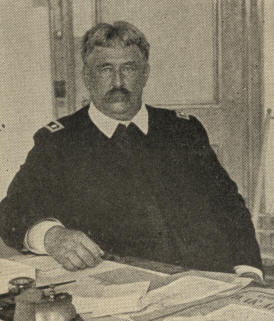
Major-General William R. Shafter.
Unfortunately delayed by inadequate shipping facilities and the
unsystematic consignment of supplies, also by the unfounded rumor of a
Spanish cruiser and destroyer lying in wait, the army of 17,000, under
Major-General William R. Shafter, landed with little opposition a short
distance east of Santiago. The sickly season had begun. Moreover, it was
as good as certain that, spite of all the miserable Cuban army could do,
Santiago's 8,000 defenders would soon be increased from neighboring
Spanish garrisons. So, notwithstanding his inadequate provision for
sound, sick, or wounded and his weakness in artillery, Shafter pushed
forward. His gallant little army brushed the enemy's intercepting
outpost from Las Guasimas, tore him, amid red carnage, from his stubborn
holds at El Caney and San Juan Ridge, and by July 3d had the city
invested, save on the west. From this quarter, however, General Escario,
with 3,600 men, had forced his way past our Cuban allies and joined his
besieged compatriots in Santiago.
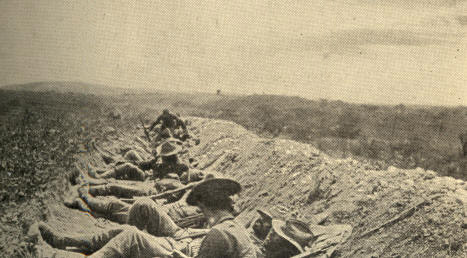
Troops in the Trenches, Facing Santiago.
The third of July opened, for the Americans, the darkest day of the war.
Drenched by night, roasted by day, haversacks which had been cast aside
for battle lost or purloined, supply trains stalled in the rear,
fighting by day, by night digging trenches and rifle-pits–little
wonder that many lost heart and urged withdrawal to some position nearer
the American base. Shafter himself for a moment considered such a step.
But General Wheeler, on the fighting line, set his face against it, as,
upon reflection, did Shafter. A bold demand for surrender was sent to
General Toral, commanding the city, while Admiral Sampson came to confer
with Shafter for a naval assault.
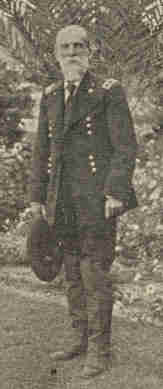
General Joseph Wheeler.
The squadron had not been idle. By day their vigilance detected the
smallest movement at the harbor mouth. Upon that point each night two
battleships bent their dazzling search-lights like cyclopean eyes.
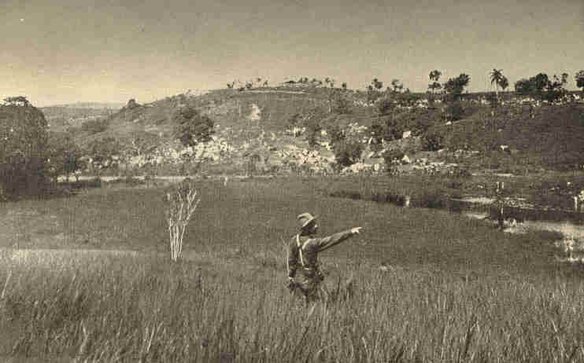
View of San Juan Hill and Blockhouse,
Showing the Camp of the United States Forces.
It was decided to block the narrow channel by sinking the collier
Merrimac across its neck. Just before dawn on June 3d the young naval
constructor, Hobson, with six volunteers chosen from scores of eager
competitors, and one stowaway who joined them against orders, pushed the
hulk between the headland forts into a roaring hell of projectiles.
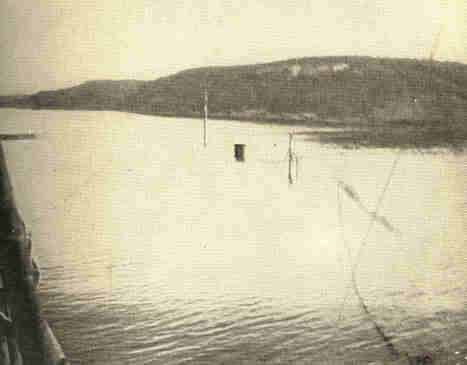
The Collier Merrimac Sunk by Hobson at the Mouth of Santiago Harbor.
An explosion from within rent the Merrimac's hull, and she sank; but,
the rudder being shot away, went down lengthwise of the channel. When
the firing ceased, the little crew, exhausted, but not one of the eight
missing, clustered, only heads out of water, around their raft. A
launch drew near. In charge was the Spanish admiral, who took them
aboard with admiring kindness, and despatched a boat to notify the
American fleet of their safety.
It was well that "Hobson's choice" as to the way his tub should sink
failed. On July 3d, just after Sampson steamed away to see Shafter, the
Maria Teresa was seen poking her nose from the Santiago harbor, followed
by the Almirante Oquendo, the Vizcaya, and the Christobal Colon. Under
peremptory orders from his Government, Admiral Cervera had begun a mad
race to destruction. "It is better," said he, "to die fighting than to
blow up the ships in the harbor." These had become the grim
alternatives.
The Brooklyn gave chase, the other vessels in suit, the Texas and the
Oregon leading. As the admiral predicted, it was "a dreadful holocaust."
One by one his vessels had to head for the beach, silenced, crippled,
flames bursting from decks, portholes, and the rents torn by our
cannonade. Two destroyers, Furor and Pluton, met their fate near the
harbor. Only the Colon remained any time afloat, but her doom was
sealed. Outdoing the other pursuers and her own contract speed the grand
Oregon, pride of the navy, poured explosives upon the Spaniard, until,
within three hours and forty minutes of the enemy's appearance, his last
vessel was reduced to junk. Cervera was captured with 76 officers and
1,600 men. 350 Spaniards were killed, 160 wounded. The American losses
were inconsiderable. The ships' injuries also were hardly more than
trifling.
So closed the third of July, so opened the glorious Fourth! To Shafter
and his men the navy's victory was worth a reenforcement of 100,000.
Bands played, tired soldiers danced, shouted, and hugged each other.
Correspondingly depressed were the Spaniards. They endeavored, as Hobson
had, to choke the harbor throat with the Reina Mercedes; but she, like
the Merrimac, had her steering apparatus shot away and sank lengthwise
of the channel. Still, it was not deemed wise to attempt forcing a way
in, nor did this prove necessary. Toral saw reenforcements extending the
American right to surround him, and out at sea over fifty transports
loaded with fresh soldiers. Spanish honor had been signalized not only
by the devoted heroism of Cervera's men but by the gallantry of his own.
The Americans offered to convey his command back to Spain free of
charge. He therefore sought from Madrid, and after some days obtained,
authority to surrender. He surrendered July 16th. Besides the Santiago
garrison, Toral's entire command in eastern Cuba, about 24,000 men,
became our prisoners of war.
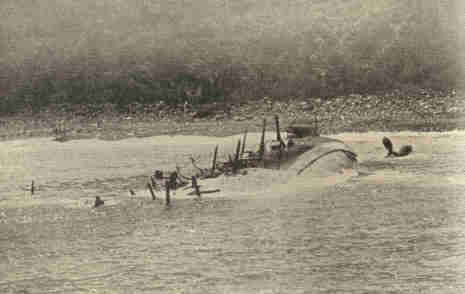
From a Photograph by F. C. Hemment. Copyright, 1898, by W. R. Hearst.
The Spanish Cruiser Christobal Colon.
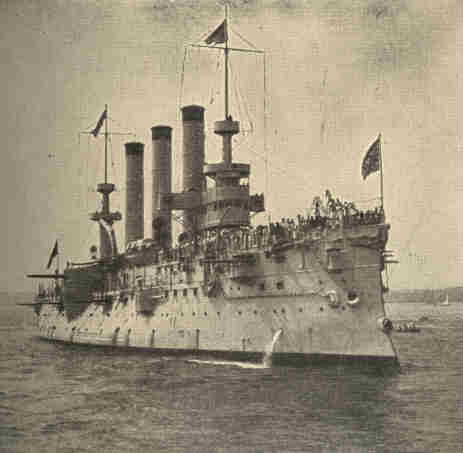
Copyright, 1898. by C C. Langill. N. Y.
The U. S. S. Brooklyn.
The Santiago surrender left the United States free to execute what
proved the last important expedition of the war, that of General Miles
to Porto Rico. It was a complete success. Miles proclaiming the
beneficent purposes of our Government, numbers of volunteers in the
Spanish army deserted, the regulars were swept back by four simultaneous
movements, and our conquest was as good as complete when the peace
protocol put an end to all hostilities.
[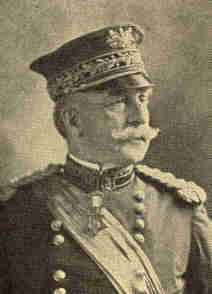
General Nelson A. Miles
Meantime an independent campaign was under way in the far Orient. At
once after war was declared Commodore George Dewey, commanding the
United States naval forces in Asiatic waters, was ordered to capture or
sink the Spanish Philippine fleet. Obliged at once to leave the neutral
port of Hong-Kong, and on April 27th to quit Mirs Bay as well, he
steamed for Manila.
A little before midnight, on April 30th, Dewey's flagship Olympia
entered the Boca Grande channel to Manila Bay, the Baltimore, Petrel,
Raleigh, Concord, and Boston following. By daybreak Cavite stood
disclosed and, ready and waiting, huddled under its batteries, Admiral
Montojo's fleet: Reina Christina, Castilla, Don Antonio de Ulloa, Don
Juan de Austria, Isla de Luzon, Isla de Cuba, General Lezo, Marquis del
Duero, El Curreo and Velasco–ten vessels to Dewey's six. Counting those
of the batteries, the Spaniards' guns outnumbered and outcalibred
Dewey's. All the Spanish guns, from ships and from batteries alike,
played on our fleet–a thunder of hostile welcome, harmless as a salute.
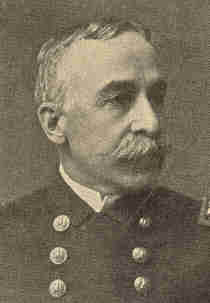
Admiral George Dewey.
The commodore delayed his fire till every shot would tell, when,
circling around in closer and closer quarters, he concentrated an
annihilating cyclone of shot and shell upon the Spanish craft. Two
torpedo boats ventured from shore. One was sunk, one beached. The Reina
Christina, the Amazon of the fleet, steamed out to duel with the
Olympia, but "overwhelmed with deadly attentions" could barely stagger
back. One hundred and fifty men were killed and ninety wounded on the
Christina alone. In a little less than two hours, having sunk the
Christina, Castilla, and Ulloa and set afire the other warships, the
American ceased firing to assure and arrange his ammunition supply and
to breakfast and rest his brave crews. He reopened at 11.16 A.M. to
finish. By half-past twelve every Spanish warship had been sunk or
burned and the forts silenced. The Spanish reported their loss at 381
killed and wounded. Seven Americans were wounded, not one killed.
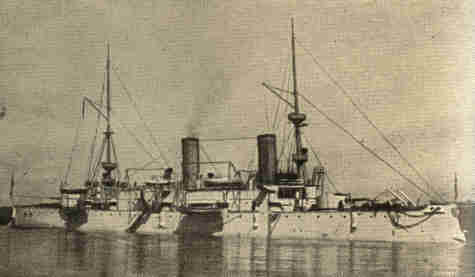
Protected Cruiser Olympia.
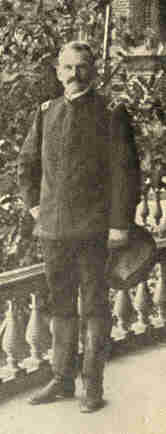
General A. R. Chaftee.
As the Filipino insurgents encircled Manila on the land side the
Spaniards could not escape, and, to spare life, Dewey deemed it best to
await the arrival of land forces before completing the reduction.
Waiting tried the admiral's discretion more than the battle had his
valor. It was necessary to encourage the insurgents, at the same time to
prevent excesses on their part, and to avoid recognizing them even as
allies in such manner as to involve our Government. Another
embarrassment, threatening for a time, was the German admiral's
impertinence. One of his warships was about to steam into harbor
contrary to Dewey's instructions, but was halted by a shot across her
bows. Dewey's firmness in this affair was exemplary.
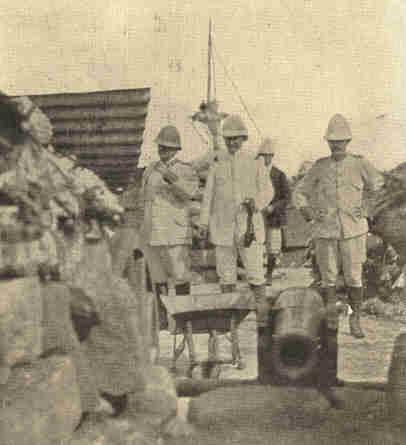
General Merritt and General Greene taking a
look at a Spanish field-gun on the Malate Fort.
On June 30th the advance portion of General Merritt's troops arrived and
supplanted the insurgents in beleaguering Manila. The war was now
closing. Manila capitulated August 13th. The peace protocol was signed
August 12th. The Treaty of Paris was signed December 10th. Spain
evacuated Cuba and ceded to the United States Porto Rico, at the same
time selling us the Philippine Archipelago for $20,000,000.