
[1897-1899]
The Nestor of the original McKinley Cabinet was John Sherman, who left
his Senate seat to the swiftly rising Hanna that he himself might devote
his eminent but failing powers to the Secretaryship of State. Upon the
outbreak of the Spanish War he was succeeded by William R. Day, who had
been Assistant Secretary. In 1898 Day in turn resigned, when Ambassador
John Hay was called to the place from the Court of St. James. The
Treasury went to Lyman J. Gage, a distinguished Illinois banker. Mr.
Gage was a Democrat, and this appointment was doubtless meant as a
recognition of the Gold Democracy's aid in the campaign. General Russell
A. Alger, of Michigan, took charge of the War Department, holding it
till July 19, 1899, after which Elihu Root was installed.
Postmaster-General James A. Gary, of Maryland, resigned the same month
with Sherman, giving place to Charles Emory Smith, of the Philadelphia
Press. The Navy portfolio fell to John D. Long, of Massachusetts; that
of the Interior to Cornelius N. Bliss, of New York; that of Agriculture
to James Wilson, of Iowa. In December, 1898, Ethan Allen Hitchcock, of
Missouri, succeeded Bliss.
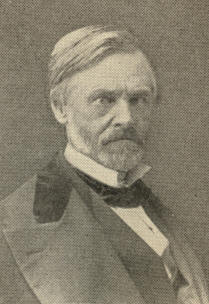
John Sherman.
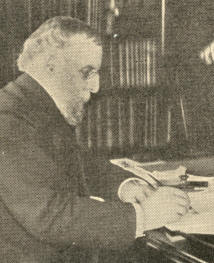
Lyman J. Gage, Secretary of the Treasury.
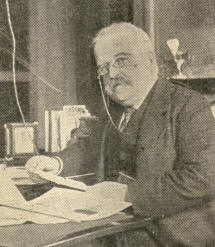
John D. Long, Secretary of the Navy.
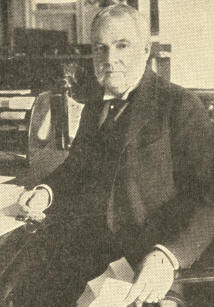
Cornelius N. Bliss,
Secretary of the Interior.
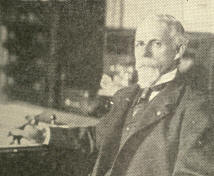
Russell A. Alger,
Secretary of War.
Fortunately for the new Chief Magistrate, who had been announced as the
"advance agent of prosperity," the year 1897 brought a revival of
business. This was due in part to the end, at least for the time, of
political suspense and agitation, in part to the confidence which
capitalists felt in the new Administration.
The money stringency, too, now began to abate. The annual output of the
world's gold mines, which had for some years been increasing, appeared
to have terminated the fall of general prices, prevalent almost
incessantly since 1873. Moreover, continued increase seemed assured, not
only by the invention of new processes, which made it lucrative to work
tailings and worn-out mines, but also by the discovery of several rich
auriferous tracts hitherto unknown.
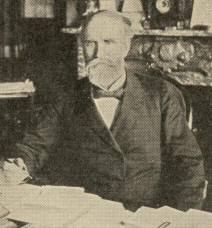
James Wilson,
Secretary of Agriculture.
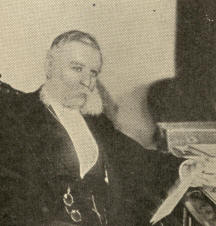
Postmaster-General Gary.
From a copyrighted photo by Clinedinst.
The valley of the Yukon, in Alaska and the adjacent British territory,
had long been known to contain gold, but none suspected there a bonanza
like the South African Rand. In the six months' night of 1896-1897 an
old squaw-man made an unprecedented strike upon the Klondike
(Thron-Duick or Tondak) River, 2,000 miles up the Yukon. By spring all
his neighbors had staked rich claims. Next July $2,000,000 worth of gold
came south by one shipment, precipitating a rush to the inhospitable
mining regions hardly second to the California migration of 1849.
Latter-day Argonauts, not dismayed by the untold dangers and hardships
in store, toiled up the Yukon, or, swarming over the precipitous
Chilcoot Pass, braved, too often at cost of life, the boiling rapids to
be passed in descending the Upper Yukon to the gold fields. Later the
easier and well-wooded White Pass was found, traversed, at length, by a
railroad. In October, 1898, the Cape Nome coast, north of the Yukon
mouth, uncovered its riches, whereupon treasure-seekers turned thither
their attention, even from the Yukon.
Little lawlessness pestered the gold settlements. The Dominion promptly
despatched to Dawson a body of her famous mounted police. Our
Government, more tardily, made its authority felt from St. Michaels,
near the Yukon mouth, all the way to the Canadian border. On June 6,
1900, Alaska was constituted a civil and judicial district, with a
governor, whose functions were those of a territorial governor. When
necessary the miners themselves formed tribunals and meted out a
rough-and-ready justice.
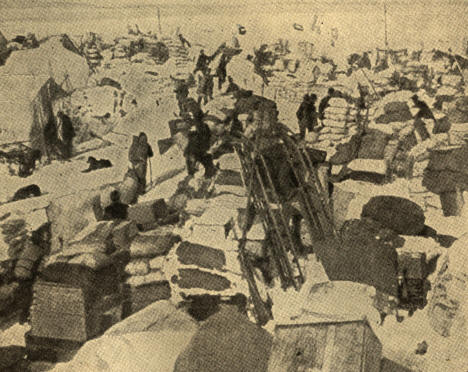
Rush of Miners to the Yukon.
The City of Caches at the Summit of Chilcoot Pass.
The rush of miners to the middle Yukon gold region, which, together with
certain ports and waters on the way thither, were claimed by both the
United States and Great Britain, made acute the question of the true
boundary between Alaskan and British territory.
In 1825 Great Britain and Russia, the latter then owning Alaska, agreed
by treaty to separate their respective possessions by a line commencing
at the southernmost point of Prince of Wales Island and running along
Portland Channel to the continental coast at 56 degrees north latitude.
North of that degree the boundary was to run along mountain summits
parallel to the coast until it intersected the 141st meridian west
longitude, which was then to be followed to the frozen ocean. In case
any of the summits mentioned should be more than ten marine leagues from
the ocean, the line was to parallel the coast, and be never more than
ten marine leagues therefrom.
When it became important to determine and mark the boundary in a more
exact manner, Great Britain advanced two new claims; first, that the
"Portland Channel" mentioned in the Russo-British treaty was not the
channel now known by that name, but rather Behm Channel, next west, or
Clarence Straits; and, secondly, that the ten-league limit should be
measured from the outer rim of the archipelago skirting Alaska, and not
from the mainland coast. If conceded, these claims would add to the
Canadian Dominion about 29,000 square miles, including 100 miles of
sea-coast, with harbors like Lynn Channel and Tahko Inlet, several
islands, vast mining, fishery, and timber resources, as well as Juneau
City, Revilla, and Fort Tongass, theretofore undisputably American.
In September, 1898, a joint high commission sat at Quebec and canvassed
all moot matters between the two countries, among them that of the
Alaska boundary. It adjourned, however, without settling the question,
though a temporary and provisional understanding was reached and signed
October 20, 1899.
The commissioners gave earnest attention to the sealing question, which
had been plaguing the United States ever since the Paris arbitration
tribunal upset Secretary Blaine's contention that Bering Sea was mare
clausum. Upon that tribunal's decision the modus vivendi touching seals
lapsed, and Canadians, with renewed and ruthless zeal, plied
seal-killing upon the high seas. Dr. David S. Jordan, American delegate
to the 1896-1897 Conference of Fur-Seal Experts, estimated that the
American seal herd had shrunken 15 per cent. in 1896, and that a full
third of that year's pups, orphaned by pelagic sealing, had starved.
Reckoning from the beginning of the industry and in round numbers, he
estimated that 400,000 breeding females had been slaughtered, that
300,000 pups had perished for want of nourishment, and that 400,000
unborn pups had died with their dams. This estimate disregarded the
multitude of females lost after being speared or shot. Dr. Jordan
predicted the not distant extinction of the fur-seal trade unless
protective measures should be forthwith devised. British experts
questioned some of his conclusions, but admitted the need of restriction
upon pelagic sealing.
The McKinley Administration besought Great Britain for a suspension of
seal-killing during 1897. After a delay of four months the Foreign
Office replied that it was too late to stop the sealers that year. In a
rather undiplomatic note, dated May 10, 1897, Secretary Sherman charged
dilatory and evasive conduct upon this question. The retort was that the
American Government was seeking to embarrass British subjects in
pursuing lawful vocations.
Moved by Canada, Great Britain recanted her offer to join the United
States, Russia, and Japan in a complete system of sealing regulations.
The three countries last named thereupon agreed with each other to
suspend pelagic sealing so long as expert opinion declared it necessary
to the continued existence of the seals. The Canadians declined to
consider suspension save on the condition that the owners of sealing
vessels should receive compensation. In December, the same year (1897),
our Government ordered confiscated and destroyed all sealskins brought
to our ports not accompanied with invoices signed by the United States
Consul at the place of exportation, certifying that they were not taken
at sea. This cut off the Canadians' best market and so far diminished
their activity; but pelagic sealing still continued, under the
inefficient Paris regulations, and the herd went on diminishing.
That these Canadian controversies left so little sting, but were
followed by closer and closer rapprochement between the United States
and Great Britain, was fortunate in view of the failure of the
Anglo-American Arbitration Treaty. This had been negotiated by Mr.
Cleveland's able Secretary of State, Hon. Richard Olney, and represented
the best ethical thought of both nations. President McKinley endorsed
it, but it fell short of a two-thirds Senatorial vote.
On June 16, 1897, a treaty was signed annexing the Hawaiian Republic to
the United States. The Government of Hawaii speedily ratified this, but
it encountered in the United States Senate such buffets that after a
year it was withdrawn, and a resolution to the same end introduced in
both Houses. A majority in each chamber would annex, while the treaty
method would require a two-thirds vote in the Senate. The resolution
provided for the assumption by the United States of the Hawaiian debt up
to $4,000,000. Our Chinese Exclusion Law was extended to the islands,
and Chinese immigration thence to the continental republic prohibited.
The joint resolution passed July 6, 1898, a majority of the Democrats
and several Republicans, among these Speaker Reed, opposing. Shelby M.
Cullom, John T. Morgan, Robert R. Hitt, Sanford B. Dole, and Walter F.
Frear, made commissioners by its authority, drafted a territorial form
of government, which became law April 30, 1900.
Pursuant to the platform pledge of his party President McKinley early in
his term appointed Edward O. Wolcott, Adlai E. Stevenson, and Charles J.
Paine special envoys to the Powers in the interest of international
bi-metallism. The mission was mentioned with smiles by gold men and with
sneers by silver men, yet the cordial cooperation of France made it for
a time seem hopeful. The British Cabinet, too, were not ill-disposed,
pointing out that while Great Britain herself must retain the gold
standard, they earnestly wished a stable ratio between silver and gold
on British India's account. Sir Michael Hicks-Beach, Chancellor of the
Exchequer, had little doubt that if a solid international agreement
could be reached India would reopen her mints to silver. But the Indian
Council unanimously declined to do this. The Bank of England was at
first disposed to accept silver as part of its reserve, a course which
the law permitted; but a storm of protests from the "city banks"
dismayed the directors into withdrawal. Lacking England's cooperation
the mission, like its numerous predecessors, came to naught.
In Civil Service administration Mr. McKinley took one long and
unfortunate step backward. The Republican platform, adopted after Mr.
Cleveland's extension of the merit system, emphatically endorsed this,
as did Mr. McKinley himself. Against extreme pressure, particularly in
the War Department, the President bravely stood out till May 29, 1899.
His order of that date withdrew from the classified service 4,000 or
more positions, removed 3,500 from the class theretofore filled through
competitive examination or an orderly practice of promotion, and placed
6,416 more under a system drafted by the Secretary of War. The order
declared regular a large number of temporary appointments made without
examination, besides rendering eligible, as emergency appointees,
without examination, thousands who had served during the Spanish War.
Republicans pointed to the deficit under the Wilson Law with much the
same concern manifested by President Cleveland in 1888 over the surplus.
A new tariff law must be passed, and, if possible, before a new
Congressional election. An extra session of Congress was therefore
summoned for March 15, 1897. The Ways and Means Committee, which had
been at work for three months, forthwith reported through Chairman
Nelson Dingley the bill which bore his name. With equal promptness the
Committee on Rules brought in a rule, at once adopted by the House,
whereby the new bill, spite of Democratic pleas for time to examine,
discuss, and propose amendments, reached the Senate the last day of
March. More deliberation marked procedure in the Senate. This body
passed the bill after toning up its schedules with some 870 amendments,
most of which pleased the Conference Committee and became law. The Act
was signed by the President July 24, 1897.
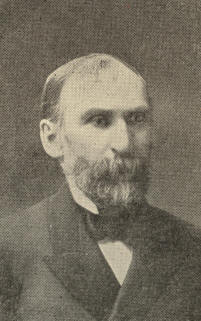
Nelson Dingley.
The Dingley Act was estimated by its author to advance the average rate
from the 40 per cent. of the Wilson Bill to approximately 50 per cent.,
or a shade higher than the McKinley rate. As proportioned to consumption
the tax imposed by it was probably heavier than that under either of its
predecessors.
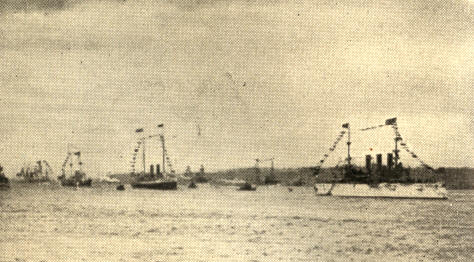
Warships in the Hudson River Celebrating
the Dedication of Grant's Tomb, April 27, 1897.
Reciprocity, a feature of the McKinley Tariff Act, was suspended by the
Wilson Act. The Republican platform of 1896 declared protection and
reciprocity twin measures of Republican policy. Clauses graced the
Dingley Act allowing reciprocity treaties to be made, "duly ratified" by
the Senate and "approved" by Congress; yet, of the twins, protection
proved stout and lusty, while the weaker sister languished. Under the
third section of the Act some concessions were given and received, but
the treaties negotiated under the fourth section, which involved
lowering of strictly protective duties, met summary defeat when
submitted to the Senate.
Grant's Tomb, Riverside Drive, New York.
Copyright, 1901, by Detroit Photographic Co.
The granite mausoleum in Riverside Park, New York City, designed to
receive the remains of General Grant, was completed in 1897, and upon
the 27th of April, that year, formally presented to the city. Ten days
previously the body had been removed thither from the brick tomb where
it had reposed since August 8, 1885. Four massive granite piers, with
rows of Doric columns between, supported the roof and the obtuse cone of
the cupola, which rested upon a great circle of Ionic pillars. The
interior was cruciform. In the centre was the crypt, where, upon a
square platform, rested the red porphyry sarcophagus. From the mausoleum
summit, 150 feet above, the eye swept the Hudson for miles up and down.
The presentation day procession was headed by the presidential party.
The Governor of New York State, the Mayor of the city, and the United
States diplomatic corps were prominent. Other distinguished guests
attended, including Union and Confederate Veterans. The entire
procession reached six miles. There were 53,500 participants, military
and civil, and 160 bands of music. At the same time, in majestic column
upon the Hudson, Great Britain, France, Italy, and Spain joined, with
men-of-war, our North Atlantic squadron, saluting the President as he
passed.
The exercises at the tomb were simple. Bishop Newman offered prayer.
"America" was sung. President McKinley delivered an address of eulogy.
General Horace Porter gave the mausoleum into the city's keeping, a
trust which Mayor Strong in a few words accepted.