
[1890-1896]
Early in 1896 it became clear that the dominant issue of the
presidential campaign would be the resumption by the United States of
silver-dollar free coinage. Agitation for this, hushed only for a moment
by the passage of the Bland Act, had been going on ever since
demonetization in 1873. The fall in prices, which the new output of gold
had not yet begun to arrest; the money stringency since 1893; the
insecure, bond-supplied gold reserve, and the repeal of the
silver-purchase clause in the Sherman Act combined to produce a wish for
increase in the nation's hard-money supply. Had the climax of fervor
synchronized with an election day, a free-coinage President might have
been elected.
Only the Populists were a unit in favoring free coinage. Recent
Republican and Democratic platforms had been phrased with Delphic genius
to suit the East and West at once. The best known statesmen of both
parties had "wobbled" upon the question. The Republican party contained
a large element favorable to silver, while the Democratic President, at
least, had boldly and steadfastly exerted himself to establish the gold
standard.
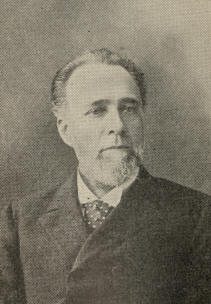
Senator Teller of Colorado.
Realignment of forces begot queer alliances between party foes, lasting
bitterness between party fellows. Even the Prohibitionists, who held the
first convention, were riven into "narrow-gauge" and "broad-gauge," the
latter in a rump convention incorporating a free-coinage plank into
their creed. If the Republicans kept their ranks closed better than the
Democrats, this was largely due to the prominence they gave to
protection, attacked by the Wilson-Gorman Act.
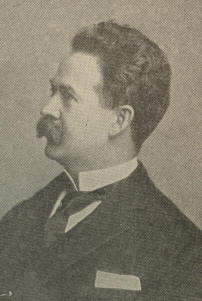
Senator Cannon.
Their convention sat at St. Louis, June 16th. It was an eminently
business-like body, even its enthusiasm and applause wearing the air of
discipline. In making the platform, powerful efforts for a
catch-as-catch-could declaration upon the silver question succumbed to
New England's and New York's demand for an unequivocal statement. The
party "opposed the free coinage of silver except by international
agreement with the leading commercial nations of the world." . . .
"Until such agreement can be obtained, the existing gold standard must
be preserved." Senator Teller, of Colorado, moved a substitute favoring
"the free, unrestricted, and independent coinage of gold and silver at
our mints at the ratio of 16 parts of silver to 1 of gold." It was at
once tabled by a vote of 818-1/2 to 105-1/2. The rest of the platform
having been adopted, Senator Cannon, of Utah, read a protest against the
money plank, which recited the evils of falling prices as discouraging
industry and threatening perpetual servitude of American producers to
consumers in creditor nations.
Then occurred a dramatic scene, the first important bolt from a
Republican convention since 1872. "Accepting the present fiat of the
convention as the present purpose of the party," Teller shook hands with
the chairman, and, tears streaming down his face, left the convention,
accompanied by Cannon and twenty other delegates, among them two entire
State delegations. Senators Mantle, of Montana, and Brown, of Utah,
though remaining, protested against the convention's financial
utterance.
The Republican platform lauded protection and reciprocity, favored
annexing the Hawaiian Islands, and the building, ownership, and
operation of the Nicaragua Canal by the United States. It reasserted the
Monroe Doctrine "in its full extent," expressed sympathy for Cuban
patriots, and bespoke United States influence and good offices to give
Cuba peace and independence.
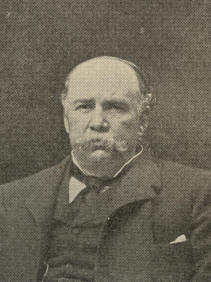
Garret A. Hobart, Vice-President.
Copyright,1899, by Pack Bros., N. Y.
The first ballot, by a majority of over two-thirds, nominated for the
presidency William McKinley, Jr., of Ohio, the nomination being at once
made unanimous. Garret A. Hobart, of New Jersey, was nominated for
Vice-President.
William McKinley, Jr., was born at Niles, Ohio, January 29, 1843, of
Scotch-Irish stock. In 1860 he entered Allegheny College, Meadville,
Pa., but ill health compelled him to leave. He taught school. For a time
he was a postal clerk at Poland, Ohio. At the outbreak of the Civil War
he enlisted as a private in Company E, 23d Ohio Infantry, the regiment
with which William S. Rosecrans, Rutherford B. Hayes, and Stanley
Matthews were connected. Successive promotions attended his gallant and
exemplary services. He shared every engagement in which his regiment
took part, was never absent on sick leave, and had only one short
furlough. A month before the assassination of President Lincoln McKinley
was commissioned a major by brevet.
After the war Major McKinley studied law. He was admitted to the bar in
1867, settling in Canton, Ohio. In 1876 he made his debut in Congress,
where he served with credit till 1890, when, owing partly to a
gerrymander and partly to the unpopular McKinley Bill, he was defeated
by the narrow margin of 300 votes. As Governor of Ohio and as a public
speaker visiting every part of the country, McKinley was more and more
frequently mentioned in connection with the presidency.
The nomination was a happy one. No other could have done so much to
unite the party. Not only had Mr. McKinley's political career been
honorable, he had the genius of manly affability, drawing people to him
instead of antagonizing them. Republicans who could not support the
platform, in numbers gave fealty to the candidate as a true man, devoted
to their protective tenets, and a "friend of silver."
The Democratic convention sat at Chicago July 7th to 10th. Though
Administration and Eastern Democratic leaders had long been working to
stem free coinage sentiment, this seemed rather to increase. By July
1st, in thirty-three of the fifty States and Territories, Democratic
platforms had declared for free coinage. The first test of strength in
the convention overruled the National Committee's choice of David B.
Hill for temporary chairman, electing Senator Daniel, of Virginia, by
nearly a two-thirds vote. The silver side was then added to by unseating
and seating.
Hot fights took place over planks which the minority thought unjust to
the Administration or revolutionary. The income-tax plank drew the
heaviest fire, but was nailed to the platform in spite of this. It
attacked the Supreme Court for reversing precedents in order to declare
that tax unconstitutional, and suggested the possibility of another
reversal by the same court "as it may hereafter be constituted."
The platform assailed "government by injunction as a new and highly
dangerous form of oppression, by which federal judges in contempt of the
laws of the States and the rights of citizens become at once
legislators, judges, and executioners."
Attention having been called to the demonetization of silver in 1873 and
to the consequent fall of prices and the growing onerousness of debts
and fixed charges, gold monometallism was indicted as the cause "which
had locked fast the prosperity of an industrial people in the paralysis
of hard times" and brought the United States into financial servitude to
London. Demand was therefore made for "the free and unlimited coinage of
silver at the present legal ratio of 16 to 1 without waiting for the aid
or consent of any other nation." Practically the entire management of
the Treasury under Mr. Cleveland was condemned.
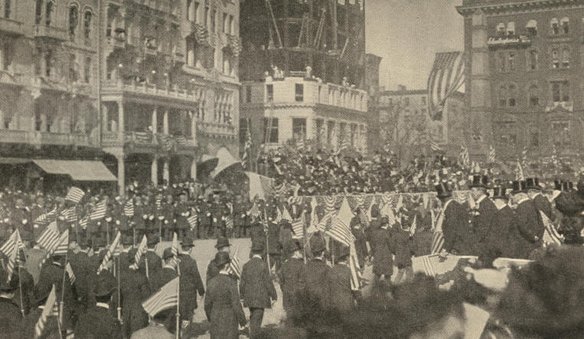
The McKinley-Hobart Parade Passing the Reviewing Stand,
New York, October 31, 1896.
The platform being read, Hill, of New York, Vilas, of Wisconsin, and
ex-Governor Russell, of Massachusetts, spoke. William J. Bryan, of
Nebraska, was called upon to reply. In doing so he made the memorable
"cross of gold" speech, which more than aught else determined his
nomination. In a musical but penetrating voice, that chained the
attention of all listeners, he sketched the growth of the free-silver
belief and prophesied its triumph. While, shortly before, the Democratic
cause was desperate, now McKinley, famed for his resemblance to
Napoleon, and nominated on the anniversary of Waterloo, seemed already
to hear the waves lashing the lonely shores of St. Helena. The gold
standard, he said, not any "threat" of silver, disturbed business. The
wage-worker, the farmer, and the miner were as truly business men as
"the few financial magnates who in a dark room corner the money of the
world." "We answer the demand for the gold standard by saying, 'You
shall not press down upon the brow of labor this crown of thorns. You
shall not crucify mankind upon a cross of gold!'"
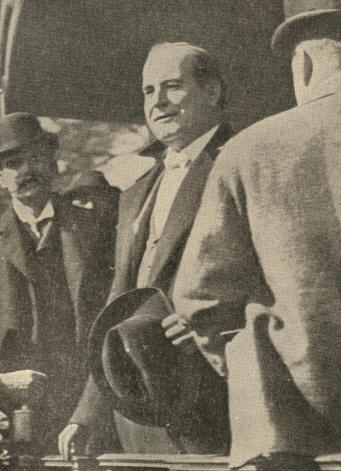
Bryan Speaking from the Rear End of a Train.
Sixteen members of the Resolutions Committee presented a minority report
criticising majority declarations. As a substitute for the silver plank
they offered a declaration similar to that of the Republican convention.
In a further plank they commended the Administration. The substitute
money plank was lost 301 to 628, and the resolution of endorsement 357
to 564. No delegates withdrew, but a more formidable bolt than shook the
Republican convention here expressed itself silently. In the subsequent
proceedings 162 delegates, including all of New York's 72, 45 of New
England's 77, 18 of New Jersey's 20, and 19 of Wisconsin's 24 took no
part whatever.
Before Bryan spoke, a majority of the silver delegates probably favored
Hon. Richard P. Bland, of Missouri, father of the Bland Act, as the
presidential candidate, but the first balloting showed a change. Upon
the fifth ballot Bryan received 500 votes, a number which changes before
the result was announced increased to the required two-thirds. Arthur
Sewall, of Maine, was the nominee for Vice-President.
Mr. Bryan, then barely thirty-six, was the youngest man ever nominated
for the presidency. He was born in Salem, Ill., March 19, 1860. His
father was a man of note, having served eight years in the Illinois
Senate, and afterwards upon the circuit bench. Young Bryan passed his
youth on his father's farm, near Salem, and at Illinois College,
Jacksonville, where he graduated in 1881 with oratorical honors. Having
read law in Chicago, and in 1887 been admitted to the bar, he removed to
Lincoln, Neb., and began practising law.
Mr. Bryan was inclined to politics, and his singular power on the
platform drew attention to him as an available candidate. In 1890 he was
elected to Congress as a Democrat. He served two terms, declining a
third nomination. In 1894 he became editor of the Omaha World-Herald,
but later resumed the practice of law.
In Nebraska, as in some other Western States, Republicans so outnumbered
Democrats that Populist aid was indispensable in any State or
congressional contest. In 1892 it had been eagerly courted on
Cleveland's behalf. Bryan had helped in consummating fusion between
Populism and Democracy in Nebraska. This occasioned the unjust charge
that he was no Democrat. The allegation gained credence when the
Populist national convention at St. Louis placed him at the head of its
ticket, refusing at the same time to accept Sewall, choosing instead a
typical Southern Populist, Thomas Watson, of Georgia.
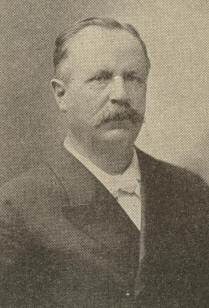
Arthur Sewall.
To Southern Populists Democrats were more execrable than Republicans.
Westerners of that faith were jealous of Sewall as an Eastern man and
rich. Too close union with Democracy threatened Populism with
extinction. Rightly divining that their leaders wished such a "merger,"
the Populist rank and file insisted on nominating their candidate for
the vice-presidency first. Bryan was made head of the ticket next day.
The silver Republicans acclaimed the whole Democratic ticket, Sewall as
well as Bryan.
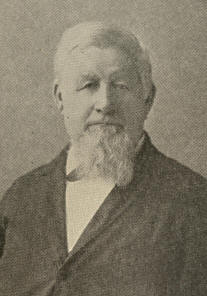
Ex-Senator Palmer.
The Democratic opponents of the "Chicago Democracy" determined to place
in the field a "National" or "Gold" Democratic ticket. A convention for
this purpose met in Indianapolis, September 3d. The Indianapolis
Democrats lauded the gold standard and a non-governmental currency as
historic Democratic doctrines, endorsed the Administration, and assailed
the Chicago income-tax plank. Ex-Senator Palmer, of Illinois, and Simon
E. Buckner, of Kentucky, were nominated to run upon this platform, Gold
Democrats who could not in conscience vote for a Republican here found
their refuge.
Parties were now seriously mixed. Thousands of Western Republicans
declared for Bryan; as many or more Eastern Democrats for McKinley.
Party newspapers bolted. In Detroit the Republican Journal supported
Bryan, the Democratic Free Press came out against him. Not a few from
both sides "took to the woods"; while many, to be "regular," laid
inconvenient convictions on the table.
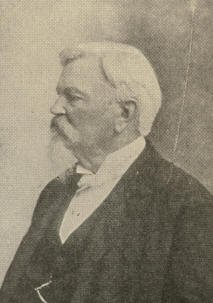
Simon E. Buckner.
The campaign was fierce beyond parallel. Neither candidate's character
could be assailed, but the motives governing many of their followers
were. Catchwords like "gold bug" and "popocrat" flew back and forth. The
question-begging phrase "sound money"–both parties professed to wish
"sound money"–did effective partisan service. Neither party's deepest
principles were much discussed. Many gold people assumed as beyond
controversy that free coinage would drive gold from the country and
wreck public credit. Advocates of silver too little heeded the
consequences which the mere fear of those evils must entail, impatiently
classing such as mentioned them among bond-servants to the money power.
So great was the fear of free silver in financial circles, corporations
voted money to the huge Republican campaign fund. The opposition could
tap no such mine. Never before had a national campaign seen the
Democratic party so abandoned by Democrats of wealth, or with so slender
a purse.
Nor was this the worst. Had Mr. Bryan been able through the campaign to
maintain the passionate eloquence of his Chicago speech, or the lucid
logic of that with which at Madison Square Garden he opened the
campaign, he would still not have succeeded in sustaining "more hard
money" ardor at its mid-summer pitch. His eloquence, indeed, in good
degree continued, but the level of his argument sank. Instead of
championing the cause of producers, whether rich or poor, against mere
money-changers, which he might have done with telling effect, he more
and more fell to the tone of one speaking simply against all the rich,
an attitude which repelled multitudes who possessed neither wealth nor
much sympathy for the wealthy.
Save for one short trip to Cleveland the Republican candidate did not,
during the campaign, leave Canton, though from his doorstep he spoke to
visiting hordes. His opponent, in the course of the most remarkable
campaigning tour ever made by a candidate, preached free coinage to
millions. The immense number of his addresses; their effectiveness,
notwithstanding the slender preparation possible for most of them
severally; the abstract nature of his subject when argued on its merits,
as it usually was by him; and the strain of his incessant journeys
evinced a power in the man which was the amazement of everyone.
Spite of all this, as election day drew near, the feeling rose that it
post-dated by at least two months all possibility of a Democratic
victory. Republicans' limitless resources, steady discipline, and
ceaseless work told day by day. They polled, of the popular vote,
7,104,244; the combined Bryan forces, 6,506,853; the Gold Democracy,
134,652; the Prohibitionists, 144,606; and the Socialists, 36,416.