
[1895]
The reader of this history is already aware how forces and events after
the Civil War gradually evolved a New South, unlike the contemporary
North, and differing still more, if possible, from ante-bellum Dixie. By
1900 this interesting situation had become quite pronounced. The picture
here given is but an enlargement of that presented earlier–few features
new, but many of them more salient, and the whole effect more
impressive.
Harmony and good feeling between the capital sections of our country
continued to manifest itself in striking ways, as by the dedication of a
Confederate monument at Chicago, the gathering of the Grand Army of the
Republic at Louisville, Ky., and the cordial fraternizing of Gray and
Blue at the consecration of the Chickamauga-Chat-tanooga Military Park,
on the spot where had occurred, perhaps, the fiercest fighting which
ever shook United States ground.
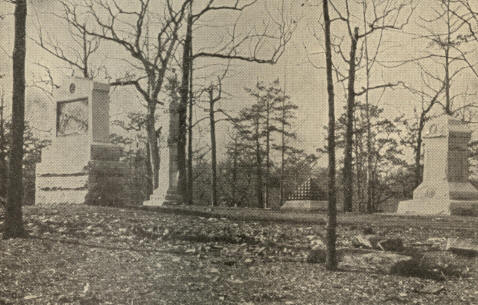
The Chickamauga National Military Park.
Group of monuments on knoll southwest of Snodgrass Hill.
The Atlanta Exposition, opening on September 18, 1895, epitomized the
Newest South. The touch of an electric button by President Cleveland's
little daughter, Marian, at his home on Buzzard's Bay, Mass., opened the
gates and set the machinery awhirl. Atlanta was a city of but 100,000,
hardly more than 60,000 of them whites, yet her Fair not only excelled
the Atlanta Exposition of 1881, that at Louisville in 1883, and the New
Orleans World's Industrial and Cotton Centennial Exposition of 1884-5,
all which were highly successful, but in many features outdid even the
Centennial at Philadelphia. The Tennessee Centennial and International
Exposition at Nashville, in 1897, was another revelation. Its total
expenditures, fully covered by receipts, were $1,087,227.85; its total
admissions 1,886,714. On J. W. Thomas Day the attendance was within a
few of 100,000. The exhibits were ample, and many of them strikingly
unique. Few, even at the South, believed that the Southern States could
set forth such displays. The fact that this was possible so soon after a
devastating war, which had left the section in abject poverty, was a
speaking compliment to the land and to the energy of those developing
it.
The progress of most Southern communities was extraordinary.
Agriculture, still too backward in methods and variety, gradually
improved, gaining marked impetus and direction from the agricultural
colleges planted in the several States by the aid of United States funds
conveyed under the "Morrill" acts. The abominable system of store credit
kept the majority of farmers, black and white, in servitude, but was
giving way, partly to regular bank credit–a great improvement–and
partly to cash transactions.
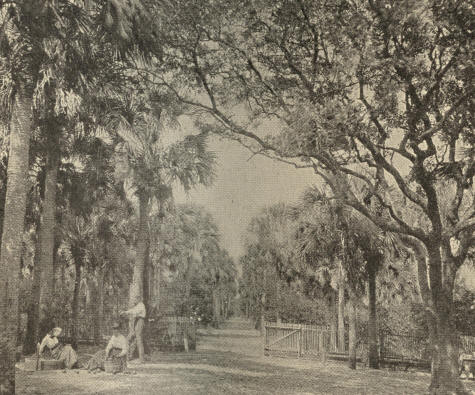
A grove of oranges and palmettoes near Ormond, Florida.
Florida came to the front as a lavish producer of tropical fruits.
Winter was rarely known there. If it paid a visit now and then the
State's sugar industry made up for the losses which frost inflicted upon
her orange crop. The rich South Carolina rice plantations bade fair to
be left behind by the new rice belt in Louisiana and Texas, a strip
averaging thirty miles in width and extending from the Mississippi to
beyond the Brazos, 400 miles. Improved methods of rice farming had
transformed this region, earlier almost a waste, into one of the most
productive areas in the country, attracting to it settlers from various
parts of the North and West, and even from Scandinavia. Dairying, fruit
and cattle-raising and market-gardening for northern markets, other new
lines of enterprise, created wealth for multitudes. King Cotton was not
dethroned to make way for these rivals, but increased his domain each
decade.
In 1880 the value of farm products at the South exceeded by more than
$200,000,000 that of the manufactured products there. In 1900 the case
was nearly reversed: manufactures outvaluing farm products by over
$190,000,000. During this decade the persons engaged in agriculture at
the South increased in number 36 per cent., but the wage-earners in
manufacturing multiplied more than four times as much, viz., 157 per
cent. Each of these rates at the South was larger than the corresponding
rate for the country. The same decade the capital which the South had
invested in manufacturing increased 348 per cent., that of the whole
United States only 252 per cent. The increase in manufactured products
value was for the South 220 per cent., for the whole country only 142
per cent. The increase in farm property value was for the South 92 per
cent., for the country only 67 per cent. The increase in farm products
value was for the South 92 per cent.; for the whole United States it was
greater, viz., 133 per cent.
Land at the South was boundlessly rich in unexploited resources. More
than half the country's standing timber grew there, much of it hard wood
and yellow pine. Quantities of phosphate rock, limestone, and gypsum
were to be dug, also salt, aluminum, mica, topaz, and gold. Especially
in Texas, petroleum sought release from vast underground reservoirs. The
farmer did not lack for rain, the manufacturer for water-power, or the
merchant for water transportation to keep down railroad rates.
The white Southerner, of purest Saxon-Norman blood, had the vigorous and
comely physique of that race. Nowhere else in the land were the
generality of white men and women so fine-looking. Easy circumstances
had enabled them to become gracious as well, with the dignified and
pleasing manners characterizing Southern society before the Civil War.
High intelligence was another racial trait. The administration of the
various Industrial Expositions named in this chapter required and
evinced business ability of the highest order. During the quarter
century succeeding reconstruction popular education developed even more
astonishingly at the South than in the North or the West. Nothing could
surpass the avidity with which young Southern men and women sought and
utilized intellectual opportunities.
With few exceptions Southerners had become intensely loyal to the
national ideal, faithfully abiding the arbitrament of the war, which
alone, to their mind–but at any rate, finally and forever–overthrew
the old doctrine that the Union was a compact among States, with liberty
to each to secede at will.
Straightforwardness and intensity of purpose marked the Southern temper.
If a county or a city voted "dry," practically all the whites aided to
see the mandate enforced. The liquor traffic was thus regulated more
stringently and prohibited more widely and effectively at the South than
in any other part of the country. Even the lynchings occurring from time
to time in some quarters, while atrocious and frowned upon by the best
people, seemed due in most cases less to disregard for the spirit of the
law than to distrust of legal methods and machinery. Indications
multiplied, moreover, that this damning blot on Southern civilization
would ere long disappear.
The most aggravating and insoluble perplexity which tormented the
Southern people lay in dealing with the colored race. Sections of the
so-called black belts still weltered in unthrift and decay, as in the
darkest reconstruction days. These belts were three in number. The
first, about a hundred miles wide, reached from Virginia and the
Carolinas through the Gulf States to the watershed of the State of
Mississippi. The second bordered the Mississippi from Tennessee to just
above New Orleans, and extended up the Red River into Arkansas and
Texas. A third region of negro preponderance covered fifteen counties of
southern Texas.
In these tracts and elsewhere white political supremacy was maintained,
as it had been regained, by the forms of law when possible; if not, then
in some other way. The wisest negro leaders dismissed, as for the
present a dream, all thought of political as of social equality between
whites and blacks. Swarms of the colored, resigned to political
impotence, were prolific of defective, pauper, and criminal population.
Education, book-education at least, did not seem to improve them; many
believed that it positively injured them, producing cunning and vanity
rather than seriousness. This was perhaps the rule, though there were
many noble exceptions. In 1892, while the proportion of vicious negroes
seemed to be increasing in cities and large towns, it was almost to a
certainty decreasing in rural districts–improvement due in good part
to enforced temperance.
A conference on the negro and the South opened at Montgomery May 8,
1900. Many able and fair-minded men participated, representing various
attitudes, parties, and sections of the country. Limitation of the
colored franchise, the proper sort of education for negroes, the evils
of "social equality" agitation, and the causes and frequency of lynching
were the main subjects discussed. The consensus of opinion seemed to be
that for "the negro, on account of his inherent mental and emotional
instability," acquirement of the franchise should be less easy than for
whites. It was maintained that the industrially trained colored men
became leaders among their people, commanding the respect of both races
and acquiring much property, yet that ex-slaves, rather than the
younger, educated set, formed the bulk of colored property-holders.
Figures revealed among the colored population a frightful increase of
illegitimacy and of flagrant crimes. It seemed that crimes against
women, almost unknown before the war but now increasing at an alarming
rate, proceeded not from ex-slaves, but from the smart new generation.
Lynching for these offences was by some excused in that negroes would
not assist in bringing colored perpetrators to justice, and in that a
spectacular mode of punishment affected negroes more deeply than the
slow process of law, even when this issued in conviction. The severer
utterances at this conference may have been more or less biased; still,
if, allowing for this, one considered the data available for forming a
judgment, one was forced to feel that calm Southerners had apprehended
the case better than Northern enthusiasts. Colored people as a class
lacked devotion to principle, also initiative and endurance, whether
mental or physical. Colored deputies, of whom there were many in various
parts of the South, so long as they acted under white chiefs, were, like
most colored soldiers, marvels of bravery, defying revolvers, bowie
knives, and wounds, and fighting to the last gasp with no sign of
flinching; but the black men who could be trusted as sheriffs-in-chief
were extremely rare.
Whether the faults named were strictly hereditary or resulted rather
from the long-continued ill education and environment of the race, none
could certainly tell. As a matter of fact, however, few even among
friendly critics longer regarded these faults as entirely eliminable. A
well qualified and wholly unbiased judge of negro character gave it as
emphatically his opinion that any autonomous community of colored
people, no matter how highly educated or civilized, would relapse into
barbarism in the course of two generations. This view was not rendered
absurd by the existence of fairly well administered municipalities here
and there with negro mayors. Many negroes were extremely bright and apt
in imitation, also in all memoriter and linguistic work. The New
Orleans Cotton Centennial and the Nashville Exposition each had its
negro department. But it was distinctive of the Atlanta Fair that one of
its buildings was entirely devoted to exhibits of negro handicraft. At
once in range and in the quality of the objects which it embraced, the
display was creditable to the race. Here and there, moreover, the race
had produced a grand character. The most notable of the opening
addresses at the Atlanta Fair was made by the colored educator, Booker
T. Washington, President of the Tuskegee Normal and Industrial Institute
for negro youth.
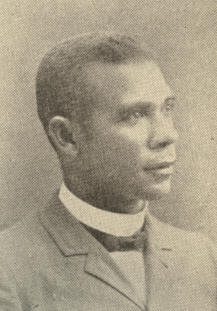
Booker T. Washington.
His oration on this occasion directed attention to Mr. Washington not
only as a remarkable negro, but as a remarkable man. Born poor as could
be and fighting his way to an education against every conceivable
obstacle, he had at the age of forty distinguished himself as a business
organizer, as an educator, as a writer, and as, a public speaker. His
modesty, discretion, and industry were phenomenal, at once constituting
him a leader of his race and rendering his leadership valuable. He
eschewed politics, avoided in everything the demagogue's ways, and never
spoke ill of the whites, not even of Southern whites.
But, unfortunately, a great negro such as Washington stood like a
mountain in a marsh, sporadic and solitary.
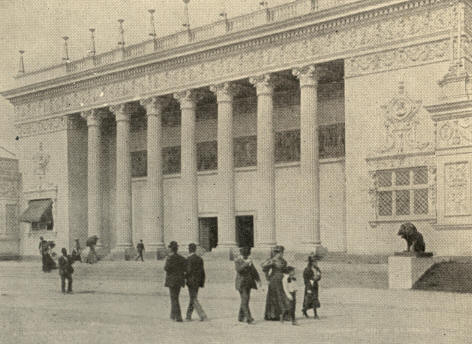
The Atlanta Exposition.
Entrance to the Art Building.
Save in West Virginia, Florida, and the black belts the whites at the
South increased more swiftly than the blacks. Certain of what Malthus
called the "positive checks" upon population–viz., diseases, mainly
syphilis, typhoid, and consumption–decimated the negroes everywhere.
Colored population drifted from the country to cities, which probably
accounted for the fact that in 1890 more negroes lived in the North than
ever before. In the South itself, on the other hand, the movement of
colored population was southward and westward, from the highlands to the
lowlands, so that Kentucky, along with western Virginia, northeastern
Mississippi, and rural parts of Maryland, North Alabama, and eastern
Virginia, had, in 1890, fewer colored inhabitants than ten years
previous.
These confusing data explain why few were rash enough to prophesy the
fate of the American negro. Such predictions as were heard, were, in the
main, little hopeful. Colonization abroad was no resource. In 1895 the
International Immigration Society shipped 300 negroes to Liberia, and in
1897 the Central Labor Union of New York 311 more, but no movement of
the kind could be set going. In fact, the one certainty touching the
American negroes' future was that they would remain in the United
States.
From 1870 to 1880 the percentage of negroes to the total population had
increased, but a century had reduced this ratio from 19.3 per cent. to
12 per cent. The climatic area where black men had any advantage over
white in the struggle for life was less than eight per cent. of the
country. White laborers competed more and more sharply. The paternal
affection of the old slave-holding generation toward negroes was not
inherited by the makers of the New South.
There was one hopeful force at work–Booker Washington at Tuskegee, in
the very heart of the Alabama black belt. His personality, his example,
his ideas were inspiring. He bade his race to expect improvement in its
condition not from any political party nor from Northern benevolence,
but from its own advance in industry and character. His great and
successful college at Tuskegee, with an enrolment of 1,231 students in
1889, gave much impetus to industrial education among the blacks,
turning in that direction educational interest and energy which had
previously found vent to too great an extent, relatively, in providing
negro students with mere literary training. The Slater-Armstrong
Memorial Trades' Building, dedicated January 10, 1890, was erected and
finished by the students practically alone. At least three-fourths of
those receiving instruction at this school pursued, after leaving, the
industries learned there.
The color line had ceased to be sectional. In 1900 mobs in New York City
and Akron, Ohio, baited black citizens with barbarity little less than
that of the worst Southern lynchings. Texas courts the same year
affirmed negroes' right to serve as jurymen. After 1900 one noticed in
several Southern States a tendency to oust negroes from official
connection even with the Republican party, each State organization
affecting to be "Lily-White." The Administration seemed to favor this
movement by appointing liberal Democrats at the South to federal
offices, allying such, in a way, with the Republican cause. This helped
make President Roosevelt popular at the South, spite of the criticism
with which the press there greeted his entertainment of Booker T.
Washington at the White House. When he visited the Exposition at
Charleston, December, 1901-May, 1902, he was enthusiastically received.