
[1887-1902]
In March, 1894, bands of the unemployed in various parts of the West,
styling themselves "Commonweal," or "Industrial Armies," started for
Washington to demand government relief for "labor." "General" Coxey, of
Ohio, led the van. "General" Kelly followed from Trans-Mississippi with
a force at one time numbering 1,250. Smaller itinerant groups joined the
above as they marched. For supplies the tattered pilgrims taxed the
sympathies or the fears of people along their routes. Most of them were
well-meaning, but their destitution prompted some small thefts. Even
violence occasionally occurred, as in California, where a town marshal
killed a Commonweal "general," and in the State of Washington, where two
deputy marshals were wounded. The Commonwealers captured a few freight
trains and forced them into service.
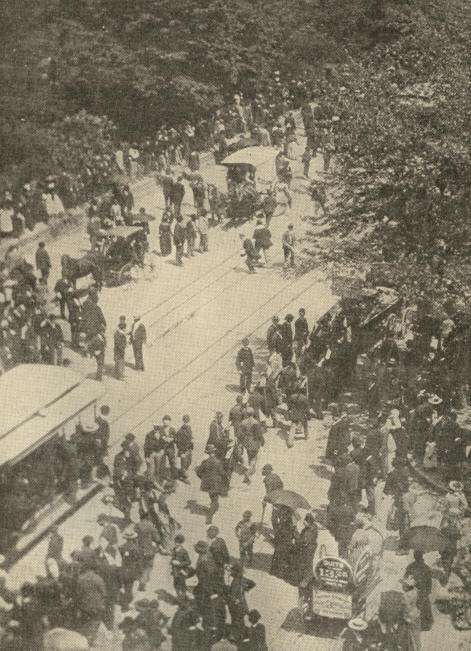
Coxey's army on the march to the Capitol steps at Washington.
Only Coxey's band reached Washington. On May Day, attempting to present
their "petition-in-boots" on the steps of the Capitol, the leaders were
jailed under local laws against treading on the grass and against
displaying banners on the Capitol Grounds. On June 10th Coxey was
released, having meantime been nominated for Congress, and in little
over a month the remnant of his forces was shipped back toward the
setting sun.
The same year, 1894, marked a far more widespread and formidable
disorder, the A. R. U. Railway Strike. The American Railway Union
claimed a membership of 100,000, and aspired to include all the 850,000
railroad workmen in North America. It had just emerged with prestige
from a successful grapple with the Great Northern Railway, settled by
arbitration.
The union's catholic ambitions led it to admit many employees of the
Pullman Palace Car Company, between whom and their employers acute
differences were arising. The company's landlordism of the town of
Pullman and petty shop abuses stirred up irritation, and when Pullman
workers were laid off or put upon short time and cut wages, the feeling
deepened. They pointed out that rents for the houses they lived in were
not reduced, that the company's dividends the preceding year had been
fat, and that the accumulation of its undivided surplus was enormous.
The company, on the other hand, was sensible of a slack demand for cars
after the brisk business done in connection with World's Fair travel.
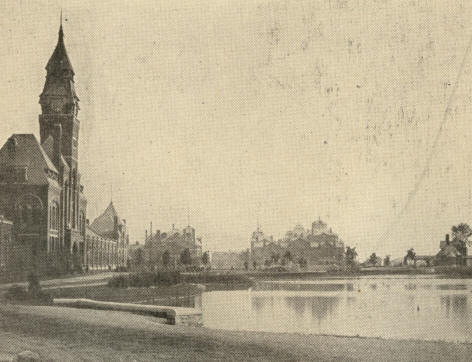
The town of Pullman.
The Pullman management refused the men's demand for the restoration of
the wages schedule of June, 1893, but promised to investigate the abuses
complained of, and engaged that no one serving on the laborer's
committee of complaint should be prejudiced thereby. Immediately after
this, however, three of the committee were laid off, and five-sixths of
the other employees, apparently against the advice of A. R. U. leaders,
determined upon a strike.
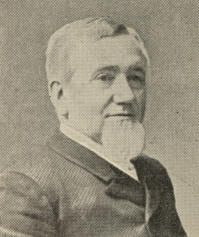
George M. Pullman.
Unmoved by solicitations from employees, from the Chicago Civic
Federation, from Mayor Pingree of Detroit, indorsed by the mayors of
over fifty other cities, the Pullman Company steadfastly refused to
arbitrate or to entertain any communication from the union. "We have
nothing to arbitrate" was the company's response to each appeal. A
national convention of the A. R. U. unanimously voted that unless the
Pullman Company sooner consented to arbitration the union should, on
June 26th, everywhere cease handling Pullman cars.
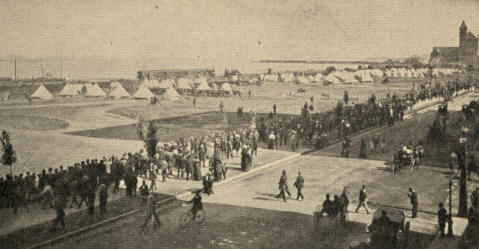
Camp of the U. S. troops on the lake front, Chicago.
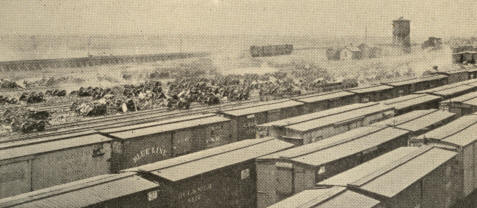
Burned cars in the C., B. & Q. yards at Hawthorne, Chicago.
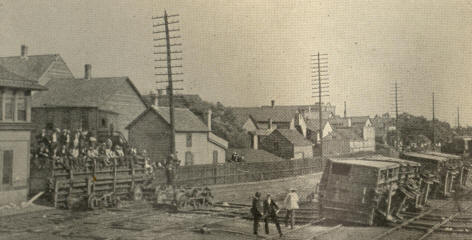
Overturned box cars at crossing of railroad tracks at 39th street, Chicago.
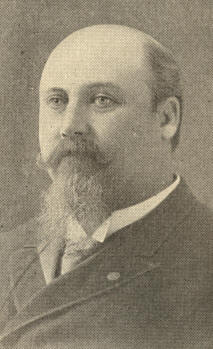
Hazen S. Pingree.
At this turn of affairs the A. R. U. found itself confronted with a new
antagonist, the Association of General Managers of the twenty-four
railroads centering in Chicago, controlling an aggregate mileage of over
40,000, a capitalization of considerably over $2,000,000,000, and a
total workingmen force of 220,000 or more. The last-named workers had
their own grievances arising from wage cuts and black-listing by the
Managers' Association. Such of them as were union men were the objects
of peculiar hostility, which they reciprocated. Thus the Pullman
boycott, sympathetic in its incipience, swiftly became a gigantic trial
of issues between the associated railroad corporations and the union.
For a week law and order were preserved. On July 2d the Federal Court in
Chicago issued an injunction forbidding A. R. U. men, among other
things, to "induce" employees to strike. Next day federal troops
appeared upon the scene. Thereupon, in contempt of the injunction,
railroad laborers continued by fair means and foul to be persuaded from
their work.
Disregarding the union leaders' appeal and defying regular soldiers,
State troops, deputy marshals, and police, rabble mobs fell to
destroying cars and tracks, burning and looting. The mobs were in large
part composed of Chicago's semi-criminal proletariat, a mass quite
distinct from the body of strikers.
The A. R. U. strike approached its climax about the 10th of July.
Chicago and the Northwest were paralyzed. President Cleveland deemed it
necessary to issue a riot proclamation. A week later Debs and his
fellow-leaders were jailed for contempt of court, and soon after their
following collapsed.
Governor Altgeld, of Illinois, protested against the presence of federal
troops, denying federal authority to send force except upon his
gubernatorial request, inasmuch as maintaining order was a purely State
province, and declaring his official ignorance of disorder warranting
federal intervention.
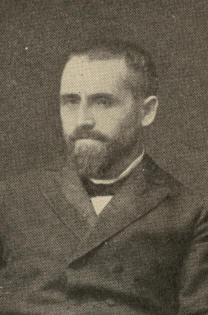
Gov. John P. Altgeld.
Mr. Cleveland answered, appealing to the Constitution, federal laws, and
the grave nature of the situation. United States power, he said, may and
must whenever necessary, with or without request from State authorities,
remove obstruction of the mails, execute process of the federal courts,
and put down conspiracies against commerce between the States.
During the Pullman troubles, the judicial department of the United
States Government, no less prompt or bold than the Executive, extended
the equity power of injunction a step farther than precedents went.
After 1887 United States tribunals construed the Interstate Commerce Law
as authorizing injunctions against abandonment of trains by engineers.
Early in 1894 a United States Circuit judge inhibited Northern Pacific
workmen from striking in a body. For contempt of his injunctions during
the Pullman strike Judge Woods sentenced Debs to six months'
imprisonment and other arch-strikers to three months each under the
so-called Anti-Trust Law.
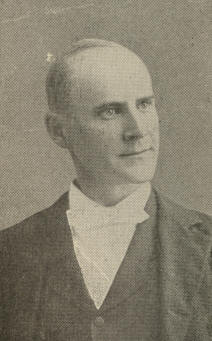
Eugene V. Debs.
As infringing the right of trial by jury this course of adjudication
aroused protest even in conservative quarters. Later, opposition to
"government by injunction" became a tenet of the more radical Democracy.
A bill providing for jury trials in instances of contempt not committed
in the presence of the court commanded support from members of both
parties in the Fifty-eighth Congress. Federal decisions upheld
workingmen's right, in the absence of an express contract, to strike at
will, although emphatically affirming the legitimacy of enjoining
violent interference with railroads, and of enforcing the injunction by
punishing for contempt.
Federal injunctions subsequently went farther still, as in the miners'
strike of 1902 during which Judge Jackson of the United States District
Court for Northern West Virginia, enjoined miners' meetings, ordering
the miners, in effect, to cease agitating or promoting the strike by any
means whatever, no matter how peaceful. Speech intended to produce
strikes the judge characterized as the abuse of free speech, properly
restrainable by courts. Refusing to heed the injunction, several strike
leaders were sentenced to jail for contempt, periods varying from sixty
to ninety days.
Late in July, 1894, the President appointed a commission to investigate
the Pullman strike. The report of this body, alluding to the Managers'
Association as a usurpation of powers not obtainable directly by the
corporations concerned, recommended governmental control over
quasi-public corporations, and even hinted at ultimate government
ownership. They counselled some measure of compulsory arbitration, urged
that labor unions should become incorporated, so as to be responsible
bodies, and suggested the licensing of railway employees. The
Massachusetts State Board of Conciliation and Arbitration was favorably
mentioned in this report, and became the model for several like boards
in various States.
The labor question and other problems excluded from public thought a
change in our dealings with our Indian wards that should not be
overlooked. Up to 1887 the Indian village communities could, under the
law, hold land only in common. Individual Indians could not, without
abandoning their tribes, become citizens of the United States. Such a
legal status could not but discourage Indians' emergence from barbarism.
A better method was hinted at in an old Act of the Massachusetts General
Court, passed so early as October, 1652.
"It is therefore ordered and enacted by this Court and the authority
thereof, that what landes any of the Indians, within this jurisdiction,
have by possession or improvement, by subdueing of the same, they have
just right thereunto accordinge to that Gen: 1: 28, Chap. 9:1, Psa: 115,
16." This old legislation further provided that any Indians who became
civilized might acquire land by allotment in the white settlements on
the same terms as the English.
In 1887, the so-called "General Allotment" or "Dawes" Act, empowered
the President to allot in severalty a quarter section to each head of an
Indian family and to each other adult Indian one eighth of a section, as
well as to provide for orphaned children and minors, the land to be held
in trust by the United States for twenty-five years. The act further
constituted any allottee or civilized Indian a citizen of the United
States, subject to the civil and criminal laws of the place of his
residence.
The Dawes Act was later so amended as to allot one-eighth of a section
or more, if the reservation were large enough, to each member of a
tribe. The amended law also regulated the descent of Indian lands, and
provided for leases thereof with the approval of the Indian Department.
This last provision was in instances twisted by white men to their
advantage and to the Indians' loss; but on the whole the new system gave
eminent satisfaction and promise.