
[1893-1895]
In the special session beginning August 7, 1893, a Democratic Congress
met under a Democratic President for the first time since 1859. The
results were disappointing. Divided, leaderless, in large part at bitter
variance with the Administration, the Democrats trooped to their
overthrow two years later.
During his second Administration Mr. Cleveland considerably extended the
merit system in the civil service. Candidates for consulships were
subjected to (non-competitive) examination. Public opinion commended
these moves, as it did the President's prompt signing of the
Anti-Lottery Bill, introduced in Congress when it was learned that the
expatriated Louisiana Lottery from its seat under Honduras jurisdiction
was operating in the United States through the express companies. The
bill prohibiting this abuse was passed at three in the morning on the
last day of the Congressional session, and received the President's
signature barely five minutes before the Congress expired.
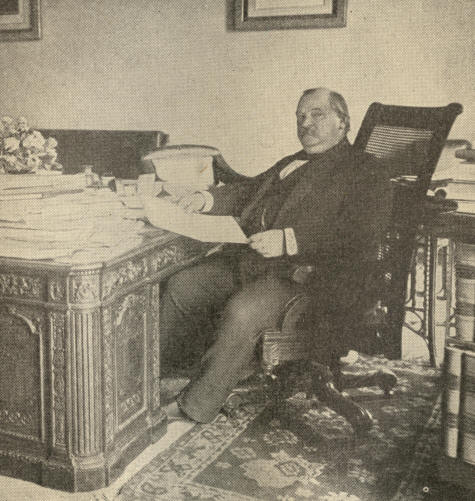
Grover Cleveland.
From a photograph by Alexander Black.
At the opening of the Special Session, in August, 1893, the President
demanded the repeal of that clause in the Sherman law of 1890 requiring
the Government to make heavy monthly purchases of silver. The suspension
in India of the free coinage of silver the preceding June had
precipitated a disastrous monetary panic in the United States. Gold was
hoarded and exported, vast sums being drained from the Treasury. Credits
were refused, values shrivelled, business was palsied, labor idle. It
was this situation which led the President to convoke Congress in
special session.
Though achieving the repeal on November 1st, after Congressional
wrangles especially long and bitter in the Senate, President Cleveland,
pursuing the policy of paying gold for all greenbacks presented at the
Treasury, was unable, even by the sale of $50,000,000 in bonds, to keep
the Treasury gold reserve up to the $100,000,000 figure. Both old
greenbacks and Sherman law greenbacks, being redeemed in gold, reissued
and again redeemed, were used by exchangers like an endless chain pump
to pump the Treasury dry. In February, 1895, the reserve stood at the
low figure of $41,340,181. None knew when the country might be forced to
a silver basis. In consequence, business revived but slightly, if at
all, after the repeal.
In its first regular session the same Congress enacted the Wilson
Tariff. As it passed the House the bill provided for free sugar, wool,
coal, lumber, and iron ore, besides reducing duties on many other
articles.
It also taxed incomes exceeding $4,000 per annum. The Senate, except in
the case of wool and lumber, abandoned the proposal of free raw
materials, stiffened the rates named by the House, and preferred
specific to ad valorem duties. Many believed, without proof, that
improper influences had helped the Senate to shape its sugar schedule
favorably to the great refiners. The President pronounced sugar a
legitimate subject for taxation in spite of the "fear, quite likely
exaggerated," that carrying out this principle might "indirectly and
inordinately encourage a combination of sugar refining interests." In a
letter read in the House, however, he upbraided as guilty of "party
perfidy and dishonor" Democratic Senators who would abandon the
principle of free raw materials. But nothing shook the senatorial will.
What was in substance the Senate bill passed Congress, and the President
permitted it to become a law without his signature.
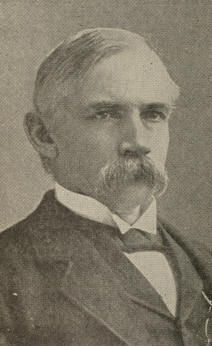
William L. Wilson.
The Wilson law pleased no one. It violated the Democrats' plighted word
apparently at the dictation of parties selfishly interested. The Supreme
Court declared its income tax unconstitutional. The revenue from it was
inadequate, and had to be eked out with new bond issues. These were
alleged to be necessary to meet the greenback debt, but this need not
have embarrassed the Government had it followed the French policy of
occasionally paying in silver a small percentage of the demand notes
presented. Borrowing gold abroad, moreover, tended to inflate prices
here, stimulating imports, discouraging exports, increasing the
exportation of gold to settle the unfavorable balance of trade, and so
on in ceaseless round.
The Democratic management of foreign affairs was severely criticised.
Our extradition treaty with Russia, a country supposed to pay little or
no regard to personal rights, and our delay in demanding reparation from
Spain for firing upon the Allianca, a United States passenger steamer,
were quite generally condemned. There were those who thought that Cuban
insurgents against the sovereignty of Spain might have received some
manifestation of sympathy from our Government, and that we should not
have permitted Great Britain to endanger the Monroe Doctrine by
occupying Corinto in Nicaragua to enforce the payment of an indemnity.
The President offended many in dealing as he did with the Hawaiian
Islands' problem. Most did not consider it the duty of this country to
champion the cause of the native dynasty there, a course likely to
subserve no enlightened interest. Whites, chiefly Americans, had come to
own most of the land in the islands, while imported Asiatics and
Portuguese competed sharply with the natives as laborers. Political
power, even, was largely exercised by the whites, through whose
influence the monarchy had been reduced to a constitutional form.
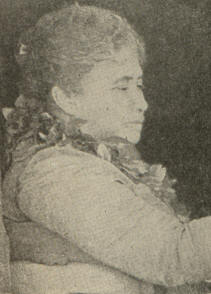
Princess (afterwards Queen) Liliuokalani.
In January, 1893, Queen Liliuokalani sought by a coup d'etat to reinvest
her royal authority with its old absoluteness and to disfranchise
non-naturalized whites. The American man-of-war Boston, lying in
Honolulu harbor, at the request of American residents, landed marines
for their protection. The American colony now initiated a counter
revolution, declaring the monarchy abrogated and a provisional
government established. Minister Stevens at once recognized the
Provisional Government as de facto sovereign. Under protest the Queen
yielded.
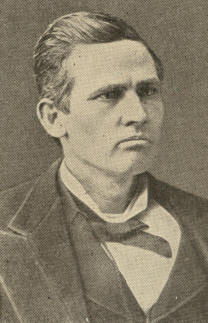
James H. Blount.
The new government formally placed itself under the protectorate of the
United States, and the Stars and Stripes were hoisted over the
Government Building. President Harrison disavowed the protectorate,
though he did not withdraw the troops from Honolulu, regarding them as
necessary to assure the lives and property of American citizens. Nor did
he lower the flag. A treaty for the annexation of the islands was soon
negotiated and submitted to the Senate.
The Cleveland Administration reversed this whole policy with a jolt. The
treaty withdrawn, Mr. Cleveland despatched to Honolulu Hon. James H.
Blount as a special commissioner, with "paramount authority," which he
exercised by formally ending the protectorate, hauling down the flag,
and embarking the garrison of marines. Mr. Blount soon superseded Mr.
Stevens as minister. Meantime the Provisional Government had organized a
force of twelve hundred soldiers, got control of the arms and ammunition
in the islands, enacted drastic sedition laws, and suppressed disloyal
newspapers.
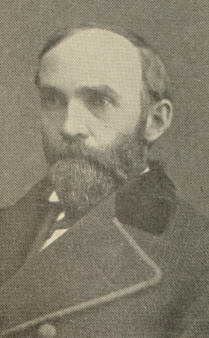
Albert S. Willis.
So complete was its sway, and so relentless did the dethroned Queen
threaten to be toward her enemies in case she recovered power, that
Minister Albert S. Willis, on succeeding Mr. Blount, lost heart in the
contemplated enterprise of restoring the monarchy. He found the
Provisional Government and its supporters men of "high character and
large commercial interests," while those of the Queen were quite out of
sympathy with American interests or with good government for the
islands. A large and influential section of Hawaiian public opinion was
unanimous for annexation, even Prince Kunniakea, the last of the royal
line, avowing himself an annexationist with heart, soul, and, if
necessary, with rifle.
A farcical attempt at insurrection was followed by the arrest of the
conspirators and of the ex-Queen, who thereupon, for herself and heirs,
forever renounced the throne, gave allegiance to the Republic,
counselled her former subjects to do likewise, and besought clemency.
Her chief confederates were sentenced to death, but this was commuted to
a heavy fine and long imprisonment. After the retirement of the
Democracy from power in 1896 the annexation of the islands was promptly
consummated.
Walter Q. Gresham, Secretary of State in the early part of Cleveland's
second term, died in May, 1895, being succeeded by Richard Olney,
transferred from the portfolio of Attorney General. In a day,
Cleveland's foreign policy, hitherto so inert, became vigorous to the
verge of rashness. Deeming the Monroe Doctrine endangered by Great
Britain's apparently arbitrary encroachments on Venezuela in fixing the
boundary between Venezuela and British Guiana, he insisted that the
boundary dispute should be settled by arbitration.
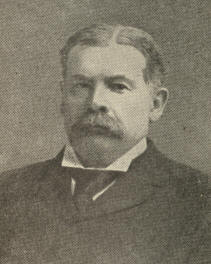
Richard Olney.
The message in which the President took this ground shook the country
like a declaration of war against Great Britain. American securities
fell, the gold reserve dwindled. The President was, however, supported.
Congress was found ready to aid the Administration by passing any
measures necessary to preserve the national credit. In December, 1895,
it unanimously authorized the appointment of a commission to decide upon
the true boundary line between Venezuela and British Guiana, with the
purpose of giving its report the full sanction and support of the United
States. The dispute was finally submitted to a distinguished tribunal at
Paris, ex-President Harrison, among others, appearing on behalf of the
Venezuelan Republic. While Great Britain's claim was, in a measure,
vindicated, this proceeding established a new and potent precedent in
support both of the Monroe Doctrine and of international arbitration.
In 1894 a ten months' session of the famous Lexow legislative committee
in New York City uncovered voluminous evidence of corrupt municipal
government there. The police force habitually levied tribute for
protection not only upon legitimate trade and industry, but upon illicit
liquor-selling, gambling, prostitution, and crime. The chief credit for
the exposures was due to Rev. Charles H. Parkhurst, President of the New
York City Society for the Prevention of Crime. A fusion of anti-Tammany
elements carried the autumn elections of 1894 for a reform ticket
nominated by a committee of seventy citizens and headed by William L.
Strong as candidate for mayor. At the next election, however, the
Tammany candidate, Van Wyck, became the first mayor of the new
municipality known as Greater New York, in which had been merged as
boroughs the metropolis itself, Brooklyn, and other near cities. As was
revealed by the Mazet Committee, little change had occurred in Tammany's
predatory spirit. In 1901, therefore, through an alliance similar to
that which elected Mayor Strong, Greater New York chose as its mayor to
succeed Van Wyck, Seth Low, who resigned the Presidency of Columbia
University to become Fusion candidate for the position.
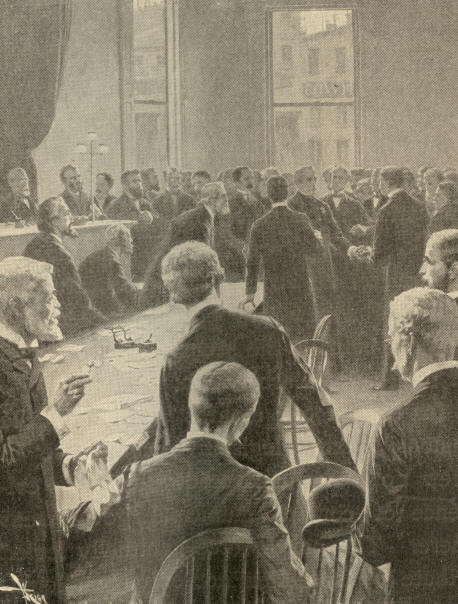
The Lexow Investigation. The scene in the Court Room after
Creeden's confession, December 15, 1894.
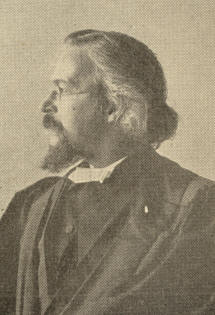
Charles H. Parkhurst.
Copyright by C. C. Langill.
A recrudescence of the old Know-Nothing spirit in a party known as the
"A. P. A.," or "American Protective Association," marked these years. So
early as 1875 politicians had noticed the existence of a secret
anti-Catholic organization, the United American Mechanics, but it had a
brief career. The A. P. A., organized soon after 1885, drew inspiration
partly from the hostility of extreme Protestants to the Roman Catholic
Church, and partly from the aversion felt by many toward the Irish. In
1894 the A. P. A., though its actual membership was never large,
pretended to control 2,000,000 votes. Its subterranean methods estranged
fair-minded people. Still more turned against it when its secret oath
was exposed. The A. P. A. member promised (1) never to favor or aid the
nomination, election, or appointment of a Roman Catholic to any
political office, and (2) never to employ a Roman Catholic in any
capacity if the services of a Protestant could be obtained. A. P. A.
public utterances garbled history and disseminated clumsy falsehoods
touching Catholics, which reacted against the order. The Association
declined as swiftly as it rose. Chiefly affiliating with the
Republicans, it received no substantial countenance from any political
party.
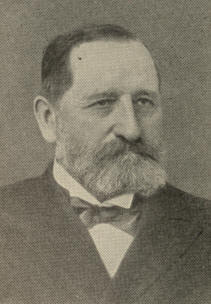
William L. Strong.