
[1890-1893]
The century from 1790 to 1890 saw our people multiplied sixteen times,
from 3,929,214 at its beginning, to 62,622,250 at its end. The low
percentage of increase for the last decade, about 20 per cent.,
disappointed even conservative estimates. The cities not only absorbed
this increase, but, except in the West, made heavy draughts upon the
country population. Of each 1,000 people in 1880, 225 were urban; in
1890, 290. Chicago's million and a tenth was second only to New York's
million and a half. Philadelphia, Brooklyn, and St. Louis appeared
respectively as the third, fourth, and fifth in the list of great
cities. St. Paul, Omaha, and Denver domiciled three or four times as
many as ten years before. Among Western States only Nevada lagged. The
State of Washington had quintupled its numbers. The centre of population
had travelled fifty miles west and nine miles north, being caught by the
census about twenty miles east of Columbus, Indiana.
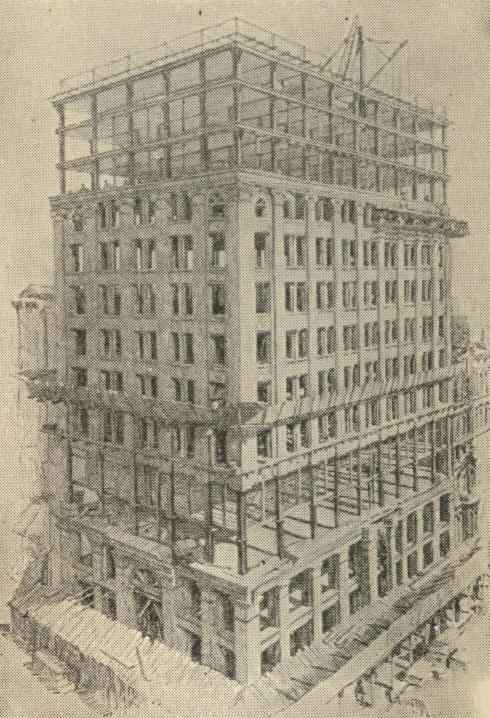
The New York Life Insurance Building in Chicago.
(Showing the construction of outer walls.)
The railroads of the country spanned an aggregate of 163,000 miles,
twice the mileage of 1880. The national wealth was appraised at
$65,037,091,197, an increase for the decade of $21,395,091,197 in the
gross. Our per capita wealth was now $1,039, a per capita increase of
$169. Production in the mining industry had gone up more than half. The
improved acreage, on the other hand, had increased less than a third,
the number of farms a little over an eighth.
School enrollment had advanced from 12 per cent. in 1840 to 23 per cent.
in 1890. Not far from a third of the people were communicants of the
various religious bodies. About a tenth were Roman Catholics.
Improvement in iron and steel manufacture revolutionized the
construction of bridges, vessels, and buildings. The suspension bridge,
instanced by the stupendous East River bridge between New York and
Brooklyn, was supplanted by the cantilever type, consisting of trusswork
beams poised upon piers and meeting each other mid-stream. Iron and
steel construction also made elevated railways possible. In 1890 the
elevated roads of New York City alone carried over 500,000 passengers
daily. Steel lent to the framework of buildings lightness, strength, and
fire-proof quality, at the same time permitting swift construction.
Walls came to serve merely as covering, not sustaining the floors, the
weight of which lay upon iron posts and girders.
At the time of the Centennial, electricity was used almost exclusively
for telegraphic communication. By 1893 new inventions, as wonderful as
Morse's own, had overlaid even that invention. A single wire now
sufficed to carry several messages at once and in different directions.
Rapidity of transmission was another miracle. During the electrical
exposition in New York City, May, 1896, Hon. Chauncey M. Depew dictated
a message which was sent round the world and back in fifty minutes. It
read:
"God creates, nature treasures, science utilizes electrical power for
the grandeur of nations and the peace of the world." These words
travelled from London to Lisbon, thence to Suez, Aden, Bombay, Madras,
Singapore, Hong-Kong, Shanghai, Nagasaki, and Tokio, returning by the
same route to New York, a total distance of over 27,500 miles.
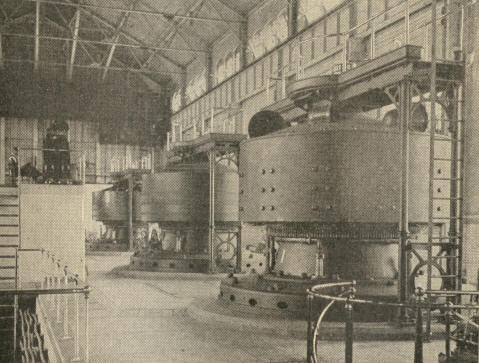
Interior of the Power House at Niagara Falls.
Self-winding and self-regulating clocks came into vogue, being
automatically adjusted through the Western Union telegraph lines, so
that at noon each day the correct time was instantly communicated to
their hands from the national observatory. Another invaluable use of the
telegraph was its service to the Weather Bureau, established in 1870. By
means of simultaneous reports from a tract of territory 3,000 miles long
by 1,500 wide, this bureau was enabled to make its forecasts
indispensable to every prudent farmer, traveller, or mariner.
The three great latter-day applications of electrical force were the
telephone, the electric light, and the electric motor. In 1876, almost
simultaneously with its discovery by other investigators, Alexander
Graham Bell exhibited an electric transmitter of the human voice. By the
addition of the Edison carbon transmitter the same year the novelty was
assured swift success. In 1893 the Bell Telephone Company owned 307,748
miles of wire, an amount increased by rival companies' property to
444,750. Estimates gave for that year nearly 14,000 "exchanges," 250,000
subscribers, and 2,000,000 daily conversations. New York and Chicago
were placed on speaking terms only three or four days before "Columbus
Day." All the chief cities were soon connected by telephone.
At the Philadelphia Exposition arc electric lamps were the latest
wonder, and not till two years later did Edison render the incandescent
lamp available.
The use of electricity for the development of power as well as of light,
unknown in the Centennial year, was in the Columbian year neither a
scientific nor a practical novelty. On the contrary, it was fast
supplanting horses upon street railways, and making city systems nuclei
for far-stretching suburban and interurban lines. Street railways
mounted steep hills inaccessible before save by the clumsy system of
cables. Even steam locomotives upon great railways gave place in some
instances to motors. Horseless carriages and pedalless bicycles were
clearly in prospect.
It was found that by the use of copper wiring electric power could be
carried great distances. A line twenty-five miles long bore from the
American River Falls, at Folsom, California, to Sacramento, a current
which the city found ample for traction, light, and power. Niagara Falls
was harnessed to colossal generators, whose product was transmitted to
neighboring cities and manufactories. Loss en route was at first
considerable, but cunning devices lessened it each year.
Thomas Alva Edison and Nikola Tesla were conspicuously identified with
these astonishing applications of electric energy. Edison, first a
newsboy, then (like Andrew Carnegie) a telegraph operator, without
school or book training in physics, rose step by step to the repute of
working miracles on notification. Tesla, a native of Servia, who
happened, upon migrating to the United States, to find employment with
Edison, was totally unlike his master. He was a highly educated
scientist, herein at a great advantage. He was, in opposition to Edison,
peculiarly the champion of high tension alternating current
distribution. He aimed to dispense so far as possible with the
generation of heat, pressing the ether waves directly into the service
of man.
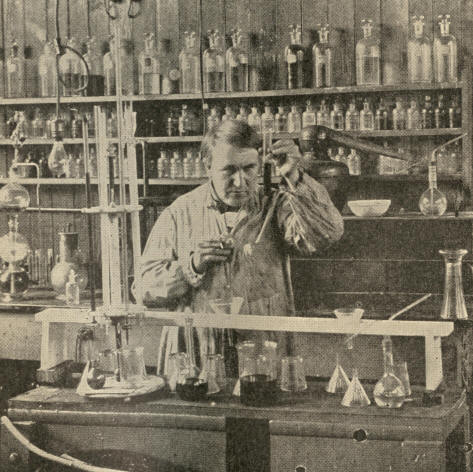
Thomas Alva Edison.
Copyright by W. A. Dickson.
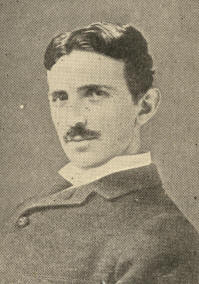
Nikola Tesla.
The bicycle developed incredible popularity in the '90's. Through all
the panic of 1893 bicycle makers prospered. It was estimated in 1896
that no less than $100,000,000 had been spent in the United States upon
cycling. A clumsy prototype of the "wheel" was known in 1868, but the
first bicycle proper, a wheel breast-high, with cranks and pedals
connected with a small trailing wheel by a curved backbone and
surmounted by a saddle, was exhibited at the Centennial. Two years later
this kind of wheel began to be manufactured in America, and soon, in
spite of its perils, or perhaps in part because of them, bicycle riding
was a favorite sport among experts. In 1889 a new type was introduced,
known as the "safety." Its two wheels were of the same size, with saddle
between them, upon a suitable frame, the pedals propelling the rear
wheel through a chain and sprocket gearing. An old invention, that of
inflated or pneumatic tires of rubber, coupled with more hygienic
saddles, gave great impetus to cycling sport. The fad dwindled, but the
bicycle remained in general use as a convenience and even as a
necessity.
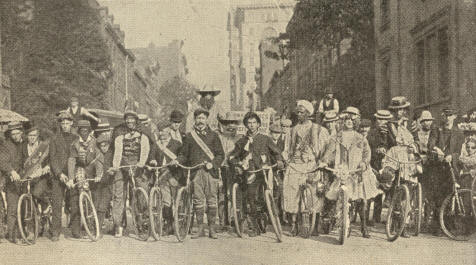
Bicycle Parade, New York.
Fancy Costume Division.
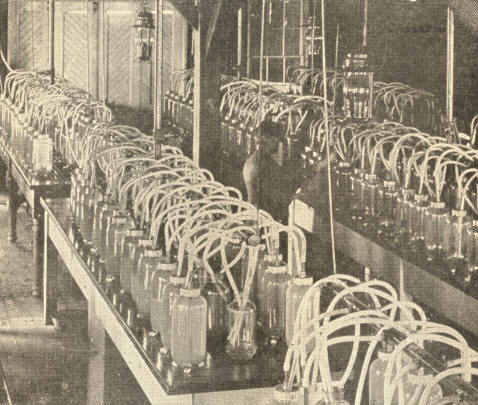
Hatchery Room of the Fish Commission Building at Washington, D. C.,
showing the hatchery jars in operation.
The Fish Commission, created by the Government in 1870, proved an
important agency in promoting the great industries of fishing and fish
culture. At the World's Fair it appeared that the fishing business had
made progress greater than many others which were much more obtrusively
displayed, though the fishtrap, the fyke net, and the fishing steamer
had all been introduced within a generation.
In no realm did invention and the application of science mean more for
the country's weal than in agriculture. Each State had its agricultural
college and experiment station, mainly supported by United States funds
provided under the Morrill Acts. Soils, crops, animal breeds, methods of
tillage, dairying, and breeding were scientifically examined. Forestry
became a great interest. Intensive agriculture spread. By early
ploughing and incessant use of cultivators keeping the surface soil a
mulch, arid tracts were rendered to a great extent independent of both
rainfall and irrigation. Improved machinery made possible the farming of
vast areas with few hands. The gig horse hoe rendered weeding work
almost a pleasure. A good reaper with binder attachment, changing horses
once, harvested twenty acres a day. The best threshers bagged from 1,000
to 2,500 bushels daily. One farmer sowed and reaped 200 acres of wheat
one season without hiring a day's work.
Woman's position at the Fair was prominent and gratifying. How her touch
lent refinement and taste was observed both in the Woman's Building, the
first of its kind, and in other departments of the Exposition. Power of
organization was noticeably exemplified in the Woman's Christian
Temperance Union. This body originated in the temperance crusade of 1873
and the following year, when a State Temperance Association was formed
in Ohio, leading shortly to the rise of a national union.
Related to this movement in elevated moral aims, as well as in the
prominent part it assigned to women, was the Salvation Army. In 1861
William Booth, an English Methodist preacher, resigned his charge and
devoted himself to the redemption of London's grossest proletariat.
Deeming themselves not wanted in the churches, his converts set up a
separate and more militant organization. In 1879 the Army invaded
America, landing at Philadelphia, where, as in the Old Country and in
other American cities, pitiable sin and wretchedness grovelled in
obscurity. In 1894 there were in the United States 539 corps and 1,953
officers, and in the whole world 3,200 corps and 10,788 officers.
Without proposing any programme of social or political reform, and
without announcing any manifesto of human rights, the Salvationists
uplifted hordes of the fallen, while drawing to the lowliest the notice,
sympathy, and help of the middle classes and the rich. Army discipline
was rigidly maintained. The soldiers were sworn to wear the uniform, to
obey their officers, to abstain from drink, tobacco, and worldly
amusements, to live in simplicity and economy, to earn their living, and
of their earnings always to give something to advance the Kingdom. The
officers could not marry or become engaged without the consent of the
Army authorities, for their spouses must be capable of cooperating with
them. They could receive no presents, not even food, except in cases of
necessity. An officer must have experienced "full salvation"–that is,
must endeavor to be living free from every known sin. Except as to pay,
the Army placed women on an absolute equality with men, a policy which
greatly furthered its usefulness.
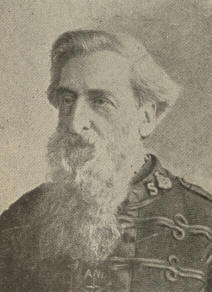
William Booth.
From a photograph by Rockwood, New York.
The peculiar uniform worn by the Salvation soldiers, always sufficing to
identify them, called attention to a fact never obvious till about
1890–the relative uniformity in the costumes of all fairly dressed
Americans whether men or women. The wide circulation of fashion plates
and pictorial papers accounted for this. About this time cuts came to be
a feature even of newspapers, a custom on which the more conservative
sheets at first frowned, though soon adopting it themselves.