
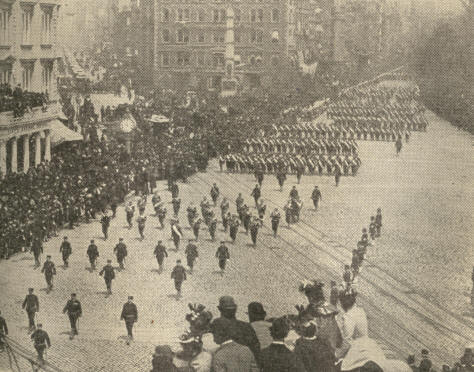
Columbian Celebration, New York, April 28, 1893.
Parade passing Fifth Avenue Hotel.
[1892-1893]
The thought of celebrating by a world's fair the third centennial of
Columbus's immortal deed anticipated the anniversary by several years.
Congress organized the exposition so early as 1890, fixing Chicago as
its seat. That city was commodious, central, typically American. A
National Commission was appointed; also an Executive Committee, a Board
of Reference and Control, a Chicago Local Board, and a Board of Lady
Managers.
The task of preparation was herculean. Jackson Park had to be changed
from a dreary lakeside swamp into a lovely city, with roads, lawns,
groves and flowers, canals, lagoons and bridges, a dozen palaces, and
ten score other edifices. An army of workmen, also fire, police,
ambulance, hospital, and miscellaneous service was organized.
Wednesday, October 21 (Old Style, October 12), 1892, was observed as
Columbus Day, marking the four hundredth anniversary of Columbus's
discovery. A reception was held in the Chicago Auditorium, followed by
dedication of the buildings and grounds at Jackson Park and an award of
medals to artists and architects. Many cities held corresponding
observances. New York chose October 12th for the anniversary. On April
26-28, 1893, again, the eastern metropolis was enlivened by grand
parades honoring Columbus. In the naval display, April 22d, thirty-five
war ships and more than 10,000 men of divers flags, took part.
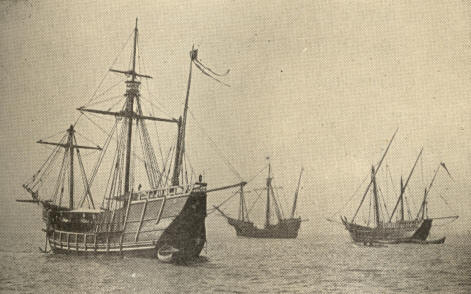
Pinta, Santa Maria, Nina,
Lying in the North River, New York.
The caravels which crossed from Spain
to be present at the World's Fair at Chicago.
Between Columbus Day and the opening of the Exposition came the
presidential election of 1892. Ex-President Cleveland had been nominated
on the first ballot, in spite of the Hill delegation sent from his home
State to oppose. Harrison, too, had overcome Platt, Hill's Republican
counterpart in New York, and in Pennsylvania had preferred John
Wanamaker to Quay. But Harrison was not "magnetic" like Blaine. With
what politicians call the "boy" element of a party, he was especially
weak. Stalwarts complained that he was ready to profit by their
services, but abandoned them under fire. The circumstances connected
with the civil service that so told against Cleveland four years before,
now hurt Harrison equally. Though no doubt sincerely favoring reform, he
had, like his predecessor, succumbed to the machine in more than one
instance.
The campaign was conducted in good humor and without personalities.
Owing to Australian voting and to a more sensitive public opinion, the
election was much purer than that of 1888. The Republicans defended
McKinley protection, boasting of it as sure, among other things, to
transfer the tin industry from Wales to America. Free sugar was also
made prominent. Some cleavage was now manifest between East and West
upon the tariff issue. In the West "reciprocity" was the Republican
slogan; in the East, "protection." Near the Atlantic, Democrats
contented themselves with advocacy of "freer raw materials "; those by
the Mississippi denounced "Republican protection" as fraud and robbery.
If the platform gave color to the charge that Democrats wished "British
free trade," Mr. Cleveland's letter of acceptance was certainly
conservative.
Populism, emphasizing State aid to industry, particularly in behalf of
the agricultural class, made great gains in the election. General Weaver
was its presidential nominee. In Colorado, Idaho, Kansas, and Wyoming
most Democrats voted for him. Partial fusion of the sort prevailed also
in North Dakota, Nevada, Minnesota, and Oregon. Weaver carried all these
States save the two last named. In Louisiana and Alabama Republicans
fused with Populists. The Tillman movement in South Carolina, nominally
Democratic, was akin to Populism, but was complicated with the color
question, and later with novel liquor legislation. It was a revolt of
the ordinary whites from the traditional dominance of the aristocracy.
In Alabama a similar movement, led by Reuben F. Kolb, was defeated, as
he thought, by vicious manipulation of votes in the Black Belt.
Of the total four hundred and forty-four electoral votes Cleveland
received two hundred and seventy-seven, a plurality of one hundred and
thirty-two. The Senate now held forty-four Democrats, thirty-seven
Republicans, and four Populists; the House two hundred and sixteen
Democrats, one hundred and twenty-five Republicans, and eleven
Populists.
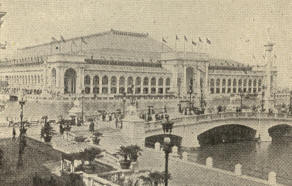
The Manufactures and liberal Arts Building, seen from the southwest.
Early on the opening day of the Exposition, May 1, 1893, the Chief
Magistrate of the nation sat beside Columbus's descendant, the Duke of
Veragua. Patient multitudes were waiting for the gates of Jackson Park
to swing. "It only remains for you, Mr. President," said the
Director-General, concluding his address, "if in your opinion the
Exposition here presented is commensurate in dignity with what the world
should expect of our great country, to direct that it shall be opened to
the public. When you touch this magic key the ponderous machinery will
start in its revolutions and the activity of the Exposition will begin."
After a brief response Mr. Cleveland laid his finger on the key. A
tumult of applause mingled with the jubilant melody of Handel's
"Hallelujah Chorus." Myriad wheels revolved, waters gushed and sparkled,
bells pealed and artillery thundered, while flags and gonfalons
fluttered forth.
The Exposition formed a huge quadrilateral upon the westerly shore of
Lake Michigan, from whose waters one passed by the North Inlet into the
North Pond, or by the South Inlet into the South Pond. These united with
the central Grand Basin in the peerless Court of Honor. The grounds and
buildings were of surpassing magnitude and splendor. Interesting but
simple features were the village of States, the Nations' tabernacles,
lying almost under the guns of the facsimile battleship Illinois, and
the pigmy caravels, Nina, Pinta, and Santa Maria, named and modelled
after those that bore Columbus to the New World. These, like their
originals, had fared from Spain across the Atlantic, and then had come
by the St, Lawrence and the Lakes, without portage, to their moorings at
Chicago.
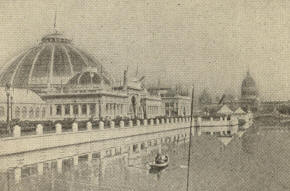
Horticultural Building, with Illinois Building in the background.
Near the centre of the ground stood the Government Building, with a
ready-made look out of keeping with the other architecture. Critics
declared it the only discordant note in the symphony, Looking from the
Illinois Building across the North pond, one saw the Art Palace, of pure
Ionic style, perfectly proportioned, restful to view, contesting with
the Administration Building for the architectural laurels of the Fair.
South of the Illinois Building rose the Woman's Building, and next
Horticultural Hall, with dome high enough to shelter the tallest palms.
The Manufactures and Liberal Arts Building, of magnificent proportions,
did not tyrannize over its neighbors, though thrice the size of St.
Peter's at Rome, and able easily to have sheltered the Vendome Column.
It was severely classical, with a long perspective of arches, broken
only at the corners and in the centre by portals fit to immortalize
Alexander's triumphs.
The artistic jewel of the Exposition was the "Court of Honor." Down the
Grand Basin you saw the noble statue of the Republic, in dazzling gold,
with the peristyle beyond, a forest of columns surmounted by the
Columbus quadriga. On the right hand stood the Agricultural Building,
upon whose summit the "Diana" of Augustus St. Gaudens had alighted. To
the left stood the enormous Hall of Manufactures. Looking from the
peristyle the eye met the Administration Building, a rare
exemplification of the French school, the dome resembling that of the
Hotel des lnvalides in Paris.
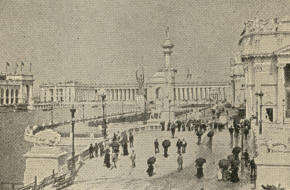
A view toward the Peristyle from Machinery Hall.
A most unique conception was the Cold Storage Building, where a hundred
tons at ice were made daily. Save for the entrance, flanked by windows,
and the fifth floor, designed for an ice skating rink, its walls were
blank. Four corner towers set off the fifth, which rose from the centre
sheer to a height of 225 feet.
The cheering coolness of this building was destined not to last. Early
in the afternoon of July 10th flames burst out from the top of the
central tower. Delaying his departure until he had provided against
explosion, the brave engineer barely saved his life. Firemen were soon
on hand. Sixteen of them forthwith made their way to the balcony near
the blazing summit. Suddenly their retreat was cut off by a burst of
fire from the base of the tower. The rope and hose parted and
precipitated a number who were sliding back to the roof. Others leaped
from the colossal torch. In an instant, it seemed, the whole pyre was
swathed in flames. As it toppled, the last wretched form was seen to
poise and plunge with it into the glowing abyss.
The Fisheries Building received much attention. Its pillars were twined
with processions of aquatic creatures and surmounted by capitals
quaintly resembling lobster-pots. Its balustrades were supported by
small fishy caryatids.
If wonder fatigued the visitor, he reached sequestered shade and quiet
upon the Wooded Island, where nearly every variety of American tree and
shrub might be seen.
The Government's displays were of extreme interest. The War Department
exhibits showed our superiority in heavy ordnance, likewise that of
Europe in small arms. A first-class post-office was operated on the
grounds. A combination postal car, manned by the most expert sorters and
operators, interested vast crowds. Close by was an ancient mail coach
once actually captured by the Indians, with effigies of the pony express
formerly so familiar on the Western plains, of a mail sledge drawn by
dogs, and of a mail carrier mounted on a bicycle. Models of a quaint
little Mississippi mail steamer and of the ocean steamer Paris stood
side by side.
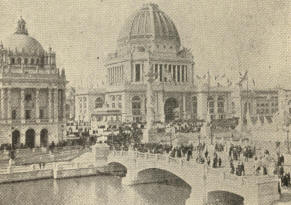
The Administration Building,
seen from the Agricultural Building.
Swarms visited the Midway Plaisance, a long avenue out from the fair
grounds proper, lined with shows. Here were villages transported from
the ends of the earth, animal shows, theatres, and bazaars. Cairo Street
boasted 2,250,000 visitors, and the Hagenbeck Circus over 2,000,000. The
chief feature was the Ferris Wheel, described in engineering terms as a
cantilever bridge wrought around two enormous bicycle wheels. The axle,
supported upon steel pyramids, alone weighed more than a locomotive. In
cars strung upon its periphery passengers were swung from the ground far
above the highest buildings.
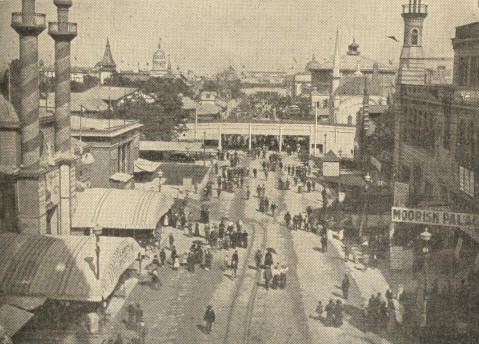
Midway Plaisance, World's Fair, Chicago.
Facilitating passenger transportation to and from the Fair remarkable
railway achievements were made. One train from New York to Chicago
covered over 48 miles an hour, including stops. In preparation for the
event the Illinois Central raised its tracks for two and a half miles
over thirteen city streets, built 300 special cars, and erected many new
stations. These improvements cost over $2,000,000. The Fair increased
Illinois Central traffic over 200 per cent.
Save the Art Building, the structures at the Fair were designed to be
temporary, and they were superfluous when the occasion which called them
into being had passed. The question of disposing of them was summarily
solved. One day some boys playing near the Terminal Station saw a
sinister leer of flame inside. A high wind soon blew a conflagration,
which enveloped the structures, leaving next day naught but ashes,
tortured iron work, and here and there an arch, to tell of the regal
White City that had been.
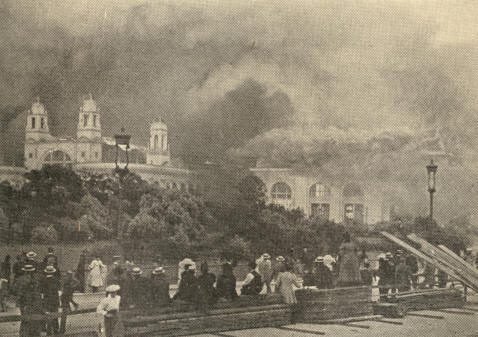
Electricity Building. Mines and Mining Building.
The Burning of the White City.
The financial backers of the Fair showed no mercenary temper. The
architects, too, worked with public spirit and zeal which money never
could have elicited. Notwithstanding the World's Fair was not
financially a "success," this was rather to the credit of its unstinted
magnificence than to the want of public appreciation. The paid
admissions were over 21,000,000, a daily average of 120,000. The gross
attendance exceeded by nearly a million the number at the Paris
Exposition of 1889 for the corresponding period, though rather more than
half a million below the total at the French capital. The monthly
average at Chicago increased from 1,000,000 at first to 7,000,000 in
October. The crowd was typical of the best side of American life;
orderly, good-natured, intelligent, sober. The grounds were clean, and
there was no ruffianism. Of the $32,988 worth of property reported
stolen, $31,875 was recovered and restored.