
[1889]
President Harrison's quadrennium was a milestone between two
generations. Memorials on every hand to the heroes of the Civil War
shocked one with the sense that they and the events they molded were
already of the past. Logan, Arthur, Sheridan, and Hancock had died. In
1891 General Sherman and Admiral Porter fell within a day of each other.
General Joseph E. Johnston, who had been a pall-bearer at the funeral of
each, rejoined them in a month.
This presidential term was pivotal in another way. The centennial
anniversary of Washington's inauguration as President fell on April 30,
1889. In observance of the occasion President Harrison followed the
itinerary of one hundred years before, from the Governor's mansion in
New Jersey to the foot of Wall Street, in New York City, to old St.
Paul's Church, on Broadway, and to the site where the first Chief
Magistrate first took the oath of office. Three days devoted to the
commemorative exercises were a round of naval, military, and industrial
parades, with music, oratory, pageantry, and festivities. For this
Centennial Whittier composed an ode. The venerable Rev. S. F. Smith, who
had written "America" fifty-seven years before, was also inspired by the
occasion to pen a Century Hymn, and to add to "America" the stanza:
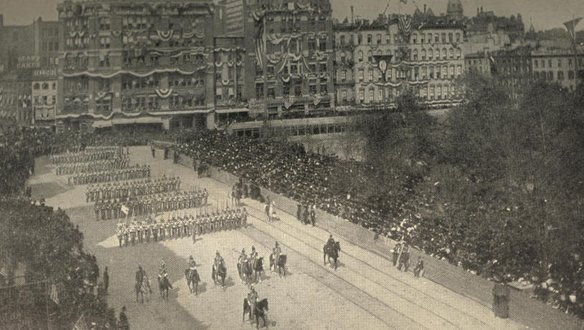
Washington Inaugural Celebration, 1889, New York.
Parade passing Union Square on Broadway.
[1890]
At the opening of this its second century of existence the nation was
confronted by entirely new issues. Bitterness between North and South,
spite of its brief recrudescence during the pendency of the Force Bill,
was fast dying out. At the unveiling of the noble monument to Robert E.
Lee at Richmond, in May, 1890, while, of course, Confederate leaders
were warmly cheered and the Confederate flag was displayed, various
circumstances made it clear that this zeal was not in derogation of the
restored Union.
The last outbreaks of sectional animosity related to Jefferson Davis, in
whom, both to the North and to the South, the ghost of the Lost Cause
had become curiously personified. The question whether or not he was a
traitor was for years zealously debated in Congress and outside. The
general amnesty after the war had excepted Davis. When a bill was before
Congress giving suitable pensions to Mexican War soldiers and sailors,
an amendment was carried, amid much bitterness, excluding the
ex-president of the Confederacy from the benefits thereof. Northerners
naturally glorified their triumph in the war as a victory for the
Constitution, nor could they wholly withstand the inclination to
question the motives of the secession leaders. Southerners, however
loyal now to the Union, were equally bold in asserting that, since in
1861 the question of the nature of the Union had not been settled, Mr.
Davis and the rest might attempt secession, not as foes of the
Constitution, but as, in their own thought, its most loyal friends and
defenders.
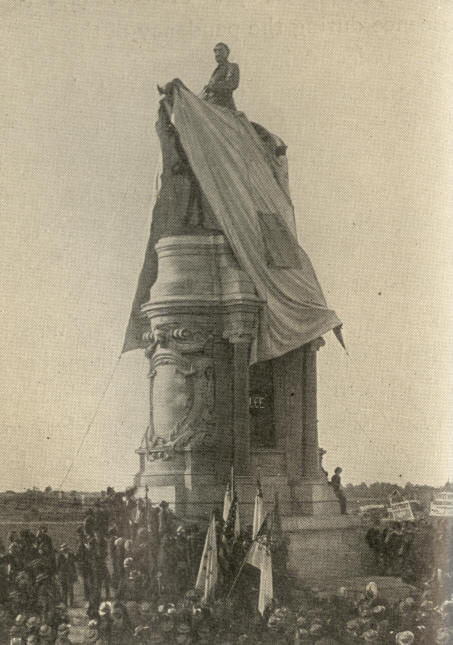
Unveiling of the Equestrian Statue of Robert E. Lee, May 29. 1890.
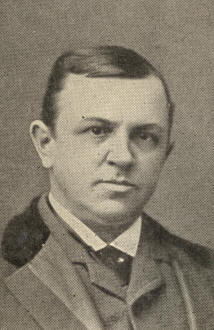
Henry W. Grady.
By 1890 the days were passed when denunciation of Davis or of the South
electrified the North, nor did the South on its part longer waste time
in impotent resentments or regrets. The brilliant and fervid utterances
on "The New South" by editor Henry W. Grady, of the Atlanta
Constitution, went home to the hearts of Northerners, doing much to
allay sectional feeling. Grady died, untimely, in 1889, lamented nowhere
more sincerely than at the North.
When Federal intervention occurred to put down the notorious Louisiana
Lottery, the South in its gratitude almost forgot that there had been a
war. This lottery had been incorporated in 1868 for twenty-five years.
In 1890 it was estimated to receive a full third of the mail matter
coming to New Orleans, with a business of $30,000 a day in postal notes
and money orders. As the monster in 1890, approaching its charter-term,
bestirred itself for a new lease of life, it found itself barred from
the mails by Congress.
And this was, in effect, its banishment from the State and country. It
could still ply its business through the express companies, provided
Louisiana would abrogate the constitutional prohibition of lotteries it
had enacted to take effect in 1893. For a twenty-five year
re-enfranchisement the impoverished State was offered the princely sum
of a million and a quarter dollars a year. This tempting bait was
supplemented by influences brought to bear upon the venal section of the
press and of the legislature. A proposal for the necessary
constitutional change was vetoed by Governor Nicholls. Having pushed
their bill once more through the House, the lottery lobby contended that
a proposal for a constitutional amendment did not require the governor's
signature, but only to be submitted to the people, a position which was
affirmed by the State Supreme Court. A fierce battle followed in the
State, the "anti" Democrats of the country parishes, in fusion with
Farmers' Alliance men, fighting the "pro" Democrats of New Orleans. The
"Antis" and the Alliance triumphed. Effort for a constitutional
amendment was given up, and Governor Foster was permitted to sign an act
prohibiting, after December 31, 1893, all sale of lottery tickets and
all lottery drawings or schemes throughout the State of Louisiana. In
January, 1894, the Lottery Company betook itself to exile on the island
of Cuanaja, in the Bay of Honduras, a seat which the Honduras Government
had granted it, together with a monopoly of the lottery business for
fifty years.
Francis T. Nicholls.
Matters in the West drew attention. The pressure of white population,
rude and resistless as a glacier, everywhere forcing the barriers of
Indian reservations, now concentrated upon the part of Indian territory
known as Oklahoma. This large tract the Seminole Indians had sold to the
Government, to be exclusively colonized by Indians and freedmen. In
1888-89, as it had become clearly impossible to shut out white settlers,
Congress appropriated $4,000,000 to extinguish the trust upon which the
land was held. By December the newly opened territory boasted 60,000
denizens, eleven schools, nine churches, and three daily and five weekly
newspapers. In a few years it was vying for statehood with Arizona and
New Mexico.
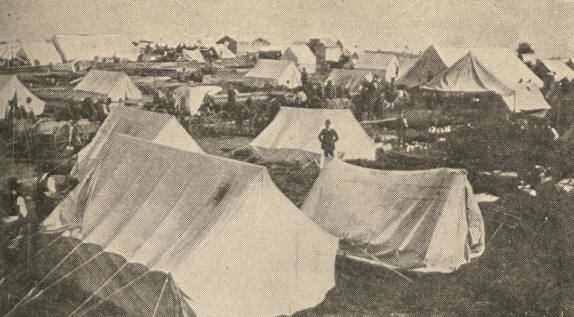
A general view of the town on April 24, 1889,
the second day after the opening.
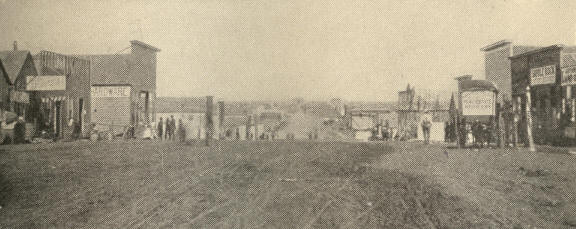
A view along Oklahoma Avenue on May 10, 1889.
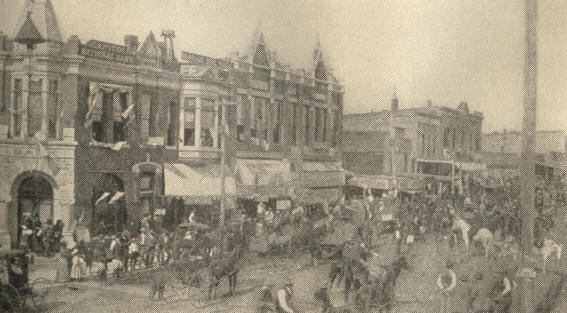
Oklahoma Avenue as it appeared on May 10, 1893,
during Governor Noble's visit.
THE BUILDING OF A WESTERN TOWN, GUTHRIE, OKLAHOMA.
In addition to the prospect of thus losing all their lands, the Indians
were, in the winter of 1890, famine-stricken through failure of
Government rations. With little hope of justice or revenge in their own
strength, the aggrieved savages sought supernatural solace. The
so-called "Messiah Craze" seized upon Sioux, Cheyennes, Arapahoes,
Osages, Missouris, and Seminoles. Ordinarily at feud with one another,
these tribes all now united in ghost dances, looking for the Great
Spirit or his Representative to appear with a high hand and an
outstretched arm to bury the white and their works deep underground,
when the prairie should once more thunder with the gallop of buffalo and
wild horses. Southern negroes caught the infection. Even the scattered
Aztecs of Mexico gathered around the ruins of their ancient temple at
Cholula and waited a Messiah who should pour floods of lava from
Popocatapetl, inundating all mortals not of Aztec race.
[1892]
While frontiersmen trembled lest massacres should follow these Indian
orgies, people in the East were shuddering over the particulars of a
real catastrophe indescribably awful in nature. On a level some two
hundred and seventy-five feet lower than a certain massive reservoir,
lay the city of Johnstown, Pa. The last of May, 1889, heavy rains having
fallen, the reservoir dam burst, letting a veritable mountain of water
rush down upon the town, destroying houses, factories, bridges, and
thousands of lives. Relief work, begun at once and liberally supplied
with money from nearly every city in the Union and from many foreign
contributors, repaired as far as might be the immediate consequences of
the disaster.
Along with the Johnstown Flood will be remembered in the annals of
Pennsylvania the Homestead strike, in 1892, against the Carnegie Steel
Company, occasioned by a cut in wages. The Amalgamated Steel and Iron
Workers sought to intercede against the reduction, but were refused
recognition. Preparing to supplant the disaffected workmen with
non-union men, a force of Pinkerton detectives was brought up the river
in armored barges. Fierce fighting ensued. Bullets and cannon-balls
rained upon the barges, and receptacles full of burning oil were floated
down stream. The assailants wished to withdraw, repeatedly raising the
white flag, but it was each time shot down. Eleven strikers were killed;
of the attacking party from thirty to forty fell, seven dead. When at
last the Pinkertons were forced to give up their arms and ammunition and
retire, a bodyguard of strikers sought to shield them, but so violent
was the rage which they had provoked that, spite of their escort, the
mob brutally attacked them. Order was restored only when the militia
appeared.
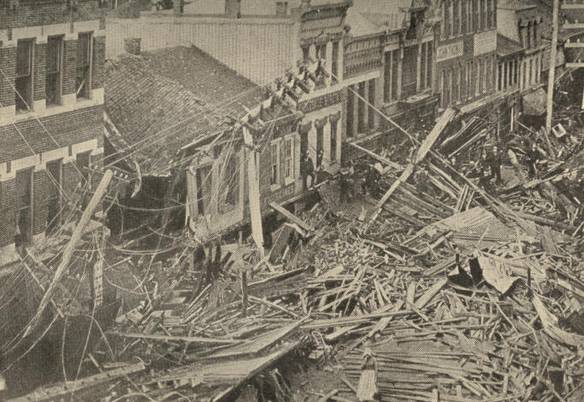
Main Street, Johnstown, after the flood.
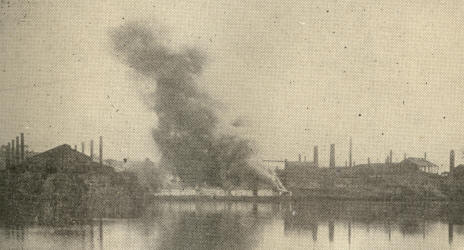
Burning of Barges during Homestead Strike.
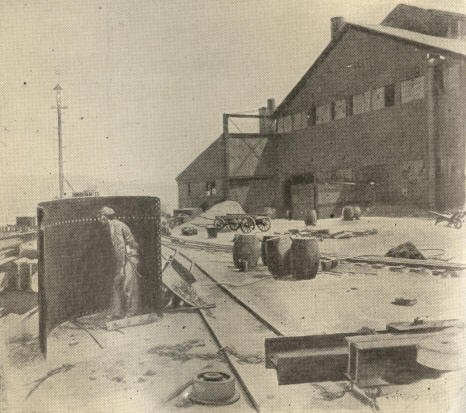
The Carnegie Steel Works. Showing the shield used by the strikers when
firing the cannon and watching the Pinkerton men. Homestead strike.
This bloodshed was not wholly in vain. Congress made the private militia
system, the evil consequences of which were so manifest in these
tragedies, a subject of investigation, while public sentiment more
strongly than ever reprobated, on the one hand, violence by strikers or
strike sympathizers, and, on the other, the employment of armed men, not
officers of the law, to defend property.
That, however, other causes than these might endanger the peace was
shown about the same time at certain Tennessee mines where prevailed the
bad system of farming out convicts to compete with citizen-miners.
Business being slack, deserving workmen were put on short time.
Resenting this, miners at Tracy City, Inman, and Oliver Springs
summarily removed convicts from the mines, several of these escaping. At
Coal Creek the rioters were resisted by Colonel Anderson and a small
force. They raised a flag of truce, answering which in person, Colonel
Anderson was commanded, on threat of death, to order a surrender. He
refused. A larger force soon arrived, routed the rioters, and rescued
the colonel.
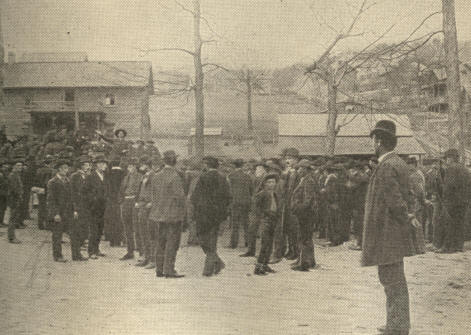
Inciting miners to attack Fort Anderson.
The grove between Briceville and Coal Creek.
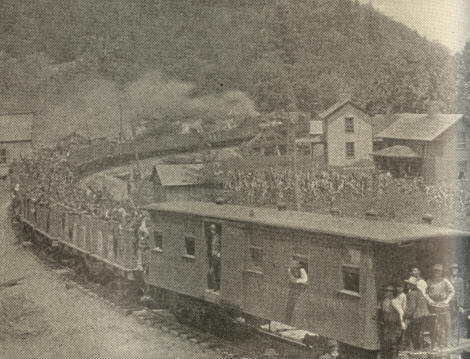
State troops and miners at Briceville, Tenn.
[1891]
The year 1891 formed a crisis in the history of Mormonism in America.
For a long time after their settlement in the "Great American Desert,"
as it was then called, Mormons repudiated United States authority.
Gentile pioneers and recreant saints they dealt with summarily, witness
the Mountain Meadow massacre of 1857, where 120 victims were murdered in
cold blood after surrendering their arms.
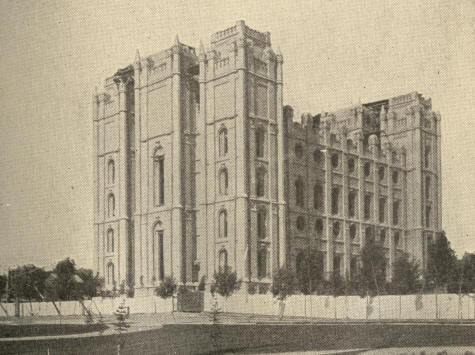
The Mormon Temple at Salt Lake City.
Anti-polygamy bills were introduced in Congress in 1855 and 1859. In
1862 such a bill was made law. Seven years later the enforcement of it
became possible by the building of a trans-continental railroad and the
influx of gentiles drawn by the discovery of precious metals in Utah. In
1874 the Poland Act, and in 1882 the Edmunds Act, introduced reforms.
Criminal law was now much more efficiently executed against Mormons. In
1891 the Mormon officials pledged their church's obedience to the laws
against plural marriages and unlawful cohabitation.
America was quick and generous in her response to the famine cry that in
1891 rose from 30,000,000 people in Russia. Over a domain of nearly a
half million square miles in that land there was no cow or goat for
milk, nor a horse left strong enough to draw a hearse. Old grain stores
were exhausted, crops a failure, and land a waste. Typhus, scurvy, and
smallpox were awfully prevalent. To relieve this misery, our people,
besides individual gifts, despatched four ship-loads of supplies
gathered from twenty-five States. In values given New York led,
Minnesota was a close second, and Nebraska third. America became a
household word among the Russians even to the remotest interior.