
[1888]
The new President, of course, renounced his predecessor's policy upon
the tariff, but continued it touching the navy. He advocated steamship
subsidies, reform in electoral laws, and such amendment to the
immigration laws as would effectively exclude undesirable foreigners.
A chief effect of the Kearney movement in California, culminating in the
California constitution of 1879, was intense opposition throughout the
Pacific States to any further admission of the Chinese. The constitution
named forbade the employment of Chinese by the State or by any
corporation doing business therein. This hostility spread eastward, and,
in spite of interested capitalists and disinterested philanthropists,
shaped all Subsequent Chinese legislation in Congress. The pacific
spirit of the Burlingame treaty in 1868, shown also by President Hayes
in vetoing the Anti-Chinese bill of 1878, died out more and more.
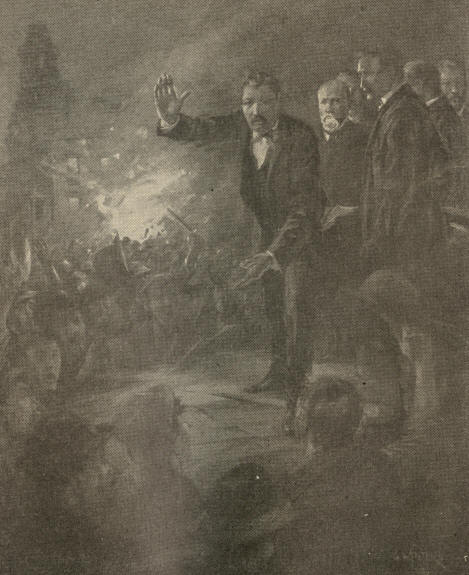
"The Chinese must go!"
Denis Kearney addressing the working-men on the night of October 29, on
Nob Hill, San Francisco.
A law passed in 1881 provided that Chinese immigration might be
regulated, limited, or suspended by the United States. A bill
prohibiting such immigration for twenty years was vetoed by President
Arthur, but another reducing the period to ten years became law in 1882.
In 1888 this was amended to prohibit the return of Chinese laborers who
had been in the United States but had left. In 1892 was passed the Geary
law re-enacting for ten years more the prohibitions then in force, only
making them more rigid. Substantially the same enactments were renewed
in 1902.
Mr. Harrison wished this policy of a closed state put in force against
Europe as well as against Asia. An act of Congress passed August 2,
1882, prohibited the landing from any country of any would-be immigrant
who was a convict, lunatic, idiot, or unable to take care of himself.
This law, like the supplementary one of March 3, 1887, proved
inadequate. In 1888 American consuls represented that transatlantic
steamship companies were employing unscrupulous brokers to procure
emigrants for America, the brokerage being from three to five dollars
per head, and that most emigrants were of a class utterly unfitted for
citizenship.
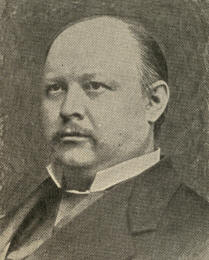
Thomas B. Reed.
The President's urgency in this matter had little effect, the attention
of Congress being early diverted to other subjects. Three great measures
mainly embodied the Republican policy–the Federal Elections Bill, the
McKinley Tariff Bill, and the Dependent Pensions Bill.
As Speaker of the House, Hon. Thomas B. Reed, of Maine, put through
certain parliamentary innovations necessary to enact the party's will.
He declined to entertain dilatory motions. More important, he ordered
the clerk to register as "present and not voting," those whom he saw
endeavoring by stubborn silence to break a quorum. A majority being the
constitutional quorum, theretofore, unless a majority answered to their
names upon roll-call, no majority appeared of record, although the
sergeant-at-arms was empowered to compel the presence of every member.
As the traditional safeguard of minorities and as a compressed airbrake
on majority action, silence became more powerful than words. Under the
Reed theory, since adopted, that the House may, through its Speaker,
determine in its own way the presence of a quorum, the Speaker's or the
clerk's eye was substituted for the voice of any member in demonstrating
such member's presence.
Many, not all Democrats, opposed the Reed policy as arbitrary. Mr.
Evarts is said to have remarked, "Reed, you seem to think a deliberative
body like a woman; if it deliberates, it is lost." On the "yeas and
nays" or at any roll-call some would dodge out of sight, others break
for the doors only to find them closed. A Texas member kicked down a
door to make good his escape. Yet, having calculated the scope of his
authority, Mr. Reed coolly continued to count and declare quorums
whenever such were present. The Democratic majority of 1893 transferred
this newly discovered prerogative of the Speaker, where possible, to
tellers. Now and then they employed it as artillery to fire at Mr. Reed
himself, but he each time received the shot with smiles.
The cause for which the counting of quorums was invoked made it doubly
odious to Democratic members. To restore the suffrage to southern
negroes the Republicans proposed federal supervision of federal
elections. This suggestion of a "Force Bill" rekindled sectional
bitterness. One State refused to be represented at the World's Columbian
Exposition of 1893, a United States marshal was murdered in Florida, a
Grand Army Post was mobbed at Whitesville, Ky. Parts of the South
proposed a boycott on northern goods. Many at the North favored white
domination in the South rather than a return of the carpet-bag regime,
regarding the situation a just retribution for Republicans' highhanded
procedure in enfranchising black ignorance. Sober Republicans foresaw
that a force law would not break up the solid South, but perpetuate it.
The House, however, passed the bill. In the Senate it was killed only by
"filibuster" tactics, free silver Republican members joining members
from the South to prevent the adoption of cloture.
A Treasury surplus of about $97,000,000 (in October, 1888) tempted the
Fifty-first Congress to expenditures then deemed vast, though often
surpassed since. The Fifty-first became known as the "Billion Dollar
Congress." What drew most heavily upon the national strong-box was the
Dependent Pensions Act. In this culminated a course of legislation
repeating with similar results that which began early in the history of
our country, occasioning the adage that "The Revolutionary claimant
never dies." By 1820 the experiment entailed an expenditure of a little
over twenty-five cents per capita of our population.
In 1880 Congress was induced to endow each pensioner with a back pension
equal to what his pension would have been had he applied on the date of
receiving his injury. Under the old law pension outlay had been at high
tide in 1871, standing then at $34,443,894. Seven years later it shrank
to $27,137,019. In 1883 it exceeded $66,000,000; in 1889 it approached
$88,000,000. But the act of 1890, similar to one vetoed by President
Cleveland three years before, carried the pension figure to $106,493,000
in 1890, to $118,584,000 in 1891, and to about $159,000,000 in 1893. It
offered pensions to all soldiers and sailors incapacitated for manual
labor who had served the Union ninety days, or, if they were dead, to
their widows, children, or dependent parents. 311,567 pension
certificates were issued during the fiscal year 1891-1892.
While thus increasing outgo, the Fifty-first Congress planned to
diminish income, not by lowering tariff rates, as the last
Administration had recommended, but by pushing them up to or toward the
prohibitive point. The McKinley Act, passed October 1, 1890, made sugar,
a lucrative revenue article, free, and gave a bounty to sugar producers
in this country, together with a discriminating duty of one-tenth of a
cent per pound on sugar imported hither from countries which paid an
export bounty thereon.
The "Blaine" reciprocity feature of this act proved its most popular
grace. In 1891 we entered into reciprocity agreements with Brazil, with
the Dominican Republic, and with Spain for Cuba and Porto Rico. In 1892
we covenanted similarly with the United Kingdom on behalf of the British
West Indies and British Guiana, and with Nicaragua, Salvador, Honduras,
Guatemala and Austria-Hungary. How far our trade was thus benefited is
matter of controversy. Imports from these countries were certainly much
enlarged. Our exportation of flour to these lands increased a result
commonly ascribed to reciprocity, though the simultaneous increase in
the amounts of flour we sent to other countries was a third more rapid.
The international copyright law, meeting favor with the literary, was
among the most conspicuous enactments of the Fifty-first Congress. An
international copyright treaty had been entered into in 1886, but it did
not include the United States. Two years later a bill to the same end
failed in Congress. At last, on March 3, 1891, President Harrison signed
an act which provided for United States copyright for any foreign
author, designer, artist, or dramatist, albeit the two copies of a book,
photograph, chromo, or lithograph required to be deposited with the
Librarian of Congress must be printed from type set within the limits of
the United States or from plates made therefrom, or from negatives or
drawings on stone made within the limits of the United States or from
transfers therefrom. Foreign authors, like native or naturalized, could
renew their United States copyrights, and penalties were prescribed to
protect these rights from infringement.
[1891]
Mr. Blaine, the most eminent Republican statesman surviving, was now
less conspicuous than McKinley, Lodge, and Reed, with whom, by his
opposition to extreme protection and to the Force Bill, he stood at
sharp variance. As Secretary of State, however, to which post President
Harrison had perforce assigned him, he still drew public attention,
having to deal with several awkward international complications.
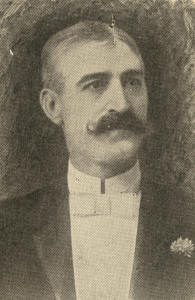
David C. Hennessy.
The city of New Orleans, often tempted to appeal from bad law to
anarchy, was in the spring of 1891 swept off its feet by such a
temptation. Chief of Police David C. Hennessy was one night ambushed and
shot to death near his home by members of the Sicilian "Mafia," a
secret, oath-bound body of murderous blackmailers whom he was hunting to
earth. When at the trial of the culprits the jury, in face of cogent
evidence, acquitted six and disagreed as to the rest, red fury succeeded
white amazement. A huge mob encircled the jail, crushed in its
barricaded doors, and shot or hung the trembling Italians within.
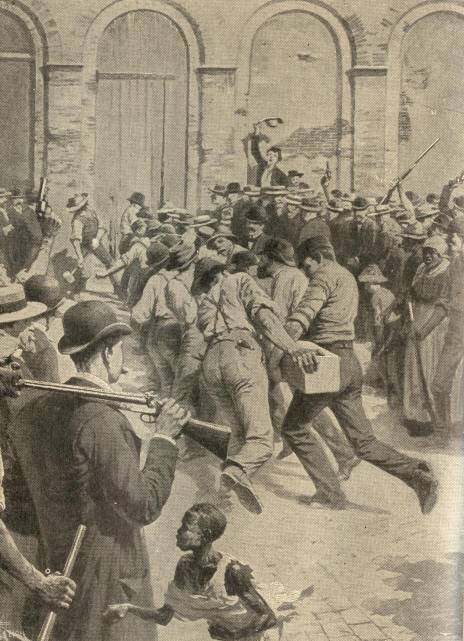
An episode of the lynching of the Italians in New Orleans. The citizens
breaking down the door of the parish prison with the beam brought there
the night before for that purpose.
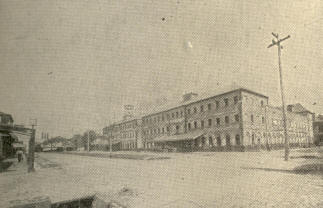
Old Parish Jail, New Orleans, La.
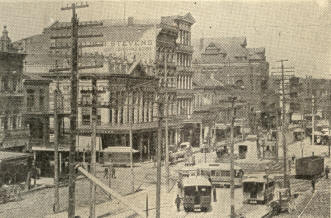
Canal Street. New Orleans La.
Italy forthwith sent her protest to Mr. Blaine, who expressed his horror
at the deed, and urged Governor Nicholls to see the guilty brought to
justice. The Italian consul at New Orleans averred that, while the
victims included bad men, many of the charges against them were without
foundation; that the violence was foreseen and avoidable; that he had in
vain besought military protection for the prisoners, and had himself,
with his secretary, been assaulted and mobbed.
The Marquis di Rudini insisted on indemnity for the murdered men's
families and on the instant punishment of the assassins. Secretary
Blaine, not refusing indemnity in this instance, denied the right to
demand the same, still more the propriety of insisting upon the instant
punishment of the offenders, since the utmost that could be done at once
was to institute judicial proceedings, which was the exclusive function
of the State of Louisiana. The Italian public thought this equivocation,
mean truckling to the American prejudice against Italians. Baron Fava,
Italian Minister at Washington, was ordered to "affirm the inutility of
his presence near a government that had no power to guarantee such
justice as in Italy is administered equally in favor of citizens of all
nationalities." "I do not," replied Mr. Blaine, "recognize the right of
any government to tell the United States what it shall do; we have never
received orders from any foreign power and shall not begin now. It is to
me," he said, "a matter of indifference what persons in Italy think of
our institutions. I cannot change them, still less violate them."
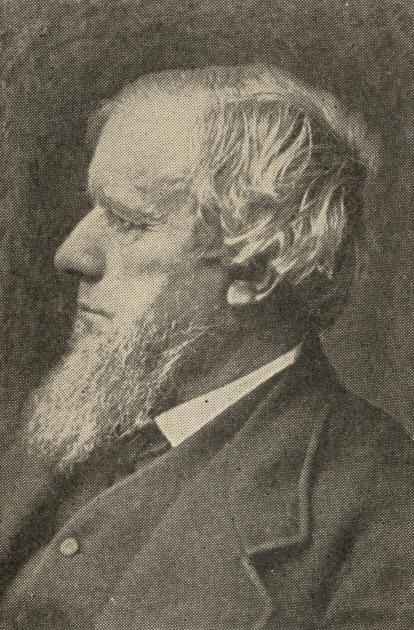
A. G. Thurman.
Such judicial proceedings as could be had against the lynchers broke
down completely. The Italian Minister withdrew, but his government
finally accepted $25,000 indemnity for the murdered men's families.
Friction with Chile arose from the "Itata incident." Chile was torn by
civil war between adherents of President Balmaceda and the
"congressional party." Mr. Egan, American Minister at Santiago, rendered
himself widely unpopular among Chilians by his espousal of the
President's cause. The Itata, a cruiser in the congressionalist service,
was on May 6, 1891, at Egan's request, seized at San Diego, Cal., by the
federal authorities, on the ground that she was about to carry a cargo
of arms to the revolutionists. Escaping, she surrendered at her will to
the United States squadron at Iquique. The congressionalists resented
our interference; the Balmaceda party were angry that we interfered to
so little effect. A Valparaiso mob killed two American sailors and hurt
eighteen more. Chile, however, tendered a satisfactory indemnity.
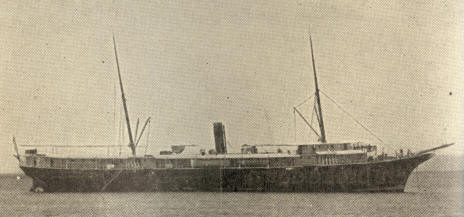
Chilian steamer Itata in San Diego Harbor.
[1890]
In the so-called "Barrundia incident" occurring in 1890 Americanism
overshot itself. The Gautemalan refugee, General Barrundia, boarded the
Pacific Mail steamer Acapulco for Salvador upon assurance that he would
not be delivered to the authorities of his native land. At San Jose de
Gautemala the Gautemala authorities sought to arrest him, and United
States Minister Mizner, Consul-General Hosmer, and Commander Reiter of
the United States Ship of War Ranger, concurred in advising Captain
Pitts of the Acapulco that Gautemala had a right to do this. Barrundia
resisted arrest and was killed. Both Mizner and Reiter were reprimanded
and removed, Reiter being, however, placed in another command.
Our government's attitude in this matter was untenable. The two
officials were in fact punished for having acted with admirable judgment
and done each his exact duty.
One of President Harrison's earliest diplomatic acts was the treaty of
1889 with Great Britain and Germany, by which, in conjunction with those
nations, the United States established a joint protectorate over the
Samoan Islands. On December 2, 1899, the three powers named agreed to a
new treaty, by which the United States assumed full sovereignty over
Tutuila and all the other Samoan islands east of longitude 171 degrees
west from Greenwich, renouncing in favor of the other signatories all
rights and claims over the remainder of the group.
In the congressional campaign of 1890 issue was squarely joined upon the
neo-Republican policy. The billion dollars gone, the Force Bill, and,
to a less extent, the McKinley tariff, especially its sugar bounty, had
aroused popular resentment. The election, an unprecedented "landslide,"
precipitated a huge Democratic majority into the House of
Representatives. Every community east of the Pacific slope felt the
movement. Pennsylvania elected a Democratic governor.
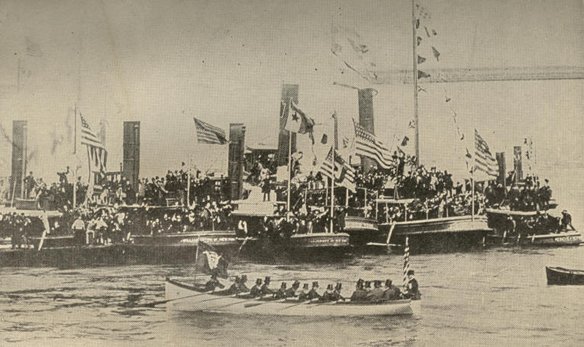
President Harrison being rowed ashore at foot of Wall Street,
New York, April 29, 1889.