
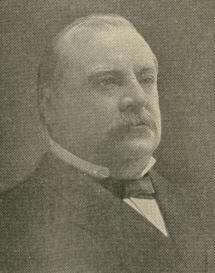
Grover Cleveland.
Photograph copyrighted by C. M. Bell.
[1888]
It looking forward to the presidential campaign of 1888 the Democracy
had no difficulty in selecting its leader or its slogan. The custom,
almost like law, of renominating a presidential incumbent at the end of
his first term, pointed to Mr. Cleveland's candidacy, as did the
considerable success of his administration in quelling factions and in
silencing enemies. At the same time reform for a lower tariff, with
which cause he had boldly identified himself, was marked anew as a main
article of the Democratic creed. The nomination of Allen G. Thurman for
Vice-President brought to the ticket what its head seemed to
lack–popularity among the people of the West–and did much to hearten
all such Democrats as insisted upon voting a ticket free from all taint
of mugwumpery.
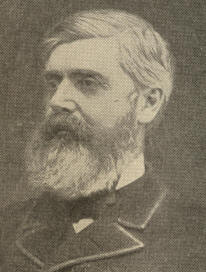
W. Q. Gresham.
The attitude of the Democratic party being favorable to tariff
reduction, the Republicans must perforce raise the banner of high
protection; but public opinion did not forestall the convention in
naming the Republican standard-bearer. The convention met in Chicago. At
first John Sherman of Ohio received 229 votes; Walter Q. Gresham of
Indiana, 111; Chauncey M. Depew of New York, 99; and Russell A. Alger of
Michigan, 84. Harrison began with 80; Blaine had but 35. After the third
ballot Depew withdrew his name. On the fourth, New York and Wisconsin
joined the Harrison forces. A stampede of the convention for Blaine was
expected, but did not come, being hindered in part by the halting tenor
of despatches received from the Plumed Knight, then beyond sea. After
the fifth ballot two cablegrams were received from Blaine, requesting
his friends to discontinue voting for him. Two ballots more having been
taken, Allison, who had been receiving a considerable vote, withdrew.
The eighth ballot nominated Harrison, and the name of Levi P. Morton,
of New York, was at once placed beneath his on the ticket.
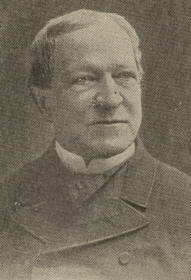
Levi P. Morton.
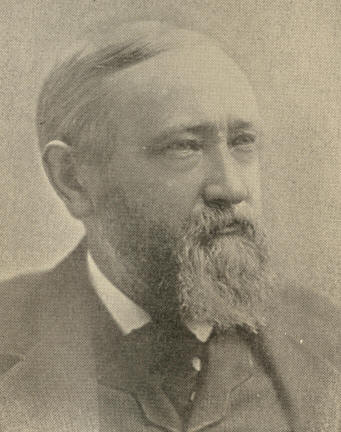
Benjamin Harrison.
Mr. Harrison was the grandson of President William Henry Harrison, great
grandson, therefore, of Governor Benjamin Harrison, of Virginia, the
ardent revolutionary patriot, signer of the Declaration of Independence.
An older scion of the family had served as major-general in Cromwell's
army and been executed for signing the death-warrant of King Charles I.
The Republican candidate was born on a farm at North Bend, Ohio, August
20, 1883. The boy's earliest education was acquired in a log
schoolhouse. He afterward attended Miami University, in Ohio, where he
graduated at the age of nineteen. The next year he was admitted to the
bar. In 1854 he married, and opened a law office in Indianapolis. In
1860 he became Reporter of Decisions to the Indiana Supreme Court. When
the civil war broke out, obeying the spirit that in his grandfather had
won at Tippecanoe and the Thames, young Harrison recruited a regiment,
of which he was soon commissioned colonel. Gallant services under
Sherman at Resaca and Peach Tree Creek brought him the brevet of
brigadier. After his return from war, owing to his high character, his
lineage, his fine war record, his power as a speaker and his popularity
in a pivotal State, he was a prominent figure in politics, not only in
Indiana, but more and more nationally. In 1876 he ran for the Indiana
Governership, but was defeated by a small margin. In 1880 he was
chairman of the Indiana delegation to the Republican National
Convention. In 1881 he was elected United States Senator, declining an
offer of a seat in Garfield's Cabinet. From 1880, when Indiana presented
his name to the Republican National Convention, General Harrison was, in
the West, constantly thought of as a presidential possibility. Eclipsed
by Blaine in 1884, he came forward again in 1888, this time to win.
In the East General Harrison was much underrated. Papers opposing his
election fondly cartooned him wearing "Grandfather's hat," as if family
connection alone recommended him. It was a great mistake. The grandson
had all the grandsire's strong qualities and many besides. He was a
student and a thinker. His character was absolutely irreproachable. His
information was exact, large, and always ready for use. His speeches had
ease, order, correctness, and point. With the West he was particularly
strong, an element of availability which Cleveland lacked. In the Senate
he had won renown both as a debater and as a sane adviser. As a
consistent protectionist he favored restriction upon Chinese immigration
and prohibition against the importation of contract labor. He upheld all
efforts for reform in the civil service and for strengthening the navy.
In the presidential campaign of 1888 personalities had little place.
Instead, there was active discussion of party principles and policies.
The tariff issue was of course prominent. A characteristic piece of
enginery in the contest was the political club, which now, for the first
time in our history, became a recognized force. The National Association
of Democratic Clubs comprised some 3,000 units, numerous auxiliary
reform and tariff reform clubs being active on the same side. The
Republican League, corresponding to the Democratic Association, boasted,
by August, 1887, 6,500 clubs, with a million voters on their rolls.
Before election day Indiana alone had 1,100 Republican clubs and New
York 1,400.
During most of the campaign Democratic success was freely predicted and
seemed assured. Yet from the first forces were in exercise which
threatened a contrary result. Federal patronage helped the
administration less than was expected, while it nerved the opposition.
The Republicans had a force of earnest and harmonious workers. Of the
multitude, on the other hand, who in 1884 had aided to achieve victory
for the Democracy, few, of course, had received the rewards which they
deemed due them. In vain did officeholders contribute toil and money
while that disappointed majority were so slow and spiritless in rallying
to the party's summons, and so many of them even hostile. The zeal of
honest Democrats was stricken by what Gail Hamilton wittily called "the
upas bloom" of civil service reform, which the President still displayed
upon his lapel. To a large number of ardent civil service reformers who
had originally voted for Cleveland this decoration now seemed so wilted
that, more in indignation than in hope, they went over to Harrison.
The public at large resented the loss which the service had suffered
through changes in the civil list. Harrison without much of a record
either to belie or to confirm his words, at least commended and espoused
the reform.
Democratic blunders thrust the sectional issue needlessly to the fore.
Mr. Cleveland's willingness to return to their respective States the
Confederate flags captured by Union regiments in the civil war; his
fishing trip on Memorial Day; the choice of Mr. Mills, a Texan, to lead
the tariff fight in Congress; and the prominence of southerners among
the Democratic campaign orators at the North, were themes of countless
diatribes.
A clever Republican device, known as "the Murchison letter," did a great
deal to impress thoughtless voters that Mr. Cleveland was "un-American."
The incident was dramatic and farcical to a degree. The Murchison
letter, which interested the entire country for two or three weeks,
purported to come from a perplexed Englishman, addressing the British
Minister at Washington, Lord Sackville-West. It sought counsel of Her
Majesty's representative, as the "fountainhead of knowledge," upon "the
mysterious subject" how best to serve England in voting at the
approaching American election. The seeker after light recounted
President Cleveland's kindness to England in not enforcing the
retaliatory act then recently passed by Congress as its ultimatum in the
fisheries dispute, his soundness on the free trade question, and his
hostility to the "dynamite schools of Ireland." The writer set Mr.
Harrison down as a painful contrast to the President. He was "a
high-tariff man, a believer on the American side of all questions, and
undoubtedly, an enemy to British interests generally." But the inquirer
professes alarm at Cleveland's message on the fishery question which had
just been sent to Congress, and wound up with the query "whether Mr.
Cleveland's policy is temporary only, and whether he will, as soon as he
secures another term of four years in the presidency, suspend it for one
of friendship and free trade."
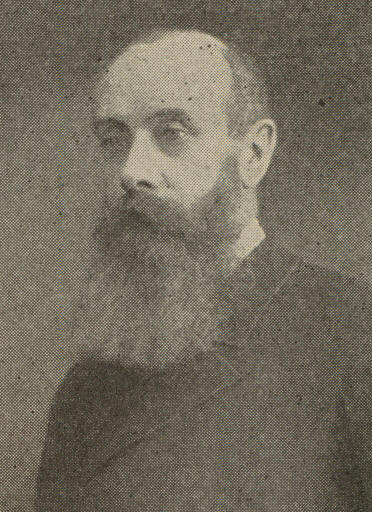
Lord L. S. Sackville-West.
The Minister replied:
"Sir:–I am in receipt of your letter of the 4th inst., and beg to say
that I fully appreciate the difficulty in which you find yourself in
casting your vote. You are probably aware that any political party which
openly favored the mother country at the present moment would lose
popularity, and that the party in power is fully aware of the fact. The
party, however, is, I believe, still desirous of maintaining friendly
relations with Great Britain and still desirous of settling questions
with Canada which have been, unfortunately, reopened since the
retraction of the treaty by the Republican majority in the Senate and by
the President's message to which you allude. All allowances must
therefore be made for the political situation as regards the
Presidential election thus created. It is, however, impossible to
predict the course which President Cleveland may pursue in the matter of
retaliation should he be elected; but there is every reason to believe
that, while upholding the position he has taken, he will manifest a
spirit of conciliation in dealing with the question involved in his
message. I enclose an article from the New York 'Times' of August 22d,
and remain, yours faithfully,
"L. S. SACKVILLE-WEST."
This correspondence, published on October 24th, took instant and
universal effect. The President at first inclined to ignore the
incident, but soon yielded to the urgency of his managers, and, to keep
"the Irish vote" from slipping away, asked for the minister's recall.
Great Britain refusing this, the minister's passports were delivered
him. The act was vain and worse. Without availing to parry the enemy's
thrust, it incurred not only the resentment of the English Government,
but the disapproval of the Administration's soberest friends at home.
Influences with which practical politicians were familiar had their
bearing upon the outcome. In New York State, where occurred the worst
tug of war, Governor Hill and his friends, while boasting their
democracy, were widely believed to connive at the trading of Democratic
votes for Harrison in return for Republican votes for Hill. At any rate,
New York State was carried for both.
It is unfortunately necessary to add that the 1888 election was most
corrupt. The campaign was estimated to have cost the two parties
$6,000,000. Assessments on office-holders, as well as other subsidies,
replenished the Democrats' campaign treasury; while the manufacturers of
the country, who had been pretty close four years before, now regarding
their interest and even their honor as assailed, generously contributed
often as the Republican hat went around.
In Indiana, Mr. Harrison's home State, no resource was left untried. The
National Republican Committee wrote the party managers in that State:
"Divide the floaters into blocks of five, and put a trusted man with
necessary funds in charge of these five, and make him responsible that
none get away, and that all vote our ticket." This mandate the workers
faithfully obeyed.
So far as argument had weight the election turned mainly upon the tariff
issue. The Republicans held that protection was on trial for its life.
Many Democrats cherished the very same view, only they denounced the
prisoner at the bar as a culprit, not a martyr. They inveighed against
protection as pure robbery. They accused the tariff of causing Trusts,
against which several bills had recently been introduced in Congress.
Democratic extremists proclaimed that Republicans slavishly served the
rich and fiendishly ground the faces of the poor. Even moderate
Democrats, who simply urged that protective rates should be reduced,
more often than otherwise supported their proposals with out and out
free trade arguments. As to President Cleveland himself no one could
tell whether or not he was a free trader, but his discussions of the
tariff read like Cobden Club tracts. The Mills bill, which passed the
House in the Fiftieth Congress, would have been more a tariff for
revenue than in any sense protective. Republican orators and organs
therefore pictured "British free trade" as the dire, certain sequel of
the Cleveland policy if carried out, and, whether convinced by the
argument or startled by the ado of Harrison's supporters, people, to be
on the safe side, voted to uphold the "American System."
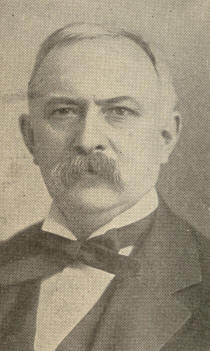
Joseph B. Foraker.
More than eleven million ballots were cast at the election, yet so
closely balanced were the parties that a change of 10,000 votes in
Indiana and New York, both of which went for Harrison would have
reelected Cleveland. As it was, his popular vote of 5,540,000 exceeded
by 140,000 that of Harrison, which numbered 5,400,000. Besides bolding
the Senate the Republicans won a face majority of ten in the House,
subsequently increased by unseating and seating. They were thus in
control of all branches of the general government.