
[1890]
Race war at the South following the abolition of slavery, new social
conditions everywhere, and the archaic nature of many provisions in the
old laws, induced, as the century drew to a close, a pretty general
revision of State constitutions. New England clung to instruments
adopted before the civil war, though in most cases considerably amended.
New Jersey was equally conservative, as were also Ohio, Indiana,
Michigan, and Wisconsin. New York adopted in 1894 a new constitution
which became operative January 1, 1895. Of the old States beyond the
Mississippi only Kansas, Iowa, Minnesota, and Oregon remained content
with ante-bellum instruments. Between 1864 and 1866 ten of the southern
States inaugurated governments which were not recognized by Congress and
had to be reconstructed. Ten of the eleven reconstruction constitutions
were in turn overthrown by 1896. In a little over a generation,
beginning with Minnesota, 1858, fourteen new States entered the Union,
of which all but West Virginia and Nebraska retained at the end of the
century their first bases of government. In some of these cases,
however, copious amendments had rendered the constitutions in effect
new.
As a rule the new constitutions reserved to the people large powers
formerly granted to one or more among the three departments of
government. Most of them placed legislatures under more minute
restrictions than formerly prevailed. The modern documents were much
longer than earlier ones, dealing with many subjects previously left to
statutes. Distrust of legislatures was further shown by shortening the
length of sessions, making sessions biennial, forbidding the pledging of
the public credit, inhibiting all private or special legislation, and
fixing a maximum for the rate of taxation, for State debts, and for
State expenditures.
South Dakota, the first State to do so, applied the initiative and
referendum, each to be set in motion by five per cent. of the voters, to
general statutory legislation. Wisconsin provided for registering the
names of legislative lobbyists, with various particulars touching their
employment. The names of their employers had also to be put down. Many
new points were ordered observed in the passing of laws, such as
printing all bills, reading each one thrice, taking the yeas and nays on
each, requiring an absolute majority to vote yea, the inhibition of
"log-rolling" or the joining of two or more subjects under one title,
and enactments against legislative bribery, lobbying, and "riders."
While the legislature was snubbed there appeared a quite positive
tendency to concentrate responsibility in the executive, causing the
powers of governors considerably to increase. The governor now enjoyed a
longer term, was oftener re-eligible, and could veto items or sections
of bills. By the later constitutions most of the important executive
officers were elected directly by the people, and made directly
responsible neither to governors nor to legislatures.
The newer constitutions and amendments paid great attention to the
regulation of corporations, providing for commissions to deal with
railroads, insurance, agriculture, dairy and food products, lands,
prisons, and charities. They restricted trusts, monopolies, and
lotteries. Modifications of the old jury system were introduced. Juries
were made optional in civil cases, and not always obligatory in criminal
cases. Juries of less than twelve were sometimes allowed, and a
unanimous vote by a jury was not always required. Growing wealth and the
consequent multiplication of litigants necessitated an increase in the
number of judges in most courts. Efforts were made, with some success,
by combining common law with equity procedure, and in other ways, to
render lawsuits more simple, expeditious, and inexpensive.
Restrictions were enacted on the hours of labor, the management of
factories, the alien ownership of land. The old latitude of giving and
receiving by inheritance was trenched upon by inheritance taxes. The
curbing of legislatures, the popular election of executives, civil
service reform, and the creation of a body of administrative
functionaries with clearly defined duties, betrayed movement toward an
administrative system.
A stronghold of political corruption was assaulted from 1888 to 1894 by
a hopeful measure known as the "Australian" ballot. It took various
forms in different States yet its essence everywhere was the provision
enabling every voter to prepare and fold his ballot in a stall by
himself, with no one to dictate, molest, or observe. Massachusetts, also
the city of Louisville, Ky., employed this system of voting so early as
1888. Next year ten States enacted similar laws. In 1890 four more
followed, and in 1891 fourteen more. By 1898 thirty-nine States, all the
members of the Union but six, had taken up "kangaroo voting," as its
foes dubbed it. Of these six States five were southern.
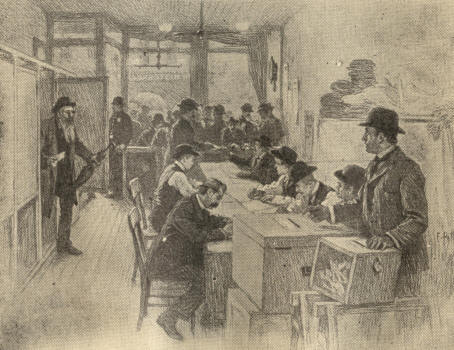
A New York Polling Place, showing booths on the left.
An official ballot replaced the privately–often dishonestly–prepared
party ballots formerly hawked about each polling place by political
workers. The new ballot was a "blanket," bearing a list of all the
candidates for each office to be filled. The arrangement of candidates'
names varied in different States. By one style of ticket it was easy for
the illiterate or the straight-out party man to mark party candidates.
Another made voting difficult for the ignorant, but a delight to the
discriminating.
The new ballot, though certainly an improvement, failed to produce the
full results expected of it. The connivance of election officials and
corrupt voters often annulled its virtue by devices growing in variety
and ingenuity as politicians became acquainted with the reform. Statutes
and sometimes constitutions therefore went further, making the count of
ballots public, ordering it carried out near the polling place, and
allowing municipalities to insure a still more secret vote and an
instantaneous, unerring tally by the use of voting machines.
In the North and West the tendency of the new fundamental laws was to
widen the suffrage, rendering it, for males over twenty-one years of
age, practically universal. Woman suffrage, especially on local and
educational matters, spread more and more, Wyoming, Colorado, Idaho, and
Utah women voted upon exactly the same terms as men, In Idaho women sat
in the legislature. There was much agitation for minority
representation. Illinois set an example by the experiment of cumulative
voting in the election of lower house members of the legislature.
Nearly everywhere at the South constitutional reform involved negro
disfranchisement. The blacks were numerous, but their rule meant ruin.
It was easy for the whites to keep them in check, as had been done for
years, by bribery and threats, supplemented, when necessary, by flogging
and the shotgun, But this gave to the rising generation of white men the
worst possible sort of a political education. The system was too
barbarous to continue. What meaning could free institutions have for
young voters who had never in all their lives seen an election carried
save by these vicious means! New constitutions which should legally
eliminate most of the negro vote were the alternative.
In Florida, Alabama, Tennessee, Arkansas, Louisiana, Mississippi,
Georgia, North and South Carolina, proof of having paid taxes or
poll-taxes was (as in some northern and western States) made an
indispensable prerequisite to voting, either alone or as an alternative
for an educational qualification. Virginia used this policy until 1882
and resumed it again in 1902, cutting off such as had not paid or had
failed to preserve or bring to the polls their receipts. Many States
surrounded registration and voting with complex enactments. An
educational qualification, often very elastic, sometimes the voter's
alternative for a tax-receipt, was resorted to by Alabama, Arkansas,
Mississippi, Tennessee, and South Carolina. Georgia in 1898 rejected
such a device. Alabama hesitated, jealous lest illiterate whites should
lose their votes. But, after the failure of one resolution for a
convention, this State, too, upon the stipulation that the new
constitution should disfranchise no white voter and that it should be
submitted to the people for ratification, not promulgated directly by
its authors as was done in South Carolina, Louisiana, and later in
Virginia and Delaware, consented to a revision, which was ratified at
the polls November, 1901, not escaping censure for its drastic
thoroughness. Its distinctive feature was the "good character clause,"
whereby an appointment board in each county registers "all voters under
the present [previous] law" who are veterans or the lawful descendants
of such, and "all who are of good character and understand the duties
and obligations of citizenship."
In the above line of constitution-framing, whose problem was to steer
between the Scylla of the Fifteenth Amendment and the Charybdis of negro
domination, viz., legally abridge the negro vote so as to insure
Caucasian supremacy at the polls, Mississippi led. The "Mississippi
plan," originating, it is believed, in the brain of Senator James Z.
George, had for its main features a registry tax and an educational
qualification, all adjustable to practical exigencies. Each voter must
pay a poll-tax of at least $2.00 and never to exceed $3.00, producing to
the election overseers satisfactory evidence of having paid such poll
and all other legal taxes. He must be registered "as provided by law"
and "be able to read any section of the constitution of the State, to
understand the same when read to him, or to give a reasonable
interpretation thereof." In municipal elections electors were required
to have "such additional qualifications as might be prescribed by law."
This constitution was attacked as not having been submitted to the
people for ratification and as violating the Act of Congress readmitting
Mississippi; but the State Supreme Court sustained it, and was confirmed
in this by the United States Supreme Court in dealing with the similar
Louisiana constitution.
As a spur to negro education the Mississippi constitution worked well.
The Mississippi negroes who got their names on the voting list rose from
9,036 in 1892 to 16,965 in 1895. This result of the "plan" did not deter
South Carolina from adopting it. Dread of negro domination haunted the
Palmetto State the more in proportion as her white population, led by
the enterprising Benjamin R. Tillman, who became governor and then
senator, got control and set aside the "Bourbons."
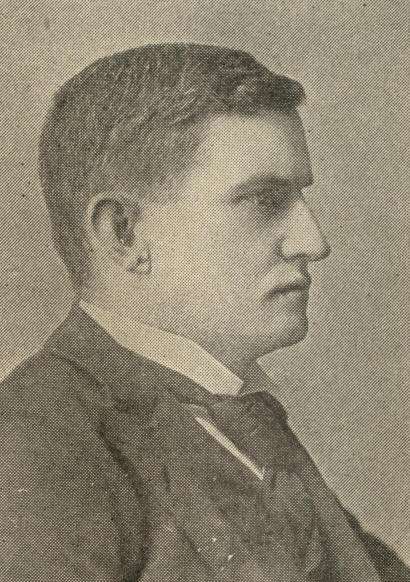
Benjamin R. Tillman.
So early as 1882 South Carolina passed a registration act which, amended
in 1893 and 1894, compelled registration some four months before
ordinary elections and required registry certificates to be produced at
the polls. Other laws made the road to the ballot-box a labyrinth
wherein not only most negroes but some whites were lost. The multiple
ballot-boxes alone were a Chinese puzzle. This act was attacked as
repugnant to the State and to the federal constitution. On May 8, 1895,
Judge Goff of the United States Circuit Court declared it
unconstitutional and enjoined the State from taking further action under
it. But in June the Circuit Court of Appeals reversed Judge Goff and
dissolved the injunction, leaving the way open for a convention.
The convention met on September 10th and adjourned on December 4, 1895.
By the new constitution the Mississippi plan was to be followed until
January 1, 1898. Any male citizen could be registered who was able to
read a section of the constitution or to satisfy the election officers
that he understood it when read to him. Those thus registered were to
remain voters for life. After the date named applicants for registry
must be able both to read and to write any section of the constitution
or to show tax-receipts for poll-tax and for taxes on at least $300
worth of property. The property and the intelligence qualification each
met with strenuous opposition, but it was thought that neither alone
would serve the purpose.
The Louisiana constitution of 1898, in place of the Mississippi
"understanding" clause or the Alabama "good character" clause, enacted
the celebrated "grandfather" clause. The would-be voter must be able to
read and write English or his native tongue, or own property assessed at
$300 or more; but any citizen who was a voter on January I, 1867, or his
son or his grandson, or any person naturalized prior to January 1, 1898,
if applying for registration before September 1, 1898, might vote,
notwithstanding both illiteracy and poverty. Separate registration lists
were provided for whites and blacks, and a longer term of residence
required in State, county, parish, and precinct before voting than by
the constitution of 1879.
North Carolina adopted her suffrage amendment in 1900. It lengthened the
term of residence before registration and enacted both educational
qualification and prepayment of poll-tax, only exempting from this tax
those entitled to vote January 1, 1867. In 1902 Virginia adopted an
instrument with the "understanding" cause for use until 1904, hedging the
suffrage after that date by a poll-tax. Application for registration
must be in the applicant's handwriting, written in the presence of the
registrar.
White solidarity yielding with time, there were heard in the Carolinas,
Alabama, and Louisiana, loud allegations, not always unfounded, that
this side or that had availed itself of negro votes to make up a deficit
or turned the enginery of vote suppression against its opponents' white
supporters.
Most States which overthrew negro suffrage seemed glad to think of the
new regime as involving no perjury, fraud, violence, or
lese-constitution. Some of Alabama's spokesmen were of a different
temper, paying scant heed to the federal questions involved. "The
constitution of '75," they said, "recognized the Fifteenth Amendment,
which Alabama never adopted, and guaranteed the negro all the rights of
suffrage the white man enjoys. The new constitution omits that section.
Under its suffrage provisions the white man will rule for all time in
Alabama."
The North, once ablaze with zeal for the civil and political rights of
the southern negro, heard the march of this exultant southern crusade
with equanimity, with indifference, almost with sympathy. Perfunctory
efforts were made in Congress to secure investigation of negro
disfranchisement, but they evoked feeble response.