
[1890]
It is a long way that we have taken the reader, from the days of
Columbus to where we can espy the dawn of the twentieth century. Yet, in
comparison with the times which our narrative has here reached, those of
three decades earlier would seem almost as remote as Columbus's own, so
swiftly did the wheels of progress turn. Everything declared that a new
age had opened. In addition to the signs of this which have been set
down in the preceding chapters, we have only space for the bare mention
of a few others.
In 1888 the United States mails flew from point to point across the
continent with a rapidity which would have astounded people so few years
back as the close of the war. Their distribution effected through the
post-office cars that ran on all the main lines and by immediate
delivery in cities and large towns, was quite as great an improvement as
the speed. The postal-car system had origin in Chicago in 1864,
spreading thence East and West. Speedy delivery was introduced in 1886.
Postal rates were lower than ever before, and destined soon to be lower
still. Much business formerly left to the express companies was now done
by mail, and much carried on in this way which formerly was not done at
all.
Our country had developed an attention to art in all its forms far
beyond anything of the kind to be observed at the end of the war. In all
the principal cities concerts of the highest order were provided and
numerously attended. Our art galleries already vied with many of those
in the Old World. Students of art were found in abundance in our own
multiplying schools for them, while many from this country sought art
instruction in Europe. Not a few Americans attained eminence in this
department year by year. In one artistic line we already excelled every
other people, viz., the application of the principles of taste in
beautifying homes, churches, structures intended for business, such as
exchanges, railway stations, and bridges, cars, and all kinds of
machinery. We led the world, too, in propriety and neatness of apparel,
at least, for men.
After the war the right to vote was extended in nearly all the States,
until by 1890 manhood suffrage was legally the rule from North to South
and from East to West. In this, indeed, we were only keeping pace with
Great Britain, France, Italy, Switzerland, and Germany. The agitation
for woman's suffrage had, however, progressed further here than in any
other land. There was a large party, quasi-political, intent upon
bringing it about. A national convention was held in that interest each
year. In Wyoming and Utah the suffrage had already been enjoyed by women
since 1869. In Kansas, by a law going into effect February 16, 1887,
they voted on all municipal affairs. In many other localities they had
the privilege of voting on certain questions, as the election of school
committees, and were eligible to membership in these committees.
Occupations of honor and profit were, more and more as the years passed,
open to the female sex. Women preached, practised law and medicine, and
furnished many of the best bookkeepers, sales-people, and principals of
schools. Vassar College, the first institution in the world for the full
collegiate education of women, was opened in 1861. Smith and Wellesley
Colleges, for the same, were opened in 1875, Bryn Mawr following in
1885. Cornell, Michigan, and all the State Universities in the West,
like a number of the best universities in the East, educated young women
on the same terms as young men. Harvard opened its Radcliffe College for
female pupils. At its commencement in 1886, Columbia College, of which
the Barnard College for women became virtually a part, conferred the
degree of Doctor in Philosophy upon a woman. Yale University and the
University of Pennsylvania opened their graduate departments to women on
the same terms as to men. Brown University did the same, besides
providing for the undergraduate instruction of women.
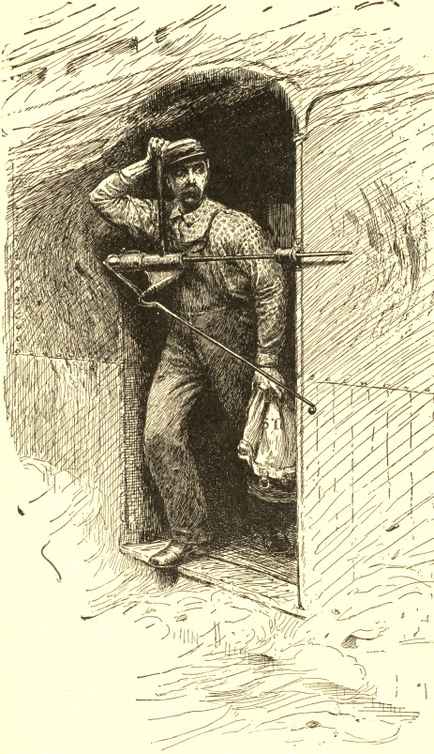
Catching the Mail Pouch from the Crane.
Another sign of the times, still more striking, was our advance toward
socialism and state socialism. This occurred for the most part in ways
so recondite as to escape observation, yet in many respects the course
of things in this direction was perfectly obvious. The powerful movement
for the legal prohibition of the manufacture and sale of intoxicants was
one instance. The extension and perfection of our public school system,
all at the expense of the taxpayers, was another, it being possible by
1890 in nearly every State for a young person of either sex to secure,
without paying a cent of tuition money, a better education than the
finest universities in the land could give a hundred years previous. The
extent of governmental surveillance over great industries was another
illustration. The Trusts spoken of in a preceding chapter were
unhesitatingly assumed to be subject to legislative investigation and
command. Great corporations and combinations, it was now well
understood, could not pursue their ends merely for profit, irrespective
of public interest. The Inter-State Railway Law of February 4, 1887,
instituting a National Commission, to which all railways crossing state
lines were responsible for obedience to certain rules which the same law
enjoined, was the boldest assertion of state supervision yet made; but
there was a great and growing number of thinkers who believed that mere
state oversight would not suffice, and that at least gigantic businesses
like telegraph, railway, and mining, must sooner or later be bought and
operated out and out by public authority. Nothing had done so much to
promote this conviction as the rise, procedure, and wealth of these
Trusts, for from the oppressive greed of many of them no legislative
regulation seemed sufficient to protect the people.
This tendency to over-exalt the State's industrial function was not the
only danger which confronted us. Another was that from immigration. So
enormous was the influx of foreigners that we were threatened with a
fatal emasculation of our national character. The manner in which we
incorporated alien elements theretofore was among the wonders of
history, but it was at least a question whether we could continue to do
this always. It seemed in part therefore a healthy sentiment which by
the law of 1882 excluded Chinese labor-immigrants. New-comers from other
lands were also refused domicile here if imported under contract,
[Footnote: Law of February 26, 1885] or unable to support themselves.
The stronger law against the Chinese at first sight seemed invidious,
but there was some justification for it in the fact that those people
almost never settled down permanently as citizens of the United States,
but returned to their native land so soon as they earned a competence.
Italians of the lowest class did this to some extent, but the great bulk
of our foreign-born population came here with the purpose of becoming
American.
Our Irish-American fellow-citizens gave concern to many. One complaint
was that they brought hither their anti-English prejudices, by the loud
and continual assertion of which they tended ever to embroil us with
England. There proved to be slight danger from this source, particularly
after the rise of a powerful pro-Irish sentiment and party among the
English themselves. Others had great fear of the Irish as Catholics,
they being the chief representatives of that faith in the United States.
The growth of the Roman Catholic Church in our borders was certainly
very rapid. An American clergyman, McCloskey, was made Cardinal in 1875.
A University, subject to the Catholic Church was erected in Washington.
Catholicism in America was no longer a mission church as it had been
until quite recently, but had a full national organization as in the
other great nations of the earth.
A strong movement was developed among the Catholic clergy against our
common schools as usually administered. Parochial schools were erected
in most Eastern cities and large towns, and efforts made to fill them
with children who, but for their existence, would be in the public
schools. Public schools were denounced as godless because they did not,
as of course they could not, give positive religious instruction. This
opposition was doubtless a menace to our time-honored and on the whole
very efficient school system, so that what the future of this was to be
no one could confidently predict. It was to be remarked, however, that
some of the warmest defenders of the public schools appeared in the
Catholic ranks; nor was there any evidence that, as a class, American
citizens of Irish birth and descent prized the free institutions of this
nation a whit less than the rest of the people.
A greater peril beset the nation in the decay which slowly crept over
our family life. The family has in every civilized age been justly
regarded as the pillar of the state, but the integrity which it
possessed among our fathers, their children invaded in many ways.
Mormonism, decadent if not dead, about which so much had been said, was
but one of these, and perhaps not the worst. If crimes of a violent
nature were becoming less frequent, crimes against chastity were on the
increase. Easy divorce was considerably responsible for this. The
diversity of marriage and divorce laws in the various States was a great
abomination. How to remedy it did not appear. Many called for a
constitutional amendment, lodging solely in Congress the power of making
laws upon this vital subject.
We proved very fortunate as a people in that our material prosperity
itself did not prove a greater curse. More than every other disaster was
to be feared the growth of a temper for mere material thinking and
enjoyment, the love of lucre and of those merely material comforts and
delights which lucre can buy. There was among us quite too little care
for the ideal side of life. Too many who purchased books loved them
only for the money they cost. Rich engravings and bindings were often
sought rather than edifying matter. Costly daubs were purchased at
enormous prices for lack of true artistic taste or relish. In sadly
frequent cases the great captain of industry was nothing but a plodder.
There was too great rush for wealth. We became nervous. Nervous diseases
increased alarmingly. We read, but only market reports. Think, we did
not; we only reckoned.
The outlook, notwithstanding, embraced much that was hopeful. Very
worthful as well as very beautiful was the new sense of nationality that
had been developed in this country in consequence of the war. While men
still differed as to the original nature of our Union, while the State
remained as yet a vital though a decreasingly important organ of the
political frame, its real status offering to reward study as never
before because no longer a sectional issue, yet the war, as unmistakably
pronouncing the national will, laid the question of Nation's supremacy
over State forever at rest, having hereupon virtually the effect of a
constitutional amendment. Close construction of the Constitution could
never again throttle this Union. Whether such quasi-amendment altered
the Constitution, Stephens's view, or served but to bring out more
clearly its old meaning, our view, practically the war had entailed
enormous new exaltation and centralization of the Union, with answering
subordination of the State.
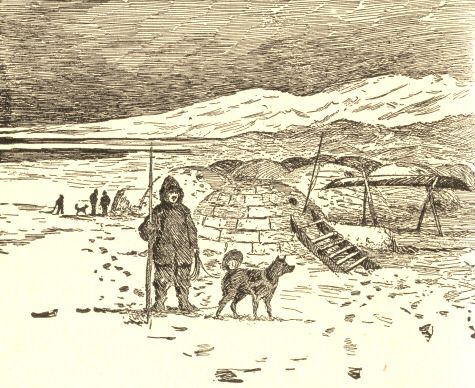
Igloos, or Esquimau Huts.
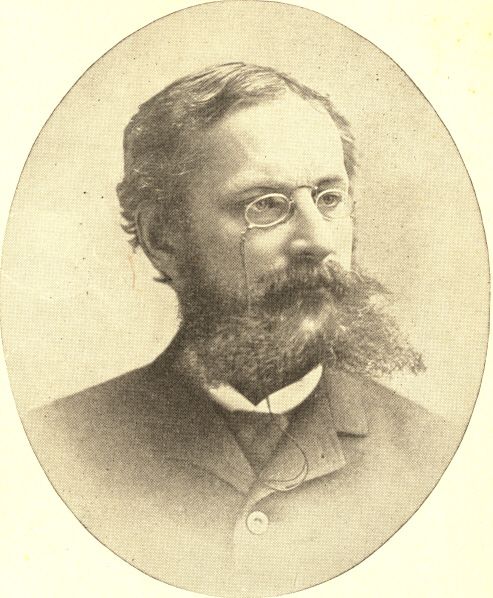
A. W. Greely.
A quickened sense of our duty as a nation might likewise be observed at
work in various directions. Our treatment of the Indians had been, since
the administration of President Grant, more humane than ever before.
Earnest and successful efforts were made, very largely at the national
expense, to educate them and prepare them for citizenship. They were
better protected from the rapacity of heartless agents and frontiersmen,
while the land in severalty legislation of 1887 opened the red man's way
to the actual attainment of civil rights and to all the advance in
civilization of which he was capable.
The part which our Government had begun to take in the advancement of
science was greatly to its credit. We have space to instance only the
expedition of 1881-1884, headed by Lieutenant Greely, to the northern
polar regions for scientific observation, reaching a point nearer to the
pole than had ever before been attained. The whole world admired the
daring and sympathized with the sufferings of these gallant explorers,
several of whom perished of cold and hunger before relief reached them,
the others rescued barely in season to save them from like fate.
The revision of King James's version of our English Bible, New Testament
finished in 1881, Old Testament in 1885, was an eminent historical event
falling in this period. American divines took prominent part in it,
though of course not under any commission from our Government.
Being the most trying crisis ever successfully met by a self-governed
people, the war lent powerful stimulus and tonic to the cause of free
institutions everywhere, proving republican loyalty to be as firm and
trustworthy as monarchical, and government by and for the governed to be
not necessarily either inefficient or ephemeral. It demonstrated that a
republic, without lessening its freedom, may become a great military
power, generals of highest genius passively obeying a popularly elected
Congress and Executive, these in turn maintaining full mastery, yet not
hampering military movements.
The achievement of this firmer national unity, with the success and the
martial and financial prodigies attending the struggle therefor, gave us
new and far higher place in the esteem of nations, with correspondingly
enlarged influence in mankind's greater affairs.
By 1890 one might observe a more or less conscious disposition on the
part of thoughtful Americans to insist that this influence be exerted,
to have the nation break over the policy wisely laid down by Washington,
for earlier times, and assert itself more in the Parliament of Man. It
was felt that our place and power among the nations of the earth had not
been given us for naught, and that, as the weal of mankind is to a
considerable degree determined by international politics, we had no
right longer to hold ourselves aloof from this field. The feeling was
emphasized by the annihilation of space between us and other nations,
brought about through steam navigation and ocean telegraphy.
Not only Great Britain and France, but Germany, Russia, and China were
now at our very doors. They would influence our weal whether or not we
reacted upon them. Why should we not, without being meddlesome, strive
to disseminate our ideas, extend our civilization, and make our national
personality felt? It was to President Arthur's praise that he caused the
United States to be represented at Berlin in the Congo Conference of
1884-85. Next, men said, our delegates would be present with voice and
vote in all regular Congresses of the Great Powers. Americans did not
prophesy, as more than one voice out of Europe itself had of late done,
that the United States would some day cross the Atlantic as a conqueror.
This, indeed, was a somewhat natural thought. The Old World reeled under
its crushing burden of national debts and military taxes, and in
material resources could not long compete with us, free from such
burdens. But the American thought was that we should express our
superiority in the form of ideas, not of arms, and use it in elevating
mankind to richer culture and a nobler life.