
[1869]
We can give but little idea of the advance in industrial artifice and
appliances of all kinds made in the United States in the two decades
after the Civil War. Take it first in textile manufacturing. A century
earlier one person in every family had to work incessantly at spinning
and weaving to keep the whole of them in clothing. Now one day's work a
year per person sufficed for this. The speed of spindles had risen since
1860 from 5,000 to 7,500 revolutions a minute. Looms had gone from 120
picks to 160, and one hand tended from 25 to 50 per cent. more work. The
"slasher" dresser accomplished ten times more than the old machine,
supplying 400 looms in place of forty, and requiring to manage it only
one man and a boy instead of two men and ten girls. A generation earlier
one operative made three yards an hour, now he made ten. In the twenty
years under survey the annual production of cotton mills rose from two
and one-half to three and one-half tons per hand. One man formerly
tended forty spindles, now he tended sixty. In 1890 a single operative
in America could make cotton cloth enough to supply 1,500 persons.
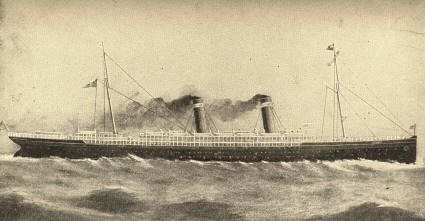
The American Line Steamship St. Louis, launched from the Cramps Docks,
November 12. 1894. (554 feet long 11,000 tons, and 20,000 horse-power.)
The improvements in woollen, iron, and miscellaneous manufacturing had
perhaps not been quite as great, but were remarkable notwithstanding.
Power and automatic machinery were the order of the day. The Corliss
engine got 23 per cent. more heat and energy from a given amount of coal
than had ever been obtained before it was invented. Instead of the
twenty-five days which the first transatlantic steamer required for the
passage from America to England, many vessels now went from New York to
Liverpool in considerably less than six days, or at an average rate of
more than twenty miles an hour. The speed of passenger trains on the
main railways had doubled. So had the weight of the freight-car load and
the amount of freight which an engine could pull. The newest locomotives
weighed nearly or quite one hundred tons each.
In 1869 a submarine cable was laid which joined the United States to the
continent of Europe. It extended about 3,050 miles, from Duxbury, Mass.,
to Brest, France, via the Island of St. Pierre, south of Newfoundland.
The company owning the cable was chartered by the waning empire of Louis
Napoleon. In 1875 a new cable was stretched between the United States
and Great Britain. It was called the United States Direct Cable, and at
first operated in opposition to the original one. The rates for cable
messages were greatly reduced in consequence. The price, once ten
dollars a word, fell in anticipation of the competition to fifty cents,
and to twenty-five after the competition actually began. The two
Anglo-American lines were subsequently united.
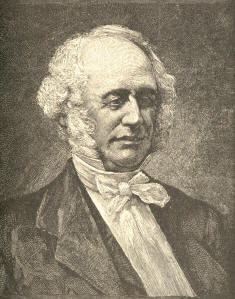
Cornelius Vanderbilt.
[1863-1869]
The year 1869 witnessed the junction of the Union Pacific with the
Central Pacific Railway, forming a continuous railway line between the
Atlantic and Pacific shores. The last rail was put down on May 12th, and
on the 15th trains began to run. This work had been in process of
construction ever since 1863. It traversed the Rocky Mountain range at
an elevation of 8,243 feet above sea-level. The Northern Pacific Railway
Company was chartered by Congress in 1864. The road was not completed
till August, 1883, nor opened to traffic before September. Its length
from Duluth to its then terminus on the Columbia River, Washington, was
1,674 miles. The Southern Pacific and the Atlantic and Pacific, both
traversing the Rockies, soon followed. Still another line, the Great
Northern, connecting St. Paul with the extreme Northwest, was opened in
1893. The country's total railway mileage in 1885 was 128,967 miles; in
1893 it was 170,607 miles.
In the same years with the opening of these continental lines began the
consolidation of the older ones into great systems. The New York Central
had already been formed out of sixteen different fragments, but the
process of consolidation in a large way may be said to have been
instituted by Cornelius Vanderbilt in 1869, when he joined the Lake
Shore and Michigan Southern with the New York Central, thus placing
under a single administration the entire route from New York to Chicago.
The first train pierced the Hoosac Tunnel, in Western Massachusetts,
February 9, 1875, completing another artery between East and West. The
tunnel passed through the Hoosac Mountain, a distance of four miles and
three-quarters, and had been in process of boring, though not
continuously, about fifteen years.
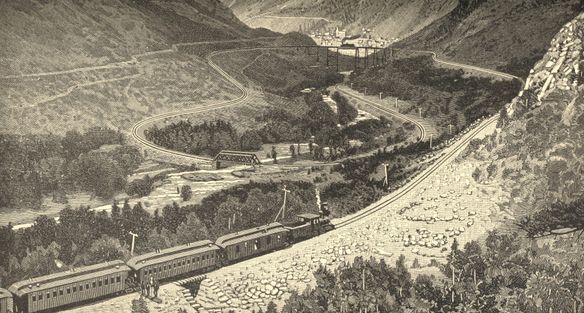
The Big Loop on the Georgetown Branch of the Union Pacific, Colorado.
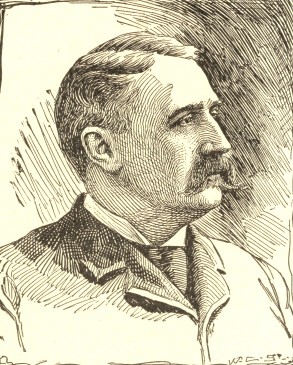
Charles F. Brush.
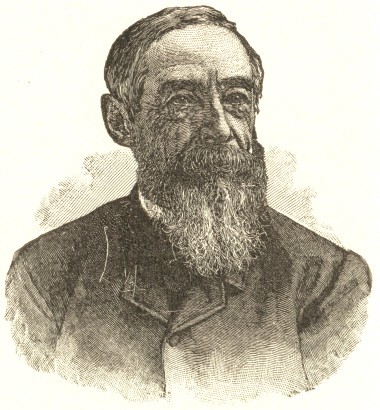
Moses G. Farmer.
[1875-1878]
The lighting of large spaces by electricity in a profitable manner may
be dated from 1875. The possibility of producing a brilliant light with
this fluid had been well known to physicists ever since Sir Humphry
Davy's experiments in 1813, but no method of generating the electricity
cheaply had hitherto been invented. Utilizing among others the
inventions of Dr. C. W. Siemens, Mr. Charles G. Brush, of Cleveland, 0.,
gave to the world in 1875 his remarkably efficient dynamo or generator,
and from that time the illumination of streets and squares by
electricity began to be somewhat common. There was, to be sure another
difficulty to be overcome, even for lighting on a grand scale, that of
maintaining a steady and continuous light. In this the Jablochkoff
candle, used in the Paris streets by 1878, was measurably successful. It
was a voltaic arc arrangement, in which, by making each of the two
carbon pencils alternately positive and negative, their ends were
consumed with equal rapidity and so kept perpetually the same distance
apart.
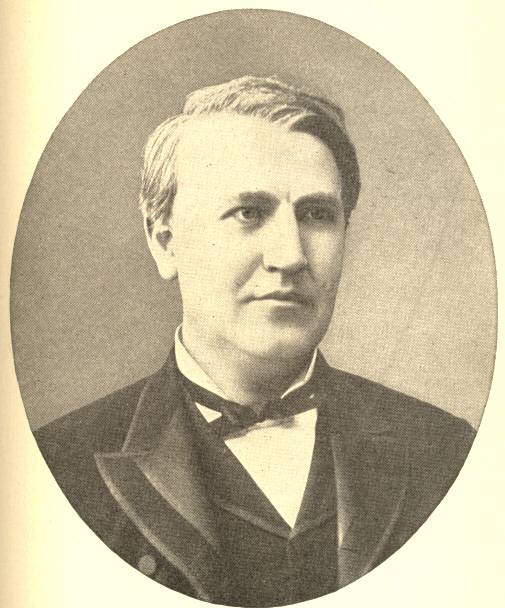
Thomas A. Edison.
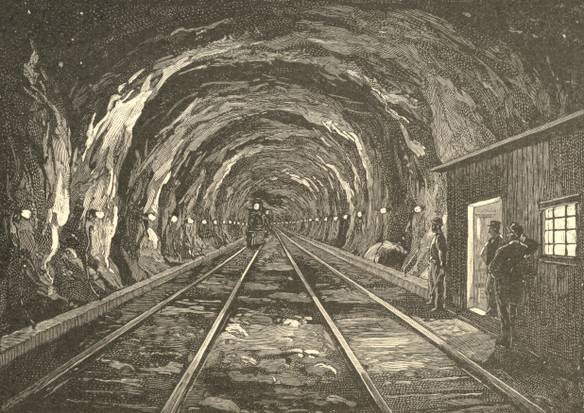
The Hoosac Tunnel Lit by Glow Lamps, after the Plan of the Marr
Construction Company.
But the voltaic light was too brilliant for a small area. How to divide
and subdue it so as to render it suitable for house lighting, was still
a difficult problem. Farmer, Sawyer, Mann, and Edison, all attacked it
at nearly the same time, going back with singular accord from the
voltaic arc principle to that of incandescence in a vacuum. Edison, the
prodigy of the century in inventive genius, was the most successful.
Besides improving the dynamo, he perfected with little difficulty a
cheap vacuum-globe. After long experimenting he succeeded in the more
arduous task of securing an automatic checking of the current before it
became hot enough to consume the incandescent carbon. He also found that
a large current could be divided into smaller ones by splitting up the
conductor into minor filaments. Triumph in household illumination was
thus achieved, and when, in October, 1878, the results of Edison's
experimenting were announced to the world, gas fell from twelve to
twenty per cent. The alarm was premature, however, since the new
illumination did not, after all, prove so satisfactory as to displace
the old. It largely did so for streets, factories, and halls, but to no
very great extent for residences.
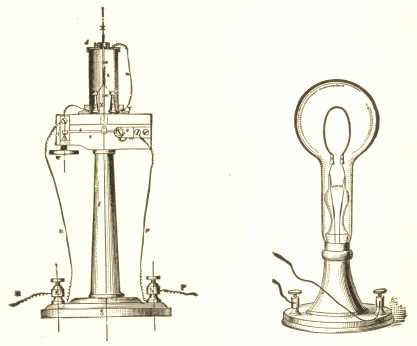
Edison's Platinum Lamp on Carbon Support, 1879.
Edison's Paper Carbon Lamp.
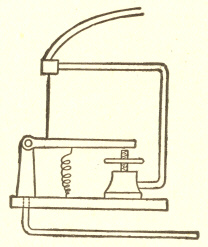
Edison's First Incandescent Platinum Lamp.
[1883-1884]
The most stupendous engineering work yet accomplished by man, the great
bridge spanning East River between Brooklyn and New York, was completed
in May, 1883, excavations for its foundations having begun so early as
1870. This wonder of the world was designed by John A. Roebling, and
after his death in 1869 finished by his son, W. A. Roebling. It cost
about $16,000,000, two-thirds coming from the city of Brooklyn,
one-third from New York. A gigantic stone tower, 277 feet high, was
built on each side of the river. Through arched apertures in these
toward the top ran the roadway, its ends being 119 feet above the water.
The centre of the bridge was supported by four steel wire cables, 16
inches in diameter, which passed from solid masonry structures nearly
1,000 feet away from the water's edge on either shore, up over the two
towers, dipping, at the centre of the river, to nearly the level of the
roadway. On account of their great weight they had to be braided, strand
by strand, in their permanent position. Suspenders from these cables
grappled the body of the bridge at frequent intervals. The main span was
I,595-1/2 feet long, the entire work about 6,000 feet. There were five
passageways–two on the outside for carriages, the next two for cable
cars, the middle one for foot passengers. The bridge curved upward from
each tower, being at the middle 135 feet above the water in summer, and
three feet higher in winter, owing to contraction by the cold. All but
the very largest ships sailed under without shortening their masts.
In connection with the great bridge, as likewise in a way possessing an
importance for the whole nation, we may mention the ingenious deepening
of Hell-gate Channel, East River, by tunnelling beneath the water and
using dynamite; and also the introduction of elevated railways in New
York City and Brooklyn. This project had been mooted by 1868. Exactly
ten years later two sections of railway were open for travel in New
York. The first elevated road in Brooklyn began operation in 1885. These
new avenues of travel at once became immensely popular. In 1884, no
fewer than 250 engines and 800 cars were in use by the New York lines,
carrying over 300,000 passengers daily, or about 103,000,000 for the
year. Nearly at the same time with the introduction of these roads in
New York, new methods of traction for surface street railways, by
electricity and by cable, were introduced in various cities of the
country, bidding fair soon to do away with horses for this service.
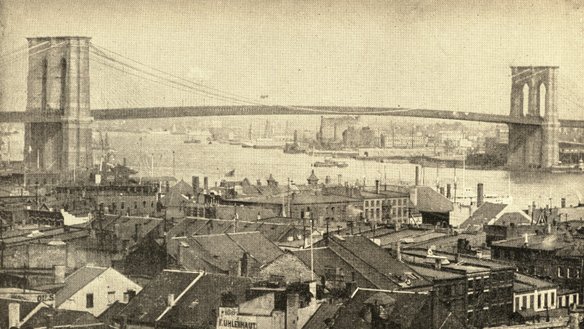
The Brooklyn Bridge, looking up the East River.
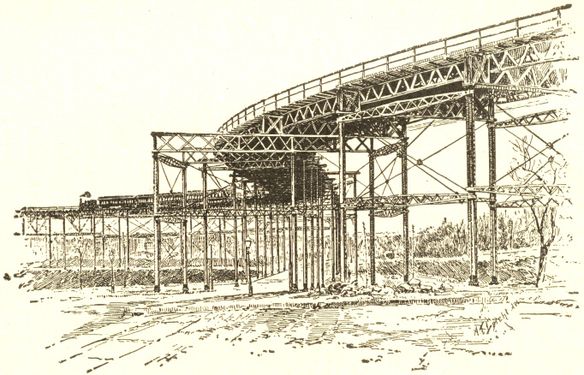
The Manhattan Elevated Railway, New York.
[1877-1887]
One of the most interesting and valuable inventions of this or any
century was that of the telephone, devised by Alexander Graham Bell, and
first put to business use in 1877. For ten years Mr. Bell had been
experimenting upon the possibility of conveying sound by means of the
electric wire. In 1876 he had so far succeeded as to exhibit a pair of
his instruments in successful operation at the Philadelphia Centennial
Exhibition. In April of the next year the Cambridge Water Board, the
Pennsylvania Railroad, and many other corporations ordered the
instrument for practical service. From this time the business grew with
incredible rapidity. The American Bell Telephone Company was
incorporated, and in January, 1886, had in use 330,000 telephones. There
were this year in various cities of the United States 752 telephone
exchanges. The total length of telephone wires operated by this company
was 114,371 miles. In addition to the system which centred in the Bell
Company there were several competing telephone establishments in
continual litigation with the Bell. The total mileage of telephone wires
in the United States in 1887 was estimated at 130,000 miles. There were
the same year 170,000 miles of telegraph wire, besides private lines. In
1893, the aggregate length of telegraph lines in the United States open
to the public exceeded 210,000 miles. There were, besides, government
and private lines to a length vast but not ascertainable. In addition to
all this, the Bell Telephone Company, which conducted the main telephone
business of the country, owned, the same year, 307,748 miles of wire,
which the lines of other companies increased to 440,750 miles.
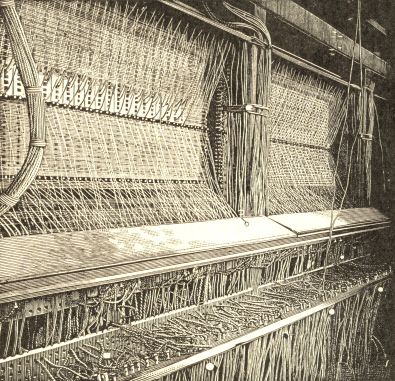
Under Side of a Modern Switchboard, showing 2,000 Telegraph Wires.
[1862-1877]
From this account of our country's material advance after the war we
purposely omit mention of the great economic progress at the South, as
that has been already reviewed in Chapter IV. We must, instead, notice
several events which decidedly checked the prosperity of these years.
So soon as gold had ceased to circulate in 1862, speculation in it
began, which was one of the most pernicious results of the depreciation
of paper. The ups and downs in the gold price of the greenback from week
to week and from day to day during the war were largely due to this
cause. In 1869 a clique of speculators in New York thought to realize an
immense fortune by cornering gold, a large proportion of the stock east
of the Rocky Mountains being known to be in New York City.
By Wednesday, September 22d, they had pushed up the price of gold in
greenbacks from 131 to 141, causing a disastrous tumble in stocks and
almost a panic. The money market grew tight, and interest enormous.
Loans were to be had only on the very best securities. On Thursday gold
still advanced, showing that the corner remained solid. At the last call
it stood at 144; at the first on Friday, September 24th, 105 was the
figure. The ring was believed at this time to hold in gold and in
contracts to deliver the same, over $100,000,000, while all the gold in
New York outside the United States Sub-Treasury was hardly over
$10,000,000. Only the Government could break the corner. At eleven
o'clock gold was at 155, whence in half an hour it rose to 160, then to
162, then to 164. In the midst of an excitement never paralleled in the
Gold Room before or since, it was announced on authority that the
Government would sell. The price at once went down to 135, and the power
of the clique was instantly broken. This day passed into history under
the name of "Black Friday."
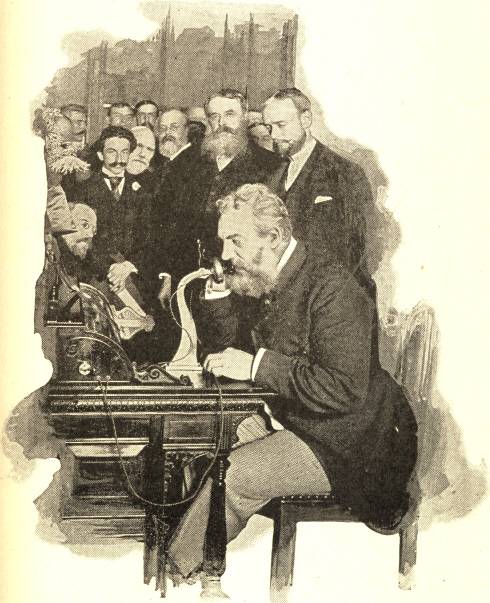
Professor Bell Sending the First Message by Long-distance Telephone,
from New York to Chicago.
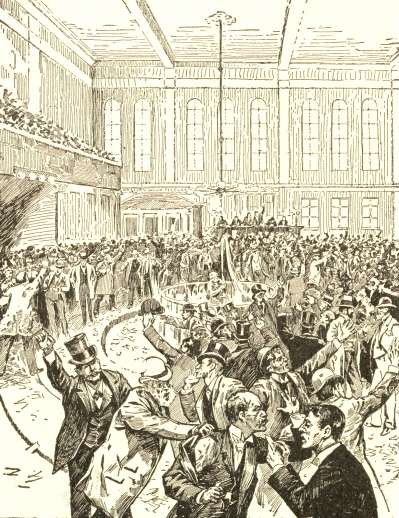
The New York Gold Room on "Black Friday," September 24, 1869.
The Chicago fire of October, 1871, was the most disastrous yet in the
chronicles of our country. It began in the evening of October 8th and
raged for over twenty-four hours. According to the best estimates 250
lives were lost, 98,500 persons made homeless, 17,500 buildings
consumed, and $192,000,000 worth of property destroyed. The main
business portion of the city was included in the tract burned. Thirteen
months later the most destructive conflagration that had ever visited
Boston swept the district below Washington Street from Summer nearly to
State, and eastward to the water's edge, being the most solid business
portion of the city. The loss was placed at $75,000,000.
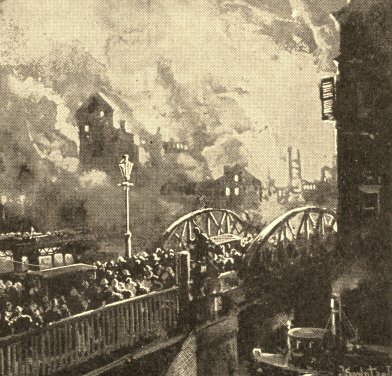
A Scene during the Chicago Fire.
The shocking destruction of wealth by these fires was part cause of the
hard times which began in 1873. But others concurred. During 1872 the
balance of trade was strongly against the United States. The
circulation of depreciated paper money had brought to many an apparent
prosperity which was not real, leading to the free contraction of debts
by individuals, corporations, towns, cities, and States. An
unprecedented mileage of railways had just been constructed. During the
half decade ending with 1873, $1,700,000,000 had thus been spent in the
country. The supposed wealth of many consisted in the bonds of these
roads and of other newly created concerns, as mining and manufacturing
corporations. Thus the entire business of the country was on a basis of
inflation, and when contraction came by the resumption of specie
payments and the demonetization of silver, disaster was inevitable.
In the course of the summer solid values began to be hoarded and
interest rates consequently to rise. In September panic came. Credit in
business was refused, debtors were pressed for payment, securities were
rushed into the market and fell greatly in price, railway stocks from
ten to forty per cent., even United States bonds from five to ten. There
was a run upon savings banks, many of which succumbed. For ten days,
beginning September 20th, the New York Stock Exchange had to suspend, so
dubious was the value of most stock contracts. Manufactured products
were little salable, and the prices of agricultural painfully sank.
Factories began to run on short time, many closed entirely, many
corporations failed. The peculiarity of this crisis was the slowness
with which it abated. No date indeed can be set as its term, its evil
effects dragging on through years, so that the ill times of 1893-94 may
be regarded as the same fever, intermittent in the meantime.
[1880]
Notwithstanding all these drawbacks, the material progress of the United
States for the two decades which we are studying was something enormous.
We have no room for details. Our total population by 1880 had swollen to
50,155,783, by 1890 to 62,622,250. The census valuation of our national
wealth, which had been for 1860, $16,159,616,068. was, for 1870,
$30,068,518,507; for 1880, $43,642,000,000; and for 1890,
$65,037,091,197. The per capita wealth was, according to the census of
1860, $514, by that of 1870, $780, by that of 1880, $870, by that of
1890, $1,036. In 1870 the United States was in wealth the third nation
on the globe; in 1880 it had distanced France and stood second. "The
country whose population has been developed within two hundred and
eighty years, does already one-third of the world's mining, one-fourth
of its manufacturing, and one-fifth of its agriculture; and at least
one-sixth of the world's wealth is already concentrated in the strip of
territory in Central North America which is the home of the United
States." These words were written after the census of 1880. Still
stronger ones would have been true in 1895.