
[1876]
It was fitting that the one hundredth anniversary of a great industrial
nation should be celebrated by a World's Fair. Such a plan was first
publicly proposed for the United States in 1870, by an association of
Philadelphia citizens. It was adopted by Congress in the following year,
when an act was passed creating a Centennial Commission, to consist of a
delegate and an alternate from each State and Territory. The commission
organized for the great and difficult work before them by choosing
General J. R. Hawley, of Connecticut, president, and by appointing an
executive committee, a board of directors, and heads of various
administrative bureaus.
The Government declined to assume the financial responsibility of the
enterprise, but in 1872 Congress appointed a Centennial Board of Finance
with power to raise a capital stock of $10,000,000. Shares to the amount
of $2,400,000 were soon sold to private citizens. Philadelphia
appropriated $1,500,000, and Pennsylvania $1,000,000. In 1876 Congress
made a loan to the Board of $1,500,000. Thus the great problem of a
financial basis for the enterprise was solved.
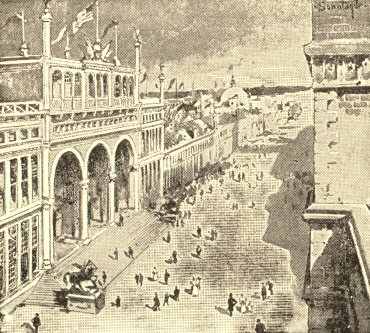
At the Centennial Exposition, Philadelphia, 1876.
The first thought had been to make the exposition exclusively national,
but subsequent deliberation made it seem best to widen the plan so that
the arts and industries of the entire world should be represented.
President Grant formally proclaimed the Exhibition in 1873, and in the
following year foreign governments were invited to participate.
Thirty-three cordially responded.
Meanwhile, the commission was pushing preparations. Philadelphia, the
birth-place of the nation, was rightly chosen as the place for this
unique memorial of that event. In the beautiful and spacious Fairmount
Park, on the high bank of the Schuylkill River, an area of 285 acres was
inclosed, and here five main buildings were soon rising rapidly as by
magic. Besides these, there were at the time of opening, smaller
structures to the number of 175, filling every available space.
On May 10th the Exposition was opened with appropriate exercises, in the
presence of 100,000 people. Wagner had composed a Centennial March for
the occasion. Whittier's Centennial Hymn was sung by a chorus of 1,000
voices. The restored South chanted the praises of the Union in the words
of Sidney Lanier, the Georgia poet. President Grant, in a short speech,
then declared the International Exhibition open. A procession of
dignitaries moved to Machinery Hall, where the President of the United
States and Dom Pedro II., Emperor of Brazil, set in motion the great
Corliss engine, and with the whirr of spindle and clatter of machinery
the world's seventh great fair began.
Weeks and months of inspection were necessary to grasp the Exhibition as
a whole and in detail, but an imaginary stroll through the grounds will
give the reader some general idea of it.
Entering through one of the 106 gates, the sight-seer naturally turned
his eye first toward the colossal Main Building. A parallelogram in
form, 1,880 feet long by 460 wide, and 70 high, it covered twenty acres.
At the centre and ends were projecting wings, large buildings in
themselves. In the middle and at the four corners rose towers. In spite
of its size the building seemed light and almost graceful. Its brick
sub-structure, seven feet high, stood upon massive masonry foundations.
The rest of the building was mainly glass and iron. The iron trusses of
the roof rested upon 672 slender iron pillars. This hall had been
erected in a year, at a cost of $1,700,000.
In the Main Building manufactures were exhibited, also products of the
mine, along with various other evidences of the condition of science and
education. The broad aisles ran the whole length of the interior,
flanked on either side by exhibits. More than one-third of the space
was reserved for the United States, the rest being divided in varying
proportions among foreign countries. The products of all climates,
tribes, and times were here crowded together under one roof. The mighty
states of Great Britain, France, and Germany exhibited the work of their
myriad roaring looms side by side with the wares of the Hawaiian Islands
and the little Orange Free State. Here were the furs of Russia with
other articles from the frozen North; there the flashing diamonds of
Brazil and the rich shawls and waving plumes of India. At a step one
passed from old Egypt to the latest-born South American republic.
Chinese conservatism and Yankee enterprise confronted each other across
the aisle. All civilized nations but Greece were represented–more than
ever before took part in an international fair.
From the novelty of the foreign display the American visitor returned
proudly to the display made by his own land. Textiles, metal work, arms
and tools, musical instruments, watches, carriages, cutlery, books, and
furniture–a bewildering array of all things useful and ornamental–made
Americans realize as never before the wealth, intelligence, and
enterprise of their native country and the proud station she had taken
among the nations of earth.
Machinery Hall came next to the Main Building in size. Of plain
architecture, built of wood, with iron ties, 1,402 feet by 360, it
covered, with an annex, about thirteen acres. Here, with infinite
clatter and roar, thousands of iron slaves worked their master's will.
Three-fourths of the space was taken up with American machines. Visitors
from the foremost foreign nations marvelled at the ingenuity of the
Yankee mind here displayed. Great Britain led the foreign nations in the
size and number of articles exhibited. Canada, France, Russia, Sweden,
Brazil, and other countries sent ingenious or powerful machines.
But as a Titan, towering above all these and all others, stood the great
Corliss engine, built by George H. Corliss, of Providence, R. I., one of
the most remarkable mechanicians and inventors of the century. A modern
Samson, dumb as well as blind, its massive limbs of shining steel moved
with voiceless grace and utmost apparent ease, driving the miles of
shafting and the thousands of connected machines. The cylinders were
forty inches in diameter; the piston stroke, ten feet. The great
walking-beams, nine feet wide in the centre, weighed eleven tons each.
The massive fly-wheel, thirty feet in diameter, and weighing fifty-six
tons, made thirty-six revolutions a minute. The whole engine, with the
strength of 1,400 horses, weighed 700 tons.
Agricultural Hall, built of wood and glass in the form of a nave with
three transepts, covered ten acres. The display it contained of
agricultural products and implements was the largest ever made. Here the
United States stood forth far in advance of all sister nations.
Specimens of the rich and deep prairie soil excited the wonder and envy
of tillers of impoverished European lands. The great West, with its
monster steam-ploughs and threshing machines, placed before the eye the
farming methods of a race of giants. The choice and delicate fruits of
sunny lands mingled with the hardy cereals of Canada and Russia.
Memorial Hall, a beautiful permanent building of granite, erected by
Pennsylvania and Philadelphia at a cost of $1,500,000, was given up to
art. This was on the whole the poorest feature of the Exposition.
America had few works of the first order to show. Foreign nations, with
the exception of England, feared to send their choicest art products
across the ocean. France, Germany, Spain, Belgium, and the Netherlands,
with some other countries, were all represented. Italy, besides
paintings, sent many pieces of sculpture. England contributed a noble
lot of paintings, including works by Gainsborough and Reynolds. In spite
of all, the collection was the largest and most notable ever seen in
this country, and throngs crowded the galleries.
Horticultural Hall, built of iron and glass in the Moorish style of the
twelfth century, also a permanent structure, was erected by
Philadelphia. Here, one walked amid the glories of tropical vegetation.
Palm, orange, lemon, camphor, and india-rubber trees rose on every hand.
The cactus of the desert, rare English flowering plants, strange growths
from islands of the sea, here flourished each in its peculiar soil and
climate. Outside the building were beds of hardy flowering plants
covering twenty-five acres. Besides these five main structures, the
United States Building, where the working of the various administrative
departments of the Government was shown, attracted thousands of visitors
daily. A Woman's Pavilion contained products of female industry and
skill. A narrow-gauge railway ran in great loops from building to
building.
Twenty-six States erected buildings of their own. These served mainly as
headquarters, but two or three contained large exhibits of state
products. Thirty or more buildings were put up by private enterprise to
illustrate various manufacturing and industrial processes. Before the
close of the Exposition more than two hundred buildings stood within the
enclosure. Several foreign Governments erected small structures of
various sorts.
Through the summer months, in spite of the unusual heat that season,
thousands of pilgrims from all parts of the country found their way to
this shrine of the world's progress. The quiet old Quaker city was moved
with unwonted life. Amidst the crowds of new-comers its citizens became
strangers in their own streets.
On July 4th, simple but impressive ceremonies were held in the public
square at the rear of Independence Hall. On temporary platforms sat
5,000 distinguished guests, and a chorus of 1,200 singers. The square
and the neighboring streets were filled with a dense throng. Richard
Henry Lee, grandson of the mover of the Declaration of Independence,
came to the front with the original document in his hands. At sight of
that yellow and wrinkled paper, the vast audience burst forth into
prolonged cheering. Mr. Lee then read the Declaration. The recitation of
an ode by Bayard Taylor and the delivery of an oration by Hon. William
M. Evarts were the other main features of the exercises.
Through the early fall the interest in the Exposition spread farther and
farther over the land, and the attendance steadily increased. On
September 28th, Pennsylvania day, 275,000 persons passed through the
gates. During October, the visitors numbered over 2,500,000. From May
10th to November 10th, the total admissions were 9,900,000; 8,000,000
admission fees were collected, amounting to $3,800,000. The fair was
brought to an end on November 10th. After brief closing exercises,
President Grant gave the signal to stop the Corliss engine. The giant
slowly came to a standstill, the hum of the machinery died away, and the
International Exhibition of 1876 was closed.
The Centennial Exposition was not a complete financial success. After
returning the United States loan of $1,500,000, the stockholders could
not be paid in full. The attendance was, however, larger in the
aggregate than at any previous international exhibition, except that of
Paris in 1867. The admissions there reached 10,200,000, but the gates
were open fifty-one days longer than at Philadelphia. At Vienna, in
1873, there were but 7,255,000 admissions in 186 days against 159 days
at Philadelphia.
The larger and more important results of this exposition cannot be
measured with precision. A thousand silent influences were set at work
upon our social, intellectual, and political life, which operated in
secret for years afterward. The most obvious, and perhaps the most
important, effect was the broadening of sympathies and mental outlook.
Visitors to Philadelphia got something of the benefit of foreign travel.
Local prejudices were broken down. New ideas of life and civilization
were planted in hitherto sterile minds. The plodding Eastern farmer
caught something of the Westerner's dash and swing. North and South,
East and West, drew nearer together. A narrow patriotism caught glimpses
of a great and noble world without.
These influences touched the most careless observer. Special classes
derived each a peculiar benefit. Mechanical invention was stimulated.
Art received an impetus which can never cease to be felt. To our
household art, especially, came much quickening from the sight of
England's beautiful display of home decorations.
The Exposition exalted the United States in the eyes of her foreign
guests. Many were amazed at such proofs of the wealth, intelligence, and
progressive spirit of the great republic. A correspondent of the London
Times wrote, in 1876: "The American invents as the Greek sculptured and
the Italian painted; it is genius." We may hope that the exhibits were
educators to Europe as well as to America.
Lastly, the American returned from the great fair with an opinion of his
own country which, if more sober and just than he had previously
entertained, was not less proud but far prouder. The Nation laid aside
its holiday attire, and, despite manifest defects and dangers in our
national life, settled down to another century of work with increased
pride in its past and stronger confidence for its future.