
[1890]
Aside from West Virginia, made during the war from the loyal part of
Virginia, the new States created between 1860 and 1900 were Kansas,
1861; Nevada, 1864; Nebraska, 1867; Colorado, 1876; North Dakota, 1889;
South Dakota, 1889; Montana, 1889; Washington, 1889; Idaho, 1890;
Wyoming, 1890; and Utah, 1896. The whole number of States had thus
become forty-five. We had also, in the year 1896, three organized
territories, Arizona, New Mexico, and Oklahoma, the last carved out of
Indian Territory in the year 1890. Alaska was as yet a partially
organized territory, having no territorial legislature, and being under
the laws of the United States and of the State of Oregon. It was
purchased by the United States from Russia in 1867, for the sum of
$7,200,000. It remained without any organization until the act of May
17, 1884, which gave it a governor, a district court, an attorney, a
marshal, and commissioners.
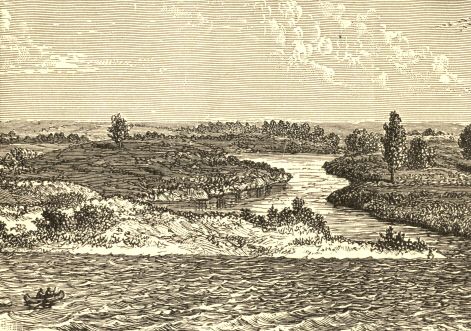
The Site of Chicago.
The value to our Union of this new acquisition, with its 531,409 square
miles and a coast-line longer than that upon our Atlantic and Gulf
coasts together, was at first doubtful, and continued so till gold was
found on the Yukon and at Cape Nome. Clearly, however, the money had not
been thrown away. Governor Swineford, appointed over the Territory in
1885, declared that throughout Southern Alaska and the Aleutian Islands
the climate was moderate, even in winter; and he gave records of
thermometrical observations which seemed to prove this. He further
maintained that, in the parts named, all our hardier plants and crops
grew to maturity in summer, and attained extraordinary luxuriance. In
1890, 4,298 white people had homes in Alaska, besides 1,823 mixed,
23,531 Indians, and 2,288 Mongolians, a total population of 32,052.
The Alaska Commercial Company paid the United States $55,000 yearly for
its monopoly of the Alaska seal-fur trade. The product of this business
was about $2,500,000 each year. An official report made to our
Government stated that in the year 1880, $2,181,832 worth of Alaska furs
found sale in London alone. Coal had been discovered in various places.
So had beautiful white marble. Gold-bearing ledges were numerous, and
the only one of these yet broached, that on Douglas Island, had
certainly yielded well. The mill connected with it, working only the
equivalent of two-thirds time, turned out during its first twelve months
a little over $750,000 worth of gold bullion. For the year 1889,
according to imperfect returns, the product from this remote patch of
our national domain was as follows: Seal fisheries, $314,925, a falling
off of over 80 per cent. in nine years; other fisheries, $1,059,365, an
increase of about 100 per cent. for the same period; 43,762 troy ounces
of gold and 9,219 troy ounces of silver. In 1890 there were ten
manufacturing establishments, whose product amounted to $58,440.
After 1860 there was a steady filling up of the Pacific coast, and an
equally continual extension of population to the west on the east side
of the Rockies. All Iowa was in cultivation, and all Minnesota but the
extreme northwest corner. In fifteen years the rate of interest went
down in Iowa from ten to seven or eight per cent., in Michigan from ten
to six or seven per cent. Chicago, from being only a borrower of money,
grew to be an immense lender for enterprises in the West. Settlement in
Kansas, Nebraska, and Texas rolled westward with strength and rapidity.
Some of the finest new towns in these States were well toward their far
western border.
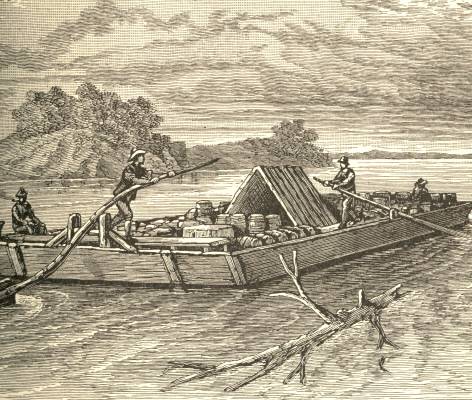
An Ohio River Flat-Boat.
The construction of the five great Pacific railway lines, the Northern,
the Union, the Santa Fe, the Southern, and the Great Northern, with
their various branches, brought into valuable employ infinite reaches of
fertile land previously as good as desert. Texas made most remarkable
advance both in square miles occupied and in density of population,
brought about by great extension of railway mileage, and of cattle,
sheep, and wheat culture. Large patches of the Dakotas, Montana, and
Idaho filled with settlers. Colorado became a giant in production, the
rush of population thither in consequence of very extensive and rich
mineral discoveries having been a stampede almost like that of 1849-50
to California. Every hill was black with miners. The growth of New
Mexico, Arizona, and Nevada, considering their natural wealth, was slow,
owing in part to Indian hostilities. New Mexico fell from rank 37 in
1870 to rank 43 in 1890. Tucson, Ariz., according to the best figures,
fell between 1880 and 1887, from 10,000 to 7,500 inhabitants. In
material things Utah prospered greatly under the thrift, economy, and
hard work of the Mormons. Here mining and speculation were less rigidly
pressed, and more energy devoted to agricultural pursuits.
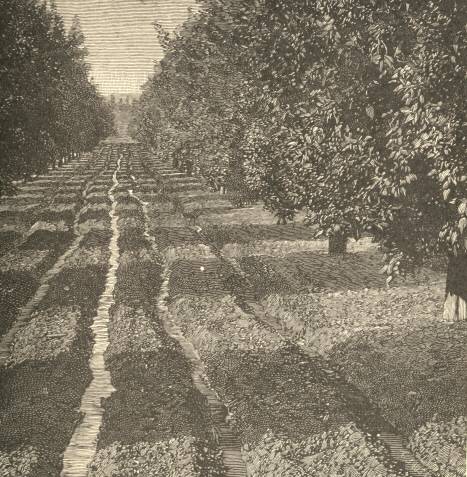
An Irrigated Orange Grove at Riverside, California.
In California, a smaller proportion than formerly of all industry was
now applied to mining, a larger to agriculture and cattle-raising.
Southern California became the competitor of Florida as a winter
residence. Oregon and Washington vied with Minnesota for the world-medal
in wheat culture. Over the infinite pasture lands at both feet of the
Rocky Mountains roamed herds of bullocks destined to feed distant cities
in America and in Europe. It was foreseen that many of these lands would
in the course of time be ploughed, and by the aid of irrigation turned
into corn-fields, wheat-fields, and market-gardens, a process which in
New Mexico had already gone far. Even the tract inclosed by the
parallels 31 and 45 degrees and the meridians 100 and 120 degrees, which
long seemed destined for perpetual sterility, spite of the many
enterprises conceived, and the others, like the scheme of the Colorado
River Irrigation Company, initiated for redeeming it, grew valuable when
it was believed that the National Government would undertake to irrigate
there. Crops in that region grew bountifully under irrigation, and
permanent water-supplies could easily be created. Natural woodland
existed there only near the few streams, and of the scanty trees which
grew scarcely a single variety of hard wood was found; but the state and
national afforestation of vast tracts bade fair to change this. The
region comprised in the States and Territories named was not only the
richest precious-metal field in America, but one of the very richest on
the globe.
The picture we have presented is too glowing for the year 1893-94,
during which great depression afflicted the whole West; but this was
only temporary. Recovery was indicated by the success of the
Trans-Mississippi Exposition at Omaha, in 1898. There were 2,600,000
admissions. The total cash receipts were $1,761,364, and the
stockholders in the enterprise were paid dollar for dollar.
The city of San Francisco had 500 inhabitants in 1840, 34,776 in 1850,
56,802 in 1860, 149,473 in 1870, 233,959 in 1880, 298,997 in 1890. This
progress may be taken as in some sense an index to that of the West as a
whole, far more so than the apparently spasmodic increase in some of
California's smaller centres. Los Angeles mounted from a population of
5,728 in 1870, and of 11,183 in 1880, to one of 50,395 in 1890. Oakland
had but 10,500 in 1870. Ten years later the figure was 34,555; and in
1890 it was 48,682. Stockton leaped from 10,287 in 1880 to 14,424 in
1890. In 1858 Denver was uninhabited. In 1870 it numbered 4,759 souls;
in 1880, 35,629; in 1890, 106,713. Portland, Oregon, had in 1890, 46,000
inhabitants; in 1900, 90,000. In the decade 1880-90 Wyoming grew from
20,789 to 60,705.
The growth and prosperity of this great western section of our country
become apparent from an inspection of the following table, compiled from
authentic sources:
| Population. | Property valuation. $ | |||
| STATES. | 1870. | 1890. | 1880. | 1890. |
| California | 560,247 | 1,208,130 | 1,343,000,000 | 2,533,733,627 |
| Colorado | 39,864 | 412,198 | 240,000,000 | 1,145,712,267 |
| Dakota, Total | 14 181 | 118,000 000 | ||
| Dakota, North | 182,719 | 337,006,506 | ||
| Dakota, South | 328,808 | 425,141,299 | ||
| Idaho | 14,999 | 84,335 | 29,000,000 | 207,896,591 |
| Kansas | 364,399 | 1,427,096 | 760,000,000 | 1,799,343,501 |
| Minnesota | 439,706 | 1,301,826 | 792,000,000 | 1,691,851,927 |
| Montana | 20,595 | 132,159 | 40,000,000 | 453,135,209 |
| Nebraska | 122,993 | 1,058,910 | 385,000,000 | 1,275,685,514 |
| Nevada | 42,491 | 45,761 | 156,000,000 | l80,323,668 |
| New Mexico | 91,874 | 153,593 | 49,000,000 | 231,459,897 |
| Oregon | 90,923 | 313,767 | 154,000,000 | 590,396,194 |
| Texas | 818,579 | 2,235,523 | 825,000,000 | 2,105,576,766 |
| Utah | 86,786 | 207,905 | 114,000,000 | 349,411,234 |
| Washington | 23,955 | 349,390 | 62,000,000 | 760,698,726 |
| Wyoming | 9,118 | 60,705 | 54,000,000 | 169,773,710 |
| TERRITORIES | ||||
| Alaska | 32,052 | |||
| Arizona | 9,658 | 59,620 | 41,000,000 | 188,800,976 |
| Value of Farms. $ | ||
| STATES. | 1880. | 1890. |
| California | 262,051,262 | 697,116,630 |
| Colorado | 25,109,223 | 85,035,180 |
| Dakota, Total | 22 401 084 | |
| Dakota, North | 75,310,805 | |
| Dakota, South | 107,466,335 | |
| Idaho | 2,832,890 | 17,431,560 |
| Kansas | 235,178,936 | 559,726,046 |
| Minnesota | 193,724,260 | 340,059,470 |
| Montana | 3,284,504 | 25,512,340 |
| Nebraska | 105,932,541 | 402,353,913 |
| Nevada | 5,408,325 | 12,339,410 |
| New Mexico | 5,514,399 | 8,140,800 |
| Oregon | 56,906,575 | 115,819,200 |
| Texas | 170,468,886 | 399,971,289 |
| Utah | 14,015,178 | 28,402,780 |
| Washington | 13,844,224 | 88,461,660 |
| Wyoming | 835,895 | 14,460,880 |
| TERRITORIES | ||
| Alaska | ||
| Arizona | 1,127,946 | 7,222,230 |
| Rail Mileage | Periodicals | Gold Troy Oz. | Silver Troy Oz. | |||||
| 1885. | 1890. | 1880 | 1893 | 1880 | 1889 | 1880 | 1889. | |
| California | 3,044 | 4,356 | 364 | 639 | 829,677 | 608,382 | 890,158 | 1,062,578 |
| Colorado | 2,884 | 4,176 | 90 | 298 | 130,608 | 187,881 | 12,800,120 | 18,375,551 |
| Dakotas, | 2877 | 66 | 159,920 | 54,770 | ||||
| North Dakota | 2,003 | 139 | ||||||
| South Dakota | 2,470 | 269 | 149,538 | 104,672 | ||||
| Idaho | 944 | 8 | 58 | 71,578 | 95,983 | 359,309 | 3,137,508 | |
| Kansas | 4,441 | 8,306 | 349 | 759 | ||||
| Minnesota | 4,331 | 5,379 | 224 | 558 | ||||
| Montana | 1,047 | 2,181 | 18 | 90 | 87,354 | 151,861 | 2,246,938 | 13,511,455 |
| Nebraska | 2,988 | 5,300 | 189 | 645 | ||||
| Nevada | 945 | 924 | 37 | 26 | 236,469 | 169,617 | 9,614,561 | 4,696,605 |
| New Mexico | 1,195 | 1,324 | 18 | 59 | 2,387 | 39,457 | 303,455 | 1,251,124 |
| Oregon | 1,181 | 1,433 | 74 | 194 | 53,101 | 46,648 | 21,496 | 17,851 |
| Texas | 6,687 | 8,630 | 279 | 678 | 330 | 323,438 | ||
| Utah | 1,085 | 1,085 | 24 | 71 | 14,105 | 23,591 | 3,668,566 | 7,005,193 |
| Washington | 736 | 1,774 | 29 | 253 | 6,569 | 9,005 | 789 | 23,464 |
| Wyoming | 617 | 941 | 10 | 43 | 838 | 711 | ||
| TERRITORIES | ||||||||
| Alaska | 4 | 238 | 43,762 | 39 | 9,219 | |||
| Arizona | 906 | 1,096 | 17 | 35 | 10,254 | 44,029 | 1,738,921 | 1,812,961 |
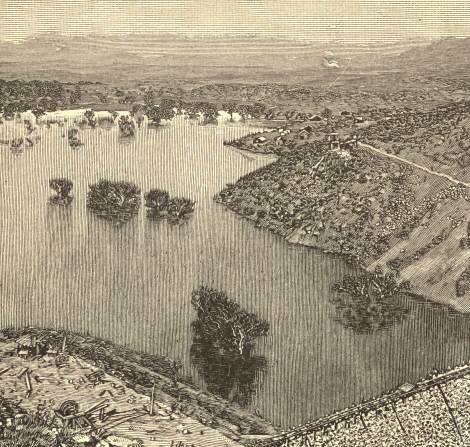
The Irrigating Reservoir at Walnut Grove, Arizona,
showing the Artificial Lake partly filled.
We shall be pardoned for recurring again to Minnesota. So recently as
1838, where St. Paul and Minneapolis now stand, the former with a
population in 1890 of 133,156, the latter with one of 164,738, not a
white man's abode had risen. There were then but three cabins between
St. Paul and Prairie du Chien, a distance of 300 miles down the
Mississippi. Summit Avenue, St. Paul, was, in 1890, the finest street
in America, if not on the globe. West St. Paul, in 1880 a hamlet of a
few huts, had by 1890 20,000 to 30,000 people, with street-cars, large
business blocks, fine houses and stores. The pioneer railway in
Minnesota was laid in 1862, from St. Paul to St. Anthony, the first
shovelful of earth being lifted by a citizen of St. Paul, who probably
lived to see his State gridironed with 5,379 miles of track; his own
firm constructing over 1,100 miles in the single year 1887. Minneapolis
in 1887 turned out 5,000,000 barrels of flour, an average of 100,000
barrels a week.
Duluth had in 1880 but 3,740 people. In 1890, 33,115. The cause of
Duluth's advantage is obvious upon a glance at the map. It is by water
no farther from Lake Erie than Chicago is, while it is some hundreds of
miles nearer the great wheat-field. It is itself the very gate of
this–the gate of Minnesota–which in 1869 brought forth 18,000,000
bushels; in 1886, 50,000,000 bushels. To this enormous yield, that of
the Dakotas, about the same, had now to be added, the one as the other
finding its way out to the hungry world largely through Duluth.
The caravans of people necessary to populate these immense western
ranges were to a very great extent immigrants from Europe. The census of
1880 gave us 6,679,043 inhabitants of foreign nativity. We have no
figures for the exact proportion of the total immigration into the
country which found its home in the West, yet a glimpse at the total
from year to year is interesting at this point. The falling off in and
after 1893 is particularly noticeable. Immigrants arrived as follows:
In
1868 282,189
1869 352,768
1870 387,203
1871 321,350
1872 404,806
1873 459,803
1874 313,339
1875 227,498
1876 169,986
1877 141,857
1878 138,469
1879 177,826
1880 457,257
1881 669,431
1882 788,992
1883 603,322
1884 518,592
1885 395,346
1886 334,203
1890 455,302
1891 560,319
1892 579,663
1893 439,730
1894 285,631.