
[1886-1870]
It cannot be denied that the radical method of reconstruction resorted
to by Congress occasioned dreadful evils. Among other things it ignored
the natural prejudices of the whites, many of whom were as loyal as any
citizens in the land. The South, subjected to a second conquest after
having laid down its arms, felt outraged and grew sullen. To most people
in that section, as well as to very many at the North, this dictation by
Congress to acknowledged States in time of peace seemed high-handed and
guilty usurpation. Northern Congressmen incessantly called slavery
barbarism, and yet combined to transmute to-day into electors and
law-makers those who but yesterday had been slaves. Black legislatures
inevitably abused their power, becoming the instruments of base
carpetbag leaders and rings in robbing white property-holders.
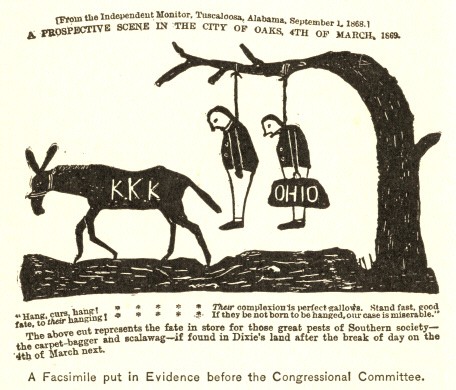
A Facsimile put in Evidence before the Congressional Committee.
"[From the Independent Monitor, Tuscaloosa, Alabama, September 1, 1868.]"
"A PROSPECTIVE SCENE IN THE CITY OF OAKS, 4TH OF MARCH, 1869."
"Hang, curs, hang! * * * * * Their complexion is perfect gallows,
Stand fast, good fate, to their hanging! * * * * *
If they be not born to be hanged, our case is miserable."
"The above cut represents the fate in store for those great pests of
Southern society–the carpet-bagger and scalawag–if found in Dixie's
land after the break of day on the 4th of March next."
Nor could any except doctrinaires or the stupid have expected that the
whites would long submit to such a regime. If the South was to become
again genuine part and parcel of this Union, it could not, nor would the
North consent that it should, be permanently under bayonet rule; and so
soon as bayonets were gone, fair means or foul would speedily remove the
sceptre from colored hands. Precisely this happened. In State after
State, the whites, without the slightest formal change of constitution
or law, recovered their ancient ascendency. Where their aims could not
be realized by persuasion or other mild means, resort was had to
merciless intimidation and violence.
The Ku-Klux Klan, a great secret society, was organized for this rough
business, numbering at first, among either its members or its abettors,
citizens of the highest respectability. Its local lodges were called
"dens," its members "ghouls," " Giants," "goblins," "titans," "furies,"
"dragons," and "hydras," were names of different classes among its
officers. Usually the very existence of a "den" in the vicinity was
sufficient to render every negro docile. If more was required, a
half-dozen ghouls, making their nocturnal rounds in their hideous masks
and uniforms, frightened all but the most hardy. Any who showed fight
were whipped, maimed, or killed, treatment which extended on occasion to
their "carpet-bag" and "scalawag" friends–these titles denoting
respectively northern and southern men bold enough to take the negroes'
side. The very violence of the order, which it at last turned against
the old Southrons themselves, brought it into disrepute with its
original instigators, who were not sorry when federal marshals, put up
to it by President Grant, hunted den after den of the law-breakers to
the death.
Yet, after all, one cannot see how the giant problem of resuscitating
the South could, under the circumstances, have been solved more
successfully. The plan proposed by President Johnson had sufficient
trial to show that it must have led to ills worse than those actually
experienced. A qualified colored suffrage would, as things then were,
have been abused. It must be remembered that the war left in the South
much less of white loyalty than it found, and Congress was certainly
justified in insisting that the revived States should be placed on the
most loyal basis possible.
Withal, considering the stupendous upheaval in southern society marked
by the erection of bondmen into full citizens, dark days were few.
Schools arose, partly from the application of a large fund left by Mr.
George Peabody for that purpose, partly from the beneficence of the
various religious denominations interested in the elevation of the
blacks, and partly from provision by the southern States themselves. The
ballot itself proved an educator, rough but thorough. The negro vote,
now that it had become a fixed fact, was little by little courted by the
jarring factions of whites, and hence protected. Political parties,
particularly in state elections, more and more divided on other lines
than that of color. The administration of President Cleveland taught the
negro that even in National affairs he had nothing to fear from
democratic dominance. And it was plainly to the freedman's infinite
advantage, meanwhile, that he was fighting not to acquire status and
rights, but for acquired status and rights guaranteed in the organic law
of his State and the Nation.
[1875]
Among the white people loyalty to the old flag increased with the days.
Of course none of them would ever confess regret at having drawn the
sword, or cease to think of the lost cause with a sigh. At the same time
a rational conviction settled down upon all its most thoughtful minds
that in secession the South had been misguided. Universal was the
admission that at least for the dominant race the death of slavery was a
blessing. Northern people and intelligent immigrants from Europe
thronged in. Coolly received at first, and in some cases maltreated if
freely expressing opinions which traversed those prevalent in the
section, in the end they were tolerated and even welcomed.
The multiplication of railways facilitated the acquaintance of southern
with northern people far beyond what had been possible before the war.
Travelling salesmen from the North penetrated the remotest hamlets at
the South, inclined from every consideration to produce the most
favorable impression possible. The selection of southerners for
important national offices by Presidents Grant, Hayes, Arthur, and
Cleveland, the election of the last-named, a Democrat, as President in
1884 and 1892, and the existence of a democratic majority in the House
of Representatives almost constantly from 1874, all felicitously
combined to beget in the people of the South a conviction that they were
really and truly citizens of the Union again. The rise in several
southern States of a strong republican organization among the whites
wrought in the same direction. Nor must we overlook as another cementing
influence the fraternizing of northern and southern soldiers in great
reunions such as occurred at Gettysburg, Richmond, and Chickamauga.
[1890]
The South's material prosperity kept pace with her political advance. It
had always been said that cotton was to be produced only by slave labor.
Nothing could have been more false. The largest cotton crop under
slavery, that of 1860, reached 4,669,770 bales. In 1871, 1876, and 1877
each, notwithstanding the economic chaos and the infinite destruction of
capital occasioned by the war, those figures were almost equalled; in
1878 they were surpassed; in 1879 and 1880 each, over 5,000,000 bales
were raised; in 1881, 1883, and 1886 each, over 6,000,000, the exact
figure for the year last named being 6,550,215. In 1890, 7,472,511 bales
were produced.
This cotton exhibit was sufficiently gratifying, yet the post-bellum
crops might have been far larger had not much energy at the South been
happily diverted into manufacturing channels. This was one of the most
hopeful features of the New South. Nearly every department of industry
in this kind was now pushed there at many points. Nashville became a
great manufacturing and commercial city. It boasted one of the largest
foundries in the country, and several flourishing cotton factories.
Chattanooga, Birmingham, and Anniston were all thrifty with iron and
steel industries, which rivalled the most prosperous ones at the North;
nor were there wanting those who predicted that the region of those
cities, viz., Southern Tennessee with Northern Georgia and Alabama, was
speedily to become the centre of iron and steel production for the
world.
The lumber trade of Chattanooga, particularly in the white woods, was
said to be second only to Chicago's. The city also had a tannery
believed to be the largest in the world, and more than one fully
appointed Bessemer steel manufactory. These steel works and the tannery
employed colored operatives almost alone, many of these exceedingly
skilful. Birmingham was entirely a creation of the days since the war,
yet it had in 1890 more than 26,000 inhabitants against 3,000 in 1880,
and enjoyed marvellous prosperity, hindered only by speculation in land.
Much of the marble in the mountains of Tennessee, Alabama, and Georgia
was finer than any elsewhere to be found in this country. The block of
it which was forwarded from Alabama for the Washington monument, experts
condemned for the purpose as certainly Italian, nor was it permitted a
place in that structure till the Governor of the State and the Members
of Congress therefrom had certified upon honor, and the quarry-masters
made affidavit, that it came out of the Alabama hills. Atlanta had risen
from the ashes in which the war left it, to be a city of over 65,000
people, with every manifestation of great industrial life and progress.
Between 1870 and 1880, although the population of Mobile decreased, that
of Charleston rose about 1-1/5 per cent., that of Savannah about 5-1/4
per cent., that of New Orleans about thirteen per cent., that of
Richmond about twenty-six per cent. Between 1880 and 1890 Mobile
advanced about 6-1/2 per cent., Charleston almost 10 per cent., Savannah
over 40 per cent., New Orleans over 12 per cent., and Richmond exactly
28 per cent.
It would be misleading to suppose the progress in welfare indicated by
these and the foregoing statements to be true of every district at the
South. The merely agricultural regions were still far behind. Methods of
tilling the soil were the same as prevailed forty years earlier, and it
was not unlikely that the colored people, who for the most part had the
immediate charge of this work, prosecuted it, as yet, with less skill
than did overseers and planters before slavery was done away. Yet in
1890 the farm valuation of the South was found to exceed its highest
ante-bellum figure and almost to equal one-fifth of the entire farm
valuation of the country.
To the general backwardness of southern agriculture there was one quite
striking exception. The State of Florida underwent after the war a most
astounding transition for the better. Her total railway mileage of 416
miles when the war ended had grown to 2,470 miles by 1890. The farm
valuation was, in 1880, $20,500,000. The population in 1890 exceeded
that of 1880 by almost 50 per cent. Steamboats were upon every coast and
river. This was due not alone to the State's popularity as a winter
sanitarium for northern people. Florida was also the early market-garden
for the North. Its oranges largely supplied the trade, and were much
sought for their excellent quality. The State was excessively rich in
the finest ornamental woods, which were rapidly finding their way into
the market. Nearly all the crops of the temperate zone and the fruits of
the torrid flourished here with the utmost luxuriance, many of them
being natives, others taking to the soil with a greater friendliness
than they displayed for that whence they were transplanted. The State
bade fair to rival Louisiana in the production of sugar, and South
Carolina in that of rice, as well as one day to supply the entire
American demand for cocoanuts. The mulberry was indigenous to every part
of this new Eden, which promised to become at no late date an immense
producer of raw silk. Cattle fed and fattened everywhere without
shelter, in winter as in summer.
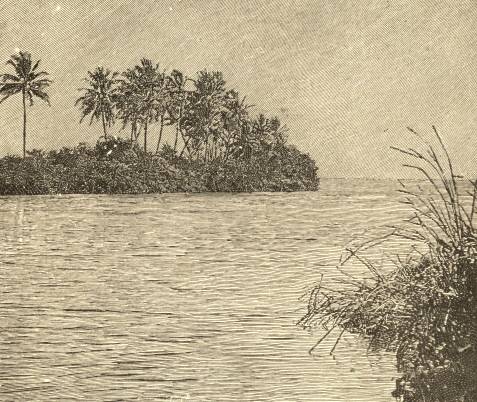
The Mouth of the Miami River, Florida
The future of the colored race no one could predict with certainty.
After the census of 1870, which reduced the percentage of our African
population from 14.13, the figure in 1860, to 12.7, many rushed to the
conclusion that these people might, in no long time, vanish from our
land. The census of 1880 dispelled this fancy, raising the percentage to
13.12. That of 1890 lowered it again to 11.93. Previously to 1870 the
race had been constantly decreasing in fecundity, but it was possible
that the better conditions afforded by freedom had changed this. Even
should the decrease go on, the colored people bade fair to be at least
eight or ten per cent. of our total population in 1900. As a matter of
fact the proportion was in 1900 11.6 per cent. These decreasing
proportions did not, of course, necessarily imply any positive decadence
in the black race, as they might be accounted for by greater prolificacy
or vitality on the part of the whites, or in part by immigration. The
subject will be resumed in Chapter IX. of Period VI.